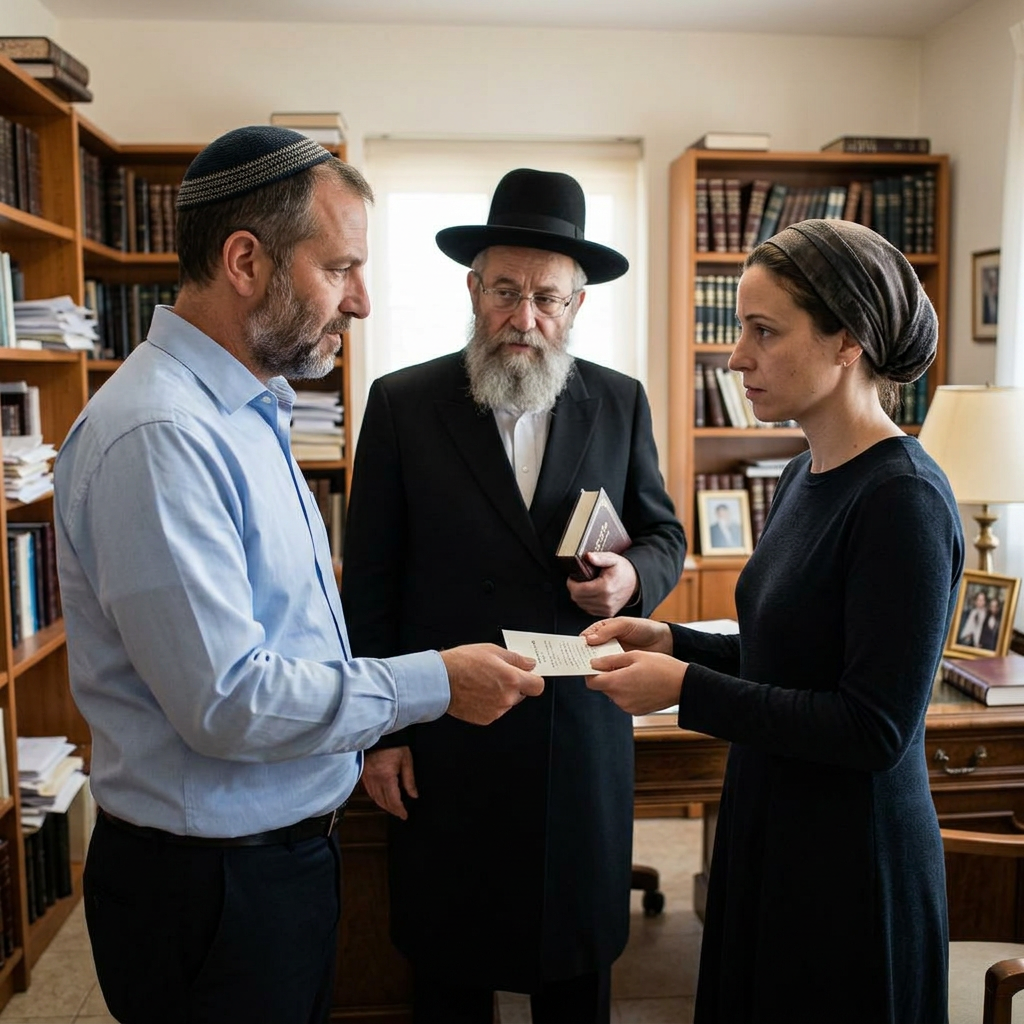
A Long-Suffering Agunah & Her Seudas Hodah
Rabbi Moshe Taub, Ami Magazine, April 2025
- The Shailah & Its Background
It is easy to guess and pontificate regarding a seemingly ‘inconsequential’ or ‘small’ hashkafic question; to debate around the Shabbos table.
Rabbanim, however, do not often share that luxury, as our answers may be taken as fact, acted upon, and quoted.
We must be careful.
So when I received the following request, I was uncertain as to the proper course of action.
“Rabbi, can we sponsor the Shabbos hagadol drasha?”
“Of course!” I enthusiastically responded.
“Ok, Rabbi. We will call the shul secretary to make sure it gets put in the flyer.
“It will say something to the effect:
‘Mazal Tov to our daughter Esther [name has been changed] upon receiving her get””.
I must have been silent for an extra beat, causing these parents to ask, “Is it not proper to say ‘mazal tov’ for such an occasion?”
I understood their relief, of course. Indeed, I too had been involved in Esther’s plight for many, many years. In fact, my ‘simcha‘ was doubled by the fact that, just days earlier, another woman also received her get after more than a decade of emotional torture.
As shailos tend to come in pairs, as I was contemplating the ‘Mazal Tov’ issue, this second newly minted gerusha invited me to a ‘seudas hodah’ her sisters were making to celebrate her finally attaining her get.
“Can you offer some divrei Torah” she requested, adding “Would it be appropriate for us to recite the pesukim for the korban todah?”
II. ‘Agunah’
I use the term ‘agunah’ cautiously, judiciously; never weakening its potency. Both of these cases above were divorces concerning true agunos.
There are the most painful elements of rabbanus; cases where husbands ignore beis din, skirt court orders, and even flee to other countries.
When I was a rav in Buffalo, I once had a chassideshe posek request permission to send a private detective to our shul on Yom Kippur. In that case, a husband absconded from beis din appointments, disappeared from his Monsey neighborhood, and whose last EZ-PASS entry was a few miles from my home (this case was the subject of another post).
I have arranged gittin in prison, in medical offices, and in abandoned buildings.
It may be surprising to learn that not do such men take my calls, but that most relish in them. On the phone, they believe they are in control, allowing them faux-power in their games of deception and manipulation; drawing yet one more person down to their pettiness, anger, and darkness.
Undeterred after inevitably failing to convince me of their righteousness, their narcissism assures them I will be convinced after the second call, the third, etc.
Often, the families of such agunos have to suffer the indignity of receiving tzedakah, and in one case, moving with their children into a frum home for battered women, and then -after the children are abandoned by their fathers – watching the horror on their children’s faces as many high schools reject them -just another in their list of men who have let them down. In one case, after showing the administrator how a particular young girl was able to destroy her yetzer and get straight alephs’s, yearly middos awards, no internet -all while living with her mother in an Ohel Home for Battered Women – I was told that they still can’t ‘risk’ having ‘such’ a girl! Unforgivable!
So, I understood how each of these gittin felt like a ‘simcha’, one worthy of a ‘mazal tov’, even if the mizbeach needed to shed tears (gittin 90).
I am writing this on the eve of Rav Nota Greenblatt’s yartzeit (28 nisan). I do not know of a single person in Jewish history, or any entire organization around today, that has ended the agunah status for more women than he, having written somewhere between 20,000-30,000 gittin. His own children never saw him during the week!
Neither of the two women mentioned above are members of my shul, nor do I have much free time in the day. But Rav Nota taught me that nothing is more important than making sure such women have a halachic closure to their pain. Zechuso yagein aleinu.
III. The Term ‘Mazal Tov‘
An easy mnemonic to recall one of the first instances of the term ‘mazal tov’ is its roshei teivos, ‘mem teis’, for pesachim daf mem teis (49a). The gemara there shares that the beracha/hope for each zivug, is that the marriage be ‘oleh yaffa’. Rashi explains this term as, “b’mazal tov” (see also Rashi to bereishis 30:1 with Targum Yonasan).
While the earliest reference to this phrase may be found by kiddush levana (from mes. soferim – ‘siman tov, u’mazal tov…’), we are seeking its provenance qas a term used by simchos.
One of the earliest mentions of the minhag of using this term at weddings, is the shu”t Maharam Mintz (#109, p. 538).
A century earlier Rabbeinu Yeruchum (b. 1290) records such a practice in reference to “giving ‘mazal’..” the night before a bris (Toldos Adam v’Chava, 17). However, he then quotes those who were concerned with this practice (see Beis Yosef to y”d 189:4; see also note to Tosefta K’Peshuta, shabbos, 6:4).
Another generation earlier, we find Rav Yehudah Hachasid sharing a minhag of issuing a ‘mazal tov’ after a birth of a child (Sefer Chasidim, #487).
As to the meaning of this phrase – and the serious hashkafic questions it brings, alluded to by Rabbeinu Yeruchum, (e.g. ‘ein mazal l’yisroel‘, etc.) – we find many explanations .
One approach -that this teffilah is to overpower potential negative potencies through Torah, teshuva, and mitzvos – is found in an essay by Rav Gavriel Tzinner (sefer Shiduchim V’Tennaim, p. 470); whereas the shu”t Be’er Eliuyahu (3:55) explains that ‘mazal’ here doesn’t refer to the constellations, but rather to certain melachim of similar names that bring beracha from Hashem, perhaps similar to barchuni l’shalom said Friday night (although, admittedly, a small minority have the minhag to omit that particular stanza).
As to saying ‘mazal tov’ by a get, I reached out to a renown posek, who has also arranged thousands of gittin. He responded: “I am not aware of a source for such a ‘minhag’ however I do wish each of the parties happiness and success going forward.”
I think that may be wise-as we should not desire to create new minhagim.
I then discovered that in the Artscroll ‘Rav Nota‘ biography, it is recorded how Rav Nota too would frown upon saying ‘mazal tov‘ by such an occasion.
IV. The Hodah ‘Event’
I walked in to the ‘event’ with my wife only to find seven women around a table -their food untouched – quietly reciting tehillim through tears.
Mi k’amcha yisroel?!
I was son introduced to say a few words.
“I don’t know a phrase to use” I admitted. “Another gerusha this week asked me if we say ‘mazal tov’. I just don’t know.
“While we must never revel at the dissolvement of a marriage, we can, and indeed must, recognize the yad Hashem and show proper hakara.
“In two days, we will recall the kriah of the yam suf. By that kriah (tearing) only those humans who were actually saved were given sanction to sing shirah. The melachim, however, were reprimanded when the sought to sing, “My creations are drowning, and you wish to sing shirah?!” (See Mishnas Rav Ahron where he makes a similar distinction between Hashem rejecting the shira of the angels, while reveling in the shira of klal yisroel).
“So, perhaps, the choice of emotion is up to the gerusha alone. Perhaps she can say that phrase…but not I.
“More, perhaps this is why chazal compare zivugim to krias yam suf. Chazal conclude that this is referring to one’s ‘second’ zivug. In other words, this kriah – this get – should lead to beracha for you down the road, iy”H.
“As for reciting the korban todah, the Rema tells us not say this parsha at all over Pesach – due to its rare chometz loaves.
“Yet, perhaps, this rare feature of the korban todah (as the Torah generally forbids chometz by korbonos) can perhaps provide for us a lesson today. The word ‘chometz’ alludes to letting things fester (e.g. mitzvah bu l’yado al tachmitzena). Todah, hakarah, or gratitude, too, is amplified with time. If an article is found as quickly as it was lost, then the thankfulness may not be as strong as when it was missing for many years.
“The longer one waits, the more anxiety and worry, the added lost sleep -the surplus of ‘chometz’ as it were- all lead to a todah and relief that is that much more intensified upon release.
“In your case, there has been much ‘chometz’; much time of waiting – so your hakara must be profound.”
(Being she was a sefardi, I thought to allow her its recital after I left, see Rema 51:9)
Rav Chaim Berlin was once imbroiled in a machlokos regarding a get. The rabbanim on either side were at odds with each other. He shared with them that when chazal mention an ‘individual who has mazal’ (bava kama 2b), Rashi explains this as “one who has the wisdom to guard himself”. Rav Berlin explained that Hashem gives us everything, but we can ruin it if we abuse our ‘mazal’. This, he explained, is why we say this phrase at a wedding. We are telling the chosson and kalla, “Be careful! Do not let a bad word or negative mood destroy what Hashem gave you”. (Nishmas Chaim, evh’a, 147).
He was hinting that their milchama shel Torah should not lead to negative words.
So, whether the reader is newly married or celebrating their fiftieth year, ‘mazal tov!’

Leave a Reply