Taanis
Bedika
Lechem Mishneh
& Much More
The Whats, Whens and Hows Of A Pesach That Falls On Motzai Shabbos (Saturday Night).
If you are overwhelmed and confused about this coming Shabbos, which is Erev Pesach, you are not alone. Even the Shulchan Aruch remarks on the confusing nature of these halachos. To help you out, I will review the most common issues, starting with a more detailed discussion of the uniqueness of this year’s taanis bechorim.
Taanis Advanced
Here’s a quick riddle. What are the two occasions where halachah would sanction an Erev Shabbos fast day? Most of you probably know the first one—Asarah B’Teves. But the other one may be more elusive.
Some of you may be thinking, “It’s a year like this! When the 14th of Nisan falls on Shabbos, we move the fast up to Erev Shabbos.” But this would be incorrect—we actually advance the taanis two days, to Thursday. The confusion is only magnified when we consider the fact that when the 14th of Nisan falls on a Friday, halachah does indeed affirm an Erev Shabbos taanis bechorim. This second case is the correct answer to the riddle.
Why the distinction? Why not observe this year’s taanis on Friday?
As mentioned in the Purim issue, not only may one fast on an Erev Shabbos, but the Shulchan Aruch records that some anshei maaseh (conscientious Jews) made it a point to fast every Friday so as to enter Shabbos hungry! However, in our generation we are advised against this practice since fasting all day would cause exhaustion and irritability, diminishing our enjoyment in the seudah and in the overall beauty of Friday night.
So although we wouldn’t establish a taanis on a Friday to begin with, if either of these two fast days naturally falls on Erev Shabbos, that’s when we observe them.
As for this year, when the taanis falls on Shabbos, even though we move it up to Thursday, the Shulchan Aruch cites an opinion that bechorim should not fast at all this year! This is because, as opposed to Asarah B’Teves, which is based on a pasuk in Zechariah, taanis bechorim is only a minhag.
The Rema rules, however, according to the first opinion.
Nevertheless, certain leniencies are endorsed this year. Some poskim allow reliance on the view that if one attends a siyum on Wednesday night, he is permitted to eat on Thursday; others allow one who can’t attend a siyum to redeem the taanis with tzedakah. Of course, these are for cases where one is otherwise stuck, and they are only for this year. Of course, as always, one should still consult his rav.
On the other hand, some poskim,such as Rav Shternbuch,urge bechorim to make a second siyum on Friday in addition to Thursday. Other poskim, such as Rav Moshe Feinstein, support this chumrah but without recommending it (4:69).
Although this chumrah may seem hard to comprehend for a taanis that is only a minhag, it actually has strong support that begs a larger question. In the case of the other taanis that is a minhag—Taanis Esther—the Rema rules that if it falls on a Shabbos, we move it up to the Thursday before. He then adds that if one had a bris that Thursday, in which case he would be allowed to eat, he must make up the fast the next day, Erev Shabbos!
Consider the similarity to Erev Pesach this year, where one attends a siyum that enables him to eat on Thursday. Wouldn’t he also have to make up the fast on Erev Shabbos?
Rav Karelitz quotes his uncle, the Chazon Ish, who dismisses the concern about having to make up the taanis bechorim on Friday because this fast is only a minhag. However, can’t one retort that Taanis Esther is also a minhag?
Nevertheless, as Rav Moshe makes clear, the minhag for a year like this is to attend a siyum on Thursday, without having to make up the fast on Friday. For whatever reason, taanis bechorim is differentiated from a Thursday Taanis Esther.
Bedikas Chametz
On Thursday night, the 13th of Nisan, bedikas chametz will be conducted with a brachah at the beginning and Kol Chamira at the end. There are many obvious reasons this cannot be done on Friday night, Erev Pesach—not the least of which is the impossibility of searching with a candle.
What is unique is the brachah we say before this Thursday-night bedikah. In a regular year, one does not recite a brachah if he makes a bedikah before the 14th of Nisan—for example, if he is going away for Pesach. This year is an exception to that rule, and it comes with the risk of creating a false memory and confusion in future years, a concern of the Shulchan Aruch.
One may keep chametz that is necessary for the next day’s burning and to eat on Shabbos in a secure location.
Although many houses become Pesachadik at this point (except for the bedikah bread needed for biur the next day), there is no halachic obligation to refrain from eating chametz until early Shabbos morning (the time to stop depends on your location).
The one main observance on Friday is biur chametz. However, we do not say Kol Chamira then; instead, we say it before the fifth hour on Shabbos day.
Obviously, chametz can’t be burned on Shabbos Erev Pesach, but why not do it later in the day on Friday? One can technically eat chametz all day Friday, so it should be permissible to do biur up until Shabbos.
The Shulchan Aruch explains that this, too, is in order not to create a false memory and confusion in future years.
What to Do for Lechem Mishneh
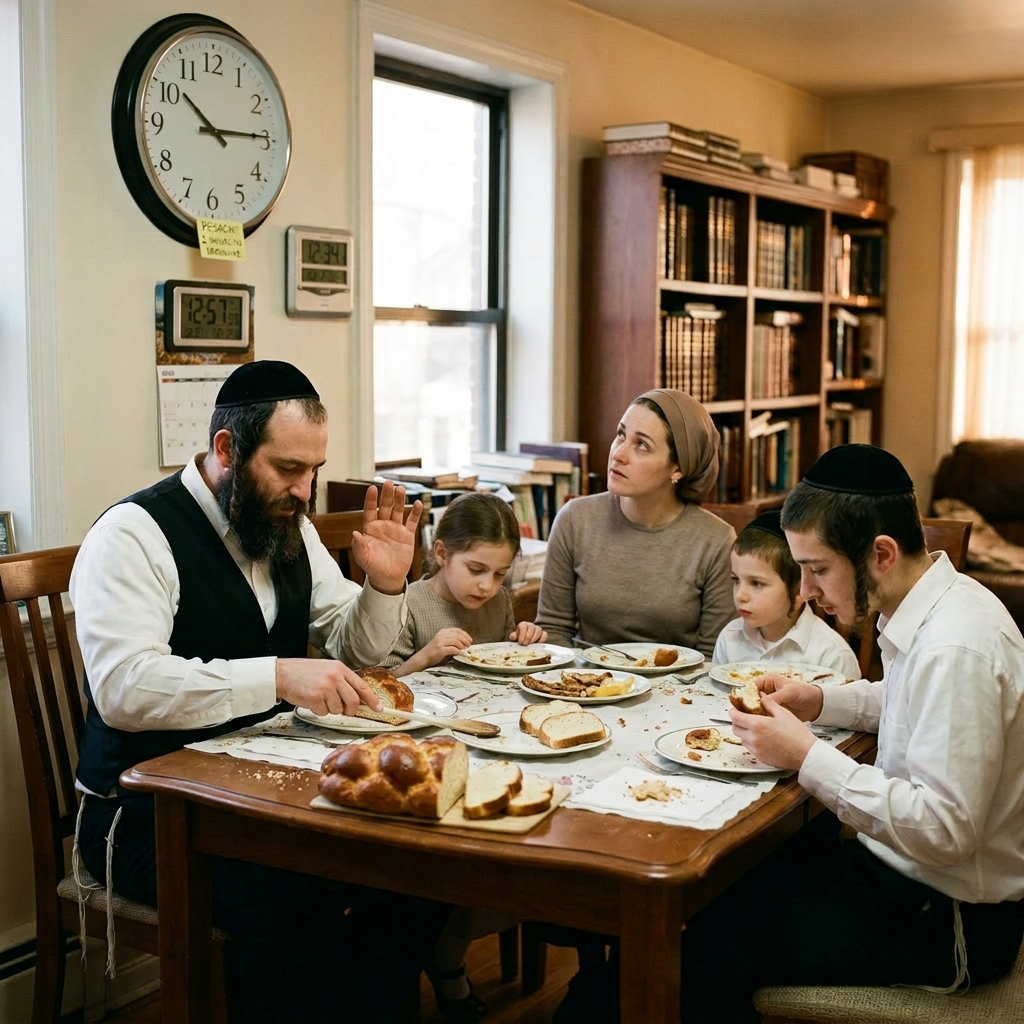
We are confronted with a quagmire about what to do for lechem mishneh on Shabbos Erev Pesach. We must have lechem mishneh for each of our Shabbos meals, but we can’t eat matzah on Erev Pesach. This is a halachah and is not to be confused with the minhag of refraining from eating matzah from Rosh Chodesh Nisan.
The poskim offer three options: regular chametz challah, egg matzah, or soaked matzah.
If your minhag is to use chametz, I would recommend bagels or pita because they don’t have as many crumbs as bread. Make sure to serve it on paper towels, a plastic table cover, or something similar. Each person should eat a kezayis over tissue paper right after washing, and the paper should be flushed down the toilet. If there are too many chametz crumbs to flush, you can pour designated bleach over them in the trash, or you can wrap up the entire tablecloth and place it somewhere hidden and secure, having in mind during Kol Chamira that you will dispose of it properly (by burning, etc.) on Chol Hamoed.
Some make recite Hamotzi and eat the chametz in a different room. After following the steps above, they eat the rest of their kasher l’Pesach meals in the dining room. If you do this, it is best if the dining room can be seen from the room where you ate the bread. However, it is not recommended that you make the Hamotzi on a porch, a balcony or in the backyard and then return inside to eat the rest of the meal.
Rav Moshe Feinstein and many others (Ashkenazim only) recommend using kasher l’Pesach egg matzah. Make sure that egg matzah crumbs do not fall on any Pesach utensils or food (even though egg matzah is allowed for the sick and infirm on Pesach).
According to Rav Moshe Feinstein and others, Ashkenazim must stop eating egg matzah before the time when one can no longer eat chametz. Some (e.g., the Noda B’Yehudah) allow egg matzah to be eaten until chatzos.
Many Sephardim encourage the use of regular kasher l’Pesach matzah for these Shabbos meals. In order to get around the prohibition of matzah on Erev Pesach, the matzos are soaked—for example, in soup—but not to the point of breaking apart.
Biur Chametz
Kol Chamira should be said before the fifth hour on Shabbos moring. Some recommend that one should think but not recite the word “hefker.”
Shalosh Seudos
In order to fulfill both the morning meal and shalosh seudos, many people break their early-morning meal into two, waiting several minutes in between.
Because shalosh seudos should be eaten no earlier than half an hour after midday (according to many), it is recommended that some fruits or other items be eaten after this time as well.
Others do not split their morning meal into two. Instead, they have shalosh seudos later in the day without washing, making sure not to spoil their appetite for the Seder.
May Hashem see His nation’s desire to fulfill hilchos Shabbos and hilchos Pesach and send us a shefa tovah!●

Leave a Reply