Author: Moshe Taub

  • Teffilin, Chol HaMoed, & Lo Tisgodedu

    Teffilin, Chol HaMoed, & Lo Tisgodedu

    The One-Man Mechitzah

    “Don’t ask Rabbi Taub a sh’eilah unless you’ve cleared your schedule” was a joke one year in the Purim grammen in shul.

    There’s some truth to this. My desire to explain the background to a psak comes in no small part from my own need for chazarah.  There  are other motives as well.

    There is a well-known concept that a little knowledge is a dangerous thing. Over the years, many of the halachic adventures I’ve shared in Ami Magazine have fallen into this category. 

    A simple illustration is the myth that a utensil does not need tevilah before its first use. This error seems to come from the fact that a disposable metal pan meant for one-time use only does not require tevilah. This“little” piece of information somehow led some people to believe that any first-time of a utensil is permitted without tevilah.

    Not true! 
    Instead, the fact that the metal pan will be discarded after its first use means that it is not considered a real kli; it has nothing to do with first-time use.

    During Sukkos, I saw this principle in action again. The following episode is the newest example to explain why I can sometimes be verbose in my answers to sh’eilos

    I was away with my family for Sukkos and was a stranger at a minyan on the second day of Chol Hamoed. The Shacharis crowd was a mix of chasidim and Litvaks, modern and yeshivish—a typical vacation Chol Hamoed minyan.
    Some wore tefillin on Chol Hamoed and some didn’t, and the shul’s rav was supportive of these diverse minhagim being observed together, and at the same time.

    I found a nice quiet corner in the back in which to daven, when, right before shemoneh esreh, I noted a peculiar sight: A bachur took two rolling mechitzos, set them up near the wall to form a triangle, and started the Amidah in his newly-created segregated corner.

    After Hallel, I heard one man joke, “Maybe he’s in cherem.” Another man responded, “Maybe he has tzaraas!”

    In truth, this young man meant well, but because he had limited information, his good intentions failed him. In order to understand why, some background information is necessary.

    Although everyone agrees that we do not wear tefillin on Shabbos or Yom Tov, Chazal do not offer a definitive practice for chol Hamoed. This has resulted in a number of disparate—and strongly held—shittos
    The Shulchan Aruch rules that it is forbidden to wear tefillin on Chol Hamoed.The Rema disagrees, saying that it is actually a chiyuv.

    While most who wear tefillin on CholHamoed do not recite a brachah, some do. This creates the separate issue of whether those who wear tefillin with a brachah should do so in a whisper so as not to cause division among those who don’t (see Shulchan AruchOrachChaim, siman 31, “nosei keilim”).

    But what should one do if a shul’s minhag is to wear tefillin on Chol Hamoedbut he doesn’t, or vice versa?

    The Chofetz Chaim rules that in such a case, one should follow the custom of the shul (ad loc. se’if 8). This is due to the prohibition of “Lo tisgodedu,” not causing machlokes within a group setting (Rambam, et al.; cf. Rishonim, who give other reasons for this prohibition). 

    When I was growing up, the minhag in my father’s shul was not to wear tefillin on Chol Hamoed, and those who did either went elsewhere or davened behind the mechitzah. Other shuls in Toronto had the same policy.

    Over time, however, many shuls began to allow people with both minhagim to Daven together on Chol Hamoed. 
    According to this approach, what happened to the prohibition of “Lo tisgodedu”?

    A contemporary of the Chofetz Chaim wrote, “In his sefer Mishnah Brurah, my dear friend, the gaon Rav Meir of Radin,says that [allowing] those who wear tefillinand those who don’t to daven together isnot appropriate [but not actually assur].This is because when people are simply acting out of doubt about what thehalachah is, it is not clear that this is actually a violation of ‘Ltisgodedu’ (SdeiChemed, Chol Hamoed, 14).

    Rav Moshe Feinstein went one step further. 

    Before technology and its ease of communication, some had no idea about minhagim in other locations. One’s bris took place in his shul and then his bar mitzvah; he davened there daily, the shul hosted his wedding, etc. making the average person wholly unacquainted with the minhagim in and of other communities. This being the case, one was liable to view any practice that was dissimilar to his shul’s as being in violation of halachah.

    Today it is vastly different. Most people have davened in many different shuls, and even within their own minyanim there are often Jews of all backgrounds. In this melting pot, the mispallelim are aware of the different tefillin minhagim, and a concern about causing machlokes is not necessarily relevant (Igros MosheOrachChaim, 5:24;6).

    The sincere bachur whom I saw in shul on Chol Hamoed had no doubt learned theMishnaBrurah advising one to davenseparately if his minhag is different from the shul’s. Seeing the mixed group, he must have thought to himself, “Since I’m wearing tefillin but the chazzan and the ravare not, I have to at least daven behind a mechitzah.”

    In fact, I know that’s what he was thinking…because I asked him directly. I then explained to him gently that he had unintentionally caused a “scene” among the regulars in the minyan. I told him that the Netziv once said, “Some people run from the mouth of a fox into the mouth of a lion,” meaning that a person may sometimes think he is being machmir in one area when in reality he is causing a breach in another. In this case, the purpose of thechumrah of davening separately is to avoid machlokes by not acting in opposition tothe established minhag.

    “In this case, the mara d’asra allows the participation of those who wear tefillin on CholHamoed,” Explaining, “By creating a mechitzah, you are actually disrupting the very harmony that you intended to protect.” 

    I immediately apologized to him if I had come across as harsh or pedantic, defending myself by sharing, “I heard people making comments and thought you-looking like a budding Talmud chacham– would want to be made aware of the halachic background”.

    It was another great example of how a little information can be a dangerous thing. 

    It is known that Rav Moshe Feinstein (and others) pasken that if one davens regularly in a shul with strong established minhagim, he should follow them—even regarding tefillin on Chol Hamoed.

    On that note, we will conclude with the following story:

    Rav Kalman Winter, a”h, founded the Young Israel of Buffalo in the 1970s. He called Rav Moshe regarding every aspect of the shul, its construction, mechitza, etc.
    Once complete, he once called asking, “The members here don’t wear tefillin on Chol Hamoed. Should that be the minhag of the shul?”

    “Absolutely,” the gadol responded.

    “But I am the rav.”

    “So?” asked Rav Moshe.

    “Well, my minhag is to wear tefillin,”Rav Winter said.

    Rav Moshe laughed and responded, “Not anymore!”

    Meaning, in that case, the rav had to yield to the minhagim of his own shul.
  • Is There A Source for the Kvatter Segula For Having Children?

    Is There A Source for the Kvatter Segula For Having Children?

    And More About ‘Kvatter’

    Rabbi Moshe Taub

    Feb. 2014

    Part 1 -The Question

    What are segulos? It would seem that the best definition of what we colloquially term ‘Segulos are deeds that in and of themselves do not bring merit per se (i.e. zchar; e.g. the mitzvah and energy toward honoring parents merits a long life) but rather actions un-tethered to commands yet that can nevertheless marshal forces to our aid that are beyond our understanding.

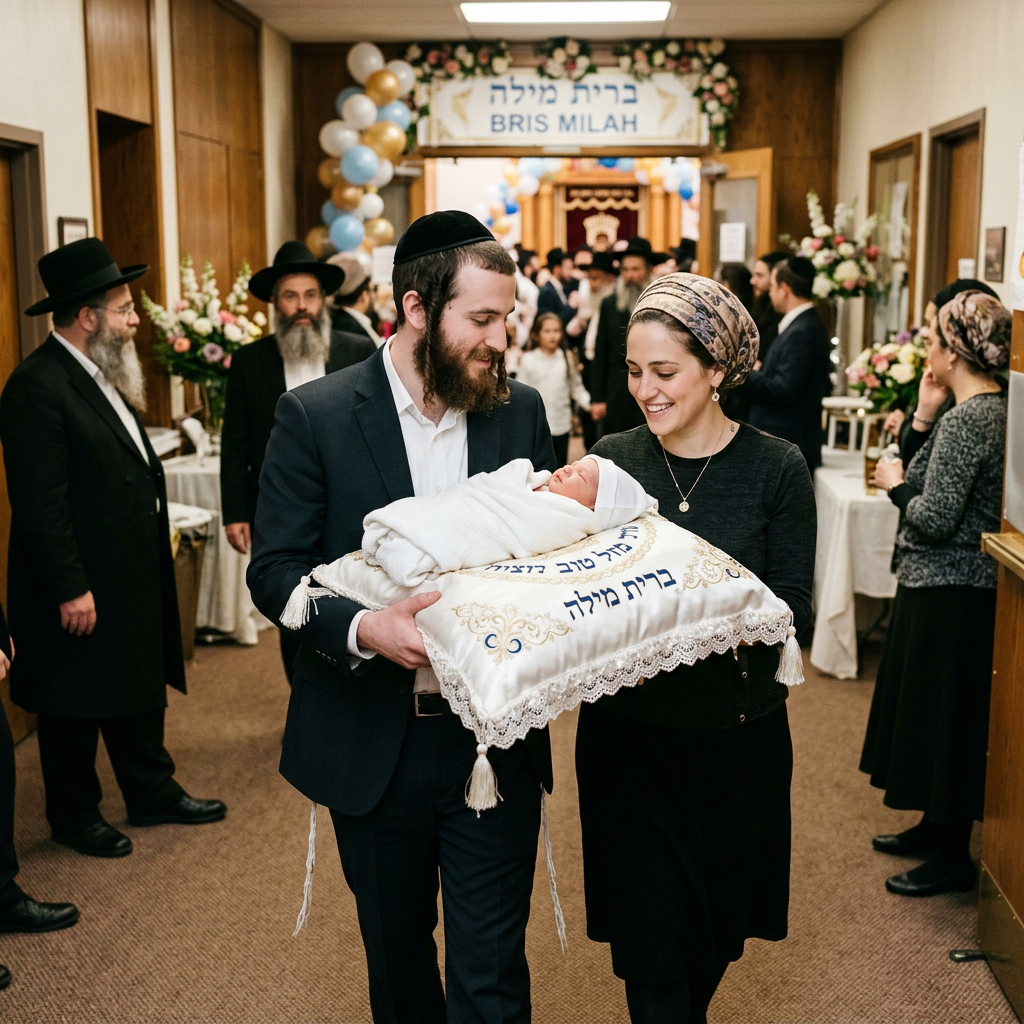
    Several weeks ago a family in another shul in-town called to inform me of a bris they would be making the next day. After notifying them that I was planning on coming, they let me know that they planned on giving me the kibud of kvatter, explaining that since we have only daughters they wanted us to have the segulah -by way of kvattering – of having boys.

    This was a very nice gesture; although, to be honest, I have never heard of the act of kvatter helping an all-girl family have boys, or visa versa.

    I hung up the phone and began to ponder if there is a source I was missing. It suddenly dawned on me that not only do I not know a source for this segulah but I also have no idea the source for the more famous segulah  that acting as kvatter is a zechus to have children in general!

    Now I am sure that there are many readers with pen already in hand ready to write a letter detailing me their or an acquaintance’s kvatter story. I too know of many such stories. Yet evne if a particular segulah is a mesorah does not then mean that it can be found in writing, and even if a segulah has worked does not mean that it based on mesorah.

    When I asked the baal simchah how he knew of such a segulah he immediately sent me a picture of a page of a modern halachik work on milah. The source in that sefer was from another modern sefer. Upon looking up the sourced second modern sefer I saw that it simply says that the idea that serving as kvatter is a segulah for children is ‘what people say’.

    While the baal simcha was satisfied with his research, it was clear to me that more research still had to be done.

    Upon further research I discovered the many gedolim were asked about this segulah and some in fact replied that they knew of no source.

    It should also be noted that the entire concept of kvatter is itself shrouded in mystery; we are unsure when this kibud began, nor do we know what the term ‘kvatter‘ even means!

    The Shulchan Aruch (Rama siman 265) states that while a woman may not serve as sandek she may however bring the baby up to the door of the shul and pass the baby to her husband who will then act as sandek. It would seem then that kvatter and sandek were once seen as one in the same. This may explain what the word kvatter means. For sandek is translated as godfather, which in Yiddish or German is GutFetter, which can easily be read as gefatter, or, kvatter.

    Furthermore, being that a sandek is high honor it is compared to being maktir ketores (offering incense on the mizbeach😉 (see Rama as well as Midrash Rabba, Nasso 14:24). This act would be termed ‘Koter’. In Hebrew the ‘o’ would be a ‘vav’ which then can easily be mistaken as being read as ‘kvatter’.

    Continuing the idea that the role of kvatter began as the role of the sandek and his wife is the idea that a sandek, and perhaps all who take part in helping with the bris, are deemed shluchim of the father and are acting on his behalf so that he can fulfill his requirement of performing a bris on his son. Kvatter then could be made up by the words of K’fetter, lit. Like the father.

    For whatever reason, at some point in the past 500 years (note that even Siddur Beis Yaakov by Rav Yaakov Emden –late 1700’s –makes no mention of our current practice) we created this new, separate kibud that we call kvatter where a wife gives the baby to her husband who will then bring him to the bris.

    Being that the entire enterprise of kvattering is relatively new what then could the source for the segula be?!

    At first, the only source I found was in my trusty Shaarei Aaron. Each week I study the parsha with this wonderful sefer that seeks to gather the main pshat oriented interpretations to each and every pasuk of the Torah. At the end of Lech Lcha he points out the correlation of Avraham’s bris and HKBH’s promise to increase his nation’s size generally and the promise of Yitzchak’s birth particularly. In pasuk 17:2 the verse states, “I will place my bris bayni u’veyncha –between Me and you – and I will increase you very much”

    The Shaarei Aaron comments on this pasuk that perhaps this is the source for the segulah, as we see a correlation between bris mila (or, helping a bris mila) with having children, for the act of kvattering is the act of helping a bris bayni u’veyncha, between you and the father (or whomever the kvatter passes the baby to) to which Hashem promised will bring children.

    While an interesting idea I was still not satisfied. I reached out to Rabbi Paysach Krohn, a mohel par excellence. He pointed out that in his book on bris mila (Artscroll) he delves into this issue. He alerted me to a midrash in Bamidbar Rabba, Nasso 14:2 (Vilna ed.). There the midrash teaches us that when Hashem sees someone helping another in serving Him, while the helper themselves lacks that very item –say a mohel who does not have kids of his own –then Hashem will grant that person with the opportunity to perform this mitzvah for themselves.

    What a source! This would mean, additionally, that anyone involved with helping or assisting in a bris would have this same merit. This may also prove that the baal simcha in my case was correct in that serving as kvatter can help with an all-girl family have boys. For, since one is assisting in a mitzvah that they themselves have never been able to perform Hashem may see this as a reason to grant them a boy to perform it themselves.

    I then recalled a similar idea from the gemara (Shekalim 14a). There the story is told regarding an individual who helped secure water for the populace. On the day of his daughter’s wedding day she was rumored to have drowned. Rav Pinchas ben Yair, after being informed of the circumstances surrounding her ‘death’, responded by asking/praying “Can one who honors Hashem through water be punished through water?!” And indeed she was found alive. From here we see the idea of Hashem also not punishing one through the very tool that he/she befits others with.

    May we have faith in the surreptitious genius of the Jewish nation and in the mysterious segulos they cite; and may Hashem have faith in us as well through granting us all what we so deeply desire.

    POSTSCRIPT:

    The sefer Zichron Yaakov (65-66), by Rav Yitzchok Elchanan Spector’s shamash Rabbi Yaakov Lipshitz, writes how in his days the kvatter were little children dressed like adults – The boy wore a shtreimel & the girl wore a tichel!

  • Spilled Ink/Spilled Blood

    Spilled Ink/Spilled Blood

    Selected Speeches, Letters, & Laments of and about the Jews In Diaspora

    Curated by Rabbi Moshe Taub, Ami Magazine, July 2025-Tisha b’Av Issue

    ——————————-

    Ramban (Nachmonides, d. 1270h, after settling in Jerusalem, writing to his son a description of its ruins, circa 1263:


    “I write this letter in ir hakodesh Yerushalaim. For, thanks and praise unto Hashem, I was privileged to arrive safely there in elul, and stayed till the day after Yom Kippur. Now I intend going to Chevron, to maaroshamachpelah, to daven

    “But what shall I say to you concerning the country? Great is the solitude and great is its devastation…The more sacred the places, the greater their desolation. Yerushalaim is more desolate than the rest of the country: AreiYehudah more than Galil. But even still in its destruction it is a blessed land…

    “[Yerushalaim] has a total of around two-thousand inhabitants, three-hundred of which are Christians who live there after escaping the sword of the Sultan. 

    “There are few Jews. For, after the arrival of the Tartars [Muslims], some fled while others died by the sword. There are only two brothers{!}, dyers by trade, who must purchase their ingredients from the government. There [at their shop] the minyan meets, and on Shabbos we daven at their home.

    “But we encouraged them, and we succeeded in finding a vacant house that we took for a shuland built pillars of marble with a beautiful arch. For the town is without a ruler, so that whoever desires to take possession of the ruins can do so. We gave our offering towards the repairs of the house. We have sent already to Shechem to procure sifrei Torah. These had initially been brought there from Yerushalim upon the invasion of the Tartars. 

    “Continually people crowd into Yerushalaim ,men and women, from Damascus, Zobah[Aleppo], and from all parts of the country, to see the makom hamikdosh and to mourn there.

    “May He who thought us worthy to see Yerushalaim in her desertion grant us that we witness her when rebuilt and restored, when Hashem’s glory will return to her. And you, my son, your brothers, and the whole of our family, may you all live to see the salvation of Yerushalim and the nechama of tzion.”

    Director General of New Amsterdam, Peter Stuyvesant, writing to his colonial bosses of the Dutch East Company back in Amsterdam on September 22, 1654.

    He composed the following letter just two weeks after the arrival of the first group of Jews to arrive to North America:

    (See Jews of the New World for a discussion of the few Jews who preceded them, as well as the suggested genesis of Stuyvesant’s antisemitism)

    “…The Jews who arrived would nearly all like to remain here. But learning that they-with their customary usury and deceitful trading with the Christians-were very repugnant to the inferior magistrates…we have, for the benefit of this weak and newly developing place and the land in general, deemed it useful to require them in a friendly way to depart; praying also…that this deceitful race-such hateful enemies and blasphemers of the name of C- -be not allowed further to infect and trouble the new colony…”  

    Domine Johannes Megapolenis, New Amsterdam’s chief minister and clergyman, supported this sentiment, writing later, on March 18, 1655:

    “Last summer some Jews came here from Holland in order to trade… they came several times to my house, weeping and bemoaning their misery…”These gdless rascals, who are of no benefit to the country, but look at everything for their own profit, may be sent away from here…”

    David Lloyd George 

    1863-1945; British Prime Minister (1916-1922), speaking on the cancer that is antisemitism:


    “Of all the bigotries that savage the human temper there is none so unwise as the anti-Semitic. It has no basis in reason, it is not rooted in faith, it aspires to no ideal-it is just one of those dank and unwholesome weeds that grow in the morass of racial hatred.
    “How utterly devoid of reason it is may be gathered from the fact that it is almost confined to nations that worship the Jewish prophets and apostles and revere the national literature of the Hebrews as the only inspired message delivered by the Deity to mankind, and whose only hope of salvation rests on the precepts and promises of the great teachers of Judaism.
    “Still, in the sight of these fanatics Jews of today can do nothing right. If they are rich, they are birds of prey. If they are poor, they are vermin. If they are in favor of war, that is because they want to exploit the bloody feuds of Gentiles to their own profit. If they are anxious for peace, they are either instinctive cowards or traitors. If they give generously – and there are no more liberal givers than the Jews-they are doing it for some selfish purpose of their own. If they don’t give- then what would you expect of a Jew?
    “If labor is oppressed by great capital, the greed of the Jew is held responsible. If labor revolts against capital as it did in Russia-the Jew is blamed for that also. If he lives in a strange land, he must be persecuted and pogrommed out of it. If he wants to go back to his own, he must be prevented….

    Rav Chasdei Crescas (d. 1410) writing to the community of Avignon, on the 12th of Cheshvan/19th of October 1391. 

    Here he details the Spanish massacre of the summer of 1391.

    Aside for the ten-of-thousands of slaughtered Jews, hy”d, this event led to the conversion of many, and was the prelude to the Spanish Inquisition, which took place one-hundred-years later. 

    He opens the letter by sharing how is only son was among martyred, Hy”d:

    “Among the many who sanctified the name of the Lord was my only son…If I were to tell you here all the numerous sufferings we have endured you would be dumbfounded at the thought of them.

    “I will therefore set before you only in brief detail the table of our disaster set with poisonous plant and wormwood [see devarim29:17], giving you a bare recital of the facts so that you may state yourselves on the bitterness of our wormwood and drink from the wine of our grief! …

    “On the day of the New Moon of the fateful month tamuz in the year 5151 [July 1391] Hashem bent the bow of the enemies against the populous community of Seville where there were between 6,000 – 7,000 heads of families, and they destroyed their gates by fire and killed in that very place a great number of people; the majority, however, changed their faith. Many of them, children as well as women, were sold to the Muslims, so that the streets occupied by Jews have become empty. Many of them, sanctifying the Holy Name, endured death…

    “From there the fire spread and consumed all the cedars of Lebanon [talmidei chachamim] in the holy community of Cordova. 

    “And on the day of misery and punishment, on which the sufferings were intensified…in the community of Toledo…the priests and the learned were murdered.

    “In that very place the rabbis, the descendants of the virtuous and excellent R. Asher of blessed memory, together with their children and pupils, publicly sanctified the Holy Name….

    “On the 7th of the month av the Hashem destroyed the community of Valencia, in which there were about a thousand heads of families; about 250 men died al kiddush Hashem the others fled into the mountain, yet some changed their faith…From there the plague spread…. On rosh chodesh elul, the bloodthirsty villains came there, profaned, plundered and robbed them and left them like a net in which there are no fish. Three-hundred died al kiddush Hashem…

    “On the following Shabbos Hashem poured out his fury like fire, and destroyed the community of Barcelona. The number of murdered amounted to 250 souls; the rest fled into the castle, where they were saved.

    “The enemies plundered all streets inhabited by Jews and set fire to some of them. The authorities of the province, however, took no part in this; instead, they endeavored to protect the Jews with all their might. They offered food and drink to the Jews, and even set about punishing the wrongdoers, when a furious mob rose against the better classes in the country and fought against the Jews who were in the castle, with bows and missiles, and killed them in the castle itself. Amongst the many who was mikadesh shem shomayim was my only son, who was a chosson and whom I have offered as a korban without blemish; I submit to Hashem’s justice and take comfort in the thought of his [his son’s] excellent portion and his delightful lot. Amongst them were many who slaughtered themselves and others who threw themselves down from the tower and whose limbs were already broken before they had reached half-way down the tower. Many also came forth anddied al kidush Hashem in the open street. Many. Others changed their faith… Because of our many sins, there is none left in Barcelona today who still bears the name of Jew…

    “In the town of Gerona, where knowledge of Torah could be found combined with humility, the Rabbis of that place publicly died al kidushHashem, and only a few changed their faith. The majority of the community escaped to the houses of the citizens…”

    (Translation of Franz Kobler, A Treasury of Jewish Letters, 1953, p. 272ff)

    Rav Chasdei ends by quoting from eichah “I am the man who has seen affliction by the rod of His wrath” (3:1), and with the following words of hope, some chizuk upon which we will too will conclude:

    “In spite of this our eyes are directed towards the Father in heaven, that He may be merciful to us and may heal us of our wounds, and keep our feet from wavering. May this be His will, Amen.”

  • Saying ‘Mazal Tov’ for a Get?

    Saying ‘Mazal Tov’ for a Get?

    A Long-Suffering Agunah & Her Seudas Hodah

    Rabbi Moshe Taub, April 2025

    1. The Shailah & Its Background

      It is easy to guess and pontificate regarding a seemingly ‘inconsequential’ or ‘small’ hashkafic question; to debate around the Shabbos table.

    Rabbanim, however, do not often share that luxury, as our answers may be taken as fact, acted upon, and quoted.

    We must be careful.

    So when I received the following request, I was uncertain as to the proper course of action.

      “Rabbi, can we sponsor the Shabbos hagadol drasha?”

    “Of course!” I enthusiastically responded.

       “Ok, Rabbi. We will call the shul secretary to make sure it gets put in the flyer.

    “It will say something to the effect:

    Mazal Tov to our daughter Esther [name has been changed] upon receiving her get””.

    I must have been silent for an extra beat, causing these parents to ask, “Is it not proper to say ‘mazal tov’ for such an occasion?”

      I understood their relief, of course. Indeed, I too had been involved in Esther’s plight for many, many years. In fact, my ‘simcha‘ was doubled by the fact that, just days earlier, another woman also received her get after more than a decade of emotional torture.

    As shailos tend to come in pairs, as I was contemplating the ‘Mazal Tov’ issue, this second newly minted gerusha invited me to a ‘seudas hodah’ her sisters were making to celebrate her finally attaining her get.

    “Can you offer some divrei Torah” she requested, adding “Would it be appropriate for us to recite the pesukim for the korban todah?”

    II. ‘Agunah’

    I use the term ‘agunah’ cautiously, judiciously; never weakening its potency. Both of these cases above were divorces concerning true agunos.

    There are the most painful elements of rabbanus; cases where husbands ignore beis din, skirt court orders, and even flee to other countries.

    When I was a rav in Buffalo, I once had a chassideshe posek request permission to send a private detective to our shul on Yom Kippur. In that case, a husband absconded from beis din appointments, disappeared from his Monsey neighborhood, and whose last EZ-PASS entry was a few miles from my home (this case was the subject of another post).

         I have arranged gittin in prison, in medical offices, and in abandoned buildings.

        It may be surprising to learn that not do such men take my calls, but that most relish in them. On the phone, they believe they are in control, allowing them faux-power in their games of deception and manipulation; drawing yet one more person down to their pettiness, anger, and darkness.

    Undeterred after inevitably failing to convince me of their righteousness, their narcissism assures them I will be convinced after the second call, the third, etc.

       Often, the families of such agunos have to suffer the indignity of receiving tzedakah, and in one case, moving with their children into a frum home for battered women, and then -after the children are abandoned by their fathers – watching the horror on their children’s faces as many high schools reject them -just another in their list of men who have let them down. In one case, after showing the administrator how a particular young girl was able to destroy her yetzer and get straight alephs’s, yearly middos awards, no internet -all while living with her mother in an Ohel Home for Battered Women – I was told that they still can’t ‘risk’ having ‘such’ a girl! Unforgivable!

       So, I understood how each of these gittin felt like a ‘simcha’, one worthy of a ‘mazal tov’, even if the mizbeach needed to shed tears (gittin 90).

       I am writing this on the eve of Rav Nota Greenblatt’s yartzeit (28 nisan). I do not know of a single person in Jewish history, or any entire organization around today, that has ended the agunah status for more women than he, having written somewhere between 20,000-30,000 gittin. His own children never saw him during the week!

           Neither of the two women mentioned above are members of my shul, nor do I have much free time in the day. But Rav Nota taught me that nothing is more important than making sure such women have a halachic closure to their pain. Zechuso yagein aleinu.

    III. The Term ‘Mazal Tov

    An easy mnemonic to recall one of the first instances of the term ‘mazal tov’ is its roshei teivos, ‘mem teis’, for pesachim daf mem teis (49a). The gemara there shares that the beracha/hope for each zivug, is that the marriage be ‘oleh yaffa’. Rashi explains this term as, “b’mazal tov” (see also Rashi to bereishis 30:1 with Targum Yonasan).

    While the earliest reference to this phrase may be found by kiddush levana (from mes. soferim – ‘siman tov, u’mazal tov…’), we are seeking its provenance qas a term used by simchos.

      One of the earliest mentions of the minhag of using this term at weddings, is the shu”t Maharam Mintz (#109, p. 538).

      A century earlier Rabbeinu Yeruchum (b. 1290) records such a practice in reference to “giving ‘mazal’..” the night before a bris (Toldos Adam v’Chava, 17). However, he then quotes those who were concerned with this practice (see Beis Yosef to y”d 189:4; see also note to Tosefta K’Peshuta, shabbos, 6:4).

        Another generation earlier, we find Rav Yehudah Hachasid sharing a minhag of issuing a ‘mazal tov’ after a birth of a child (Sefer Chasidim, #487).

         As to the meaning of this phrase – and the serious hashkafic questions it brings, alluded to by Rabbeinu Yeruchum, (e.g. ‘ein mazal l’yisroel‘, etc.) – we find many explanations .

    One approach -that this teffilah is to overpower potential negative potencies through Torah, teshuva, and mitzvos – is found in an essay by Rav Gavriel Tzinner (sefer Shiduchim V’Tennaim, p. 470); whereas the shu”t Be’er Eliuyahu (3:55) explains that ‘mazal’ here doesn’t refer to the constellations, but rather to certain melachim of similar names that bring beracha from Hashem, perhaps similar to barchuni l’shalom said Friday night (although, admittedly, a small minority have the minhag to omit that particular stanza).

      As to saying ‘mazal tov’ by a get, I reached out to a renown posek, who has also arranged thousands of gittin. He responded: “I am not aware of a source for such a ‘minhag’ however I do wish each of the parties happiness and success going forward.”

       I think that may be wise-as we should not desire to create new minhagim.

    I then discovered that in the Artscroll ‘Rav Nota‘ biography, it is recorded how Rav Nota too would frown upon saying ‘mazal tov‘ by such an occasion.

    IV. The Hodah ‘Event’

    I walked in to the ‘event’ with my wife only to find seven women around a table -their food untouched – quietly reciting tehillim through tears.

     Mi k’amcha yisroel?!

    I was son introduced to say a few words.

        “I don’t know a phrase to use” I admitted. “Another gerusha this week asked me if we say ‘mazal tov’. I just don’t know.

     “While we must never revel at the dissolvement of a marriage, we can, and indeed must, recognize the yad Hashem and show proper hakara.

     “In two days, we will recall the kriah of the yam suf. By that kriah (tearing) only those humans who were actually saved were given sanction to sing shirah. The melachim, however, were reprimanded when the sought to sing, “My creations are drowning, and you wish to sing shirah?!” (See Mishnas Rav Ahron where he makes a similar distinction between Hashem rejecting the shira of the angels, while reveling in the shira of klal yisroel).

     “So, perhaps, the choice of emotion is up to the gerusha alone. Perhaps she can say that phrase…but not I.

    “More, perhaps this is why chazal compare zivugim to krias yam suf. Chazal conclude that this is referring to one’s ‘secondzivug. In other words, this kriah – this get – should lead to beracha for you down the road, iy”H.

        “As for reciting the korban todah, the Rema tells us not say this parsha at all over Pesach – due to its rare chometz loaves.

        “Yet, perhaps, this rare feature of the korban todah (as the Torah generally forbids chometz by korbonos) can perhaps provide for us a lesson today. The word ‘chometz’ alludes to letting things fester (e.g. mitzvah bu l’yado al tachmitzena). Todah, hakarah, or gratitude, too, is amplified with time. If an article is found as quickly as it was lost, then the thankfulness may not be as strong as when it was missing for many years.

       “The longer one waits, the more anxiety and worry, the added lost sleep -the surplus of ‘chometz’ as it were- all lead to a todah and relief that is that much more intensified upon release.

       “In your case, there has been much ‘chometz’; much time of waiting – so your hakara must be profound.”

    (Being she was a sefardi, I thought to allow her its recital after I left, see Rema 51:9)

         Rav Chaim Berlin was once imbroiled in a machlokos regarding a get. The rabbanim on either side were at odds with each other. He shared with them that when chazal mention an ‘individual who has mazal’ (bava kama 2b), Rashi explains this as “one who has the wisdom to guard himself”. Rav Berlin explained that Hashem gives us everything, but we can ruin it if we abuse our ‘mazal’. This, he explained, is why we say this phrase at a wedding. We are telling the chosson and kalla, “Be careful! Do not let a bad word or negative mood destroy what Hashem gave you”. (Nishmas Chaim, evh’a, 147).

        He was hinting that their milchama shel Torah should not lead to negative words.

       So, whether the reader is newly married or celebrating their fiftieth year, ‘mazal tov!’

  • E-mailing the Past and the Future

    E-mailing the Past and the Future

    A Rabbi and His Congregants Debate Our Jewish Future

    Published in Ami Magazine in October of 2013

    The October 1 edition of the New York Times published a Pew Research Poll regarding the state of Judaism in America.

    The numbers are a sorry sight. Intermarriage has surged, synagogue attendance has declined, and a large number of American Jews (32%) define themselves as “having no religion”.

    The only growth and stability found in this poll was among the Orthodox.

    What follows is a series of email exchanges between Rabbi Moshe Taub and members of his community in Buffalo, NY on how to deal with these statistics as well as their cause(s). While names, other than Rabbi Taub’s, have been left out, permission has been received from the others to print their emails.

    On Oct 1, 2013, at 1:13 PM, X wrote:

    To: Rabbi Taub

    CC: Y

    You may have seen this article, but I thought I would pass it on.  It

    is sad that less than 70 years after the Holocaust and the founding of

    the State of Israel, Jews, by sheer indifference, begin to disappear.

    After spending 100 hours in Shul in the last month, it is hard to

    imagine that most Jews didn’t go at all!  Not fair!

    On 10/1/2013 4:10 PM, Moshe Taub wrote:

    Yes, very sad, even sadder that I am not surprised.

    Based on these statistics, in two generations Orthodox will be the

    majority -based both on its fast-growing numbers and due to the continuing cultural suicide of the other movements.

    Every few years a poll like this gets picked up and the Reform et al.

    have serious discussions as to what they can do to fix the problem.

    Ironically, up till the late 70’s the Orthodox were seen as a

    disappearing relic and the other movements thought they had a monopoly

    on the future.

    Chacham Einav B’roshoThe wise man sees far, far ahead, and in the

    40’s and 50’s, while many chose to bend to the will and desires of their

    Congregants -and wer seen as pioneers in the process – the true and great pioneers were in fact the ones who ignored them while simultaneously planting seeds for the next generation.

    Thankfully, what these men planted on these shores was an Ilan Chazak. And like Choni HamAgel, 70 years later we wake up and see the fruits of their tireless labor.

    The saddest part of all this is witnessing the decline of Conservative

    Judaism, both in numbers and in policy. They will feel the brunt of this

    more so than Reform etc.

    Moshe Taub

    On Oct 2, 2013, at 9:48 AM, Y wrote:

    Dear Rabbi Taub,

    I don’t disagree with your assessment.  But there are other matters, perhaps ones which you broach indirectly in mentioning that the saddest part of all this is the decline of Conservative Judaism.  Granted the wisdom of Orthodoxy hoeing its own garden, rather than worrying so much about “outreach,” must not Orthodoxy ask itself if the alienation of so many Jews from Orthodoxy expressed by the very formation of the Conservative and Reform movements does not have something–at least something, if not everything–to do with the way in which Orthodoxy, in its various institutions and functionaries, conceives of itself?  When Conservative and Reform disappear, are we confident that new break-offs will not arise and that those who break off will not do so because they are repelled by Orthodox behaviors, attitudes, ways of doing things?

    And as for Orthodoxy in itself, it is not good that it should be monolithic.  Not good, because sages, wise as they are, have an inherent tendency toward arrogance about their wisdom (I think of kin’as sofrim) and, if not arrogance, at least complacency.  The sin of the people of Babel is that they were all one people speaking one language, and this was equivalent to building a tower to heaven and replacing God with themselves.  God multiplied their languages–not, by my lights, a klalla but a bracha.

    Y

    On Oct 2, 2013, at 11:24 AM, Moshe Taub wrote:

    I hope you won’t be mad if I respond with honesty…

    –  Imagine if there was a breakdown in academia. Schools were closing one after the next, and that scholarly interest, if existing at all, were purely for vocational purposes. Harvard soon shuts down its Humanities Dept. etc., etc., etc. 

    In the entire country of three hundred million there is no more than 1000 people left who know how to read Shakespeare, who have even heard of Plato, who have ever truly read a poem.

    After meditating on that new reality for a minute….

     As a passionate student and teacher of such subjects, how would your plan for fixing this differ than Rav Moshe’s? Would your main focus be to get the 40 year olds back to school, is that where you would spend your energy?

    I hope not. 

    Rather the smarter bet would be to first make sure that these studies can live on authentically. Second, you will work on the upcoming college age kids, while not ignoring the already lost -and certainly composing books geared toward them.

    Infrastructure for the future, preserving an authentic rendering of whichever subject or school, must come first.

    – Would the above be seen as arrogant? Probably. But to define it as ‘hoeing one’s own’ would, I contend, be simplistic, as well as not giving Torah L’Shmah the same urgency as you would your own life focus.

    – As for outreach, Orthodox has not failed. Many more people have flocked to Orthodoxy on serious religious grounds than any of the other movements, which have, often, acted as weigh stations as one’s family and history exits the nation – sadly. Yes, they often extend this life, yet like a hospice, few make it out alive. Indeed, the other movements cannot hold a candle to the energy that the Orthodox have devoted in outreach toward other Jews.

    But perhaps your point is not that we do not reach-out to others, but that we reject the other paths, and they notice this. Which leads to my next point…

    – Your proof from Babel is, in my judgment, misplaced. Again, imagine we are talking about your acceptance of how yeshivos edit Shakespeare’s works for tznius purposes. Do you accept that, and if not, what of alienation? And then what do you do if colleges begin a puritan streak and begin doing the same, rejecting, say, Romeo and Juliet? Do you go silent? Would you worry about alienation above authenticity? We mustn’t have separate rules governing modes of protection for authentic Torah vs. protecting the things outside of faith that we most passionately pursue.

     – Yes, Gd allows each of us to find our own emes (see Bereishis Rabba, bereishis where Gd threw emes to the earth and it shattered into many pieces). But there are limits, as any system must have. 

    Where are those goal posts? That is a question that we all must ponder before discussing inclusiveness, not after. Otherwise one runs the risk of falling into the trap that Aaron fell into (al pi pshat) -a much better illustration in my view.

    So, yes, diversity exists within Torah, as it does within Academia. Yet, in both there are limits -must be limits. You alienate a nice chunk of people who call you ‘Elitist’, as I too am viewed bleakly by many. And we both sleep well at night, confident that we have preserved what we need to.

    A few final points: 

    – Considering my example, you know that if you would allow for the ‘Disney-fication’ of academics, if Readers-Digest-like critiquing is respected, and if you allow those teachers to join you as equals at the table it would influence over time the authentic teachers far more so than the inauthentic teachers. A broom gets dirty as it cleans up (see introduction to shu’t Chasam Sofer from Avraham and Sdom where he wonders just how ‘dirty’ a rabbinic broom must get).

    – Your disappointment would be better directed at the founders of the other failed and inauthentic movements, not those who, whether true or not, did not do enough to clean up their mess. The NYT article was about their failure, not ours.

    –  Lakewood has 6500 students currently enrolled; this is not including the many Lakewood affiliated yeshivos and kollelim throughout that city and the world. Surely you are aware that not all of their students’ grandparents were frum. Compare this number to any of the other schools of higher Jewish learning, even high schools. Lakewood did not succeed alone but with the help of the many other yeshivos and derachim that helped either turn those students’ families onto yiddeshkeit or that produced the rabbanim who inspired them toward change. Remarkable, for had we asked any branch of Judaism in 1950, “Considering that each of you claim a monopoly in saving the future of Jewish America, venture a guess as to the enrollment of all of your branch’s yeshivos, rabbinical schools, and high schools in 60 years, 2013”, no one, aside for Rav Aaron, would have guessed this result (and the design for a 3000 student yeshivah found in his notes following his pertira –at a time when the yeshiva numbered in the low hundreds – is testimony to his confidence in his approach’s future success).

    While some would argue that the number of people enrolled in yeshiva is not the best yardstick, this last poll proves that this is the only yardstick to know what will be in 60 years from now, in 2073.

    On this point, and with respect to the tzadikei shluchei Chabad, Morristown’s enrollment has not shifted much for deacdes. This is not to take away from their amazing work, rather to say that a Top-Down approach -create the highest level Kolellim, Yeshivos, etc. -seems to be a winning one. In my father’s day at NCSY, its Shabbatonim were never seen as an end onto itself, rather sending the girl to Neve Yerushalaim, or a boy t Telshe was.

     – One must be careful regarding inclusiveness; a demarcation between the beauty of outreach and the enticement for overreach. Judaism mustn’t turn into a pyramid scheme. The objective mustn’t be to inspire so that those people can then inspire people so that now those people can inspire people, etc. This is not Glengerry Glenn Ross, rather our end goal is to become, support, strive for, be envious of Elite Torah L’Shmah…the singular book Gd gave us to study and from which to learn, the book that is the envy of every nation and that has been robbed and pillared for every other system, of faith.

    The man alone in the beis midrash learning a ketzos must be seen as the preserver not the ignorer

    Otherwise we have become Am-way.

    Lakewood knows this, YU knows this, Chabad knows this.

    When a retired conservative rabbi began to daven in our shul he remarked that in his movement the rabbi is seen as the frum one, the knowledgeable one, on behalf of all others. “He keeps Shabbos so I don’t have to”. He was amazed to see a shul where the balla battim know enough to challenge a rav during a shiur, or even to give a shiur of their own.

    Finally, and to sum up:

    No matter our tiny size, no other religion fills up stadiums every seven years. But it is deeper than that:

    I defy anyone to discover another cause within yiddeshkeit other than Torah study that could fill 100,000 seats in Giants Stadium. No other branch of Judaism could do it, and even the Orthododx would struggle unless it is a celebration of each Jew’s personal authentic Torah study.

    Kiruv could not do that, Hatzala could not do that, Bikur Cholim could not do that.

    You know how I know? Because if they could, they would!

    Of course, we NEED all the above chesadim, and it would be specious and pure sophistry to misread me as diminishing those holy tasks in any way (after all, I myself am a rabbi in Buffalo!)!

    Rather, that the authenticity of Torah and its study, and our preserving of it, must always remain focus number one, for it is the elixir that has always saved us from withering on the vine.

    M

    PS – I would be remiss not to mention that the entire enterprise of outreach has been compromised of late due to the high intermarriage rate. Many Temples have a higher rate of halachic gentiles among their memberships now (especially the children) than halachic Jews.

    PPS –As to who gets to decide what is authentic Torah study, ahhhh, well that is an email exchange for another time…

  • The Secret of the Shlisel Challa

    The Secret of the Shlisel Challa

    A Short Thought Exploring the Tradition of Shlisel Challa

    Rabbi Moshe Taub, April 2013, Ami Magazine

    One of the most interesting minhagim, specifically as it relates to this time of year, is the shlisel challa (literally: the ‘key bread’. In truth, ‘challa‘ does not mean ‘bread’, and how it attained this monicker is the focus of another post).

    For those unfamiliar, the minhag of shlisel challa is where, for the shabbos after Pesach, many prepare their challa either in the shape of a key, or, place an actual key inside the dough before it is baked (for sources, see Imrei Pinchos #298; Ohev Yisroel, likutim, shabbos achar Pesach, inter alia.).

    While we find many unique customs relating to challa throughout the year -e.g. round on yom tov/straight on Shabbos, braids, etc. –shlisel challa has distinctively captured the imagination of many, leading to an abundance of theories and explanations as to its meaning and representation.

    I will, la”d, offer my own theory to this minhag, and why its appeal spread beyond the province of its chassidic provenance:

    Notes:

    [1] Why was this strange deed of ‘blood pouring’ chosen by Gd as our means of escape?

    Lulei D’Mistapinah, I will offer a theory:

    The Chizkuni suggests the brothers sold Yosef because they could be not tolerate the uncertainty of the future slavery decree — when would it begin?

    They therefore made the grave error of taking Hashem’s plan into their own hands, acting in Full-Hishtadlus mode (similar to Chizkiyahu’s error-see berachos 10a).

    How did they facilitate this?

    By slaughtering a goat, dipping, and bringing this false evidence to Yaakov.

    To correct this original sin of our entrance to Egypt, a striking parallel was necessary in our yetziah m’sham:

    Same animals (goat/sheep), same dipping in blood — but this time as an act of defiant Bitachon. We dip in blood not to deceive Yaakov but to mark our doorposts, publicly declaring our faith to Hashem alone (Shmos 12:6–8).

    The Korban Pesach is the tikkun for the sale of Yosef. Where the brothers used hishtadlus to take Hashem’s plan into their own hands, we use the same act as a declaration of pure bitachon.

    I have not seen this above connection made by anyone else, and have been pointing this out for years! Whenever I share it, people always assert that this connection must also be a Midrash (it is not).

  • The Amazing Life & Conversion of Warder Cressin

    The Amazing Life & Conversion of Warder Cressin

    A 19th Century American Patriot From Derby, PA who Converted in Yerushalaim

    He arrived on the shores of eretz yisroel in the summer of 1844 holding a dove and an American flag.

    After receiving approval to be the first American Consul to Jerusalem, Warder Cresson was unaware that the President of the United States had revoked his status while already Israel bound.

    Yet this is by no means the most fascinating part of his story.

    ‘Who was Warder Cresson?’ you may ask.

    Well…who wasn’t Warder Cresson!

    Polymath, convert, source of halachic battle, mevakesh, man of history, the list goes on.

    Several years ago my predecessor in Buffalo, HaRav Yirmiyah Milevsky, published a wonderful article researching the life of Warder Cresson. His discovery was passed around rabbinic circles as it resolved an old halachic history that we shall soon discuss.

     Warder was born July 13, 1798 to a deeply devout Quaker family. After some business success, by the age of thirty he began to question his faith. According to the historical research of Dr. Yitzchak Levine, “By the 1840’s he had become, in turn, a Shaker, a Mormon, a Seventh Day Adventist and a Campbellite.”

    Like Yisro, or the King of Kuzar of the sefer Kuzari, who had examining many faiths until discovering Torah and yiddeshkeit, Warder was a searcher, a mevakesh.

    Inspired by the writings of some of the rabbis of his time, his heart began to pine for avira d’arah. Before embarking on this journey he somehow convinced the American government to give him the official title of American Consul to Israel. There were men who knew of Warder, and viewed him as a religious fanatic (we can only imagine how many faiths he had angered by this point!). One man, Samule D. Ingham, who had served as President Jackson’s Secretary of Treasury ten years earlier and who knew Warder wrote to President Tyler’s administration to have Warder’s title revoked. They concurred. But it was too late for Warder to find out before his arrival.

    In time he became dismayed at what he saw. Missionaries living in luxury while the Jews and others lived in utter poverty.

    He also strongly criticized the church’s overt desire to convert Jews. He wrote a parody titled ‘The Society Formed in England and America for Promoting Sawdust, Instead of good Old Cheese, amongst the Jews in Jerusalem

    In it he compared Cheese to Judaism and sawdust to his and the missionaries’ faith that may look like shredded cheese and be sold as such but was a ruse and not the real thing.

    A few years after, and now almost fifty years of age, Warder Cresson became a ger.

    He wrote: “When I became fully satisfied that I could never obtain Strength and Rest, but by doing as Ruth did, and saying to her Mother-in-Law, or Naomi ‘Entreat me not to leave thee … for whither thou goest I will go’…. In short, upon the 28th day of March, 1848, I was circumcised, entered the Holy Covenant and became a Jew….”

    After a short visit to America, he returned to Israel under the name Michael Boaz Yisroel Ben Abraham, married, had two children and lived the life of a sefardi. He died in 1864 and was buried on har zeisim. His burial spot was only discovered last year.

    While Warder Cresson’s life still had even more fascinating turns –his autobiography detailing his life choices titled ‘Key of David’, his divorce from his first wife and loss of much of his American estate, his likely 1857 meeting with Herman Mellville, author of Moby Dick – it is his halachic legacy that I wish to share.

    The shu’t Binyan Tzion (91) by Rav Ettlinger –better known perhaps as the Aruch L’ner –discusses the case of a Moroccan convert in Israel.

    Here is the shailah that was posed to him (translation from Rabbi Milevsky):

    Here in Yerushalaim on Tuesday the twenty third day of the month of Adar Sheni of the year (5)608, a non Jew came from Morocco and had a bris for the sake of geirus, and accepted all the mitzvos. On the following Shabbos, he had not fully recovered from the circumcision and thus not entered the Mikvah…a rabbi claimed that due to the fact that he did not yet enter the Mikvah he must not observe Shabbos and must perform a melacha…Consequently he violated Shabbos by writing a few letters. After Shabbos when the Rabbis in town heard of the ruling they disagreed claiming that after his bris he is considered a Jew and must not violate Shabbos.”

    The question is a fascinating one. What is the status of a ger between the stages of bris and tevilah? Many teshuvos have been written about this case throughout the years from all over the world.

    The Binyan Tzion has a remarkable approach that while not yet a yid, once convalescing from his bris and before tevila he is also no longer a gentile, and the prohibition on gentiles in keeping Shabbos no longer applies! This seems to be the understanding of the Chasam Sofer (oh’c 116) and can also be inferred from the Tosphos Yeshanim (Yevamus 48b).

    The Sochachover rebbe takes this even further (Avnei Nezer y’d 352), that not only may someone in this ‘quasi’ state observe Shabbos, but they must! Basing himself on the Zohar, we know that the Jews received the mitzvah of Shabbos in Marah –after mila but before the tevila of Sinai (See also shu’t Eretz Tzvi 1:41). He even goes so far as to say that even if earlier sources would seem to argue on this quasi status it may only be due to the fact that the Zohar was not yet known in their time.

    In fact, the Midrash would imply (Devarim Rabba 1:20) that this prohibition on a gentile to observe Shabbos is only until “one accepts mila” clearly indicating that this ger should not have been instructed to write on Shabbos after his mila (see shu’t Divrei Yosef 3:24).

    What about the rav from Yerushalaim who had this quasi convert write on Shabbos, what was his basis?

    The name of this rav was Rav Asher Lemmel, who indeed rejects many of the proofs brought.

    But a greater mystery has always been who this convert was. Keep in mind that this was at a time when very few became geirim.

    Rabbi Milevsky took the date of the geirus found in Rav Ettlinger’s teshuvah and calculated the equivalent secular date and…lo and behold it was March 28, 1848 the exact same date that Warder Cresson converted! He was the source behind this famous debate!

    As for his being called Moroccan, in Hebrew America has the exact same spelling save for one letter.

    When Artscroll published their new English Midrash Rabba (Ibid. 213 note 241) they seem to have fully accept Rabbi Milevsky’s contention that the man behind the story was Warder Cresson.

    One Quaker from Derby PA began to search, became a ger tzedek and had an impact still being felt today.

  • Purim Halacha Primer

    Purim Halacha Primer

    Rabbi Moshe Taub

    A Halachic Review of: Taanis Esther; Zecher L’Machatzis HaShekel; Megilla Reading(s); Matanot Levyonim; Shaloch Manos; Seudah

    Click Here For Why We Dress-Up On Purim

    Click Here For Why/When/How/Who We Get Drunk On Purim

    Taanis Esther

         Taanis Esther is a most unique fast.

    As opposed to all other yearly Fasts, it is not overtly mentioned in verse or even in the Talmud/Midrash (the other rabbinical Fasts are mentioned in zechariah 8:19).

    Any number of reasons is brought for our custom of Fasting on this day (see Rambam, hil. Taanis 5:5, inter alia).

    For a complete history of this fast click here.

     According to Kaballa the reason for this Fast is due to the following: as we know the original sin of the Purim story was our joining Seudat Achashveirosh, a party that was predicated on the mistaken belief that the Second Temple would not (soon) be rebuilt.

    Food, then, became a central part of this story. Therefore, in remembrance of this fact, we both obligate ourselves in food with a Seudah on Purim day and abstain from food the day before. By doing so we do not only atone for our error in Persia, but also for our error of eating in the Garden of Eden (Shla; Bnei Yisaschar; Rav Chaim Vital)!

      However, one isn’t to breech the customs of our heritage, however mysterious they may appear to us.

        Yet, because this Fast is but a custom one should certainly not be overly stringent and must speak to a Rav if not feeling well, even slightly.

       If Fasting will ruin a person’s Simcha on Purim, a Rav should be consulted.

    A pregnant or nursing woman should not fast Taanis Esther.

    Someone with severe migraines need not Fast Taanis Esther.

    One who wishes to eat early in the morning before the Fast begins should state as such before going to bed the night before.

    Zecher L’Machatzis HaShekel

    There is a Minhag to give three ‘half’ coins to Tzedaka at some point during these days.

         Most give this either before or after Mincha on Taanis Esther, while others do so on Purim before the Megilla reading.

          A plate will be in the shul with these three coins (taped together).

    PROCEDURE:

        Place money or a check onto this plate having in mind to thereby purchase one of the few, taped, sets of three coins (the money/check may be of greater value than these coins’ worth!).

        Then, the purchaser should lift up ‘his’ coins before donating them back to the same plate from which it was taken.

    IMPORTANT NOTE:

          One must be careful not to call this custom ‘Machatzis HaShekel’, rather “Zecher L’Machatzis HaShekel”, as it is but a remembrance.

    Megilla Reading(s)

          All adult Jews are obligated in reading/hearing the Megilla twice each Purim; once at night – from the emergence of stars until the morning; and once again during the day – from sunrise (netz) until sundown.

        If someone needs to hear one of the Megilla Readings at an earlier or later time than the shul is offering, please call or text me at 732-.

         Because these obligatory readings are ‘time/date-based/passing Mitzvos’, it is forbidden to eat a meal from the moment that each reading’s obligation begins (sundown, and sunup), other than a coffee or the like.

         Indeed (see Rama 692:4 and commentaries), the laws of performing any subjective task before the Megilla Readings is uniquely strict when compared to other passing Mitzvos.

    PROCEDURE:

         NIGHT READING:

    1. One must listen to the three blessings, answer Amen, and be sure not to talk at all until the Megilla is completed.
    2. Sefardim should have in mind (as should he who is making the blessings) that this Shehechiyanu blessing be an umbrella blessing for all the mitzvos of Purim into the next day (i.e., the Mitzvos of Shaloch Manos and Seudah).
    • Ashkanazim do not have these other Mitzvos in mind at the night leining, as they will be making another Shehechiyanu on the morning’s reading, and will have this in mind then.
    • One is obligated to hear the entire Megilla.
    • If one misses hearing a single word of the leining one should quickly make that up by quietly reading inside a printed Chumash until caught-up.
    • If one ‘spaces out’ but hears every word they still fulfill their obligation according to most. (But don’t space out 😉
    • It is best, halachicly, to hear the Megilla in a large crowd because the purpose of reading the Megilla is to publicize the Purim story.
    • The poskim posit that for the needs of the sick, or, a helping spouse, a large reading may be missed (see Biur Halacha 690:18; Shaar Hatzion 687:10 with Aruch Hashulchan and Achronim)
    • The reader needn’t know the meaning of the words, so long as he knows the major beats of the events in the Megillah
    • One need not follow along inside the text and may rather simply listen.
    • However, due to numbers 4-6, it is advisable to follow with a printed version. However, if one will focus more by listening, then this is all they should do. Although the Mishneh Berrura urges everyone have a Chumash/Megilla with which to follow along, it very well may be that in our generation of quick clicks and short attention spans, closing one’s eyes and listening my offer the less distracted experience. Each person is different, of course.
    • A Kosher Megilla is an advantage, as then even if entire sections of the Megilla are missed, they may be madeup – and the listener caught-up – by simply reading from a Halachic Megilla.

        Some contend that a Kosher Megilla serves additional advantages, such as listening while also reading along in a low whisper from his Megilla (audible enough so that at least he can hear). Then it may be deemed as if he both fulfilled the Mitzvah of listening to the Megilla in a large crowd, and also is deemed to have been the one to have read it (according the Chazon Ish; the Brisker Rav strongly disagrees, arguing that by reading it to oneself, he would lose the Pirsumei Nissei and Rav Am

    Matanot Levyonim

          On Purim we give charity to whoever asks. Some contend that this is the origin of our masquerading-so those who may need some finical aid may ask without shame.

         We also make sure to actively distribute funds on the day of Purim.

         This latter act is termed Matanot Levyonim and is one the Mitzvos of Purim, along with a Seudah and Mishaloach Manos.

       This Mitzvah is usually accomplished through giving funds to one’s Rav before or on Purim as he likely has a method of distributing on that day.

          I our Shul, it is recommended that people send money to the Rabbi’s Discretionary Account, earmarked in Memo as ‘Matanot Levyonim’, before Purim.

          Such checks should not be postdated for after Purim, if possible.

          The minimum one must give is $1, preferably for each member of his-or-her household.

       Of course, Kol HaMarbeh Meshubach/All who give more are praised!

    Shaloch Manot

    Either friends like Job’s – or death” (Bava Basra 16b).

    If one has no friends, it is better he not be alive” (Rashi, ad loc. s.v. ooh chavrei)

            Purim is a celebration of the living, of our nation surviving a physical threat. This is as opposed to Chanukah where our vulnerabilities were chiefly in the spiritual domain. This is the motivation behind Purim’s unique focus on the enjoyment of food, wine, friends, and gifts – as this day is a celebration of our physical existence and human survival (Levush; Rav Hirsch, etc.)

          Friendship and camaraderie, being so paramount to the human condition, are therefore at the heart of Purim in general and the Mitzvah of Mishaloach Manos in particular.

        As in all matters of importance, and certainly all matters of Halacha, there are rules governing this wonderful Mitzvah.

          What follows are several of the fundamental Halachos relating to the performance of this Mitzvah.

    • Every man, woman and child are required to give Shaloch Manos to at least one individual.
    • Shaloch Manos must include at least two items of ready-to-eat either food or drink.
    • One may send Shaloch Manos items that all have the same Beracha (e.g., a peach and an apple, or, a steak and a beer).
    • Nevertheless, it is best if the two items sent are not of similar stock (e.g., apples and applesauce;) unless they are also of vastly different in taste or texture (e.g., rib steak and pepperoni, see R. Z.P. Frank in Mikroei Kodesh #38), although it is best to avoid even this. (Although I would accept rib steak and pepperoni! 😉
    • This Mitzvah must be done Purim DAY (sunrise to sundown), not Purim night.
    • If one sends it on the night of Purim they have not fulfilled their obligation (Rama).
    • B’dieved (post facto) one can mail or ship Mishaloach Manos before Purim and have it arrive at the appropriate time.
    • Someone in their twelve-months of mourning/kibbud av v’eim for his/her parents, or the thrity-days for other relatives, l’a, is still obligated in this mitzvah and should give Mishaloach Manos to a few close friends.
    •  
    • Regarding this mourner receiving Mishaloach Manos, the reader should consult a rav.

        However, in such cases, one may still give to the avel’s family.

          The one exception to the above is one’s rav, rebbe, or the like. Since this is customary, one may give them Mishaloach Manos even should they be in. a state of aveilus, l’a (Divrei Malkiel).

    • Some hold that Mishaloach Manos must be fulfilled through a shliach/messenger (shu”t Binyan Tzion).

    This is a novel and minority opinion.

       However, should one anyway be giving out multiple Misholach Manos, it is a fine idea to give at least one of these through a messenger so as to satisfy this opinion.

      A child can be used for this purpose.

    We must note that not only do many disagree with this view, some go as far as to say that if given through a Shliach/messenger it doesn’t count toward Shaloch Manos at all! (This is because the fostering of friendship is diminished with a messenger)

    • Some are of the opinion that spouses, as well as children living at home and reliant on their parents for food etc., may fulfill this mitzvah through the giving of their spouse/parent.

    (See Aruch HaShulchan 674:2. Either way, parents still carry the obligation of education their children in this Mitzvah).

    • If the receiver of the Shaloch Manos is not home or available when brought, then so long as he will find it before the end of the day one would still fulfill their mitzvah; provided that the reciever will know from whom it came (Ksav Sofer).

    –       There is an American custom of giving “themed” Mishaloach Manos.

    In some Kehillos, families can spend weeks preparing creative and/or elaborate set-ups and designs. ‘Deracheha Darchei Naom’/Her (the Torah’s) Ways Are Pleasant, and Torah should never become an unnecessary burden.

    Although a simple Mishaloach Manos with sizable portions suffices, and although this new ‘theme’ Minhag can potentially lead to concern – we may suggest a virtuous origin for it: Some poskim rule that Mishaloach Manos must be worthy of the receiver (Biur Halacha 695 s.v. chayav). Based on this view, one would not fulfill his obligation giving a multi-billionaire a piece of fruit and a bottle of water, or, to a sitting president, a bag of potato chips and a V8 (I, however, LOVE V8, especially the spicy one! ;). Because of the bountiful blessings we all enjoy today relative to our not-so-distant past, simple common fruit may seem just, well, too common/pedestrian to elicit the needed special excitement and enhanced adoration by the receiver, and may then, therefore, not accomplish the goal of this Mitzvah (see Aruch HaShulchan ad loc. #15).

    Based on this stricter approach, giving it some uniqueness fosters greater love/friendship, and may even be deemed worthy of display at the seudah (should that be this mitzvah’s purpose, see above).

    While this may help explain this new minhag it is not meant as an endorsement of it, and one fulfills this mitzvah even if very simple.

    Seudah

     (Purim Day)

         The climax of our Purim celebration is a joyous meal commemorated with friends and family.

    •  A Mourner should speak to a Rav as to how, where, and with whom to conduct this meal.
    • One should make sure that they focus their joy toward Hashem and in the service of being thankful for our lives -through His Hashgacha.
    • Torah, song, and Achdus (unity) should be the center of this meal and our celebratory atmosphere.
    • There is an obligation on men to drink slightly more wine than during the year. This may be accomplished with a simple extra sip of wine, and according to many, the Ad D’lo Yada is a ceiling and not a floor.
    • For those who can’t drink for whatever reason then for them there is no Mitzvah to drink wine on Purim. If they wish to fulfill this Mitzvah anyway, they should simply take a nap for a few minutes.

    May we soon celebrate Purim in the era of Moshiach!

    Wishing Everyone a Freilchin and Happy Purim!

    Rabbi Moshe Taub

    Please call with any question(s) or if in need of a Megilla Leining.

     732-

  • Where Does The 18 Minute Shabbos Lighting Time Come From?

    Where Does The 18 Minute Shabbos Lighting Time Come From?

    Why Does Shabbos ‘Start’ Eighteen Minutes Before Shekiah/Sundown?

    December 2025

    I. Forgetting the Frequent

        One of the saddest realities of our temporal existence is the temptation to take the common for granted.

      That newer friendship, those fresher experiences, or a novel skill will often garner the most attention – often at risk of overshadowing our more entrenched relationships and the more deeply-rooted elements of our lives.

       I have seen this play out in the high schools in which I teach. Should a new and talented student arrive and quickly find new friends, old loyalties often become jaded, feelings get hurt and, invariably, ‘drama’ ensues.

       The Ramban alludes to this phenomenon in a famous treatise (end of parshas bo).

       In a deeply complex exposition on the topic of nissim versus teva (miracles versus nature), Ramban teaches us something best aided with the following example: Consider a discarded apple seed that mindlessly stumbled from one’s mouth. Amazingly, the very soil at one’s feet will swallow that neglected matter, nurture it, until the ‘Calvin cycle’ commences the natural progression of photosynthesis. The sun, CO2 , oxygen, water, and minerals work together as this tiny germ converts itself into energy. In time, that tiny crumb will flourish into a majestic apple-producing entity of its own.

       Is this all not a ‘miracle’, a ‘ness’? Why then do we relegate it, simply, to the grandiosity of nature?

    Now consider how every one of these seeds contains a tiny ‘embryo’ for a new plant, as well as the nutrients to support that embryo (endosperm), and a coat to protect both. This ‘coat’ around each seed contains specific chemicals that signal if the embryo is in a safe environment to break free and develop or if it must stay as is, like when it’s in one’s hand.

     All of this is nothing less than dumbfounding!

    To a man of faith, is this ‘nature’ or ‘miracle’?

    More, why don’t we walk around in a state of shock regarding this and virtually every other aspect of chochmas haborei?

        This, Ramban explains, is due to teva’s sheer frequency, causing many to gloss over the fantastical ‘nature’ of yad Hashem around us. So that, on a surface level, the critical difference between a ness and teva is regularity.

     We simply often overlook that which we become accustomed to, that which is customary.

        Aside for explaining the distinction between ness and teva, and even beyond its underlying message regarding our friendships and loyalties, this often spills over into inyanei halacha.

    II. Heligeh Shabbos

    While balla batim will correctly encourage their rabbanim to spend significant time reviewing the halachos of Pesach, the kashrus of the daled minim, the dinnim for cholim, R”l, on Yom Kippur, and other seasonal issues, too often hilchos Shabbos can get left behind. This, although Shabbos is the holier than all other days save for Yom Kippur, a fact only known to us due to the Torah giving Yom Kippur the imprimatur of Shabbos (‘shabbos shabbason’)!

       Precisely because Shabbos is so constant, always coming back, returning again in six more days – come rain or shine – that we may subconsciously hit the snooze button on our desire and need to strengthen our relationship with it.

    Chazal share a similar thought when explaining why Hashem shifted the length of an average human life after the mabul from several hundreds to into the hundredth year. When people lived for six, seven hundred years, they more easily procrastinate. “I will start doing the daf in a few hundred years”, “I have all the time in the world to improve”. This led to the many blunders committed in those epochs.

         Lahvdil, most of us consider yom tov seasons finite, thus forcing us to get it right, while subconsciously viewing Shabbos as infinite, full of ‘second chances’.

       As we start this winter, let us spend the next week or two discussing some fascinating shailos I’ve received recently that relate to Shabbos, and to all of us.

    III. Long Shabbos, Short Shabbos, Early Shabbos  

    It’s funny to consider the nickname many give to winter shabbosim -a ‘short Shabbos’- considering that Shabbos is obviously always going to be the exact same length of time each week!

       Of course, this moniker is simply referring to the the daytime, when we are awake and available to go for a walk, attend a shiur, etc. Summer provides long afternoons, while the winter rushes us from bentching to mincha. Hence, “short”.

       But what if I told you there was a way to make these “short shabbosim” longer? More, this is not just a method, but a full-fledged obligation!

        This is due to a halacha that everyone sort-of knows yet that is rarely taken out for deeper inspection.

    The Shulchan Aruch twice mentions a halacha called tosefes Shabbos, of adding onto Shabbos, both at its start and its conclusion (261:2 and 293:1).

       This is not simply a nice thing to do, but, according to many, a Torah command (see Magen Avraham, Shulchan Aruch HaRav, etc.).

    The earliest one can fulfill the halachic demand of tosefes Shabbos is at ‘plag hamincha’, which, depending on the deason, can equal anywhere from forty-five minutes to two hours before shekiah (sundown).

       As to the latest one can accept Shabbos and still fulfill tosefes Shabbos -there is some debate. While some seem to posit that even a few moments before shekiah is enough (see Aruch HaShulchan 261:2), most give a minimum of at least a couple of minutes before shekiah.

      So that what we in the summer colloquially call “An Early Shabbos” is, more literally, “An Earliest Possible Shabbos”. Meaning, this should not blind us to a weekly -yearly- obligation to take on each and every Shabbos at least a few minutes before shekiah.

       This halacha of tosefes Shabbos is the chief motivation behind the concept of ‘candle lighting times’ or ‘licht bencthing’. Have you wondered why there is a need for a special zeman for this lighting? The truth behind this zeman is that although one can fullfil the obligation to light candles right up until shekiah (although not recommended), we try to enforce tosefes Shabbos. Since women anyway accept Shabbos with their lighting, by creating this earlier time for them to light we thereby assure their tosefes Shabbos (see also Rema 256:1, with meforshim)!

    While a woman may light past this time (before shekiah), it is a good guidepost to assure some tosefes was added to Shabbos.

       What about the men? Well, another obvious hint to this being a halacha is the fact that we introduce maariv with a special teffilah called…kabalas shabbos. The secret is in its name! Through this teffilah we can accept Shabbos on our own, early, and preferably before being forced upon us through sundown.

    IV. 18 Minutes? Forty Minutes? Etc.

      Many questions remain.

    For example, different communities established conflicting times to announce the start of Shabbos/licht. In parts of Yerushalaim, for example, the minhag is to announce and accept Shabbos/light about forty minutes before Shabbos (see shu”t Mishnas Yosef 4:33 for the history and its reasons behind this minhag), while other places in eretz yisroel do this at twenty minutes before shekiah.

      In most of America the minhag is to announce it at about eighteen minutes.

       Where did all these times come from? How does one (especially) men assure they accept Shabbos early in the winter, and what other minhagim were borne out of this halacha?

    V. Zman Liche Bentching

    Tosefes Shabbos is the chief motivation behind ‘candle lighting’ or ‘licht bencthing’ times we find in all calendars and zemanim charts. Those times are always set at some distance from shekia, varying in amount depending on minhag hamakom. Since women accept Shabbos with their lighting, creating this earlier time assures, at least for them, a tosefes Shabbos (see also Rema 256:1, with meforshim).

       Men too must accept Shabbos early, either through the teffila we name ‘kabalas Shabbos’ (for this reason!) or through a personal acceptance.

       We would be remiss not to make mention that this halacha applies both for going into Shabbos as well as coming out if it; in that one should wait some period of time after Shabbos is technically over before doing any melacha. (However, and depending on one’s city as well as personal minhag, the motzai Shabbos tosefes is often covered by the extra time we add before we declare it as being ‘ois Shabbos’).

    VI. 18 Minutes & How Long Is Too Short?

    Let’s start with when would be too early.

       The earliest possible time for tosefes Shabbos and for lighting neros Shabbos is plag hamincha (a season-dependent timeframe, which can be anywhere from forty-five minutes to two hours before shekiah).

      One who lights before plag should extinguish the candles and relight them at a proper time (Rema, 263:4).

       So that to tosefes can only be accomplished at some point between plag and shekia.

    We mentioned above that in the Aruch HaShulchan’s view even if one accepts Shabbos a moment before shekia it would suffice for tosefes.

       Yet, this seems to be a minority opinion, as the views vary radically as to how long before shekia one would still fullfil their obligation of tosefes:

    • One minute before shekia (Darchei Chaim V’Shalom, 2:364);
    • Two minutes (shu”t Shvus Yaakov, 8:17;2; shu”t Eretz Tzvi, #60);
    • Three minutes (Belz, al pi edus Rav Moshe Shternbuch, shu”t Teshuvos V’Hanhagos 3:83);
    • Four minutes (shu”t Avnei Nezer, 2:498, et al.);
    • Five minutes (Pichei Kehuna, siman 8);
    • Between six and seven minutes (shu”t Maharshag, #38);
    • Eight minutes (shu”t Toras Mordechai, 57:3)
    • Ten minutes (Chut Hashani, shabbos, 4:84;1)
    • Twelve minutes (Halichos Tzadikim, 1:p.322, note this is a different eidus of Belz than Rav Shternbuch’s three minutes. Although, in truth, Rav Shternbuch only mentions ‘three minutes’ regarding how long the rebbe would wait after Shabbos);
    • Eighteen minutes (view of the Chasam Sofer, as reordered in Tzyana Malei Safra, p. 134)
    • Thirty minutes (Arugos HaBosem (rishon), 1:p.224)
    • Forty minutes (minhag Yerushalim, see shu”t Mishnas Yosef, 4:33, as well Tosefes Shabbos K’Hilchasa, p. 51 for the logic behind this lengthy tosefes; see also Dirshu to siman 262, #24)

    In America we seemed to settle on ‘Eighteen minutes’, but we see from the above that even if someone missed that time-frame, their lighting or acceptance of Shabbos up until shekia may still accomplish tosefes.

      While I do not claim to know for sure the history behind our settling on eighteen minutes, we can share its possible preeminence.  

         In a separate mention of the chiyuv of tosefes Shabbos, the Shulchan Aruch writes, “…so long as one accepts Shabbos early at some amount of time when it is certain day” (261:2).  The Mishneh Berrura comments that this does not mean ‘even a moment’ before shekia, rather:

    A tiny addition to Shabbos would not suffice, as a little more is needed. The way to measure this would be that one’s hosafa [addition], added together with the length of bein hashmashos [until tzeis] would equal to about thirty minutes (ad loc. #22).

      If we can simply calculate how long shekia takes until tzeis, we can then easily subtract that time from the Chofetz Chaim total of thirty minutes to get to his number of minutes for tosefes!

    Chazal teach that from sundown until tzeis takes the amount of time for one to walk three/fourths of a mil. Now, the measurement of time it takes to walk a full mil is seen throughout halacha -e.g. the time it takes for the chometz process to begin – and we generally take the position that this is equall to eighteen minutes.

       From there the math is simple: Three/fourths of a mil (3/4 of 18) would equal thirteen and a half minutes. Subtract that from the Mishneh Berrura’s total time of thirty minutes and we are left with about seventeen minutes for tosefes – sixteen and a half, to be exact.

       Rav Nissim Karelitz also makes this calculation to explain eighteen minutes (in the source above, in ha’ara).

      But wait! If that is the case, why not make the zman sixteen-and-a-half minutes, or round to seventeen minutes? How does this explain eighteen?

      While one may be tempted to suggest that this is to represent ‘chai’, this is not a check for a bar mitzvah! Not to belittle the koach of eighteen, but halacha would typically have more severe reasoning so as to infringe on people’s time!

        To explain this, we need to go back to the 12th century. The great tosefis, Rav Eliezar of Metz (d.1198), argued the shekia does not begin when the sun goes beneath the horizon, rather it begins three/fourths of a mil (thirteen and a half minutes) before sundown!

       What does this view have to do with our minhag of eighteen minutes?   In a footnote to the above Mishneh Berrura (Shaar HaTion, #21) he reminds us that although we tend to calculate the full mil as equal to eighteen minutes, some poskim put it as high as twenty-four minutes. Meaning, even according to the strictest view of the time to walk a full (twenty four minutes) together with the severest view of when Shabbos actually should begin (three/fourths of that before sundown), tosefes would protect one from chillul Shabbos.

       Can the reader guess what three/fourths of twenty-four is?

    That’s right…eighteen minutes!

       It would seem the Chofetz Chaim wanted us to make the sixteen and a half calculation, but then see his note, which would add another minutes and a half, to get to eighteen!

       To my surprise, Rav Moshe Feinstein rejects this as the source for our eighteen minutes candle lighting time (shu”t Igros Moshe 2:6).

  • The Frozen Esrog & Why No Shabbos Hoshana Rabbah? 

    The Frozen Esrog & Why No Shabbos Hoshana Rabbah? 

    Two Sukkos Quandaries

    1. The Mysterious Case of the Frozen Esrog

    A few years ago, I was zocheh to a stunning esrog for yom tov. It was beautiful subjectively and, more importantly, it was close to perfection halachically. One night during chol hamoed, I used my halacha shiur following mincha to explain my excitement. I allowed the esrog to be carefully passed around as I explained some of the halachos of esrogim and its hiddurim.

       I concluded, “This is why I am so thrilled with this esrog and why it is very rare to find one like it. As it was being handed back to me, one of the balla battim asked aloud, “Why don’t you freeze it for next year? Use it for seven days this year, freeze it, use it next year for seven days and, perhaps, freeze it again to get another year out of it!”

       Everyone laughed…but did he have a point?

    Leaving aside a freezer for a moment, the Rema rules that a year-old esrog will likely be considered too dry to be used for the mitzvah (siman 648:1).

        However the Chofetz Chaim comments (Shaar Hatzion, #8), “I once an esrog after a full a year since it was picked from its tree. It was protected from the elemnts by being sealed in a special metal utenils and left in a cold and humid storage. He ends by ruling that such an esrog has the potential to be kosher if one can find a way to test its moisture without causing a halachic blemish in it!

       Would this also be a halachically feasible option for my prized esrog if placed in a freezer?

       At the time, I was only able to respond with the psak of Rav Moshe Feinstein (shu”t Igros Moshe, 1:185) who rules in the negative. He bases this on the words of the Shulchan Aruch who rules that an esrog whose inside are crushed or ruined in some other way -even if on the outside it looks perfect, should be ruled as pasul (ibid., sif 4). Rav Moshe then explains how we all see how frozen items such as fruits will spoil rapidly upon thawing or be otherwise quick to rot. Just as the Shulchan Aruch assumes that an inner rot or ruin in a concern even if not now visible, the same would apply to a frozen esrog.

       However, in preparing this article, I’ve found that not all agree. The new Piskei Teshovos brings in the name of Rav Elyashiv that perhaps we can allow such an esrog! This is because perhaps what causes quick rotting soon after thawing is not due to an inner havoc, rather it is due to its managing going from one extreme temperature (cold) to another (warm). Therefore, so long as it had not spoiled it is perfectly acceptable to use (ibid. new edition, page 634, note #15)!

    1. The Mysterious Case of the Silent Hoshanah

       Two week ago, we reminded readers of the calendar rule: lo ad”u rosh. The Ibn Ezra (Sefer HaIbur) used this to remind us of the following tenet: “Not [on] Sunday (aleph), Tuesday (daled), and Friday (vav) [will fall] Rosh Hashanah (rosh). The phrase is borrowed from Ezra’s request to message Eido, the leader of the exiled Jews. “V’atzevah osom al Eido harosh hachasifya hamakom…//and I sent them to the leader of the place Chasifia…” (Ezra, 8:17;).

       Let us briefly elaborate so as to share a most fascinating question.

    Most know that the reason for this Rosh Hashanah rule is to avoid a ‘two-day Shabbos’, which would lead to both a physicall and spiritual challenge (e.g., preparing in advance two-days’ worth of food, lights, etc., as well as avoiding the 39 melachos, at a Torah level and at risk of kares – for two day straight).

        How could a two-day Shabbos have occurred?

    If We Allowed a Friday Rosh Hashanah: Yom Kippur would then fall motzai Shabbos, overlapping immediately with Shabbos.

    If We Allowed a Wednesday Rosh Hashanah: Yom Kippur would fall on a Friday, with Shabbos beginning during neilah.

    OK, but what then is the concern with a Sunday Rosh Hashana?

    Well, this would lead a Shabbos Hoshana Rabbah, not allowing us to perform the minhag of aravos.

        So what is the mystery?

    Have you stopped to wonder why we manipulate the calendar just to avoid an outcome of a Shabbos Hoshana Rabbah to be able to perform what is today but a minhag chazal …while at the same time resigning ourselves to the common outcome of a Shabbos Rosh Hashanah or a Shabbos first day of Sukkos, which prevent us from performing actual Torah requirements (shofar, daled minim yom rioshon deroissa)?!

       Many approaches were suggested through the ages, first providing some further background, going in historical order:

    • In the yerushalmi (sukka, 4:2), R’ Symon suggested his preference that neither Rosh Hashana nor Hoshana Rabbah fall on a Shabbos. However, he concludes that if this is unavoidable and we are forced to choose between them, then we should rather a Shabbos Rosh Hashanah than a Shabbos Hoshanah Rabbah. Why? It is implied that this is because the shofar will at least be blown on the second day. Although we would still lose the positive Torah command of the first day, at least in such a case it isn’t a complete avoidance. On Hoshanah Rabbah, however, if we miss its aravos, there is no second day to make it up (see below, where this answer is stated more explicitly by many rishonim).
    • Later, in the bavli (sukka 43b), chazal first share that in the time of the beis hamikodosh we would not only have a Shabbos Hoshanah Rabbah, but would even allow the performance of the arava ceremony on Shabbos! This was because, among other reasons, by doing so on a Shabbos it demonstrated to the public that although unwritten in the Torah, this mitzvah is indeed a halacha Moshe m’sinai. The gemara then wonders if perhaps even today we should allow the performance of Hoshanah Rabbah’s aravos ceremony on a Shabbos. After all, this would further demonstrate that in the time of the beis hamikdosh this mitzva is/will be from the Torah. To this challenge, Bar Hedya explains that we need not wory about it, as we don’t allow Hoshana Rabbah to fall on Shabbos (as we practice in our present calendar). However, the gemara thebn brings the opinion of Ravin, who argues on Bar Hedya, sharing that we indeed do allow Hoshana Rabbah to fall on Shabbos! However, if this occurs, aravos no longer overrides Shabbos (for reasons stated there).
    • In fact, according to many, in Hillel’s original calendar Rosh Hashana was indeed able to fall on a Sunday, leading to a Shabbos Hoshana Rabbah (on which we simply wouldn’t do aravos)! According to this view, at some point in the geonic era when, for some reason, we avoided the Sunday Rosh Hashana/Shabbos Hoshana Rabbah (6th to 9th centuries; see Mavana Luach Hashana, by Rav Tzvi Kohen, p. 219, very end of note #4).
    • However, Tosfos to this gemara seems to assume that our present calendar is indeed based on Bar Hedya’s view, and then proceeds to ask our question: why avoid a Shabbos Hoshana Rabbah while allowing a Shabbos Rosh Hashanah, etc.? Tosfos explains that because aravos is not explicit in the Torah, and is not even a Torah commands in our days, if it is missed one year due to a Shabbos there is a real fear it could come to be belittled or even forgotten. This is as opposed to shofar which is explicit and known to be a Divine command where, of if we need to skip it one year due to a Shabbos there would be no concern of its future abandonment. This approach is also offered by Rashi (shu”t Rashi, 118, as recorded by Rav Menachem Kasher in his Torah Shleimah vol. 13), the Tifferes Yisroel (Shibelie D’Rikia, found at the end of seder moed, 1:11;1), and many others.
    • Tosfos then gives us a second answer, similar to what we inferred from the yerushalmi above: a missed shofar or daled minim due to Shabbos can still be performed the next day, whereas aravos on Hashana Rabbah is one and done.
    • The Ravyuh (d. 1225) suggests -in addition to the above answers -that a Rosh Hashanah on Shabbos still has unique quilities that speak to its uniqueness, such as malchiyos, zichronos, and shofros. On Hoshanah Rabbah, however, if we don’t do aravos, t will look like any day of chol hamoed Sukkos. This is when we don’t allow a day to fall on a Shabbos (hilchos lulav, siman 669)
    • The Levush (d. 1612) has a novel approach to this mystery. Part of the minhag of aravos is banging them on the ground. Now, removing leaves is itself a violation of Shabbos law at a Torah level. Should we allow Hoshana Rabbah to fall on Shabbos we would have, likely, simply not banged them, leading to this newer minhag being forgotten in time! –this the chief factor in our complete avoidance (siman 428:1 -his approach, and that this would even be an issur doraissa, is questioned and debated, see Elyah Rabbah ibid. and shu”t Shaar Efraim #2, et al.).
    • Machatzitz Hashekel (d. 1806) quotes the Rokeach (d. 1238) with an extraordinary approach: He writes that the reason we avoid a Shabbos Hoshanah Rabbah has nothing to do with aravos! Rather, since HOshanah Rabbah is a time of din on water [and, later revealed to be the final din for all else-MT]. Due to this day’s finality, we cry, we plead, and we supplicate before our Creator. On Shabbos such bakashos are generally not allowed. This is the true reason we move it away from Shabbos! (Why wouldn’t this same logic be activated for a Shabbos Rosh Hashanah as well? Interestingly, the Gra and others forbade crying on any Rosh Hashanah! There is even some debate regarding which type of bekashos are allowed on the yom hadin, as well as certain piyyutim left out when Rosh Hashanah falls on Shabbos-making this Hoshana Rabbah approach dependent on that expensive discussion)
    • Finally, and perhaps the best answer of them all. This approach to our question can be foundfrom the 20th century Aruch Hashulchan (Hasid, kiddush hachodesh, siman 98: 3 and 7) to the 18th century Pnei Yehishua (to rosh hashana 20a), from the holy rebbe the Avnei Nezer (shu”t, y’d, chelek 2, 469;7) to the gaon of the litvish world the Brisker Rav (kuntros kiddush hachodesh), from the  16th century descendent of Rashi, the Levush (kidush hachodesh 7:7) to its main source as found in Rabbeniu Chananel (d. 1055, see his commentary to rosh hashana 20a): Some say the following in response to our question, and others state this in response to other anonymities of the calendar: All of the calendar omissions, tools, skipped days, etc. were handed down from Moshe to Yehoshua, etc. until our time. This is what is known as as the ‘sod haibur’ (cf. Chazon Ish, siman 140; see Mavana Luach Hashana, ibid. notes #5 and 4#5).

    In other words, while chazal may share ‘reasons’ for certain decisions – such as why we don’t allow a Friday or Sunday Yom Kippur -, or allude to others – such as our discussion-, none of these get to the true majestic secrets that lay beneath their necessity (how their approach would explain the approaches that our avoidance of a Shabbos Hoshanah Rabbah only came about in the middle ages, I simply do not know).

    These may have to wait until yimei hamoshiach…may they come soon!

    Wishing you all a wonderful yom tov!

    The Complete History of Machine Matza — Halacha, History and Controversy

    Understanding the Lecha Dodi Niggun Change

    The Weeks of ‘Shovavim’: Their History and Minhag