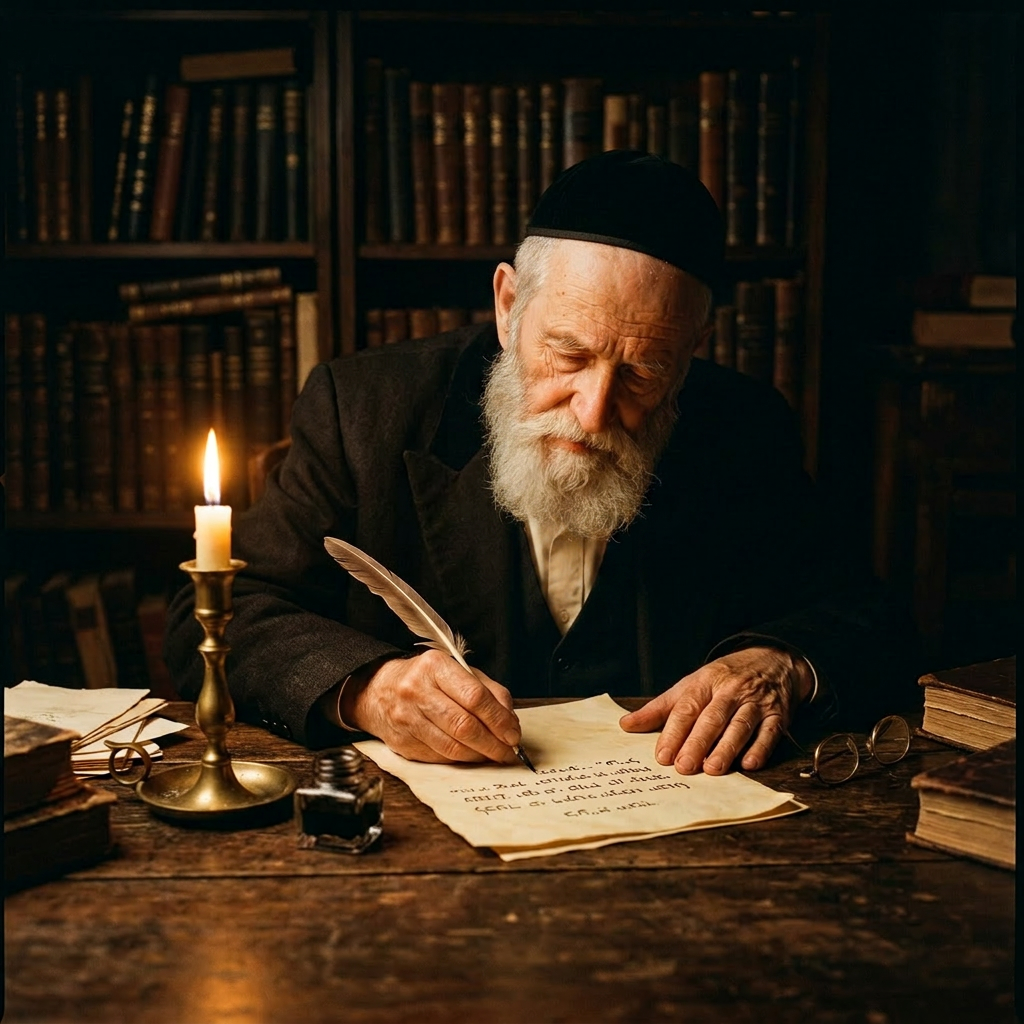
Selected Speeches, Letters, & Laments of and about the Jews in Diaspora
Curated by Rabbi Moshe Taub, and published in Ami Magazine, July 2025-Tisha b’Av Issue
——————————-
Ramban (Nachmonides, d. 1270h, after settling in Jerusalem, writing to his son a description of its ruins, circa 1263:
“I write this letter in ir hakodesh Yerushalaim. For, thanks and praise unto Hashem, I was privileged to arrive safely there in elul, and stayed till the day after Yom Kippur. Now I intend going to Chevron, to maaroshamachpelah, to daven…“But what shall I say to you concerning the country? Great is the solitude and great is its devastation…The more sacred the places, the greater their desolation. Yerushalaim is more desolate than the rest of the country: AreiYehudah more than Galil. But even still in its destruction it is a blessed land…
“[Yerushalaim] has a total of around two-thousand inhabitants, three-hundred of which are Christians who live there after escaping the sword of the Sultan.
“There are few Jews. For, after the arrival of the Tartars [Muslims], some fled while others died by the sword. There are only two brothers{!}, dyers by trade, who must purchase their ingredients from the government. There [at their shop] the minyan meets, and on Shabbos we daven at their home.
“But we encouraged them, and we succeeded in finding a vacant house that we took for a shuland built pillars of marble with a beautiful arch. For the town is without a ruler, so that whoever desires to take possession of the ruins can do so. We gave our offering towards the repairs of the house. We have sent already to Shechem to procure sifrei Torah. These had initially been brought there from Yerushalim upon the invasion of the Tartars.
“Continually people crowd into Yerushalaim ,men and women, from Damascus, Zobah[Aleppo], and from all parts of the country, to see the makom hamikdosh and to mourn there.
“May He who thought us worthy to see Yerushalaim in her desertion grant us that we witness her when rebuilt and restored, when Hashem’s glory will return to her. And you, my son, your brothers, and the whole of our family, may you all live to see the salvation of Yerushalim and the nechama of tzion.”
Director General of New Amsterdam, Peter Stuyvesant, writing to his colonial bosses of the Dutch East Company back in Amsterdam on September 22, 1654.
He composed the following letter just two weeks after the arrival of the first group of Jews to arrive to North America:
(See my book Jews of the New World for a discussion of the few Jews who preceded them, as well as a suggested genesis for Stuyvesant’s rabid antisemitism)
“…The Jews who arrived would nearly all like to remain here. But learning that they-with their customary usury and deceitful trading with the Christians-were very repugnant to the inferior magistrates…we have, for the benefit of this weak and newly developing place and the land in general, deemed it useful to require them in a friendly way to depart; praying also…that this deceitful race-such hateful enemies and blasphemers of the name of C- -be not allowed further to infect and trouble the new colony…”
This letter was given greater purchase when Domine Johannes Megapolenis, New Amsterdam’s chief minister and clergyman, composed a letter supporting such ugly sentiment, writing later, on March 18, 1655:
“Last summer some Jews came here from Holland in order to trade… they came several times to my house, weeping and bemoaning their misery…”These gdless rascals, who are of no benefit to the country, but look at everything for their own profit, may be sent away from here…”
The following diagnosis comes from David Lloyd George 1863-1945, who served as British Prime Minister (1916-1922), speaking on the cancer that is antisemitism:
“Of all the bigotries that savage the human temper there is none so unwise as the anti-Semitic. It has no basis in reason, it is not rooted in faith, it aspires to no ideal-it is just one of those dank and unwholesome weeds that grow in the morass of racial hatred.
“How utterly devoid of reason it is may be gathered from the fact that it is almost confined to nations that worship the Jewish prophets and apostles and revere the national literature of the Hebrews as the only inspired message delivered by the Deity to mankind, and whose only hope of salvation rests on the precepts and promises of the great teachers of Judaism.
“Still, in the sight of these fanatics Jews of today can do nothing right. If they are rich, they are birds of prey. If they are poor, they are vermin. If they are in favor of war, that is because they want to exploit the bloody feuds of Gentiles to their own profit. If they are anxious for peace, they are either instinctive cowards or traitors. If they give generously – and there are no more liberal givers than the Jews-they are doing it for some selfish purpose of their own. If they don’t give- then what would you expect of a Jew?
“If labor is oppressed by great capital, the greed of the Jew is held responsible. If labor revolts against capital as it did in Russia-the Jew is blamed for that also. If he lives in a strange land, he must be persecuted and pogrommed out of it. If he wants to go back to his own, he must be prevented….
The following was composed by Rav Chasdei Crescas (d. 1410), writing to the community of Avignon, on the 12th of Cheshvan/19th of October 1391.
Here he details the Spanish massacre of the summer of 1391.
Aside for the ten-of-thousands of slaughtered Jews, hy”d, this event led to the conversion of many, and was the prelude to the Spanish Inquisition, which took place one-hundred-years later.
He opens the letter by sharing how is only son was among the martyred, Hy”d:
“Among the many who sanctified the name of the Lord was my only son…If I were to tell you here all the numerous sufferings we have endured you would be dumbfounded at the thought of them.
“I will therefore set before you only in brief detail the table of our disaster set with poisonous plant and wormwood [see devarim29:17], giving you a bare recital of the facts so that you may state yourselves on the bitterness of our wormwood and drink from the wine of our grief! …
“On the day of the New Moon of the fateful month tamuz in the year 5151 [July 1391] Hashem bent the bow of the enemies against the populous community of Seville where there were between 6,000 – 7,000 heads of families, and they destroyed their gates by fire and killed in that very place a great number of people; the majority, however, changed their faith. Many of them, children as well as women, were sold to the Muslims, so that the streets occupied by Jews have become empty. Many of them, sanctifying the Holy Name, endured death…
“From there the fire spread and consumed all the cedars of Lebanon [talmidei chachamim] in the holy community of Cordova.
“And on the day of misery and punishment, on which the sufferings were intensified…in the community of Toledo…the priests and the learned were murdered.
“In that very place the rabbis, the descendants of the virtuous and excellent R. Asher of blessed memory, together with their children and pupils, publicly sanctified the Holy Name….
“On the 7th of the month av the Hashem destroyed the community of Valencia, in which there were about a thousand heads of families; about 250 men died al kiddush Hashem the others fled into the mountain, yet some changed their faith…From there the plague spread…. On rosh chodesh elul, the bloodthirsty villains came there, profaned, plundered and robbed them and left them like a net in which there are no fish. Three-hundred died al kiddush Hashem…
“On the following Shabbos Hashem poured out his fury like fire, and destroyed the community of Barcelona. The number of murdered amounted to 250 souls; the rest fled into the castle, where they were saved.
“The enemies plundered all streets inhabited by Jews and set fire to some of them. The authorities of the province, however, took no part in this; instead, they endeavored to protect the Jews with all their might. They offered food and drink to the Jews, and even set about punishing the wrongdoers, when a furious mob rose against the better classes in the country and fought against the Jews who were in the castle, with bows and missiles, and killed them in the castle itself. Amongst the many who was mikadesh shem shomayim was my only son, who was a chosson and whom I have offered as a korban without blemish; I submit to Hashem’s justice and take comfort in the thought of his [his son’s] excellent portion and his delightful lot. Amongst them were many who slaughtered themselves and others who threw themselves down from the tower and whose limbs were already broken before they had reached half-way down the tower. Many also came forth anddied al kidush Hashem in the open street. Many. Others changed their faith… Because of our many sins, there is none left in Barcelona today who still bears the name of Jew…
“In the town of Gerona, where knowledge of Torah could be found combined with humility, the Rabbis of that place publicly died al kidushHashem, and only a few changed their faith. The majority of the community escaped to the houses of the citizens…”
(Translation of Franz Kobler, A Treasury of Jewish Letters, 1953, p. 272ff)
Rav Chasdei ends by quoting from eichah “I am the man who has seen affliction by the rod of His wrath” (3:1), and with the following words of hope, some chizuk upon which we will too will conclude:
“In spite of this our eyes are directed towards the Father in heaven, that He may be merciful to us and may heal us of our wounds, and keep our feet from wavering. May this be His will, Amen.”


Leave a Reply