The Sources For Chumros/Being Machmir/Strict During The Ten Days of Repentance…and Its Possible Limitations
Rabbi Moshe Taub – September, 2026
A Minhag’s Many Shailos
“I’m not using the eruv during aseres yimei teshuva. May I still ask my wife to carry for me?”
“I’m going on a business trip during aseres yimei teshuva. They usually feed me from a local cholov stam shop. What do I do now?”
“Must I be mattir neder after assuming these aseres yimei teshuva chumros?
“If this is the appropriate path, why are we told only to take them on only for these ten days?”
“Is this not ‘arama’, playing tricks/games, with teshuva?”
These are a good sample of the common questions rabbanim receive relating to the following minhag recorded in the Shulchan Aruch:
“Even one who’s not careful regarding pas palter [during the year], during the aseresyimeiteshuva he should be careful”
Shulchan Aruch, oh”ch 603:1
To best understand this halacha, we must first disentangle a misconception.
II. A Minhag Defined
Many mistakenly define a ‘minhag’ as any action/abstention untethered to either Torah or Rabbinical halacha; the unique familial/communal customs relating to Jewish life that are source-less in our legal cannon.
However, nothing could be further from the truth. Rather, all minhagim must have a real-although minority- halachic viewpoint that is being followed or be grounded in chazal (see, e.g. shu”t Noda B’Yehudah, 2, evh’a, #79; see also Tzava Rav Yehudah Hachasid, Otzar HaPoskim edition).
This does not mean that we must first discover each-and-every minhag’s source before acting on them. Rather, that our reverence for our true minhagim allows to be confident that such sources already exist, known to their creators.
A helpful illustration would be a 1969 letter from Rav Yechezkel Grubner, famed rav of Detroit (d. 2009) to Rav Moshe Feinstein (shu”tIgros Moshe oh’c 3:3) regarding the minhag to fast for a fallen sefer Torah, R”l. Now, one may think that such a minhag is self-evidently appropriate, requiring no source. But as explained, this would be an error. Because Rav Moshe did not often research most achronim, Rav Grubner sent Rav Moshe the many distinctive sources that admorim and roshei yeshiva had marshalled over the years to back-up this minhag. Rav Moshe dissects each potential source and shows how it would affect the halacha of this minhag, finally settling on one chazal he felt was the most likely source (based on taanis 16a).
All this is not to chalila dimmish minhagim – on the contrary!
With this in mind we can briefly discuss the above famous minhag of aseresyimei teshuva, its source and possible limitations.
III. The Source
The Tur is the first to bring this minhag, in the name of his father, the Rosh. He bases it on a chazal found in the Yerushalmi (shabbos 1:3):
“Rav Chiya explicitly told Rav: “If you are able to eat ordinary food b’tahara(in a state of ritual purity) all year long, do so. But if you cannot, at least make sure to do sofor seven days out of the year.”
What ‘seven days’ was he referring to? The Ravya (Avi HaEzri; d. circa 1220) interrupted this to refer to the seven days in-between Rosh Hashana and Yom Kippur.
Based on this, the Tur concludes:
“…theminhagdeveloped inashkanazthat those not careful regardingpas goyimshould be careful during theaseres yimei teshuva”.
The Beis Yosef (Rav Yosef Karo, the author of the Shulchan Aruch) notes how Rav Chiya did not make a suggestion to Rav relating to a halachic matter, rather one of minhag. After all, there is no obligation for one to eat food b’tahara! Rather, he recommended an extra holy step for these seven days of the year.
Based on this, the Beis Yosef rejects the Tashbeitz’s concern for either hataras nedarim following Yom Kippur, or being forced to abide by these ten-day chumros for the rest of the year.
How does the Beis Yosef answer this? We will now explain…
IV. Why Bread?
The Beis Yosef goes on to explain that this is why the Tur chose, out of all chumros, to be machmir during aseres yimei teshuva regarding, specifically, pas akum.
Without getting too in the weeds, although the mishneh teaches us that such bread was banned (avoda zara 35b), when it comes to non-Jewish bakeries/stores it is not so clear if this decree was ever rescinded (see Tosfos s.v. bklal). The Rosh (2:23) explains that since bread is fundamental for life, we were not able to abide by such a decree, at least fully (see Yerushalmi, avoda zara, 2:8).
To what extent has it been nullified?
While pas akum (privately baked goods/not for sale) are almost never allowed (y”d 112:8),pas palter (sold baked goods) is based on minhag. While the Rema allows buying from a non-Jewish baker, the Shulchan Aruch only allows it if there’s no Jewish alternative and also, according to some, when the pas palter options are better (112:2-5).
This stringent minhag of the Shulchan Aruch is not active if one needs to travel a great distance to attain the pas yisroel (112:8).
Now we understand the Beis Yosef’s response to the Tashbeitz:
“The concern for now having to keep this chumra the rest of the year is not a tayna (argument) as pas palter’s prohibited status is not at all clear, rather it’s only a minhag, and therefore when he abstains his mind is not to continue in this practice…”.
V. Application
Based on this the Mishneh Berrura, the Magen Avarham and others limit the aseres yimei teshuva minhag to be machmir not to surpass the actual halachos of pas palter. Meaning, if one is stuck somewhere without access to pas yisroel, he may eat pas palter. This is because the chumrah can’t go beyond the minhag as recorded by its laws where even the stringent view allows pas palter in such a case!
The Aruch Hashulchan takes this all one step further (603:2), stating that the aseres yimei teshuvachumros are only regarding minhagim, but not actual halachic debates of interpretation among the poskim. Based onhis view, such ten-day chumros would not relate to issues like cholov yisroel when one is following their posek. Whereas the avoidance of using any city eiruv during these days would be an acceptable temporary chumra, as poskim indeed record a minhag of being machmir on all eiruvin.
Rav Shmuel Kamanetzky goes one step further, arguing that this chumraminhag of aseres yimei teshuva is limited only to the halachos of pas yisroel (Kovetz Halachos, p.268, note #3).
Based on the Chayay Adam (Chachmas Adam 25:2), bread is essential to life and is therefore used as a tool of awakening toward general -and more longstanding- growth and change.
While I have always paskened to only be machmir during these days on ‘minhag halachos’, others disagree. Minchas Yaakov (klal 75:1) as well as the Piskei Teshuvos imply that one can apply these temporary chumros to any halacha (the latter states that hataras nedarim would still not be needed. His proof, however, is difficult to fathom, as he derives it from the same Beis Yosef above who stressed that this is unique to minhagim).
VI. Trickery?
There are many explanations of this minhag and how it is not a contradiction if we know we will not continue.
Due to space, bl”n we will save this question for next year. However, Iwill leave the reader with one approach to take into this holy week. The Alef L’Magen brings from the Ramak: “…this is appropriate even if we do not continue with this middas chassidus afterward. This is because if Hashem is acting toward us during this time with chassidus, is it not appropriate if do the same…”.
May we take advantage of Hashem’s extra rachamaim during this time, while being halachtav bdrachav -mirroring His actions. Both toqard halacha and toward eachother.
BY: Rabbi Moshe Taub (Written in 2000, a few years before Rav Singer’s passing)
This is an Elul story.
This is a Rosh Hashanah story.
This is a story of Jewish survival.
It is a story of a beracha from the Frideker Rebbe of Chabad;
The words of Torah from Rav Moshe Feinstein;
And, a promise made a century ago to Rav Aaron Kotler.
It is now 5780-1, and these Berachos and promises are now being fulfilled;
And they can grow still ever more…
Personal Preamble
Elul always reminds me of Rav Shlomo Singer.
It is no secret that one of the best and sharpest yeshivashiurim given today is Rav Meir Stern’s brilliant shiur in Yeshiva Gedolah of Passaic.
Aside from the bnei hayeshiva and the yungeleit that attended his daily shiur was one Rav Singer, a retired individual living in Passaic.
For two years –some 20 years ago –I sat mere feet from him, but we never spoke until this summer.
Like the nephews of Rabbi Yochanan Ben Gudgada (see Chagiga 3) who would make sure to sit in front of Rebbe Yehudah Hanassi, Rav Shlomo Singer would sit almost directly in front of the rosh yeshiva with a tape recorder and intently focus on the words being taught.
I was told he was a local retired chazzan, who went by ‘Cantor’ Singer.
I assumed he was a baal teshuva, or someone without a classic yeshiva background who upon retirement asked Rav Stern to attend his shiurim.
Looking back, that (self) explanation made little sense. Young men begged and clawed to get in to this shiur, and even then they had trouble fully understanding it until after a number of reviews.
But Rav Singer did understand the shiur.
How do I know that?
You see, as the zman went on I witnessed this ‘Cantor Singer
do something so different, so revolutionary, that I can honestly say that it has inspired how I act today as a person and as a rav.
When I first saw him do this it blew-my-mind.
Rav Singer was involved in kiruv rechokim, and he has had the privilege of bringing back many to the fold.
But here is what was inimitable: while other kiruv workers give lectures on light topics, or subjects that they think will draw people inside a shul, regardless whether it’s misleading/misinformed or not (‘Kabbala in the 21st Century’, is always popular), he would invite these unaffiliated men inside one of the most prestigious yeshivos in the world and give a class on…Rav Meir Stern’s shiur!
That’s right! He would stand before men who never saw the inside of a chumash – let alone a gemara – and first slowly and carefully explain the gemara under discussion, go-over the points of Rashi or Tosfos or any other rishon that will be needed to understand what was to come.
Then, slowly and painstakingly he would pierce it, drawing their attention to the apparent inconsistencies or chakiros, and finally penetrate the sugya and tie it all together in a bow with the rosh yeshiva’s analysis and explanation of the pertinent achronim.
Rav Chaims; Reb Elchanans; The Ketzos vs. the Nesivos; Rav Barush Ber, etc., nothing real-and-true was off the table.
And, he was successful – he made people frum this way!!!
It was a lesson that while the not-yet-frum may not know a lot of Torah, we err when we treat them as a remedial group.
Years ago, I received a letter from a chashuveh rosh kollel. “I was passing through Buffalo and stopped into your shul for Mincha and Maariv. When you spoke in-between, you talked about deep halachik topics that, while interesting, were likely above the heads of your audience, and not what they needed to hear” he wrote.
Respectfully, and while I understood where he was coming from, he could not have been more wrong. He never saw Rav Singer in action.
Aside for the fact that every member there that night was already frum, even if this rosh kollel assumed they did not have a yeshiva education, they too can understand a ‘Rav Chaim’, they too can see the intellectual marvel of chochmas haTorah. Why should we deprive them of the very thing that gives us the most simchas hachaim – Simchas Torah?!
Why not explain the reason behind the psak? Why not challenge them?
This brings me to Elul. Throughout the year we convince ourselves that we are not at ‘that’ level. We see others, or read about others whose ways are inspiring and the kinas soferim, a healthy jealousy and pining, begins to stir within us.
Elul is when we all attend -metaphorically speaking – Rav Singer’s class. When we all walk into Passaic Yeshiva, don one of those silk-like yarmulkas found in a basket and sit and bask at who we can, one day, become.
‘Taylor’ed Beginnings
R’ Shlomo Singer comes from Torah royalty.
His father, Rav Dovid Yehudah Singer, was a rav in Taylor, Pennsylvania where he sought for many years to spread yiddeshkiet in the early part of the 20th century.
He would soon move his family to Scranton and open a sefarim printing company.
He was a known talmudchacham raising frum children in America (not so common in those days, sadly), and so one day he received a plea from Rav Meir Greenberg.
Rav Meir Greenberg was an emissary of the friedekerrebbe of Chabad. Rav Meir was a massive talmudchacham, and had spent years learning under Rav Shlomo Heiman, and received semicha from Rav Moshe Feinstein.
Rav Meir would later become the rosh yeshiva of the central Chabad yeshiva of Paterson, now in Morristown.
I had the zechus to have met Rav Meir Greenberg on many occasions before his passing. He was a chavrusah with both Rav Shustel and Rav Shisgal zecher tzadikim l’breacha (their nickname in yeshiva was ‘the three musketeers’).
Rav Meir’s son, Rav Heshel Greenberg, a gaon in his own right, has been a rav in Buffalo for many decades, and his father Rav Meir lived with him until his passing. I had the zechus to talk to Rav Meir in learning, and even see his notes on the Chidushei Rav Akiva Eiger, and ask his about the time he received a psak from Rav Menachem Zembah hy’d (alas, I will have to share more about him in another article, iy’H)
In any event, Rav Meir called Rav Singer to plead with him to bring his family and children to New York. Spreading Torah is vital, but now he must make sure his children themselves would become bnei Torah. Before we re-build Torah, we first need bnei Torah!
And so, Rav Singer senior sprung into action, and with no money brought his family to the Lower East Side.
Young Shlomo Zalman was sent to Crown Heights to learn –after all it was the rebbe who had reached out to save them and have them raised as bnei Torah.
Rav Singer recently related to me, “I can still remember bringing the rebbe milk in his study. When I walked in their it was like walking into ganeden! Not just because of the kedusha in the air, but in the rebbe’s smile”
Little Shlomo Zalman’s brother had one of the first Bar Mitzvah’s to ever take place in 770.
“I can still remember being brought with my brother to the rebbe for a beracha. ‘Be a yoreishomyaim and grow in gadlus b’Torah!’ the rebbe said”
It was only a matter of time that young Shlomo Zalman would take advantage of his living location. After spending some time in RJJ, he went to Mesivta Tifferes Yerushalaim, led by Rav Moshe Feinstein, mere blocks from his house.
And so, together with a young Jackie Mason (“Jackie’s father was one of gedolim of the last generation” Rav Singer shared with me) enrolled to learn under Rav Moshe.
“Rav Moshe would always ask Yaakov Moshe (Jackie) to emcee events. Rav Moshe loved to see the talmidim happy and laughing”, he shared.
During his time by Rav Moshe Fenstein, he learnt the power of middos tovos and hasmada. When Rav Singer contracted pneumonia, Rav Moshe traveled aline to his house to visit in person! And as for Rav Moshe’s legendary hasmada, Rav Singer –being close friends with Rav Reuvein, would from time-to-time sleep over in the Feinstein’s apartment. To get to the bathroom in the middle of the night, one had to pass by Rav Moshe’s room where he learnt. Once, in the middle of the night he looked in and saw Rav Moshe learning, in a chair without a back, and with his feet in a bucket of ice so he would be able to stay up!
While continually growing in his own learning, he also kept hearing about this ‘Ari Shel Torah –Lion of Torah’, by the name of Rav Aaron Kotler.
Rav Aaron was a legend of Torah even while still in Europe, and his arrival to America was a watershed moment in Jewish history.
“I wanted to meet him, to see him”.
And one day he got his chance.
Rav Moshe and the entire yeshiva were heading to Boro Park to celebrate in the siyum of another yeshiva.
As Rav Shlomo Zalman was leaving, his friend tugged at his sleeve. “Shlomo! You wanted to meet the Ari Shel Torah? Well, he is right over there waiting for a taxi!”
They ran toward Rav Aaron, grabbed his suitcase, hailed a cab for him, and escorted him into the taxi.
The destination of Rav Aaron mattered little to these two yeshivabachurim; Wherever Rav Aaron was heading, they would follow.
“As soon as I closed the door, and the taxi drove off, I thought to myself, ‘What have I done?! What have I gotten myself into?! He will talk to me in learning! He will see I am nobody in Torah! But he never did, You know why? Because he didn’t want to embarrass or hurt me. Instead, Rav Aaron only asked me personal and sweet questions about my life. And, when he arrived at his destination, he gave a tip to the can driver like you would not believe!”
“So when did you go learn by him?” I asked.
“The next day”!
The Lion Roars
Rav Singer was trying to explain to me who Rav Aaron was.
“Rav Aaron would clean your house, he would polish your shoes, if it meant you would come learn in yeshiva. He was fighting for the very survival of Torah!”
I’ve spoken to Rav Singer many times in preparation for this article, and each time he shares a different event to capture Rav Aaron’s milchama for Torah in America.
“Once, I was in his home when a cousin was mentioned. ‘Where does he go to yeshiva?’ asked Rav Aaron. ‘He doesn’t. He is going to law school in the fall’, I answered. Rav Aaron then asked me to dial his number, and as soon as he came on the phone Rav Aaron quickly grabbed the phone from me. ‘You are coming to yeshiva!’ Rav Aaron ordered into the phone!”!
Each time, another story to illustrate Rav Ahron’s passion for American Torah growth.
In fact, just last month, the OU’s Jewish Action published an interview with Rabbi Berel Wein. He quoted Rav Soloveitchick who told Rabbi Wein that the students he had in the later years were much more proficient in learning than the early days of YU. Rav Soloveitchick said this was all due to Rav Aaron Kotler’s long fight for classic limud Torah in America! (Jewish Action, Fall 5781, p. 58)
Rabbi Singer continued:
“I saw with my own eyes the assimilation at that time. When I first came to Passaic there were ten frum families I saw growing up men with longa burds (long beards) whose kids intermarried, Rachamanal’tzlan!
“Rav Aaron had to ‘kidnap’ people to come to his yeshiva. But he was fighting for our survival. He killed himself! And for what? Look around! Find me a major city without a kollel today!”
Mishnas Rav Singer
While learning in BMG –which at the times had about one-hunded students, everyone would struggle to understand the breadth and depth of Rav Aaron’s shiurim.
Together with Rav Shneur Kotler, Rav Shlomo Singer got a hold of a reel-to-reel recorder, created a surreptitious hole in the ceiling and lowered a microphone.
For some time he recorded the rosh yeshiva’s shiurim, allowing bachurim and yungeleit the amazing opportunity to hear it again and again, until they ‘got it’.
There was one problem. How will they break this news to the roshyeshiva? Perhaps he didn’t want these shiurim recorded.
So, a plan was set. When Purim came around, one of the bachurim went up to a shtender during the yeshiva’s seudah. With Rav Aaron in attendance, this bochur was to give over a drasha or shiur imitating the style and speech patterns of Rav Aaron, all in good humor. What Rav Aaron –and most others- didn’t know, however, is that instead of speaking, they would simply play a recording of one of the secretly taped shiurim with this bachur simply mimicking the gestures of Rav Aaron.
The bachor stood by the shtender and began to ‘speak’. Rav Aaron sat and listened and… was enjoying the Torah! This was not Purim Torah, this was deep stuff! Keep in mind, such recordings were not common in those days, and coming from Kletzk, this technology was not on Rav Aaron’s mind.
Rav Aaron was nodding in agreement and enjoying the Torah, when suddenly it dawned on him that he was listening to himself deliver a shiur!
Rav Aaron put everything together, and did not get upset that his most precious Torah was being recordered. Rather, he made them promise to keep these tapes safe. Today, it is these reel-to-reel tapes that are still utilized by BMG in their production of Rav Aaron’s writings in Mishnas Rav Aaron!
A Promise To Rav Aaron
When Rav Singer was preparing to leave Lakewood, Rav Aaron asked him, “Will you open a yeshiva?”
“No” said Rav Singer.
“Maybe you will enter the rabbinate”
“That too is not for me”, he honestly responded
“Well, what will you do?”
“I will be a chazzan”
“A Chazzan! You can sing! And you never sang for me and the yeshiva!?”
Then Rav Aaron commanded the following: “Wherever you go, whatever shul you work for, you must work to turn that shul into a yeshiva! No balla buss is below learning deeply, with chaburos, in depth b’iyun rabba. It is not enough to make them shomer Shabbos. They must know how to delve into the amkusshel Torah (the truest de;th and brilliance of Torah)!”
“I promised my rebbe” said Rav Singer, now crying. “I promised me rebbe! And forty years ago is when the yeshiva I have today began.”
Rav Singer continued sharing, “I want you to know, this was not my rebbe’s message unique just to me. Rather he told this to everyone who went into rabbanus: ‘A Shul must be a yeshiva! A rav must be a a rosh yeshiva!’”
Rav Singer accomplished a lot in Adas Israel as cantor. This includes serving as the menahel and opening of a Hebrew Day School, under the guidance of Rav Moshe. There he taught many.
“I didn’t care to teach them ‘Bar Mitzvah’ laining and a speech –and I am a chazzan and could have taught them this! Rather I focused on amkus shel torah!Now, so many of these students are in eretz yisoel. Many of these boys came from deeply conservative homes.”
It was over forty years ago is when Rav Singer invited a balla buss Bruce Goldberg to his house on Shabbos for some kugel, cholent and in-depth Gemara.
Soon, the entire dining table was filled with men learning the depth of the yamhatalmud. Then it stretched into the kitchen.
Soon, there were so many attendees; they had to move to his garage.
Eventually, Rav Meir Stern urged Rav Singer to use the yeshiva.
This was close to 25 years ago, when I first saw Rav Singer.
Soon, he realized that he needed his own building.
He told his late wife, “We need a place where people from all backgrounds could attend shiurim and give real chaburos, say chiddushim in Torah, experience the beauty of real learning, each on their own level. In-depth learning for balla battim”.
She got nervous. “How will we pay for the mortgage?”
“But we both understood they that Hashem had a lot of money”
Rebbetzin Ita Singer, was niftar just a few years ago. She was the emotional and financial support for tis yeshiva throughout its early and challenging phases. She also urged a focus on women who need classes and shiurim in depth.
“The address of our new, and first home, was street number 441 Passaic Avenue”, exclaimed Rav Singer.
I started to quickly think what the significance of this number was.
Rav Singer explained, “441 is gematriaemes! How amazing is that!”
He Just Needs a Gemara
Rav Singer has the secret to kiruv: He truly loves every Jew. It drips off of him.
One of his children shared an amazing story. Growing up, their Shabbos table was always graced by Jews of all paths. “A yid is always special” Rav Singer would say.
Once, the Sukkos after 9/11, a young man, maybe twenty years old, arrived for the seudah in their sukkah.
The world was still on edge, and this young man was a committed Leftist. He blamed democracy, Israel, America, etc. for these horrific events, focusing on their ‘treatment’ of Arabs as the cause for their own chosen actions.
“I had enough” one daughter told me. “There has to be limits to can come to our home. It was so soon after 9/11, I simply could not bare taking any more of this man’s childlike view of the world”.
“My father told me, ‘You are wrong. His values may be corrupt but they come from good middos. It is his pinteleh yid for rachmanus that is behind his Leftism.
“You see”, explained Rav Singer, “All he needs is a gemara, to be trained in learning, and he will be an amazing Jew!”
That young man is now married and living in Bnei Brak!!
This love for all Jews, and for their potential, is seen in the shul/yeshiva still today.
VII. Ner Boruch/PTI (Passaic Torah Institute)
Today, Rav Singer has a new beautiful building on the way (still at ‘441’), with over 200 balla battim from all backgrounds attending shiurim and learning b’chavrusah per week.
Sure, there is davening, and shaloshseudos on Shabbos, but this shul is the fulfillment of a dream – it is also a yeshiva!
In-depth shiurim are given for different all levels of backgrounds. The attendees prepare chaburos, give over their own chiddushim.
The only difference between their learning style and a yeshiva is that of age.
Rav Baruch Bodenheim –one of Rav Singer’s son-in-laws –is the accsosiate rosh yeshiva at PTI, along with a group of talented maggideishiurim.
“I want you to know” says Rav Singer, “This is not created just for those new to Torah. What will be of the kollelyungerman who leaves the walls of the beismidrash to go to work? What? He will learn the daf? That’s great, but what of the amkus of Torah, its true depth and simcha?!”
He continued, “When I would speak to Rav Yaakov Kamanetzky about my idea, he too would scream ‘Lomdus! Its all about lomdus!’”
As his rebbetzin urged, Rav Singer also has a slew of classes and shiurim for women of all backgrounds, housed in a separate place. This women’s learning program is called Ateres Beracha/Nvei TTI.
I could spend the rest of the article speaking about Ner Baruch/PTI, but this is not what Rav Singer wants.
“I am 86 years old. I have to spread the message that every shul can be a yeshiva! We have to share with the world the sweetness of amkus haTorah! This is what I promised my rebbe, Rav Aaron.”
On this last point, a video spread around after this past year’s Tisha B’Av.
It was the renowned rav Rav Zev Leff speaking to his shul by kinnos.
“A rav in Pasaaic, Rav Shlomo Singer, he has a shul where the balla battim learn, but not just stam learning daf yomi, or learning something peripheral, but learning mammashb’omek. Ad kdei kach, that these balla battim write chaburos! And, they are mechedesh chiddushim!
“And he feels that this is something that is crucial. Torah b’amkus is not just for bneihayeshiva, but every shul should be like a yeshiva.
“I heard this not just from him, but from Rav Mordechai Schapiro zt’l, that Rav Aaron said every shul should be a yeshiva.
“A shul should be a yeshiva!”
I should here make the obvious point, that all of the above is not, chalilla, to disparage dafhayomi (which I myself do), rather to challenge ourselves if in addition to that general crucial knowledge, if we need to go deeper.
The Dream
Rav Singer shared with me, “Many years ago, when Torah Umesroah was successful in placing Day Schools all across the country, they held a special event in Lakewood.
“Principals from North Carolina, Tennessee, and all over the country came. While the goal was to give a mazaltov and mach ah shehechiyanu, the principles arriving looked despondent.
“I mean, put yourself in their shoes! They were dealing largely with families not interested in Torah-true Judaism. It was an uphill battle. They would teach the essentials and then see these children go off to public schools or college and forget their yiddeshkiet. It was a painful job to have back then.
[What follows is Rav Singer’s recounting of the speech]
“But Rav spoke last, and he stole the show. I still have this recording.
“Rav Moshe asked, why do we bless our children to be like Efraim and Menashe?
“Perhaps you will say that its because they were raised in Torah in the depth of tumas mitzriam…and that is true, but its also a lie! Our children cant reach that level. We can try they becomes a Rebbe Akiva, an Abayay, but Efraim and Menashe?
“Rabbossei, we bless our children this way, even though its impossible, even though it is but a guzmah (an exaggerated desire). Because to succeed in chinuch we have to compare them to the best there ever was. If you wish to succeed in chinuch you can just teach them the essentials, but rather to teach them as if they could become the next Menasheh and Efraim!
“And if you wonder, how indeed was Yosef so successful? It is because he taught them from Yaakov, the personification of pure, unbridled, unfiltered, unwashed-down Torah. This is how we succeed in chinuch! Hold them to the highest potential!”
Rav Singer said that every menahel walked out of that speech with a new mission: they will not shy-away from teaching youngsters amkushaTorah.
“Look at Passaic today. So many mosdos. How did this happen? I remember when it was a midbar! I came for parnasa, and to fulffil the promise to my rebbe. I would never have dreamed Passaic would be what it is today.”
Rav Singer, paused, and then again began to cry.
“Yes, there have a lot of chashuveh and hard working rabbanim, but it all could not have happened if Rav Meir Stern didn’t walk into to town so many years ago with ten talmidim!
“AmkushaTorah is the only future cities have for growth. And now we have baruch Hashem reached the point in American Jewry where it need not be reserved just for yeshivaleit!”
In other words, and as Rav Moshe expressed in that speech, for a school, city, kehilla to thrive they must have the highest, even impossible to reach, goals. They must be able to witness Torah at its deepest levels. Without that ingredient –without a kollel or a yeshiva, and without a roshyeshiva or a rosh kollel for their children to look up to –it is hard to grow a town.
This brought to mind growing up in Toronto, and the influence of Rav Shlomo Miller and Rav Hirschman’s Kollel Avrechim –founded by Lakewood –and its mark on the city of my youth, as well.
Rav Singer concluded our conversation. “I am just a talmud trying to fulfill the promise to his rosh yeshiva. Help me spread the word, help me share how successful this can be.
“Every shul can become a yeshiva!”
Rav Singer’s dream –and sole reason for agreeing to this interview –is for this vision to spread.
“Every town needs a real yeshiva for balla battim. Not only will one make more people frum by utilizing this derecho, but the bnei yeshiva who are working are thirsting for this. There are local talmidei chachamim in every town who can use extra parnassa, who have the ability to give high-end shiurim, to challenge these older students. They will then give chaburos, write chiddushim. Shuls will publish sefarim!”
“My rebbe wanted this so much. I saw its success in Passaic, and I know it can happen everywhere.
“Many shuls already have a few in-depth shiurim. But this has to be a program, a night seder, where the balla battim too give-over Torah.
“This can change the Torah world!”
Rav Malkiel Kotler, Rosh Yeshiva of Beth Medresh Govoha of Lakewood, addrssing PTI
As Rav Bodenheim shared with me, “It is not just these ballabattim that grow, but time-after-time their children who watch them come home arguing over a Rav Baruch Ber become superstar talmidiechachaim and geonim. We literally see the fruits ever day”
This means that troughout davening, kids will mount the few steps to the podium and, depending on their age, will either stick out their hand, request a candy, or say ‘Good Shabbos’.
If they approach during leining or kaddish I teach them to wait and read along with me, training them in the importance of silence during teffila.
But that is not my central motive in embracing this role.
Once a child is of speaking age, they know that they will only get a candy if they name the parshah, leading to some tots yelling out ‘T’tzaveh!’ long before they reach me!
As they get older, my ‘candy-interrogation’ become more age-appropriate, where I request they share what the parshah about, along with more detailed information and questions.
While this is a great way to get to know the kids, this too is not why I chose this role.
Rather, the two main reasons are to create a girsa d’yankusah.
I. Chibuv
For one, these are dangerous times. These same children will soon grow into teenagers. The day may come when they will be tested, when two paths will appear before them. Temptation or technology, friends or fascination, may entice one path. Such luring pulls require we implant now equal competitive future forces.
Should such moments of trial arise, few teenagers will be thinking of a drasha or a rav’s distant words of inspiration.
What their mind may drift toward is true feelings of chibuv/love. So, while the rav may not come to mind, the ‘Candyman’ might.
In our day, an earnest sense of affection toward the rav of one’s youth is indispensable.
A guest once challenged me, “It’s very nice and all, but is this role appropriate for a rav? Shouldn’t a rav present himself more reserved and distant from such petty matters? Teaching children that a proposed talmud chacham be shown extra dignity is also chinuch!”
I explained by sharing the purpose of Moshe rabbeinu and Dovid hamelech having served as shepherds. Chazal explain that in that role they had to care for these creatures to the point of cleaning up their dung. This infused them with a model for leadership, training them in the fact that if an act is permissible and purposeful then it is not seen as ‘beneath one’s dignity’.
And purposeful this is.
When I was in high school, I heard that a camp friend suddenly left his yeshiva. What happened to him after, and his state of religiosity, becoming somewhat of a mystery. No one in my friend group knew where he was living, let alone how he was living.
Several years later, I bumped into him by chance in Buffalo. His head was shaved clean, he wasn’t wearing a yarmulka, and the rest of his look seemed to confirm my worst fears.
After exchanging pleasantries -and without prompt -he opened up about his childhood – one stained with severe trauma. It went unspoken, but this no-doubt offered a glimpse into his stung spirit.
He then shared something unbelievable:
“While I wouldn’t say I’m frum, you should know that I’ve never once been michalel Shabbos on a Torah level all of these years”.
That comment led to many questions, however in these situations one best keeps quiet, allowing the speaker to decide what he wishes to disclose.
After I nodded alone, and became oddly silent, he shared an explanation.
When he was a young boy, about seven or eight, his private trauma was unfolding, a rav was asked to consult, Rav Gedalia Felder, tz”l.
He was little at the time and his awe of the rav and his fear of sharing, of ‘taking sides’, caused him to cry in response to the rav’s first question.
“I was ashamed to be crying, thinking this was not the time or place.
“But as I looked up, I saw that the rav was also crying…in reaction to my pain.
“This only made me cry more.
“This in turn made the rav cry more.
“At the end of the meeting all one could observe was two people crying – a child in agony, and a rav aching from that child’s pain.
“That memory is so fresh, and no matter what I’ve done, no matter where I’ve been, no matter how much I’ve ‘fallen’, whenever I am about to break Shabbos I think of Rav Felder’s tears. I don’t know if I still believe in Yiddishkeit, but I still believe in him because he believed in me”.
II. Approachable
This leads to my second reason for serving as the Candyman.
Not only do I want the children to feel I care about them, I also want them to know I am accessible.
If they learn to approach me when they are young, it will be far easier when they grow up.
For this same reason, on my halacha exams at Shevach High School in Queens, I offer an extra credit at the end of every exam -told to them in advance – that each share a shailah they asked their rav, or any rav who is not related to them and who does not work at the school. I urge this because, Sadly, too often, people are too shy or too afraid or feel their question is not important enough to call a rabbi.
I often share with my wife:
“I’ve rarely been called on a taanis by someone who feels sick yet for whom the psak is that they must continue Fasting.
“This is because most people are too shy, afraid, embarrassed, or reticent to even ask the shailah.
“Those that are sick enough to actually pick up the phone probably should have done so hours ago!”
In our generation especially, a communal rav being perceived as aloof can be perilous.
Being approachable doesn’t mean the rav can’t present himself with authority. Rather, that this authoritative presence is not to be kept on a mantle, untouched by the masses.
The day may come where this young boy or girl is tested, and that fleeting thought of ‘Should I call my rav?’ will be quickly dashed by the sword of unapproachability.
There is an old saying that as much as a rav is annoyed by getting a call during dinner, he is more annoyed not getting a call during dinner.
If one wishes to enjoy the rewards that come with rabbanus, he must make the sacrifices too -and let people know he is accessible.
Such is our task in this role.
In truth, it is little sacrifice if done out of love – and doesn’t hold a candle to what true gedolim must endure.
As the Rambam expressed to his student:
“G-d knows that in order to write this to you I have escaped to a secluded spot, where people would not think to find me, sometimes leaning for support against the wall, sometimes lying down on account of my excessive weakness, for I have grown old and feeble…I cannot but say how greatly your visit would delight me…Yet …Do not expect to be able to confer with me…for even one hour either by day or by night, for the following is my daily occupation [Rambam describes his heavy palace workload, as well as its great travel distance]…Then I am almost dying with hunger. I find the antechamber filled with people, both Jews and Gentiles, nobles and common people, judges and bailiffs, friends and foes — a mixed multitude, who await the time of my return. I dismount from my animal, wash my hands, go forth to my patients, and entreat them to bear with me while I partake of some slight refreshment, the only meal I take in the twenty-four hours. Then I attend to my patients, write prescriptions for their various ailments. Patients go in and out until nightfall, and sometimes even, I solemnly assure you, until two hours and more in the night. I converse and prescribe for them while lying down from sheer fatigue, and when night falls, I am so exhausted that I can scarcely speak. In consequence of this, no Israelite can have any private interview with me, except on the Shabbath. On that day the whole congregation, or at least the majority of the members, come unto me after the morning service, when I instruct them as to their proceedings during the whole week; we study together a little until noon, when they depart. Some of them return, and read with me after the afternoon service until evening prayers. In this manner I spend that day. I have here related to you only a part of what you would see if you were to visit me…”
Who Invented, Named,& Separated the “Parshios HaShevua“?
Visiting Eretz Yisroel When They Are A Week Ahead
Why Do We Wait So Long To Re-Align With Eretz Yisroel?
Why Is Our Siyum of Our Yearly Cycle On Shemini Atzeres and Not On Shavuos?
Rabbi Moshe Taub
A Merger Of Several Articles Published In AMI MAGAZINE in 2016, 2019, & 2026
I. Parsha vs. Parsha
A young member of my shul approached me during the simchas torah hakafos one year and asked, “Wouldn’t Shavuos be a more apt time to complete our siyum of the Torah?”
An adult member overheard the question, and I could only guess he had been overwhelmed with the simcha of the day when he offered: “It’s because today is SimchasTorah! How could we not finish now! Imagine SimchasTorah without a siyum of the Torah!”
As soon as he completed his ‘answer’, he realized he was in no state to offer teirutzim.
Indeed, Simchas Torah is often misunderstood.
The history behind how we came to commemorate the completion of the Torah on (the second day of) shemini atzeres is fascinating, beguiling, and furnishes us with a unique opportunity to appreciate certain rudimentary arrangements of our Torah lives.
How old is this minhag of Simchas Torah?
Is not this siyum haTorah interfering with our separate Torah obligation of simchas yom tov (based on the rule, ‘ein ma’arvin simcha b’simcha‘, we don’t intermingle certain simchos)?
Why don’t we complete the Torah on a Shabbos, the day we had leined it until now?
Most saliently, who divided our parshios of the week into the names and partitions with which we are so familiar, and through which this special siyum was created?
I once published a lengthy post titled Chapter and Verse, where we explained the halachic and hashkafic the Christian-introduced divisions of the ‘chapters/perakim’, as well as their dividing of sifreimelachim, shmuel, divrei hayamim and ezra, each, into two separate books; even naming the ‘second part’ of Ezra into a newly-named sefer called ‘nechemia’ (Cf. Sanhedrin 93b where chazal explain why Nechemia was not to have a sefer named for him!).
Our mesorah already gave us divisions of our own, called ‘parshios’. These are not to be confused with what we colloquially call the ‘parshas hashavuah’. Rather, these mesorah ‘parshios’ are breaks/spaces found inside sifrei Torah and come to represent a new subject, event, or simply the pause Moshe was given when being taught by Hashem (see Rashi to Vayikra 1:1 with Toras Kohanim; neviim and kesuvim also have such breaks). There are two types of such breaks/spaces in Torah: pesuchos (represented in most standard chumashim with a large letter pei), and setumos (represented in chumashim with a large letter samech).
A Stumah: when the new section continues on the same line as the last, but with a space (of nine-letters);
A Pesucha: where the new parsha begins on a new line, but with a space of the same size.
These parshios are significant, and a sefer Torah without them, or where they are placed incorrectly, would be pasul.
Many are already aware of this, and that our parshios hashavuah have nothing to do with the halachic concept of ‘parshios‘. In another post, I discussed the weeks known as ‘Shovavim’ (from shemos–mishpatim) and shared that the parshios hashavuah became universally adopted – along with a yearly Simchas Torah—only about 800 years ago (see megillah 29b and sofrim 16:10, with Rambam, hilchos tefillah 13:1).
Furthermore, Rav Shlomo Luria (d. 1573) shares that for those in eretz yisroel who were observing a triennial cycle, Simchas Torah would be celebrated once every three-and-a-half years, and that this siyum would veer from city-to-city! (Yam Shel Shlomo, end of bava kama, kuntrus ‘chilukei denim bein bnei e’y u’vein bnei bavel’. See also Otzar Plios HaTorah, emor, p. 931)
II. Blunders & Parsha Names
Here is a ubiquitous example of how confusion regarding the above may even lead to real blunders:
A well-known Rashi – and a favorite of children’s parsha sheets – is found in the beginning of ‘parshas’ Yisro. Rashi quotes a chazal listing Yisro’s many names and their meanings.
“Yeser [to add]: as Yisro added a parsha of the Torah” (shemos, 18:1)
This is often erroneously repeated as meaning that Yisro received the zechus to have this parshas hashavua named for him –parshas ‘Yisro’!
This is a misconception. Rather, what chazal meant, is that Yisro’s urging of Moshe to set up court systems ‘shaped’ a new parsha/section/inyan/subject inside the Torah -along with its own breaks before and after it (setuma/pesucha), i.e. the ‘parsha’ of courts!
Rebbeim certainly teach this accurately, yet some misunderstand or misremember their words, when in truth it is unlikely that Rashi even ever heard of ‘Parshas Yisro’ as we know it!
There are more examples, but I trust that the reader now appreciates that this distinction between parsha and parsha is substantial.
IIa. Parsha ‘Names’
Some may now assume the other extreme: the parshios hashavuah, while wisely divided so as to complete the Torah once a year, are capricious in nature.
Rav Tzadok Hakohen teaches that just as our parents gave us personal names – which form/describe our essence -so too the names we have given and accepted for the weekly parshios carry their essence (Resisei Layla, ois 44).
In fact, the Chasam Sofer (Drashos, Sukkos, p.52; likuttim Tehillim, p. 157) teaches that one should look at the parshas hashevua to find the answer to personal life-questions. This is especially true of the aliya one may receive (see ‘Melech B’yofiuv’ p. 5). Amazingly, Rav Yair Chayim Bacharach (d. 1702) named his famous sefer ‘Chavos Yair’ based on an aliyah he received (Bamidbar, 32:41)!
Metzorah, mattos, shemeni and more are not named for their first word (‘v’elah shemos’ is indeed how Rav Saadia Gaon referred to shemos), and these accepted names are to be deemed kodosh.
While we do find some names of our current weekly parshios already in chazal (e.g. ‘kedoshim’ – see zevachim 28a), most names evolved over centuries, many in the days of the geonim (Rav Chaim Kinievsky, Derech Sicha, p. 3; see Yesodei Yeshurin, 4:363ff).
In fact, we used to divide parshas mishpatim into two parshios on certain years, the latter half with its own name (see Sefer HaChinuch).
There are some who posit, that our present-day parshios hashevuah were passed down from Moshe or Ezra, and were always seen as the optimal way to read the Torah (see Ohr Zarua, hilchos shabbos, siman 45, Meiri, Kiryas Sefer, maamer 5 perek 1, and Tanchuma to Ki Sisa 3; see also sefer ‘Toldos Simchas Torah’).
Some go further, asserting that the triennial completion of the Torah was a temporary aberration (Rav Reuven Melech Schwartz, Yemei Shovavim).
We will delve further into this in V. below.
III. Why Sukkos?
Whatever the history, there is no doubt that great sagacity was applied to our current system. So, we must ask: Why do we choose to finish the Torah at this time of year?
When I was younger, I would surmise that this was because the luchos rishonos of Shavuos were broken, then we did teshuvah, and on Yom Kippur Hashem forgave us making our kabalas hatorah complete with our receiving the luchos sheniyos. The first ‘available’ day after Yom Kippur to venerate this kabalas hatorah – when all are gathered without additional/special mitzvos of the day – is shemeni atzeres.
Later, I grasped a far simpler solution and, chasdei Hashem, I now discovered that Rav Gedalya Felder (d. 1991) makes the same point (Yesodei Yeshurin, chelek 4, p. 355-365).
Chazal share that Ezra obligated us in two specific leinings on two precise Shabbosim of the year -no matter the cycle of Torah reading one may be utilizing. We must read the tochecha found at the end of sefer vayikra (in ‘bechukosei’) before Shavuos, and those found at the end of sefer devarim (in ‘ki savo’) before Rosh Hashana (as to why we today lein these tochechos two Shabbosos before these yomim tovim, see tosfos to megila 31b).
For those that observed the triennial cycle, then, during these two Shabbosos, they would have likely paused their cycle and instead read these tochechos, returning the next week to their cycle. Or they may have read their regular reading and simply added these special readings as a maftir.
However, for our current yearly cycle of parshios, it not only works out perfectly with this gezeira of Ezra, but it seems to have been arranged around it! We place bechukosei before Shavous, and ki savo before Rosh Hashana, and everything falls where it falls -including our yearly completion happening right after sukkos.
There are many questions we have yet to answer, such as why do not why to make this siyum on the Shabbos following shemini atzeres, why this isn’t a concern of ein maavirin, who introduced the positions where we stop for aliyos, who decided which parshios are sometimes combined, and how we developed various fascinating minhagim on simchas torah.
IV. Misaligned Parshios
I often share that one of the great maalos of rabbanus is the interesting questions one receives. While we all hear great kashos from time to time, only rabbanus demands one to give at least some effort in finding answers.
I was recently asked a question which I would venture every reader has had in their back of their minds. Even those who have verbalized it may have not taken the time to search for an answer.
Thankfully, I do not have that ‘luxury’.
This morning, after shachris, a young member asked”
“Whenever the 22nd of Nissan fall on Shabbos a strange situation is created. In eretz yisroel it is just a regular Shabbos, although issru chag, and they read the parshas hashavuah. For us in chutz l’aretz, it is acharon shel pesach, which has its own special kriah. Meaning, the next week we read the parsha they had read the Shabbos before.
“We are out of sync!
“This continues so that the week you are reading this article, if you are in chutz l’aretz the parsha is Emor, and if you are in eretz yisroel, the parsha is Bahar!”
This can happen due to Shavuos as well, see Biur HaGr’a and Biur Halacha siman 428 s.v. bamidbar for all the ways the parshios can fall out each year, and why. See also Shaarei Yitzchak end of klal 11. See Magen Avraham ad loc. sif katan 6 and Mishna Berrura 10.
Before revealing his central concern, we should point out that this observations leads to numerous isues, many of which will be discussed below. For instance, those who were here for Pesach will return to eretz yisroel and suddenly be one parsha behind! What should they do?
IV. The Visiter
Let’s pause to discuss this issue. What should a visiter to Israel from America do about his missed parsha should he arrive after such a Pesach or Shavuos?
Should they make a minyan of bnei chutz l’aretz?
If so, should they lein then both nasso (which chutz l’aretz is reading) and bahaloscha the same week?
How would they divide those aliyos?
What about the reverse -where over the next few weeks, an Israeli visits America?
The Strict View
The Chida discusses a case where people are stuck in a city without a Torah -missing that parsha completely, ruling that they need not make up this missed parsha the next week.
While a tempting comparison to our case -and the American visitor should just skip nasso -many reject the connection. In the case of the city without a Torah, the next week will not be the time for the missed parsha, while in our case, the missed parsha may be seen as related to that Shabbos since it’s read that week back home!
This is indeed how many poskim see it. They compare our case, rather, to the shul that read the wrong parsha one week, where we rule that the next week they read the missed parsha plus the parsha of the week (siman 135, Rema based on the Ohr Zaruah).
In our case, then, a visiting American should read both parshios if when he arrives we are still not aligned (Yesodei Yeshurin, 4, p. 388).
While the poskim seem to say that in such a case we would read the parshios in order -the missed one and then the regular one -some suggest otherwise (based on the Shu”t Maharsham 1:213).
Nevertheless, the leining by mincha and Mondays and Thursday will remain like eretz yisroel’s (see shu”t Btzel Chachmah, 1:2-8 where every permutation of these questions are discussed in great detail).
This is also the view found in Piskei Teshuvos (285:9).
The Leneint View
Rav Moshe Feinstein was often quoted agreeing with the above view, obligating Americans to read a make-up leining the first week in Israel.
However, Rav Fried of Dallas, the author of Yom Tov Sheni K’Hilchoso heard from talmidim of both Rav Shach and Rav Aurbach that they struggled to accept Rav Moshe would ever rule this way.
He then reached out to Rav Dovid Feinstein who confirmed that this was indeed a false rumor, and that Rav Moshe ruled that there is no need for any leining make-up, as one is to simply to follow the leining of the place one is presently in (as for learning the missed sidreh -a rav should be consulted).
Rav Sholmo Zalman Aurbach and Rav Elyashiv agreed (see ibid. at length, p. 238-240).
While Rav Elyashiv looks favorably on such a person hearing a make-up leining of the missed parsha, he says it’s not an obligation.
For those that are machmir, Rav Elyashiv gives the following procedure – the missed parsha is read first; the first aliya should be for that entire missed parsha; this is followed by the ‘real’ parsha, divided into six aliyos (or with a seventh hosafa).
As for the Israeli visiting America during these misaligned weeks, he may lein, get an aliyah, and should certainly attend this leining as part of the kehilla.
These questions are complex, and a rav must be consulted. For instance, must such a make-up leining only be performed if there’s minyan of Americans, etc.
V. Why The Long Wait?
But there is a deeper, non-halachik question that this creates, and it was this that the young man this morning wished to know.
In some years, we wait until the parshios of matos–massei to catch up! (In that, that Shabbos in eretz yisroel they lein only massei while outside lein both are read).
There are certainly are earlier candidates! For example, in the year of this writing, chutz l’aretz could have caught up the very first week following yom tov – by merging achrei mos and kedoshim!
If for whtever reason this was not an option, what about behar–bechukosei -which this year was not merged, but could have been for this purpose!?
Why then do we wait all the way till the summer? It seems that we are going out of our way to stay out of sync for some time.
Strange.
To get an understanding of all of this, we first have to review our unpacking above of the history of the parshios.
Historically, finishing the Torah once a year was not a universal custom, with some communities completing it only once every three years-three and a half (see Megilla 29b).
Still in the year 1170 there were two shuls in Egypt –one that leined what we know today as the parshios of the week, and the other that read at a third that pace (Masoas Binyamin M’Toledo, Adler edition, p. 63)!
Yes, this means that the latter group did not have ‘Simchas Torah’! (See Toldos Simchas Torah, ch. 1)
At some point, around eight-hundred years ago, everyone began to complete the Torah cycle once every year.
The system still went through certain revisions, for instance the Avudaram gives us one double parsha that we no longer observe –shelach–korach!
In fact, the Chida quotes from the Rosh that “The purpose of the divisions of parshios is simply so as to finish the Torah once every year. Each leader of every community separates and combines the parshios as he sees fit, for these are not halachos rather minhag (shu”t Chaim Shaal, Chazah HaTenufa; Kitzur Teshuvos HaRosh 54. See also shu”t Ohr Zarua 2:45 for an interesting communal case where he echoes the same point as the Rosh).
However, certainly at our point in history we are obliged to follow minhag yisroel.
With all of this in mind we get an answer as to why we wait so long to be in sync with eretz yisroel.
[See CHART at the end of article of all possible outcomes]
The Maharit (d.1639) in a teshuva (2:4) asks this question. He first quotes the above gemara about takanas Ezra, and reminds us that we follow the view of Tosfos (s.v. kelolos) to lein the kelolos two shabbosim before those yomim tovim, so that we have a buffer of one stam parsha in-between.
Now we can understand why we wait so long to join eretz yisroel. Because of the way Pesach fell this year they will be leining the kelolos with a two week buffer before Shavous. While they have no choice in the matter, we certainly do not wish to join them in being so distant from the takana of Ezra!
But why this long? We could easily accomplish the above without going through almost all of sefer bamidbar missaligned!
First note that chukas-balak is only read together outside of eretz yisroel, as it’s an invention solely as a means to catch up.
In a play on ‘yom tov sheni shel golios’, my predecessor in Buffalo, Rav Yirmiyahu Kaganoff, calls that double parsha: ‘parshios shel golios’.
Aside for a Friday Shavuos, the other scenario when we become misaligned with eretzyisroel is when acharon shel Pesach falls on Shabbos.
However, it is when that occurs during a leap year that we wait until matos-massei to conjoin, even though there seems to be many options to combine prior to matos–massei.
Why?
The Maharit explains that we do not wish to alter the norm. Since in most years matos–massei are leined together – and chukas and Balak are leined separately – we seek to maintain this.
Another approach comes from the Bnei Yissoschor (maamreichodeshtammuz–av, 2). He wonders why we generally leinchukas and balak separately, while matos and massei are almost always read together.
He explains that we strive to lein the parshios that speak of chalukas ha’aertz – the division of eretz yisroel – specifically during beinhametzarim, the Three Weeks as a means of hope.
Since the chalukas ha’aretz is also discussed in parshaspinchas, we separate chukas and balak so that pinchas could also be leined during the Three Weeks.
This logic of the BneiYissoschor may also explain this long wait of conjoining when the last day of Pesach occurs on Shabbos during a leap year. If chukas and balak would be read together -and thus allowing a quicker catch up to eretz yisroel – then pinchas would be read before the Three Weeks.
In fact, in eretz yisroel, all the parshios during such a year must be read separately to allow for this.
However, in chutz l’aretz, we avoid this by simply refraining from combining parshios until matos–massei.
The result is that pinchos, with its topics of chalukasha’aretz, will be lained during the Three Weeks here and in eretzyisroel, and we will also then catch up.
Ah, the beauty of halacha and minhag!
Below:
While doing research for this topic, my chaver Dr. Shlomo Dalezman, was very helpful. He was also kind enough to prepare the following chart:
1 –
Shavuos on Friday1 – Shavuos on Friday
In Chu”l shabbos is second day Shavuos , in E”Y it is isru chag and they lein naso
Date – Chul- EY
7 Sivan – Shavuos – Naso
14 Sivan – Naso – Behaloscha
21 Sivan – Behaloscha – Shelach
28 Sivan – shelach – Korach
5 Tammuz – Korahc – chukas
12 Tammuz – Chukas& Balak – Balak –
19 Tammuz – Pinchas – 1st of 3 weeks
(note it doesn’t matter if was a leap year or not)
2 –
Pesach on shabbos in a leap year
In chu”l acharon shel Pesach is on Shabbos, in E”Y it is acharei mos.
Date – Chul- EY
22 Nissan – Acharon shel PEsach – Acharei
29 Nissan – Achaeri- Kedoshim
6 Iyar – Kedoshim – emor
13 Iyar – Emor – Behar
20 Iyar – Behar – Bechukosai
27 Iyar – Bechukosai – Bamidbar
5 Sivan – Bamidbar – Naso (Erev Shavuos)
12 Sivan – Naso – Behaloscha
19 sivan Behaloscha – shelach
26 Sivan – shelach – Korach
3 Tammuz – Korach – chukas
10 Tammuz – Chukas – Balak
17 Tammuz – Balak – Pinchas
24 Tammuz – Pinchas – Matos (1st 3 weeks)
2 Av – Matos + MAsei – MAsei (2nd 3 weeks)
9 Av- Devarim – (3rd 3 weeks)
3 –
Acharon Shel Pesach falls on Shabbos in non-leap year
In chu”l it is acharon shel Pesach, in E”Y they read shemini.
Is The New Prenuptial Agreement The Solution We’ve Been Waiting For?
Why Has It Not Caught On In Some Circles?
Rabbi Moshe Taub
Winter, 2015
“The truth is obtained from within, in accord with the methodology given to Moses and passed down from generation to generation. The truth can be discovered only through joining the ranks of the chachmei hamesorah. It’s ridiculous to say ‘I have discovered something of which the Rashba didn’t know, the Ketzos didn’t know, the Vilna Gaon had no knowledge; I’ve discovered an approach to the interpretation of Torah which is completely new.’ It’s ridiculous! One has to join the ranks of the chachmei mesorah, Chazal, rishonim, gedolei acharonim, and must not try to rationalize from without the chukei haTorah, and judge. We must not judge chukim umishpatim in terms of a secular system of values.”
Rav Yosheh Ber Soloveitchik (in response to an unrelated, and radical, ‘innovation’)
It should go without saying that the brilliant pre-nuptial agreement of HaGaonHarav Willig and other tzadikim and chachamaim is, of course, unrelated to the innovations referenced in the opening quote. Rather, this quote is simply to set the stage for the general pause some innovations may induce. At times, it may even cause an ‘overcorrection’, such as the initial and harsh response to machine matzos.
I. [I]nnovation vs [i]nnovation
Innovation and originality in halacha pesuka can be broken into two distinct categories:
Application
Discovery
The former happens all the time and is part of the general halachic process. Cars, electricity, Keurig machines and millions of other items and cases that did not heretofore exist, or were not yet overtly discussed, yet for which we must mine from the Torah’s wellspring of wisdom to discover how halacha seeks we operate.
This is, primarily, the focus of sifrei shaalos u’teshuvos.
These may be classified as ‘lower innovation’.
A simple example of ‘lower innovation’ is the new category of ‘cholev stam’. Chiefly defended by Rav Moshe Feinstein, it was based, in part (in addition to other reasons, e.g. the Pri Chodosh), on the idea that if the Chasam Sofer -who took the stricter understanding of this rabbinic injunction– would be alive to see certain changes in the monitoring of our milk production he too may/would concur.
Meaning -the reality changed and a new application was thereby suggested (cf. PriChadash). No one denies the obligation of abstaining from choluv akum [1], rather some take the position that modern dairies in many Western countries would avoid that monicker by default. The term cholov stam is a legal fiction created solely so as not to cause the detractors of Rav Moshe’s view to accidentally consume it.
In contrast, the more precarious type of innovation – ‘higher innovation’ – while at times valid and even needed, is riddled with complexity and is seen, at times, with suspicion.
What is ‘higher innovation’?
This is when seemingly nothing has changed, the halachic reality on the ground is the same as it was in the days of Ramban, Rashba, and Rambam – and yet a new approach is offered.
Even should this new approach seem logical and valid, one can’t help but feel a nagging concern: ‘Why didn’t the Ramban think of this? Or, did he, only to reject it?'[2]
It was to this type of innovation that our opening quote concerns.
‘Mimetic‘ halacha is part of our backbone, our survival. “This is how my mother/father/rav did it” is never something to capriciously dismiss. At the very least, a moment is always taken to try to decode why those before us did not come up with whatever tactic we are inventing.
It is not surprise then that the relatively modern prenuptial agreement, composed in order to prevent the painful problem of agunas that has sadly always existed, has not spread as fast as some may have hoped. This although some great poskim have supported it.
Over the past several weeks of this writing, various blogs and postings have asserted that further consensus on this matter has arrived. Quoting numerous charedi rabbanim, the claim is now that the prenup has grown in popularity; has finally arrived.
The purpose of this short monograph is to discuss, primarily, the rabbinic support for such agreements; a history of psak.
II. Prenup
The idea of a prenup may not be as new as one might think, as its basic concept, in some form, is found in early writings.
In the 1600’s the rav of Bamburg published his seminal Nachalas Shiva which includes many types of halachic contracts, forms and kesubos. In #9 he brings a form that may date all the way back to the end of the 12th century and the takanas sh’um, decrees from the rabbanim (some of whom were baalei Tosphos, or students thereof) of Speyer, Worms and Mainz. This form is in some ways similar to the modern prenup under discussion.
Even Rav Moshe Feinstein (evh’e 4:107) supported certain types of similar agreements.
However, both the former and the latter were in support of agreements that forced the husband and wife to either go to a beis din for any divorce proceeding or to follow said beis din’s rulings.
While not a document that is pleasing to sign on one’s wedding day, there are no halachic concerns involved.
Nevertheless, none of these would solve the agunah concern. Even the Nachalas Shiva’s form, which includes fines on the husband so long as he does not appear in beis din, never mentions his obligation in giving a get. So long as he shows up the debt is erased.
Throughout the centuries other ideas have been introduced to solve various agunah concerns, such as Rav Singer of Galicia’s method for soldiers pre-World War 1. Although this method found prominent support, it offers no advantage in a modern setting for reasons too broad to go into here (see Rav Singer’s great nephew’s GreyMatter [Rav Jachter] for further discussion of this method. See also IgrosMoshe ibid. 111).
Other methods have been proposed by such luminaires as Rav Henkin zt’l, but were unfeasible, often dubious and were ultimately retracted (see also Rav Ahron Kotler, Mishnas Rav Ahron 60).
In the 1920’s a sefer was composed titled ‘Ein Tnai B’kidushin’ which came to oppose directly the many innovative ideas that were being introduced at the time. This sefer comes with a haskama and a halachic history lesson by Rav Chaim Ozer zt’l.
These names and histories are important because the relatively modern prenuptial agreement comes to assuage many of the known prior concerns.
The chief novelty of the modern prenup is simple (what follows is not meant as an exhaustive review):
To take advantage of the husband’s halachic obligation to support his wife.
The idea is simple and brilliant: Why not put that in writing, either before (prenup) or after (postnup) marriage stating that, should it, chalila, come to such a point, they will settle their divorce through the arbitration of a reputable beisdin? But more: The chosson would further agree that should the marriage dissolve to the point that his wife lives away from him –or he from her- then he should pay her $X per day (about $150 changing for inflation and customary needs) in living expenses [an anyway existing obligation of mezonos or extra mezanos] until such time that a get is delivered.
This would greatly dissuade a husband from withholding or preventing a get, and should secular courts honor such agreements (and it seems as if they would) this would leave him few places to hide.
The geonim, such as Rav Willig, who helped compose this prenup reached out to prominent poskim in Eretz Yisroel, such as Rav Ovodia Yoseph and Rav Asher Zelig Weiss, who either verbally or in writing supported this new idea.
While we will name below the many geonim who outright support this prenup, it is important to point out that some supporters’ positions on this matter is not as black and white as it may first seem.
Rav Asher Zelig Weiss, for instance, certainly does not agree with the composers shlita on every point. Most extraordinary is his point of departure on the knas/fine itself. He points out in his public letter of support that the wife will not in reality have an automatic claim on this money (due to homotzi meichaveiro aluv haraya – as the husband could say ‘kim li’ [a halachic tool beyond the scope of this short monograph])! While he agrees that there is no halachic concern with the prenup, he raises this (and other) weaknesses in the power this arrangement will serve, as well as challenging its historical precedent, most critically that contra Rav Willig, the NachalasShiva’s form can not serve as precedent to the modern prenup.
Rav Zalman Nechemia Goldberg is also quoted as supporting this prenup, and is listed as such on the RCA’s prenup website.
However, some have pointed out (see ‘Communications’, Tradition 44:1) that he may have retracted or clarified his position. The idea that the husband obligates himself to waive certain rights and to also finically support his wife daily may only be done, he says, if there is no other ulterior motive involved; it must be done simply so as to attend to his wife’s needs (for reasons made clear below).
In addition, some of the rabbanim who have been quoted in certain non-rabbinic venues and blogs as newly or for the first time publicly supporting the prenup have a far more nuanced position than as described. Some are listed as supporters simply based on the fact that they are known to support people or organizations that themselves support this new prenup. While these poskim may perhaps also support this modern prenup, such chadgadya’s are not the way of discovery on the matter.
One prominent posek named in one such article as a supporter shared with me over the phone that he would not urge its use (for reasons beyond the scope of this article) and he only said that such a prenup does not invalidate the get.[3]
This is an important leniency in and of itself.
III. A ‘Forced’ Get
A common misconception among the laity is that we may force a husband to write a get.
Not only is this false, worse, a get meusah/a forced get is invalid in most instances. Indeed, before a husband gives a get, the mesaderget will ask him if there is anything obligating him to give it!
The Rashba writes in a teshuvah that should a husband even except upon himself a knas (fine) should he not give a get (e.g. “If I don’t give a get in 10 days then I will give $100,000 to Ploni”) such a get would be deemed a get meusa (a forced get) and be pasul. The Rama (siman 134) paskens that we should be machmir like the Rashba.
Some, then, may argue that the modern prenuptial agreement – where the husband sets a fine for each day that he does not give a get – would be precisely what the Rashba ruled is forbidden!
Nevertheless, one could easily retort (as does Rav Asher Zelig Weiss, and this other prominent posek with whom I spoke [3]) that this prenuptial agreement does not tie the husband’s obligational payment to giving-or-not-giving the get. Rather, and only that, the giving of a get would stop a already current payment; a payment which regarding which his kesubah already obligates him.
While there are certainly prominent poskim who support this prenup, such as Rav Ovadia Yosef (although some contest the strength of this endorsement– see R. Shalom C. Spira, 5th edition, A:26) Rav Chaim Zimbalist, Rav Reiss, Rav Shachter, Rav Willig, and many others – there are many who are parve or opposed to it.
Rav Aviner, one of the leading daati leumi poskim in Israel opposes the prenup and quotes Rav Shternbuch of the eidah hachareidis as saying that it could lead to what would be tantamount to a coerced get (based on the Rashba above).
Regarding Rav Elyashiv’s view, it gets a little interesting. One of the central debates surrounding the prenup is the issue of asmachta –a commitment that is dependent on other factors and toward which the agree-er does not really expect to happen. A groom signing this document on his happiest day likely can’t truly and honestly imagine getting into a disagreement with his new bride let alone divorcing her! Therefore, perhaps, anything he agrees to in a prenup is voided!
While many debate this issue back-and-forth, Rav Willig proves from a teshuvah of Rav Elyahsiv (1:163) that this type of asmachta would be of no concern. However elsewhere, ironically, it is Rav Elyahsiv himself -in a latter teshuva in his next volume – who seems to disallow the entire enterprise of such prenups to begin with!
IV. Lakewood & Beyond?
Most in Lakewood do not sign these agreements. Some roshei yeshiva tell their students to go out of their way to avoid them. ON matters of such import, they feel, change must come from an overriding consensus of gedolei hador.
However, all agree that on this matter of prenups, boruch Hashem, all parties involved are talmidei chachamim par excellence and lshemshomayim.
Consensus, should it come at all, will take time.
In the meantime, each of us should simply follow our own rebbeim on the matter.
The goal of this monograph was simply so each talmud can understand the views of their friends who happen to have other rebbeim. So as to avoid machlokos.
Regrettably, I have heard comments surrounding this topic akin to ‘I guess Lakewood doesn’t take the cause of agunos seriously’, or, ‘The Modern-Orthodox are once-again seeking to “fix” halacha‘. Such statements are not only ugly caricatures, but a perversion of the holy reality, and, it may be a violation of chazal‘s words, warning us against using Torah/halacha as a dagger or spade (avos 4:5; nedarim 62a)[4].
Let us hope that our respect for the halachik process will be a zechus toward the agunos of today and help prevent any agunah of tomorrow.
NOTES:
1 –Pri Chadash aside, it is critical to remember that we ALL eat only Cholov Yisroel. Just becaouse one relies on Rav Moshe in America does not mean he can drink the milk in, say, Peru. A few years ago, someone showed me a package with a hechsher from a rabbanut in a small town in Israel, wishing to know its reliability. I gave a quick ‘No’. “How can you know so fast? Do you know their policies?” he gently challenged. I explained, “Listen, it may be fine. Indeed, some rabbanuts and their products I may eat myself. However, in this case, I saw a clue that speaks to serious concerns. On this package {of dairy Cheetos} they write, “Under the hashgacha of the rabbanut of x…this product is cholov akum…”! Cholov akum?! Gevalt! While perhaps an error on the part of the printer, it is highly suspect of kashrus ignorance”.
2-The famous story of Rav Gifter, the late Rish Yeshiva of Telshe, Cleveland, comes to mind: Rav Gifter was once giving his shiur, focusing on a complicated question Rav Akiva Eiger asked on the gemara. Like many ChiddushaiRav Akiva Eiger, this question was left unanswered. In the midst of explaining Rav Eiger’s strong question, Rav Gifter suddenly shut his gemara and left the room. He went directly into his office, locked the door, and did not leave for several hours. The next day by shiur, he began by explaining his strange actions from the day before. “While I was repeating Rav Eiger’s question, I suddenly thought of a perfect solution; a way to avoid all of his difficulties while keeping the gemara perfectly intact. But then I thought to myself, ‘My answer seems so clear, so correct, how could it be that Rav Eiger himself would have missed it?! So, I went to my office to see where I had gone wrong, and did not leave until I was satisfied that I was indeed misguided”! Rav Gifter then preceded to repeat Rav Eiger’s question, share his initial approach, and then explain, brilliantly, why it was wrong. Of course, this is an extreme example, but it serves to make the greater point.
3 -I can now reveal this to be Rav Nota Greenblatt tz”l. He also shared that he can’t imagine this would ever have its desired effect in reality or in a secular court. I have since heard that indeed it has been tried in court and was in fact held up.
4- My wife once was sent me a podcast or video of some type where a woman was making just such a claim. My wife was aghast as her ‘Lakewood-musmuch‘ husband was, at that moment, driving around with Rav Nota and knocking on doors seeking to find a recalcitrant husband. Indeed, Rav Nota alone likely saved 20,000 agunos!
What are segulos? It would seem that the best definition of what we colloquially term ‘Segulos’ are deeds that in and of themselves do not bring merit per se (i.e. zchar; e.g. the mitzvah and energy toward honoring parents merits a long life) but rather actions un-tethered to commands yet that can nevertheless marshal forces to our aid that are beyond our understanding.
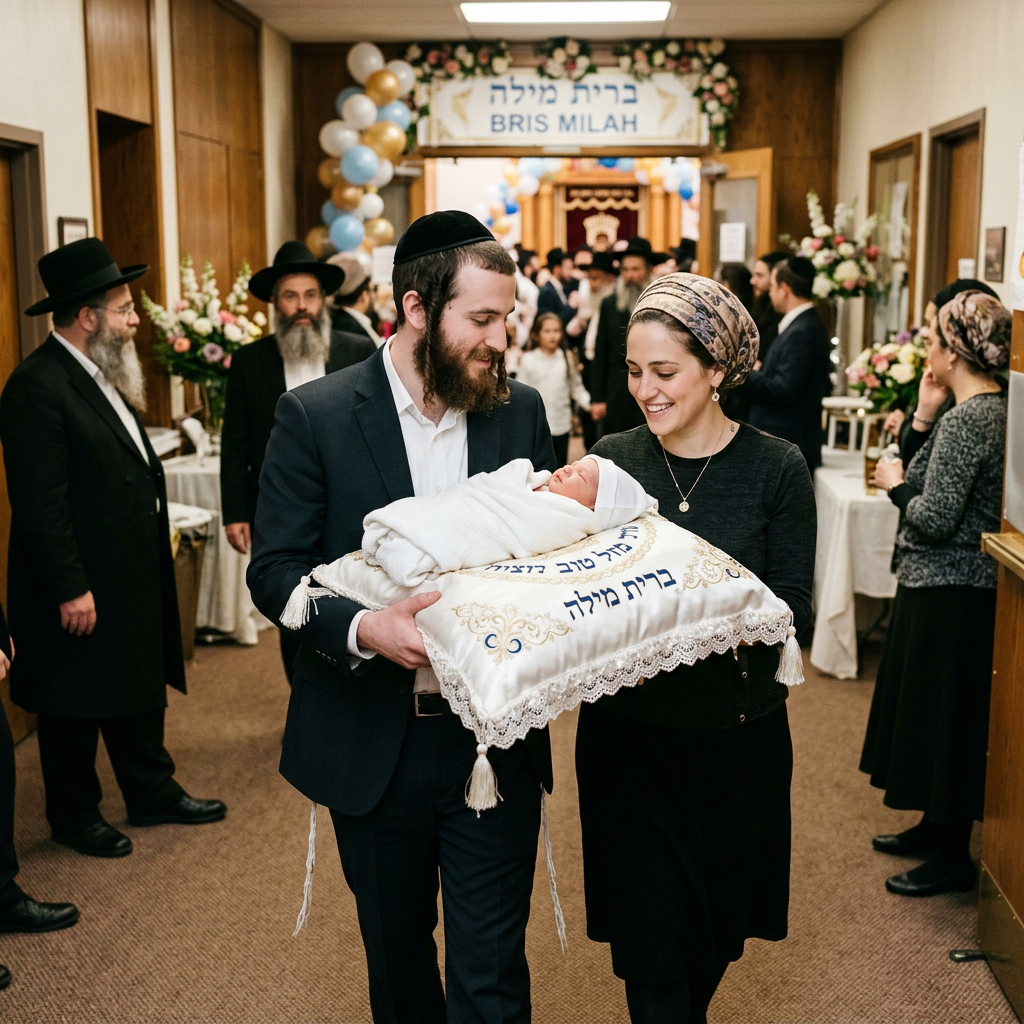
Several weeks ago a family in another shul in-town called to inform me of a bris they would be making the next day. After notifying them that I was planning on coming, they let me know that they planned on giving me the kibud of kvatter, explaining that since we have only daughters they wanted us to have the segulah -by way of kvattering – of having boys.
This was a very nice gesture; although, to be honest, I have never heard of the act of kvatter helping an all-girl family have boys, or visa versa.
I hung up the phone and began to ponder if there is a source I was missing. It suddenly dawned on me that not only do I not know a source for thissegulah but I also have no idea the source for the more famous segulah that acting as kvatter is a zechus to have children in general!
Now I am sure that there are many readers with pen already in hand ready to write a letter detailing to me their or an acquaintance’s kvatter story. I too know of many such stories. True, even if a particular segulah is a mesorah does not then mean that it can be found in writing. Yet also true is the fact that even if a segulah has seemed to ‘work’ does not mean that it based on mesorah.
When I asked the baalsimchah how he knew of such a segulah he immediately sent me a picture of a page from a modern halachik work on milah. The source in that sefer was from another modern sefer. Upon looking up the sourced second modern sefer I saw that it simply says that the idea that serving as kvatter is a segulah for children is ‘what people say’.
While the baal simcha was satisfied with his research, it was clear to me that more investigation was needed.
I would soon discover that many gedolim were asked about the provenance of this segulah, with some replying that they knew of no source.
It should also be noted that the entire concept of kvatter is itself shrouded in mystery; we are unsure when this kibud began, nor do we know what the term ‘kvatter‘ even means!
The ShulchanAruch (Rama siman 265) states that while a woman may not serve as sandek she may however bring the baby up to the door of the shul and pass the baby to her husband who will then act as sandek. It would seem then that kvatter and sandek were once seen as one in the same. This may explain what the word kvatter means. For sandek is translated as godfather, which in Yiddish or German is GutFetter, which can easily be read as gefatter, or, kvatter.
Furthermore, the high honor of acting as the sandek is compared to being maktirketores (offering incense on the mizbeach; see Rama as well as Midrash Rabba, Nasso 14:24). Such an act would be termed ‘Koter’. In Hebrew the ‘o’ vowel would be effected by the letter ‘vav’, which can easily be mistaken as a ‘v’ dound, being read as ‘kvatter’.
Continuing the idea that the role of kvatter began as the role of the sandek (and his wife) is the idea that a sandek, and perhaps all who take part in helping with the bris, are deemed shluchim of the father – acting on his behalf so that he can fulfill his requirement of performing a bris on his son. Kvatter then could simply be made up by the words of K’fetter, lit. Like the father.
For whatever reason, at some point in the past 500 years (note that even Siddur Beis Yaakov by Rav Yaakov Emden –late 1700’s –makes no mention of our current practice) we created this new, separate kibud that we call kvatter where a wife gives the baby to her husband who will then bring him to the bris.
Being that the entire enterprise of kvattering is relatively new what then could be the source for the segula?!
At first, the only source I found was in my trusty ShaareiAaron. Each week I study the parsha with this wonderful sefer that seeks to gather the main pshat-oriented interpretations to each and every pasuk of the Torah. At the end of Lech Lcha he points out the correlation of Avraham’s bris and HKBH’s promise to increase his nation’s size generally as well as the promise of Yitzchak’s birth in particular. In pasuk 17:2 the verse states, “I will place my bris bayni u’veyncha –between Me and you – and I will increase you very much”
The ShaareiAaron comments that perhaps this is the source for the kvattersegulah, as we see here a correlation between brismila (or, helping with a brismila) and having children; as the act of kvattering is the act of helping a brisbayni u’veyncha, between you and the father (or whomever the kvatter passes the baby to)…to which/whom Hashem promised will bring children.
While an interesting idea I was still not satisfied.
I then reached out to Rabbi Paysach Krohn, a mohelparexcellence. He pointed out that in his book on brismila (Artscroll) he delves into this issue. He alerted me to a midrash in BamidbarRabba, Nasso 14:2 (Vilna ed.). There, chazal teache us that when Hashem sees someone helping another in serving Him regarding a matter for which the helper themselves lacks – say a mohel who does not have kids of his own –then Hashem will grant that person with the opportunity to perform this mitzvah for themselves.
What a source!
This would mean, additionally, that anyone involved with helping or assisting in a bris would have this same merit! This may also prove that the baal simcha in my case was correct in that serving as kvatter can help with an all-girl family have boys. For, since one is assisting in a mitzvah that they themselves have never been able to perform Hashem may see this as a reason to grant them a boy to perform it themselves.
I then recalled a similar idea from the gemara (Shekalim 14a). There, the story is told regarding an individual who helped secure water for the populace. On the day of his daughter’s wedding day she was rumored to have drowned. Rav Pinchas ben Yair, after being informed of the circumstances surrounding her ‘death’, responded by asking/praying “Can one who honors Hashem through water be punished through water?!” And indeed she was found alive. From here we see the idea of Hashem also not punishing one through the very tool that he/she befits others with.
May we have faith in the surreptitious genius of the Jewish nation and in the mysterious segulos they cite; and may Hashem have faith in us as well through granting us all what we so deeply desire.
POSTSCRIPT:
The sefer Zichron Yaakov (65-66), by Rav Yitzchok Elchanan Spector’s shamash Rabbi Yaakov Lipshitz, writes how in his days the kvatter were little children dressed like adults – The boy wore a shtreimel & the girl wore a tichel!
Ramban (Nachmonides, d. 1270h, after settling in Jerusalem, writing to his son a description of its ruins, circa 1263:
“I write this letter in ir hakodesh Yerushalaim. For, thanks and praise unto Hashem, I was privileged to arrive safely there in elul, and stayed till the day after Yom Kippur. Now I intend going to Chevron, to maaroshamachpelah, to daven…
“But what shall I say to you concerning the country? Great is the solitude and great is its devastation…The more sacred the places, the greater their desolation. Yerushalaim is more desolate than the rest of the country: AreiYehudah more than Galil. But even still in its destruction it is a blessed land…
“[Yerushalaim] has a total of around two-thousand inhabitants, three-hundred of which are Christians who live there after escaping the sword of the Sultan.
“There are few Jews. For, after the arrival of the Tartars [Muslims], some fled while others died by the sword. There are only two brothers{!}, dyers by trade, who must purchase their ingredients from the government. There [at their shop] the minyan meets, and on Shabbos we daven at their home.
“But we encouraged them, and we succeeded in finding a vacant house that we took for a shuland built pillars of marble with a beautiful arch. For the town is without a ruler, so that whoever desires to take possession of the ruins can do so. We gave our offering towards the repairs of the house. We have sent already to Shechem to procure sifrei Torah. These had initially been brought there from Yerushalim upon the invasion of the Tartars.
“Continually people crowd into Yerushalaim ,men and women, from Damascus, Zobah[Aleppo], and from all parts of the country, to see the makom hamikdosh and to mourn there.
“May He who thought us worthy to see Yerushalaim in her desertion grant us that we witness her when rebuilt and restored, when Hashem’s glory will return to her. And you, my son, your brothers, and the whole of our family, may you all live to see the salvation of Yerushalim and the nechama of tzion.”
Director General of New Amsterdam, Peter Stuyvesant, writing to his colonial bosses of the Dutch East Company back in Amsterdam on September 22, 1654.
He composed the following letter just two weeks after the arrival of the first group of Jews to arrive to North America:
(See my book Jews of the New World for a discussion of the few Jews who preceded them, as well as a suggested genesis for Stuyvesant’s rabid antisemitism)
“…The Jews who arrived would nearly all like to remain here. But learning that they-with their customary usury and deceitful trading with the Christians-were very repugnant to the inferior magistrates…we have, for the benefit of this weak and newly developing place and the land in general, deemed it useful to require them in a friendly way to depart; praying also…that this deceitful race-such hateful enemies and blasphemers of the name of C- -be not allowed further to infect and trouble the new colony…”
This letter was given greater purchase when Domine Johannes Megapolenis, New Amsterdam’s chief minister and clergyman, composed a letter supporting such ugly sentiment, writing later, on March 18, 1655:
“Last summer some Jews came here from Holland in order to trade… they came several times to my house, weeping and bemoaning their misery…”These gdless rascals, who are of no benefit to the country, but look at everything for their own profit, may be sent away from here…”
The following diagnosis comes from David Lloyd George 1863-1945, who served as British Prime Minister (1916-1922), speaking on the cancer that is antisemitism:
“Of all the bigotries that savage the human temper there is none so unwise as the anti-Semitic. It has no basis in reason, it is not rooted in faith, it aspires to no ideal-it is just one of those dank and unwholesome weeds that grow in the morass of racial hatred. “How utterly devoid of reason it is may be gathered from the fact that it is almost confined to nations that worship the Jewish prophets and apostles and revere the national literature of the Hebrews as the only inspired message delivered by the Deity to mankind, and whose only hope of salvation rests on the precepts and promises of the great teachers of Judaism. “Still, in the sight of these fanatics Jews of today can do nothing right. If they are rich, they are birds of prey. If they are poor, they are vermin. If they are in favor of war, that is because they want to exploit the bloody feuds of Gentiles to their own profit. If they are anxious for peace, they are either instinctive cowards or traitors. If they give generously – and there are no more liberal givers than the Jews-they are doing it for some selfish purpose of their own. If they don’t give- then what would you expect of a Jew? “If labor is oppressed by great capital, the greed of the Jew is held responsible. If labor revolts against capital as it did in Russia-the Jew is blamed for that also. If he lives in a strange land, he must be persecuted and pogrommed out of it. If he wants to go back to his own, he must be prevented….
The following was composed byRav Chasdei Crescas (d. 1410), writing to the community of Avignon, on the 12th of Cheshvan/19th of October 1391.
Here he details the Spanish massacre of the summer of 1391.
Aside for the ten-of-thousands of slaughtered Jews, hy”d, this event led to the conversion of many, and was the prelude to the Spanish Inquisition, which took place one-hundred-years later.
He opens the letter by sharing how is only son was among the martyred, Hy”d:
“Among the many who sanctified the name of the Lord was my only son…If I were to tell you here all the numerous sufferings we have endured you would be dumbfounded at the thought of them.
“I will therefore set before you only in brief detail the table of our disaster set with poisonous plant and wormwood [see devarim29:17], giving you a bare recital of the facts so that you may state yourselves on the bitterness of our wormwood and drink from the wine of our grief! …
“On the day of the New Moon of the fateful month tamuz in the year 5151 [July 1391] Hashem bent the bow of the enemies against the populous community of Seville where there were between 6,000 – 7,000 heads of families, and they destroyed their gates by fire and killed in that very place a great number of people; the majority, however, changed their faith. Many of them, children as well as women, were sold to the Muslims, so that the streets occupied by Jews have become empty. Many of them, sanctifying the Holy Name, endured death…
“From there the fire spread and consumed all the cedars of Lebanon [talmidei chachamim] in the holy community of Cordova.
“And on the day of misery and punishment, on which the sufferings were intensified…in the community of Toledo…the priests and the learned were murdered.
“In that very place the rabbis, the descendants of the virtuous and excellent R. Asher of blessed memory, together with their children and pupils, publicly sanctified the Holy Name….
“On the 7th of the month av the Hashem destroyed the community of Valencia, in which there were about a thousand heads of families; about 250 men died al kiddush Hashem the others fled into the mountain, yet some changed their faith…From there the plague spread…. On rosh chodesh elul, the bloodthirsty villains came there, profaned, plundered and robbed them and left them like a net in which there are no fish. Three-hundred died al kiddush Hashem…
“On the following Shabbos Hashem poured out his fury like fire, and destroyed the community of Barcelona. The number of murdered amounted to 250 souls; the rest fled into the castle, where they were saved.
“The enemies plundered all streets inhabited by Jews and set fire to some of them. The authorities of the province, however, took no part in this; instead, they endeavored to protect the Jews with all their might. They offered food and drink to the Jews, and even set about punishing the wrongdoers, when a furious mob rose against the better classes in the country and fought against the Jews who were in the castle, with bows and missiles, and killed them in the castle itself. Amongst the many who was mikadesh shem shomayim was my only son, who was a chosson and whom I have offered as a korban without blemish; I submit to Hashem’s justice and take comfort in the thought of his [his son’s] excellent portion and his delightful lot. Amongst them were many who slaughtered themselves and others who threw themselves down from the tower and whose limbs were already broken before they had reached half-way down the tower. Many also came forth anddied al kidush Hashem in the open street. Many. Others changed their faith… Because of our many sins, there is none left in Barcelona today who still bears the name of Jew…
“In the town of Gerona, where knowledge of Torah could be found combined with humility, the Rabbis of that place publicly died al kidushHashem, and only a few changed their faith. The majority of the community escaped to the houses of the citizens…”
(Translation of Franz Kobler, A Treasury of Jewish Letters, 1953, p. 272ff)
Rav Chasdei ends by quoting from eichah “I am the man who has seen affliction by the rod of His wrath” (3:1), and with the following words of hope, some chizukupon which we will too will conclude:
“In spite of this our eyes are directed towards the Father in heaven, that He may be merciful to us and may heal us of our wounds, and keep our feet from wavering. May this be His will, Amen.”
It is easy to guess and pontificate regarding a seemingly ‘inconsequential’ or ‘small’ hashkaficquestion; to debate around the Shabbos table.
Rabbanim, however, do not often share that luxury, as our answers may be taken as fact, acted upon, and quoted.
We must be careful.
So when I received the following request, I was uncertain as to the proper course of action.
“Rabbi, can we sponsor the Shabbos hagadol drasha?”
“Of course!” I enthusiastically responded.
“Ok, Rabbi. We will call the shul secretary to make sure it gets put in the flyer.
“It will say something to the effect:
‘Mazal Tov to our daughter Esther [name has been changed] upon receiving her get””.
I must have been silent for an extra beat, causing these parents to ask, “Is it not proper to say ‘mazal tov’ for such an occasion?”
I understood their relief, of course. Indeed, I too had been involved in Esther’s plight for many, many years. In fact, my ‘simcha‘ was doubled by the fact that, just days earlier, another woman also received her get after more than a decade of emotional torture.
As shailos tend to come in pairs, as I was contemplating the ‘Mazal Tov’ issue, this second newly minted gerusha invited me to a ‘seudas hodah’ her sisters were making to celebrate her finally attaining her get.
“Can you offer some divrei Torah” she requested, adding “Would it be appropriate for us to recite the pesukim for the korban todah?”
II. ‘Agunah’
I use the term ‘agunah’ cautiously, judiciously; never weakening its potency. Both of these cases above were divorces concerning true agunos.
There are the most painful elements of rabbanus; cases where husbands ignore beis din, skirt court orders, and even flee to other countries.
When I was a rav in Buffalo, I once had a chassidesheposek request permission to send a private detective to our shul on Yom Kippur. In that case, a husband absconded from beis din appointments, disappeared from his Monsey neighborhood, and whose last EZ-PASS entry was a few miles from my home (this case was the subject of another post).
I have arranged gittin in prison, in medical offices, and in abandoned buildings.
It may be surprising to learn that not do such men take my calls, but that most relish in them. On the phone, they believe they are in control, allowing them faux-power in their games of deception and manipulation; drawing yet one more person down to their pettiness, anger, and darkness.
Undeterred after inevitably failing to convince me of their righteousness, their narcissism assures them I will be convinced after the second call, the third, etc.
So, I understood how each of these gittin felt like a ‘simcha’, one worthy of a ‘mazal tov’, even if the mizbeach needed to shed tears (gittin 90).
I am writing this on the eve of Rav Nota Greenblatt’s yartzeit (28 nisan). I do not know of a single person in Jewish history, or any entire organization around today, that has ended the agunah status for more women than he, having written somewhere between 20,000-30,000 gittin. His own children never saw him during the week!
Neither of the two women mentioned above are members of my shul, nor do I have much free time in the day. But Rav Nota taught me that nothing is more important than making sure such women have a halachic closure to their pain. Zechuso yagein aleinu.
III. The Term ‘Mazal Tov‘
An easy mnemonic to recall one of the first instances of the term ‘mazaltov’ is its roshei teivos, ‘mem teis’, for pesachimdaf mem teis (49a). The gemara there shares that the beracha/hope for each zivug, is that the marriage be ‘oleh yaffa’. Rashi explains this term as, “b’mazal tov” (see also Rashi to bereishis 30:1 with Targum Yonasan).
While the earliest reference to this phrase may be found by kiddush levana (from mes. soferim – ‘siman tov, u’mazal tov…’), we are seeking its provenance qas a term used by simchos.
One of the earliest mentions of the minhag of using this term at weddings, is the shu”t Maharam Mintz (#109, p. 538).
A century earlier Rabbeinu Yeruchum (b. 1290) records such a practice in reference to “giving ‘mazal’..” the night before a bris (Toldos Adam v’Chava, 17). However, he then quotes those who were concerned with this practice (see Beis Yosef to y”d 189:4; see also note to Tosefta K’Peshuta, shabbos, 6:4).
Another generation earlier, we find Rav Yehudah Hachasid sharing a minhag of issuing a ‘mazal tov’ after a birth of a child (Sefer Chasidim, #487).
As to the meaning of this phrase – and the serious hashkafic questions it brings, alluded to by Rabbeinu Yeruchum, (e.g. ‘ein mazal l’yisroel‘, etc.) – we find many explanations .
One approach -that this teffilah is to overpower potential negative potencies through Torah, teshuva, and mitzvos – is found in an essay by Rav Gavriel Tzinner (seferShiduchim V’Tennaim, p. 470); whereas the shu”t Be’er Eliuyahu (3:55) explains that ‘mazal’ here doesn’t refer to the constellations, but rather to certain melachim of similar names that bring beracha from Hashem, perhaps similar to barchuni l’shalom said Friday night (although, admittedly, a small minority have the minhag to omit that particular stanza).
As to saying ‘mazaltov’ by a get, I reached out to a renown posek, who has also arranged thousands of gittin. He responded: “I am not aware of a source for such a ‘minhag’ however I do wish each of the parties happiness and success going forward.”
I think that may be wise-as we should not desire to create new minhagim.
I then discovered that in the Artscroll ‘Rav Nota‘ biography, it is recorded how Rav Nota too would frown upon saying ‘mazal tov‘ by such an occasion.
IV. The Hodah ‘Event’
I walked in to the ‘event’ with my wife only to find seven women around a table -their food untouched – quietly reciting tehillim through tears.
Mi k’amcha yisroel?!
I was son introduced to say a few words.
“I don’t know a phrase to use” I admitted. “Another gerusha this week asked me if we say ‘mazal tov’. I just don’t know.
“While we must never revel at the dissolvement of a marriage, we can, and indeed must, recognize the yad Hashem and show proper hakara.
“In two days, we will recall the kriah of the yam suf. By that kriah (tearing) only those humans who were actually saved were given sanction to sing shirah. The melachim, however, were reprimanded when the sought to sing, “My creations are drowning, and you wish to sing shirah?!” (See Mishnas Rav Ahron where he makes a similar distinction between Hashem rejecting the shira of the angels, while reveling in the shira of klal yisroel).
“So, perhaps, the choice of emotion is up to the gerusha alone. Perhaps she can say that phrase…but not I.
“More, perhaps this is why chazal compare zivugim to krias yam suf. Chazal conclude that this is referring to one’s ‘second’ zivug. In other words, this kriah – this get – should lead to beracha for you down the road, iy”H.
“As for reciting the korbantodah, the Rema tells us not say this parshaat all over Pesach – due to its rare chometz loaves.
“Yet, perhaps, this rare feature of the korban todah (as the Torah generally forbids chometz by korbonos) can perhaps provide for us a lesson today. The word ‘chometz’ alludes to letting things fester (e.g. mitzvah bu l’yado al tachmitzena). Todah, hakarah, or gratitude, too, is amplified with time. If an article is found as quickly as it was lost, then the thankfulness may not be as strong as when it was missing for many years.
“The longer one waits, the more anxiety and worry, the added lost sleep -the surplus of ‘chometz’ as it were- all lead to a todah and relief that is that much more intensified upon release.
“In your case, there has been much ‘chometz’; much time of waiting – so your hakara must be profound.”
(Being she was a sefardi, I thought to allow her its recital after I left, see Rema 51:9)
Rav Chaim Berlin was once imbroiled in a machlokos regarding a get. The rabbanim on either side were at odds with each other. He shared with them that when chazal mention an ‘individual who has mazal’ (bava kama 2b), Rashi explains this as “one who has the wisdom to guard himself”. Rav Berlin explained that Hashem gives us everything, but we can ruin it if we abuse our ‘mazal’. This, he explained, is why we say this phrase at a wedding. We are telling the chosson and kalla, “Be careful! Do not let a bad word or negative mood destroy what Hashem gave you”. (Nishmas Chaim, evh’a, 147).
He was hinting that their milchama shel Torah should not lead to negative words.
So, whether the reader is newly married or celebrating their fiftieth year, ‘mazal tov!’
A Rabbi and His Congregants Debate Our Jewish Future
Published in Ami Magazine in October of 2013
The October 1 edition of the New York Times published a Pew Research Poll regarding the state of Judaism in America.
The numbers are a sorry sight. Intermarriage has surged, synagogue attendance has declined, and a large number of American Jews (32%) define themselves as “having no religion”.
The only growth and stability found in this poll was among the Orthodox.
What follows is a series of email exchanges between Rabbi Moshe Taub and members of his community in Buffalo, NY on how to deal with these statistics as well as their cause(s). While names, other than Rabbi Taub’s, have been left out, permission has been received from the others to print their emails.
On Oct 1, 2013, at 1:13 PM, X wrote:
To: Rabbi Taub
CC: Y
You may have seen this article, but I thought I would pass it on. It
is sad that less than 70 years after the Holocaust and the founding of
the State of Israel, Jews, by sheer indifference, begin to disappear.
After spending 100 hours in Shul in the last month, it is hard to
imagine that most Jews didn’t go at all! Not fair!
On 10/1/2013 4:10 PM, Moshe Taub wrote:
Yes, very sad, even sadder that I am not surprised.
Based on these statistics, in two generations Orthodox will be the
majority -based both on its fast-growing numbers and due to the continuing cultural suicide of the other movements.
Every few years a poll like this gets picked up and the Reform et al.
have serious discussions as to what they can do to fix the problem.
Ironically, up till the late 70’s the Orthodox were seen as a
disappearing relic and the other movements thought they had a monopoly
on the future.
“Chacham Einav B’rosho” The wise man sees far, far ahead, and in the
40’s and 50’s, while many chose to bend to the will and desires of their
Congregants -and wer seen as pioneers in the process – the true and great pioneers were in fact the ones who ignored them while simultaneously planting seeds for the next generation.
Thankfully, what these men planted on these shores was an Ilan Chazak. And like Choni HamAgel, 70 years later we wake up and see the fruits of their tireless labor.
The saddest part of all this is witnessing the decline of Conservative
Judaism, both in numbers and in policy. They will feel the brunt of this
more so than Reform etc.
Moshe Taub
On Oct 2, 2013, at 9:48 AM, Y wrote:
Dear Rabbi Taub,
I don’t disagree with your assessment. But there are other matters, perhaps ones which you broach indirectly in mentioning that the saddest part of all this is the decline of Conservative Judaism. Granted the wisdom of Orthodoxy hoeing its own garden, rather than worrying so much about “outreach,” must not Orthodoxy ask itself if the alienation of so many Jews from Orthodoxy expressed by the very formation of the Conservative and Reform movements does not have something–at least something, if not everything–to do with the way in which Orthodoxy, in its various institutions and functionaries, conceives of itself? When Conservative and Reform disappear, are we confident that new break-offs will not arise and that those who break off will not do so because they are repelled by Orthodox behaviors, attitudes, ways of doing things?
And as for Orthodoxy in itself, it is not good that it should be monolithic. Not good, because sages, wise as they are, have an inherent tendency toward arrogance about their wisdom (I think of kin’as sofrim) and, if not arrogance, at least complacency. The sin of the people of Babel is that they were all one people speaking one language, and this was equivalent to building a tower to heaven and replacing God with themselves. God multiplied their languages–not, by my lights, a klalla but a bracha.
Y
On Oct 2, 2013, at 11:24 AM, Moshe Taub wrote:
I hope you won’t be mad if I respond with honesty…
– Imagine if there was a breakdown in academia. Schools were closing one after the next, and that scholarly interest, if existing at all, were purely for vocational purposes. Harvard soon shuts down its Humanities Dept. etc., etc., etc.
In the entire country of three hundred million there is no more than 1000 people left who know how to read Shakespeare, who have even heard of Plato, who have ever truly read a poem.
After meditating on that new reality for a minute….
As a passionate student and teacher of such subjects, how would your plan for fixing this differ than Rav Moshe’s? Would your main focus be to get the 40 year olds back to school, is that where you would spend your energy?
I hope not.
Rather the smarter bet would be to first make sure that these studies can live on authentically. Second, you will work on the upcoming college age kids, while not ignoring the already lost -and certainly composing books geared toward them.
Infrastructure for the future, preserving an authentic rendering of whichever subject or school, must come first.
– Would the above be seen as arrogant? Probably. But to define it as ‘hoeing one’s own’ would, I contend, be simplistic, as well as not giving Torah L’Shmah the same urgency as you would your own life focus.
– As for outreach, Orthodox has not failed. Many more people have flocked to Orthodoxy on serious religious grounds than any of the other movements, which have, often, acted as weigh stations as one’s family and history exits the nation – sadly. Yes, they often extend this life, yet like a hospice, few make it out alive. Indeed, the other movements cannot hold a candle to the energy that the Orthodox have devoted in outreach toward other Jews.
But perhaps your point is not that we do not reach-out to others, but that we reject the other paths, and they notice this. Which leads to my next point…
– Your proof from Babel is, in my judgment, misplaced. Again, imagine we are talking about your acceptance of how yeshivos edit Shakespeare’s works for tznius purposes. Do you accept that, and if not, what of alienation? And then what do you do if colleges begin a puritan streak and begin doing the same, rejecting, say, Romeo and Juliet? Do you go silent? Would you worry about alienation above authenticity? We mustn’t have separate rules governing modes of protection for authentic Torah vs. protecting the things outside of faith that we most passionately pursue.
– Yes, Gd allows each of us to find our own emes (see Bereishis Rabba,bereishis where Gd threw emes to the earth and it shattered into many pieces). But there are limits, as any system must have.
Where are those goal posts? That is a question that we all must ponder before discussing inclusiveness, not after. Otherwise one runs the risk of falling into the trap that Aaron fell into (al pi pshat) -a much better illustration in my view.
So, yes, diversity exists within Torah, as it does within Academia. Yet, in both there are limits -must be limits. You alienate a nice chunk of people who call you ‘Elitist’, as I too am viewed bleakly by many. And we both sleep well at night, confident that we have preserved what we need to.
A few final points:
– Considering my example, you know that if you would allow for the ‘Disney-fication’ of academics, if Readers-Digest-like critiquing is respected, and if you allow those teachers to join you as equals at the table it would influence over time the authentic teachers far more so than the inauthentic teachers. A broom gets dirty as it cleans up (see introduction to shu’t Chasam Sofer from Avraham and Sdom where he wonders just how ‘dirty’ a rabbinic broom must get).
– Your disappointment would be better directed at the founders of the other failed and inauthentic movements, not those who, whether true or not, did not do enough to clean up their mess. The NYT article was about their failure, not ours.
– Lakewood has 6500 students currently enrolled; this is not including the many Lakewood affiliated yeshivos and kollelim throughout that city and the world. Surely you are aware that not all of their students’ grandparents were frum. Compare this number to any of the other schools of higher Jewish learning, even high schools. Lakewood did not succeed alone but with the help of the many other yeshivos and derachim that helped either turn those students’ families onto yiddeshkeit or that produced the rabbanim who inspired them toward change. Remarkable, for had we asked any branch of Judaism in 1950, “Considering that each of you claim a monopoly in saving the future of Jewish America, venture a guess as to the enrollment of all of your branch’s yeshivos, rabbinical schools, and high schools in 60 years, 2013”, no one, aside for Rav Aaron, would have guessed this result (and the design for a 3000 student yeshivah found in his notes following his pertira –at a time when the yeshiva numbered in the low hundreds – is testimony to his confidence in his approach’s future success).
While some would argue that the number of people enrolled in yeshiva is not the best yardstick, this last poll proves that this is the only yardstick to know what will be in 60 years from now, in 2073.
On this point, and with respect to the tzadikei shluchei Chabad, Morristown’s enrollment has not shifted much for deacdes. This is not to take away from their amazing work, rather to say that a Top-Down approach -create the highest level Kolellim, Yeshivos, etc. -seems to be a winning one. In my father’s day at NCSY, its Shabbatonim were never seen as an end onto itself, rather sending the girl to Neve Yerushalaim, or a boy t Telshe was.
– One must be careful regarding inclusiveness; a demarcation between the beauty of outreach and the enticement for overreach. Judaism mustn’t turn into a pyramid scheme. The objective mustn’t be to inspire so that those people can then inspire people so that now those people can inspire people, etc. This is not Glengerry Glenn Ross, rather our end goal is to become, support, strive for, be envious of Elite Torah L’Shmah…the singular book Gd gave us to study and from which to learn, the book that is the envy of every nation and that has been robbed and pillared for every other system, of faith.
The man alone in the beismidrash learning a ketzos must be seen as the preserver not the ignorer.
When a retired conservative rabbi began to daven in our shul he remarked that in his movement the rabbi is seen as the frum one, the knowledgeable one, on behalf of all others. “He keeps Shabbos so I don’t have to”. He was amazed to see a shul where the balla battim know enough to challenge a rav during a shiur, or even to give a shiur of their own.
Finally, and to sum up:
No matter our tiny size, no other religion fills up stadiums every seven years. But it is deeper than that:
I defy anyone to discover another cause within yiddeshkeit other than Torah study that could fill 100,000 seats in Giants Stadium. No other branch of Judaism could do it, and even the Orthododx would struggle unless it is a celebration of each Jew’s personal authentic Torah study.
Kiruv could not do that, Hatzala could not do that, Bikur Cholim could not do that.
You know how I know? Because if they could, they would!
Of course, we NEED all the above chesadim, and it would be specious and pure sophistry to misread me as diminishing those holy tasks in any way (after all, I myself am a rabbi in Buffalo!)!
Rather, that the authenticity of Torah and its study, and our preserving of it, must always remain focus number one, for it is the elixir that has always saved us from withering on the vine.
M
PS – I would be remiss not to mention that the entire enterprise of outreach has been compromised of late due to the high intermarriage rate. Many Temples have a higher rate of halachic gentiles among their memberships now (especially the children) than halachic Jews.
PPS –As to who gets to decide what is authentic Torah study, ahhhh, well that is an email exchange for another time…
For those unfamiliar, the minhag of shlisel challa is where, for the shabbos after Pesach, many prepare their challa either in the shape of a key, or, place an actual key inside the dough before it is baked (for sources, see Imrei Pinchos #298; Ohev Yisroel,likutim, shabbos achar Pesach, inter alia.).
I will, la”d, offer my own theory to this minhag, and why its appeal spread beyond the province of its chassidic provenance:
The yom tov of Pesach, as the word itself declares, recalls how Hashem passed over our homes as He killed the Egyptian firstborn. Sadly, this was a necessary miracle, being that the Jews at the time were on the 49th level of tumah, underserving salvation on their own merit[1]. To recall this, in our yearly preparation for this yom tov, we clean our homes from even a trifle of chometz – which chazal share is representative of the sneakily metastasizing power of the yetzer hara (e.g. berachos 17a). We do this in the hope that Hashem will continue to protect us; skipping over our homes no matter the storm brewing outside. But now it’s after Pesach, after we have successfully purged our homes from its negative chometz forces. No more do we seek, simply, that Hashem protect us by skipping over our homes, that He not bear witness to our actions inside. Now confident in our bedikah, we – kaviyochel– invite Hashem inside, accentuating this confidence by offering Him an actual key to our abode! It is as if to say, “Riboneh Shel Olam! We are now confident we can be saved based on what we have accomplished therein; Come, and see for Yourself!”
Notes:
[1] Why was this strange deed of ‘blood pouring’ chosen by Gd as our means of escape?
Lulei D’Mistapinah, I will offer a theory:
The Chizkuni suggests the brothers sold Yosef because they could be not tolerate the uncertainty of the future slavery decree — when would it begin?
They therefore made the grave error of taking Hashem’s plan into their own hands, acting in Full-Hishtadlus mode (similar to Chizkiyahu’s error-see berachos 10a).
How did they facilitate this?
By slaughtering a goat, dipping, and bringing this false evidence to Yaakov.
To correct this original sin of our entrance to Egypt, a striking parallel was necessary in our yetziah m’sham:
Same animals (goat/sheep), same dipping in blood — but this time as an act of defiant Bitachon. We dip in blood not to deceive Yaakov but to mark our doorposts, publicly declaring our faith to Hashem alone (Shmos 12:6–8).
The Korban Pesach is the tikkun for the sale of Yosef. Where the brothers used hishtadlus to take Hashem’s plan into their own hands, we use the same act as a declaration of pure bitachon.
I have not seen this above connection made by anyone else, and have been pointing this out for years! Whenever I share it, people always assert that this connection must also be a Midrash (it is not).