Saying Half-verses & Another Siddur Mystery
January, 2026
It is always a delight when a reader introduces themselves and shares a thought on something I had written or on a matter related to our many topics.
As it relates to our perennial topic of siddur imponderables, I will share an email Ami received, as well as some possible solutions to the question this reader raised. Let us hope that his question galvanizes each of us to pay more attention to the siddur!
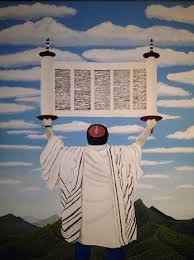
The difficulty pertains to the holy moment of hagbah, when the Torah is lifted for all to see. We will soon discover that the vitality of hagbah may date to the times of Moshe rabbeinu.
Not only is this a time mesugal for ruchniyos growth (see Magen Avraham that when looking at the ksav one can receive an ‘ohr gadol’), it is also a rare occasion where halacha goes out of its way to demand of us to be mindful of the women who are in shul.
The Shulchan Aruch states (siman 134):
“One shows the ksav of the Torah to those standing to one’s right and left, to those in front and behind, for it is a mitzvah for all the men and women to see the writing and to bow and to say ‘v’zos Hatorah…’.
With this brief background, let us share what this reader noticed, and that many of us missed:
Dear AMI,
I hope this note finds you well. I’m writing with a question related to tefilah and minhag, and I was hoping you might be willing to forward it to Rabbi Moshe Taub.
This is a question that people in my circles haven’t been able to answer.
When we lift the Torah during hagbah, we say ‘v’zos haTorah asher sam Moshe lifnei Bnei Yisrael’ (devarim 4:44), and then add ‘al pi Hashem b’yad Moshe”’(bamidbar 9:23), creating a stitched pasuk.
While the minhag to recite ‘v’zos haTorah’ appears in maseches soferim 14:14, there’s no mention of this bamidbar fragment.
This Shulchan Aruch also does not mention it. While this addition does appear in the siddur of the Shelah ha-Kadosh (1565–1630 CE), and from my understanding, the Shelah ha-Kadosh would have had access to the Shulchan Aruch.
Does anyone know of a primary source that addresses who instituted this addition, where it originated, and why ‘al pi Hashem b’yad Moshe’ was added to ‘v’zos ha-Torah’?
T.T., Toronto Canada”
This is indeed a fascinating question, and good on him for noticing this oddity!
It is critical for the reader to note that, as a rule, we are never to recite an incomplete pasuk (berachos 12b)- especially out loud, so to have this minhag develop and accepted is indeed odd.
One may now wonder, “Don’t our teffilos include many stitched-together pesukim from across Tanach? However, those are largely whole pesukim, or, at times, simply borrowed terms utilized by the anshei knesses hagedolah (often, Artscroll, in their shrewd decision to share the sources for many of the phrases found in our siddur, Selichos, etc. may have inadvertently caused some to miss that many of these are mere paraphrases).
This email can be broken down to four mysteries:
- Why do we have to add to meseches soferim’s suggested verse – V’Zos HaTorah – at all?
- Whatever the reason for this addition, why did we choose this verse specifically?
- How are we allowed to recite this partial pasuk?
- Finally, and not mentioned in the email: the mystery of this half pasuk only widens when we consider that there are several pesukim that state ‘al pi Hashem b’yad Moshe’, including even from tanach (yehoshua, 22:9)! in Bamidbar alone, at least four Pesukim have the phrase of “al pi Hashem, begging the question: From which verse is this being taken?!
To unpack all of this, we must first understand the source for hagbah.
By the kelelos of sefer Devarim, the pasuk curses those who do not uphold the Torah. The Ramban interrupts this to being referring to the shul/chazan who does not literally hold up the Torah for all to see (27:26; see Beis Yosef).
The Be’er Hagoleh to the Shulchan Aruch (ibid.) brings this Ramban as one of the main sources of our hagbah.
In other words, hagbah is our fulfillment of a Torah protection against one of the arrurim!
The goal of this public display of the Torah is to demonstrate our safeguarding for an unchanging Torah; showing off it un-manipulated state. It now makes perfect sense why chazal urge is to make a battlecry at this moment- declaring in words-after-action how our Torah is intact and remains identical to the Torah from the days of Moshe.
Hence: ‘V’zos hatorah asher sam Moshe…’.
So fundamental is the act of hagbah, and this declaration that went along with it, that basic halacha desired it to be performed before krias HaTorah! Indeed, this is how the Shulchan Aruch rules.
The ashkanazi minhag to perform hagbah only after leining was due to a past concern regarding the more-simple Jews. Often, these unsophisticated Jews saw hagbah as the main event -as opposed to the leining – and would therefore not even stay after for the actual kriah.
So, Ashkanazim we switched it until after kriah.
Now that we know hagbah’s purpose and halachic history- as well as the likely reason chazal have us recite this pasuk (V’zos…)- we can now resolve our remaining questions.
As to the concept of reciting additional pesukim by hagbah, some versions of meseches soferim indeed bring the addition of “Toras Hashem temmima…”.
However, many, including the Vilna Gaon, argue that this was a later addition, not part of the authoritative girsa.
While the email-er is correct that we already find our addition of “Al Pi…” in the Siddur HaShelah, however, the Tzelusa D’Avraham wisely notes that the Shelah makes no reference to it in his commentary. In other words, it may just be a printers’ addition due to it already being a widespread custom.
The questions remaining:
- Which pasuk of “al pi Hashem” is being referenced?
- How are we allowed to recite a half pasuk?
- Why do we add to the pesuk of “Al Pi Hashem…” at all?
Rav Chaim Volozioner resolves some of these questions.
He posits that the half-verse being referenced is from bamidbar 9:22, describing our journeys in the midbar.
More, he argues that it must be said in its entirety (Shaarei Rachamim, siddur HaGra; Dover Shalom in Otzar Hatefillos).
Nevertheless, the minhag of the majority seems to be to only recite the half pasuk.
The Aruch Hashulchan is very bothered by this, leaving that question unanswered.
However, we could answer the half-pasuk issue by math soaking the many sources who posit that such recitals are not always a concern. This can be evidenced by those who start their Friday night kiddush with the words yom hashishi or va’yehi erev, neither of which are at the start of the pasuk!
This is explained by many as follows: when we are reciting an incomplete verse in a teffila or a praise it is of no concern, especially when the context is clear (see, e.g., shu”t Maharam Shik 124).
Such an approach however may feel unsatisfying in our case, as not all concur with this lenient approach to half verses (see, e.g., shu”t Chasam, Sofer 10; e.g. that that begin kiddush at the start of the pasuk) yet most ashkanazim still say this half pasuk by hagbah.
I would therefore suggest the following approach to all of our questions, lulei d’mistapinah.
While the provenance of our adding ‘al pi Hashem’ is unclear, we have sources for many other (full) pesukim that were added through the generations, including ‘Toras Hashem temima’ as alluded to above (a full list of these verses can be found in Encylpodia Talmudis, 8, p. 170).
Each of these added pesukim have one common denominator: they highlight that our Torah is from Hashem.
If, as the Ramban stated, hagbah’s goal is to make us alacritous to the kiyum/continuation of the Torah-indeed one of our Ani Maamins– then we run into a frightening risk.
As we saw above, the simple of the ashkanazim would leave after hagbah, which is why it was moved to the end. For such people who often only knew Torah – ceremony and content-through this proclamation, we may have been concerned for another of the ani maamins: that the Torah was written directly from the word of Hashem.
Why?
Because the verse chazal share-V’zos HaTorah- only mentions Moshe’s writing!
Since the goal is to aid the simple in accepting and celebrating our Torah, we were cognizant of corrupting their emunah, chalila.
This may be why some added ’Toras HASHEM Temimma…”
Bear in mind that before the advent of the printing press, everything was said by heart and many could not even read. It therefore became far easier to just add these three word “al-pi-Hashem” to stave off this very real concern.
Indeed, Lulei D’Mistapina, I would posit that perhaps this phrase (al pi Hashem) is not even referencing a Pasuk at all!! Rather it is a kinuy, a maxim, (see nedarim 10a).
Such kinnuyim may be done so long as Hashem’s name follows two words prior (see Tzelusa D’Avraham p.371-372; this would seem especially true during davening when Hashem’s name is used even outside of pesukim.
One thing I know for certain: so much Torah is hidden in our siddurim and minhagim!

Leave a Reply