Author: Moshe Taub

  • Is ‘Zos Chanukah’ Really The End of Our Yemei Hadin?

    Is ‘Zos Chanukah’ Really The End of Our Yemei Hadin?

    Rabbi Moshe Taub

    Chanukah, 2021

    The days of din that commence with Elul do not culminate on Yom Kippur or even Hoshana Rabbah; rather, they continue until the final days of Chanukah, when we still have the potential to change our din. Before we explain this incredible mesorah, a brief introduction to the “days” of judgment is in order, derived largely from Rav Yaakov Kamenetsky.1

    There is something mysterious about our yemei din. For thousands of years, from nesinas haTorah through the Anshei K’nesses Hagedolah’s writing of our siddur, there was never any explicit mention of even Rosh Hashanah itself being a day of judgment. It was only in the Mishnah and the Gemara that this became clear.

    There are other days of din that even Chazal are silent about. Several years ago, I was speaking in my shul and mentioned in passing the notion that Hoshana Rabbah is the final day of din following Yom Kippur. Someone asked why Chazal chose not to explicitly inform us of this important, even imperative fact anywhere in Gemara or Midrash, instead leaving it for later sefarim to share with us.

    I replied that I recall that Rav Kalman Epstein asked this question to Rav Yaakov Kamenetsky. Mentioning many of the points raised above, he explained that certain mysteries were reserved for tzaddikim and the keepers of our secrets. In later generations, the hamon am (general public) would need some of these secrets due to their own shortcomings and need for growth and a deeper connection to the Ribbono shel Olam.

    Initially, even Rosh Hashanah was publicly reserved only as a day to be mamlich Hashem, without a focus on it being a yom din, thereby allowing us to attain a good din lishmah, without even knowing we were being carefully watched or judged. However, Chazal soon saw that spiritually weakened masses would be better able to be mamlich Hashem if they also understood the deeper truth of the day—that it is the Yom Ha’din.

    As for Hoshana Rabbah, Rav Yaakov explained that we find many gezeiros Chazal that until their day were not needed. Chazal saw a yeridas ha’doros and sought to fix it with these new decrees. A similar thing happened as it related to the secret of Hoshana Rabbah. There was a concern that the weight of this being the final day of din would eclipse our necessary simchas ha’chag, and therefore only the greatest tzaddikim, whose joyous attitude would not be shaken by din, were let in on this secret. Sadly, continued Rav Yaakov, due to our further yeridah, our Chachamim realized that even something as weighty as a yom din would no longer counter our joy, and so they let it be known the true value of Hoshana Rabbah as well.

    Chanukah shares a similar secret. Many Chassidishe sefarim teach us a remarkable revelation: the final din of Rosh Hashanah goes through many phases. It begins during Elul, culminating on Yom Kippur, when the din is sealed. These papers can still potentially be modified with sincere repentance and action. This continues through Hoshana Rabbah, when the sealed din is delivered, as it were. But this is not the end of the road. Rather, our din continues and can still be changed through the days of Chanukah, terminating on the last day, known as Zos Chanukah.2 While some sefarim mention the kisvei Arizal as the source for this secret, in truth, it is not found in the Arizal’s writings, but rather, similar to what Rav Yaakov writes regarding Hoshana Rabbah, “this matter was passed down among the fearful members of the keepers of secrets, one man [generation] to the next [generation].”3

    Indeed, although the bikkurim may be brought until Sukkos, they may still be brought until Chanukah with the caveat that “meivi v’eino korei”—one brings [the bikkurim] but does not recite [the special verses]. Many see this as an allusion to this secret, in that we, too, may only speak publicly about our ability to gain atonement through Sukkos, but after, while we can still repent and atone through Chanukah, “eino korei,” we do not (in the past, “we did not”) speak about it.

    Others add that notwithstanding this being a long-held secret, many allusions and hints to this fact are scattered throughout divrei Chazal.4 In fact, we find such allusions mentioned by those outside the camp of Chassidus. Rav Yosef Chaim Sonnenfeld, a student of the K’sav Sofer, is quoted as teaching the following remez to Chanukah being the finality to the yemei din: The Gemara teaches that a borrower has ninety days to prove a loan document fictitious or pay up.5 Upon failure to prove this within that time period, the beis din will then demand that the creditor take assets away from the borrower. So, too, explains Rav Yosef Chaim, there are ninety days from Rosh Hashanah until Zos Chanukah, and we, too, have that same time to prove the verdict wrong!

    Others explain the designation of this last day of Chanukah by the title “V’Zos Chanukah” as an allusion to the verse “B’zos yechupar avon Yaakov— Through this will the iniquity of Jacob be atoned.”6 In other words, on the day of zos, we will have a last opportunity to repent.7

    Another verse that speaks to this theme and also hints to just how secretive this day is comes from Tehillim: “U’chesil lo yavin es zos—And the fool does not understand this,”8 as hinting to the yetzer hara (often referred to as or called a kesil) being oblivious to the power of this day, thereby allowing us to accomplish much spiritual gain. (Perhaps, at times, the fool is us: we let days of Chanukah go by without significant improvement and change.)

    The grandson of the B’nei Yissaschar, the B’nei Binyamin (quoted above), brings another verse, as heard from his grandfather: “Zos chanukas haMizbeiach—This is the dedication of the Altar,”9 meaning that until the day of zos (Chanukah), we can still atone.

    However, the question remains: Why is this so? What is so special about Chanukah, which did not even exist in the times of Tanach, that makes it so unique as to have the culmination of kapparah happen during its waning moments?

    The Kedushas Levi10 suggests that Rosh Hashanah and Chanukah have something very exclusive in common. Whereas all other Yamim Tovim take place when the moon is at its strength (or on its way), only Chanukah and Rosh Hashanah are holy days also when the moon is at its weakest, as Chanukah, too, takes place on the first of a month. Indeed, some observe that “Rosh Hashanah” has the same gematria as “Mattisyahu,” alluding, perhaps, to this connection.

    But it is the Aruch Hashulchan11 who illuminates the Rosh Hashanah- Chanukah connection even more. He observes that due to the assaults of the Syrian-Greeks, as recorded in Sefer Hamacabim, we were unable to celebrate properly (i.e., unable to bring the korbanei ha’chag) the Sukkos and Shemini Atzeres prior to the miracle of Chanukah. For this reason, explains the Aruch Hashulchan, Chanukah is eight days and not seven, as the other holidays are, so as to recall the seven days of Sukkos and the one day of Shemini Atzeres for which we fought to regain in full.12

    Indeed, the Shibolei Haleket explains that it is for this reason that we see so many Sukkos-Chanukah connections in Chazal (e.g., Beis Shammai says that we go down in candles each night l’zecher the korbanos ha’chag). Based on this, I wonder if we can suggest that Hashem therefore granted them an extension of din, a respite, until the end of that war, and retained it until today. B’chasdei Hashem, I then saw that the late Klausenberger Rebbe13 makes this same connection. As the paytan writes (in a piyut for a second Shabbos Chanukah): “On Sukkos, all the enemies came to destroy, and on Chanukah they returned home.”

    Let us conclude with two ideas. Rabbi Aryeh Pinchas Strickoff, in his astounding series of sefarim on the Yamim Tovim, brings the following amazing insight in the name of Rav Moshe Wolfson. Parshiyos Nitzavim, Vayeilech, and Haazinu are all read around the time of the Yamim Noraim.

    • Vayeilech has thirty pesukim, alluding perhaps to the thirty days of Elul.
    • Nitzavim contains forty pesukim, perhaps hinting to the forty days from Elul through Yom Kippur.
    • Haazinu has fifty-two pesukim, perhaps suggesting the fifty-two days from Elul through Hoshana Rabbah.
    • When one adds these together, we get a total of 122, the exact number of days from Elul through Zos Chanukah.

    Rav Wolfson concluded this idea by pointing out that the next parashah is called V’zos Haberachah, hinting to the idea that Zos Chanukah is where we can find berachah and atonement.

    Finally, an allusion of my own:

    We know that in U’nesaneh Tokef, the tefillah that best represents our fear and awe of the yemei hadin, on top of the words teshuvah, tefillah, and tzedakah are found (in most machzorim) the words tzom (fasting), kol (voice or prayer), and mammon (money), respectively. It has been pointed out by many that each of these three words equal the value of 136, and together they equal 408, which is the value of the term used for Aharon when he was to enter the Mishkan on Yom Kippur. And that term? “B’zos yavo Aharon.” The word zos also equals 408. Perhaps this is also an allusion, a hint, said on Yom Kippur to the true end of our din: Zos Chanukah!

    NOTES

    1 Emes L’Yaakov al HaTorah, Vayikra 23:24.

    2  See Likutei Maharil (a student of the Noam Elimelech) D’rush L’Chanukah, p. 53; B’nei Yissaschar, Chodesh Kislev; Imrei Noam, Behaalosecha, among others.

    3 See L’Dofkei B’Teshuvah 746; Shaar Yissaschar (from the Munkatcher Rebbe), Kislev 4:4.

    4 See Pardes Eliezer, Chanukah; Inside Chanukah, p. 76.

    5  Bava Kama 112b.

    6  Yeshayahu 27:9.

    7  B’nei Binyamin, as brought in Pardes Yosef, p. 545.

    8  Tehillim 92:7.

    9  Bamidbar 7:84.

    10  Derushim L’Chanukah.

    11  Aruch Hashulchan, siman 670:5.

    12  See She’iltos D’Rav Achai Gaon 27, who posits the same.

    13 Shu”t Divrei Yatziv 283.
  • Understanding the Connection Between Chanukah and Mezuzah

    Understanding the Connection Between Chanukah and Mezuzah

    Rabbi Moshe Taub, 2024

    Ami Magazine

    As discussed in another post, most living outside eretz yisroel light their menoros indoors.

    Although chazal and the Shulchan Aruch rule that we should only light inside in times of danger, the Rema (672:2) states that the standard practice is to continue to light indoors.

    Above, we shared numerous approaches to this issue, ending with the words of Rav Moshe Shternbuch (Moadim U’zmnaim, vol. 2, p. 79) who suggests that just because we live in peace now does not mean that we should forget or abandon the concerns of the past, and that they may, l”a, revisit us at some future time, l”a.

    For obvious reasons, following the pogrom of October 7, 2023, his argument came to mind, and I repeated it in shul.

    After, a young boy asked, “Shouldn’t we also now cover our mezuzos?”

    Seeing the surprise on my face, he continued. “I understand that the obligation for a mezuzah is from the Torah, as opposed to Chanukah. But if the issue is sakana, why don’t we find chazal or poskim discussing covering or hiding it presence?”

    Sadly, it has not been only little boys wondering this:

    Do Not Take Down Your Mezuzos!” yelled the headline in The New York Times op-ed page right after the October 7th attacks. The article went on to state how some non-religious Jews were indeed taking theirs down due to fear.

    More positively, and on the other hand, reports have also been published of mezuzos being vandalized, R”l, causing a reaction to the other extreme: non-Jewish neighbors putting up (empty) mezuzos of their own! While potentially an issue of halacha, their intent is beautiful.

    I explained to this boy that there is a deeper significance here: The story of Chanukah is about surviving the culture around us. In our days, such chinuch, such light, must begin in the home. As we shall see below, I am not alone in this idea.

    Interestingly, Chanukah is in fact deeply rooted in the mitzvah of mezuzah.

    First, contemporaneously, relating to this just this year and the current eis tzara: I’ve heard from a very prominent sofer sta”m how there is now a shortage of klaf due to the fact that many Palestinian Arabs would do the stretching for the klaf and, obviously, are not now available (a frum yid always begins the ibud process lishmah, and with the Gentile there to hear, for more details, see Shulchan Aruch, siman 32:8 and Mishneh Berurua sif kattan 30).

    However, the connection to Chanukah and mezuzah runs far deeper.

    The gemara states:

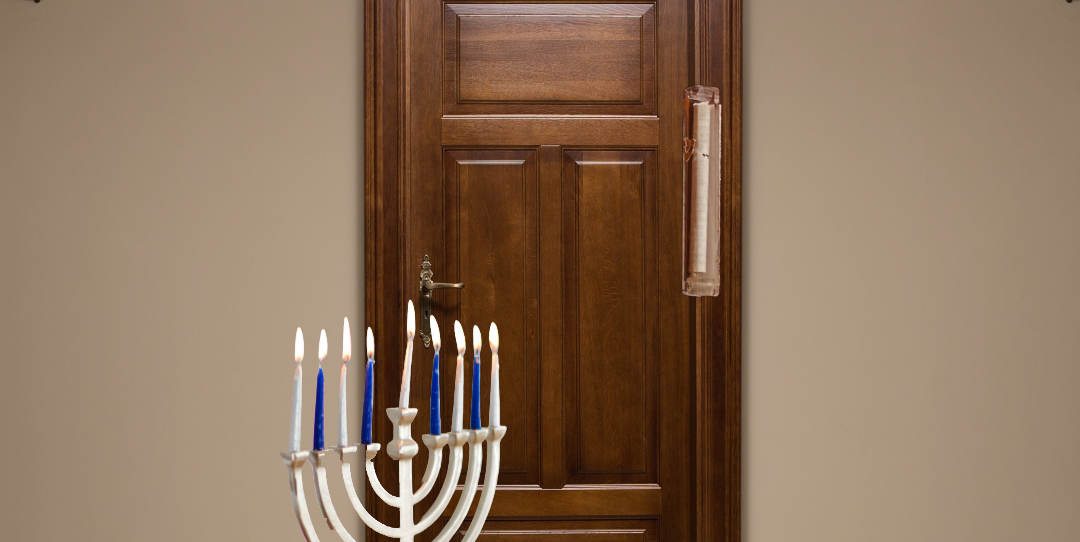
    “Rabbah taught: ‘It is a mitzva to place one’s menorah within a tefach/handbreadth adjacent to the entrance.’ On which side does he place it? Rav Achah ben Rava said: ‘On the right;’ Rav Shmuel of Difti said: On the left. The halacha is to place it on the left, so that the menorah will be on the left and the mezuza on the right.” (shabbos 22a)

    Chazal are teaching that by placing one’s menorah opposite one’s mezuzah he will thereby be surrounded by mitzvos. Chazal here teach that by placing one’s menorah opposite one’s mezuzah, he will thereby be surrounded by mitzvos.

    Meseches sofrim expands on this:

    “…The mezuzah should be on the right, and the ner chanukah to the left. Thereby fulfilling the verse (Shir HaShirim 7:7) ‘mah yafis u’mah y’amt…-how fair and how beautiful-. ‘Mah yafis’ -is mezuzah; ‘u’mah y’amt’ is ner Chanukah.” (Sofrim 20:5; cf. Shir HaShirim Rabbah, 7:1)

    But why specifically mezuzah? What is its unique connection to Chanukah?

    The Shem M’Shmuel (mikeitz) shares that the goal of the menorah is m’bifnim l’chutz-to take the kedusha created in our homes and bring it to the outside world. Whereas the goal of mezuzah is in the opposite direction – serving as our home’s most vital ‘filtering’ system, placed based on our way of entering our homes from the streets of life; our cue to first strain any-and-all tumah.

    The Sefas Emes (Chanukah trn’t; see Sefer HaChinuch #423) explains that mezuzah ought to remind us of Hashem’s Torah u’mitzvos. After the yevanim wished for us to ‘forget Your Torah,’ we, dafka, wait until people are found in the street (tichleh regel) when they will then bear witness to the ner Chanukah and mezuzah – our constant symbiotic tools to succor our combat against the potent pull of regilos and tevious (culture and conditioning).

    As to connecting the leniency by danger in regard to Chanukah to that of mezuzah, the Shulchan Aruch shares that whoever is careful in mitzvas mezuzah will be protected for a long life; he and his family (yoreh deah, siman 285). In other words, there is a built-in structure of protection already. (Of course, and as the Aruch HaShulchan stresses, we do not keep this or any mitzvah due to any specified protection that it may bring, rather, and only, as a gezeira from Hashem.)

    In fact, it is not just ner Chanukah that we place opposite our mezuzos.

    Growing up, following sukkos, we would lean our lulavim on the left side of the doorway, opposite our mezuzah, until nissan when the dried lulavim fueled the burning of our chometz (see Rema, orach chaim, siman 664:9).

    Our mezuzos are uniquely empowered to bring an abundance of steady stimulus and koach, and also have the power to accentuate the other mitzvos performed in our homes (see further, Shir HaShirim Rabbah, ibid.).

    In fact, this is why we have the minhag to touch the mezuzah upon passing it. The Shulchan Aruch (see Rema, yoreh deah, siman 285:2) writes:

    “Some say that when one leaves a house/doorway, he should place his hand on the mezuzah…as well as when he enters.”

    One of the sources for this practice is the famous gemara (sanhedrin 11a), regarding the soldiers sent to bring Onkeles back to Rome (after his gerus). When they witnessed him touch his mezuzah, they asked for an explanation. Onkeles responded: “The way of the world is that a king of flesh and blood sits inside his palace while his servants stand guard outside; but with regard to Hashem, His servants sit inside their homes and He guards over them outside. As it is stated: ‘Hashem guards your going out and your coming in, now and always’ (tehillim 121:8).When kissing one’s mezuzah, it is brought, al pi kabbala, that one should use, specifically, his middle finger (‘amah’), kissing his finger after (Birkei Yosef, siman 285:2; see Taz, sif katan 5; see shu’t Rav Akiva Eiger 1:58 regarding touching the actual klaf).

    It is recorded, amazingly, how the Chasam Sofer once revoked a semicha after witnessing the young musmuch consistently ignoring the mezuzah when entering and leaving rooms (Maamer Mordechai [2007] p. 494)!

    May we, too, follow toras chazal and their guidelines in how to protect ourselves.

    May we have a safe and growing Chanukah, as we await the menorah of bayis shlishi!

  • The House That Ruth Built

    The House That Ruth Built

    Secrets Contained in the Book of Rus (Ruth)

    2013 – Shavuos Feature, Ami Magazine
    Rabbi Moshe Taub

    For this year’s Shavous feature, I wish to focus on but one stealthily hidden wonder contained in megillas Rus [the Book of Ruth]; the book which is read across the world on this holiday.

    I. The Mystery

    What I wish to share begins with just one line in a midrash.

    [‘Midrash’ refers to the many books of commentary on the bible by the rabbis of the Talmud, from about 300 BCE to 300 CE. Far more authoritative than a standard commentary, it is rather seen as part of the chain of the Oral Tradition].

    In this midrash (Midrash Zutta, parsha 2), a mysterious element of the story is shared (I will paraphrase):

    In the entire book of Rus –all of its eighty-five pesukimeach and every pasuk begins with letter vav; save for eight verses.

    [Pesuk=Verse; Pesukim=Verses]

    I can assure the reader that this checks out, as I went through Rus and counted myself.

    The great rabbi and mystic, Rav Shlomo Alkabetz (d. 1584)–the composer of lecha dodi – posits that this is to be expected, since that the letter vav often plays the role of continuity, called the ‘Vav Hachibur; Connective Vav‘.

    The function of this letter -when found at the start of a sentence – is no different that the word ‘and‘ in the English language, although it plays a slightly deeper role, conceptually akin to ‘Yes and…” used in drama and improv classes; it is the glue that binds and then pulls forward the ‘before‘ to the ‘now‘.

    Indeed, the literal meaning of the word we use to represent this letter ‘vav‘ is ‘hook’.

    A megilla, by its very definition, is one long story; one thing should lead naturally into the next and then that into the next, and so on; it is to flow. Vavim make sense in a megilla.

    Although only the Book of Esther is given the official title of ‘Megillah’, Jews colloquially use this same term also for the following books: Ruth, Song of Songs, Lamentations, Ecclesiastes, and sometimes, Jonah

    For example, the Shabbos reading of parshas Vayeitzei [Genesis 28:10-32:3] is also one long story where only twenty-one out of one-hundred-and-forty-five pesukim begin without a vav!

    In other words, the fact that Rus contains so many pesukim which begin with a vav must not the sole chiddush of this midrash, rather, explains Rav Alkabetz, the midrash is drawing our attention to the exceptions to the norm – those eight verses that do not begin with a vav.

    II. The First Secret

     Rav Alkabetz goes on to explain that the lack of vavim in those pesukim come to signify that Rus, in those places perhaps, chose to break from her natural order, her flow and rhythm of life –her vavim – in order to convert and to become the matriarch of the holy Davidic monarchy.

    III. The Secret Within the First

    I then took a closer look at context of these eight pesukim.

    The first one (1:9) is when Naomi says her goodbyes to Rus and Orpah, blesses them, and they all weep together.

    Here are the rest:

    • Naomi seeks to change their minds about joining her.
    • Naomi explains that joining her would turn into a period of waiting.
    • When Rus, referencing death, “Where you die I will die, and there I will be buried…”.
    • After that it is when Naomi recounts how much had changed since she had last been to beis lechem, and that she must change her name from Naomi.
    • Boaz speaks to Rus for the first time, and tells her not to glean in other fields.
    • Boaz promises Rus that Hashem will reward her in the future.
    • In a verse that begins with an enlarged lamed, Boaz promises a redeemer, and if not he will take his place.

    Amazingly, and in support with Rav Alkabetz, each one of these verses reflects a change of some kind; a change that Rus, or another, had been through, are going through, or will go through. Whether it’s from life to death, wealth to poverty, the company of loved ones to loneliness, or change in mazel, the theme seems clear by each.

    This break of connection to the past is seen through the absence of the letter vav commencing those verses/themes.

    IV. The Second Secret

    But why eight?

    If Shmuel [Samuel, the author of Ruth] wished to draw our attention to the many vavim – to their role when used and when not – he could have done so one or two times.

    Is there any signifiance to this number?

    • We can suggest that Shmuel chose precisely eight pesukim, perhaps, to allude to King David, who was the eighth of Yishai’s [Jesse’s] sons.
    • Furthermore, the gemara [Talmud] tells us (sanhedrin 97a) that in the ‘seventh year’ will be war, and in the eighthth year ben-Dovid (messiah) will arrive.
    • This may be alluded to in Tehillim/Pslams 12:1 “lamnateach al haShminis”, a reference to eight being representative of mashiach tzeiten (Messianic times).
    • Eight being a symbol to the Davidic line is hinted to in the gemara (arachin 13) where we are taught that although the harp has seven strings, this same instrument of moshiach will have eight.
      • (See ‘Jewish Wisdom in the Numbers‘ by Rabbis Levene and Hartman, for further allusions regarding the significance of the number eight).
    • Furthermore, the Chida (died. 1806) and others famously posit that the reason we read Rus on Shavous is because, like Rus herself, we are all converting to the Torah anew each and every Shavous. Perhaps, then, these eight comes to symbolize bris mila, typically performed on the eighth day, the final step for a male in converting -their ‘eighth day’ as it were.

    Indeed, many suggest that ‘Rus’ was chosen as her name only after her conversion. This is because, as we know, the Torah commands all Jews in 613 mitzvas, which is an additional 606 mitzvas from the seven laws which are incumbent upon all of humanity [the seven Noachide laws, sheva mitzvos bnei noach]. ‘Rus’ was chosen because it has the exact gematria [numerical value] of 606 [Reish=200, Vav=six, Tav=400], which is the precise number of mitzvas a convert must accept upon themself on top of the seven laws -just as the Jews had to do at Sinai!

    Alas, there still seems to be a piece missing from this puzzle…

    V. The Third Secret

    We shared above how Rav Alkabatz suggests that any megillah, or long-form connected event, would naturally have verses that begin, mostly, with vavs, ‘and‘…’.

    Yet, if that is the case, why don’t we find this same feature in the Book of Esther, or our other megillos?!

    (While they too certainly contain a large amount of vavim, only Rus is has a percentage this high).

    So, I decided to take a different tact: To look at these anomalous eight pesukim in Rus; the exceptions that do not begin with the letter vav.

    They are to be found in:

    • 1:9,
    • 1:12,
    • 1:13,
    • 1:17,
    • 1:21,
    • 2:9,
    • 2:12,
    • and, 3:13.

    I then wrote down the letters with which those outlier pesukim began.

    Although I am not good at word jumbles, I started to consider how Rus represents the seeds of moshiach.

    This was all the impetus I needed to be inspired to the follwing thought:

    These letters spell ‘yeshua bo l’kah’ –’a salvation shall come to Hashem‘.

    We borrow a similar term in in our weekly havdala, taken from King David, who may have been alluding to this term in Tehillim/Psalms when he writes (3:9) ‘la’Hashem Hayeshua…’/’to Hashem is salvation…,’ which the Zohar (vol. 3 90b) explains to refer to Hashem’s awaiting His own salvation from exile through moshiach.[1]

    A Lesson To Take Home

    The vavim of our lives pull us into a senseless rotation; what we did yesterday is what we will do today, and what we will do again tomorrow.

    the holiday of Shavous is when we are supposed to accept the Torah anew; to re-discover why it is so dear, to re-affirm that it is our precious life-jacket.

    Shavuos is a time to tear down the vavs of our existence and re-enter our lives; to take control…as did Rus.

    As I was writing this I recalled something I had written about ten years ago.

    In parshas Pekudei [end of the book of Exodus] we are taught that Moshe rabbeinu [Moses] had trouble accounting for 1775 talents of silver that made up the vavim/hooks[2] of the mishkan [tabernacle]. Several years earlier I had figured out that the only pasuk in all the chamisha chumsha Torah [the Five Books of Moses] that has the exact gematria of 1775 is from Shmos [Exodus] 2:12: “And he (Moshe) turned in all directions…”.

    A man was beating a Jew, so he killed him.

    This was Moshe’s chance to discover his own vav. Meaning, and as the Ibn Ezra (died. 1167) explains, that at that juncture Moshe had to decide whose side he was on, and how his future would turn out.

    Should he continue his life an an Egyptian? Or was this the moment to throw off his princely status and align with his brethren?

    Indeed, he broke off that hook, that vav, and became our leader.

    I came upon another discovery: there is one parsha in the Torah that also has a vav at the start of each pasuk except for eight pesukim: parshas Vayeshev (Genesis 37:1-40:23). Indeed, the Rokeach (died. 1238) mentions this fact without reference to megillas Rus. [3]

    This is extraordinary for two reasons.

    • Vayeshev contain the story of Tamar and Yehudah –the first seeds of moshiach before Rus, and indeed Tamar’s son Peretz is mentioned in the genealogy up to Dovid found at the end of Rus!
    • This is also the first story of someone forced to make a change in his life; when everything he knew was altered. He thought it was for the worse; we know it would be for the better. I refer, of course, to Yosef [Joseph].

    So many secrets contained in the Torah…even in one midrash!

    May the only continuity we see be that of Torah, kindness, and health.

    Gutt Yom Tov!

    Rabbi Moshe Taub

    NOTES


    [1] This that Gd awaits His own salvation, as it were is a deeply mystical concept, and impossible to review without a deep familiarity with Torah subjects and the Talmud. Briefly: See Rashi to Devarim 30:3 and Megilla 29a (see also Yerushalmi to Taanis 1:1; MechiltaBo; Yalkut, Shmuel remez 92) that “kaviyochel, the Shechina rests with bnei yisroel in galus and its hardships and when we are redeemed He writes it as if He too has been redeemed, for He shall return with them. Although Hashem is under no authority other than His own, there is a concept of Hashem waiting for us to act before He does. See also Berachos 7a where Hashem requests a beracha from the kohein gadol, as it were. See Even Yisroel that l’asid lavo Hashem will not just put us in judgment (see Rosh Hashana 16b, Ramban Shaar Hagmul based on Sanhedrin) but Himself as well. This last source can be found quoted in Shalal Rav yomim noraim p. 58 (although Shalal Rav quotes this source as saying Hashem judges Himself each Rosh Hashana, this is not what the source he bring seems to be saying when one looks inside the source).

    [2] While we are tying the idea of the hooks being called vavim to the idea above, as well as the idea to follow, I would be remiss not to mention that my father has a different, and wonderful, interpretation to the hooks in pekudai meaning vavim –by way of a halacha in the Shulchan Aruch –that one can find on O.U.’s website.

    [3] (Vayeishiv non-Vav pesukim, are:

    • Aleph; 37;2;
    • Lamed  37:27;
    • Hei 35:25;
    • Aleph 39;9;
    • Aleph 39;23;
    • Beis 40;13;
    • Choff 40;13;
    • Choff 40;15;
  • Exploring Connections Between Joseph (Yosef) and Esther’s

    Peculiar Similarities Between Mechiras Yosef and Megillas Esther

    Many have written showing the connections between the parshiyos of Vayeishev, Mikeitz, Vayigash, and the story of Chanukah. However, what is most striking is that the story of Yosef does not read

    like any other in the Torah, in that this episode is laid out in over ten chapters, like a megillah. No other event or episode in the Torah is given this much Scriptural detail or space.

    Moreover, throughout the story of Yosef one can believe he is reading Megillas Esther—consider:

    • A king has trouble sleeping (41:4);
    • two men are punished for a crime against the king (40:1).1
    • A king’s party ensues, helping to lay out the foundation of as- tounding chains of events to come (40:20).
    • Someone was killed (by the order of the king) at said party because of their lack of proper respect for the king (sar ha’opheh, 40:22; although, in truth, Vashti’s death is only implied and is not written explicitly).
    • The protagonist is honored by becoming the ‘mishneh l’melech’ (see Ramban 41:43).
    • Also, he is repaid by being afforded the luxury of riding on the king’s horses while wearing the king’s clothing (41:42–43); Pharaoh removed his ring to place it on Yosef (41:42).
    • See Baal HaTurim 41:34, who makes a few grammatical and textual comparisons to Megillas Esther without further comment;
    • Yaakov, while “giving in” to an ultimate sacrifice, exclaims, “Ka’asher shacholti, shachalti” (43:14), which is strikingly and eerily familiar to Esther’s statement when she had to make the ultimate sacrifice, “V’cha’asher avadeti avadeti.” [Indeed, see Ramban (to 43:14), who also draws this comparison without further comment]
    • The Midrash Tehillim states: “You sold your brother, then sat down to eat…there will come a time when your descendants will be ‘sold’ by a feast as well (Esther 3:5), when Haman and Achashveirosh will partake in a feast and decide there to exterminate the Jews.”3
    • See Rav Hirsch on 43:32, that Yosef never revealed that he was a Jew, for that would have compromised his position. This is similar to Esther (as the megilla shares). (However, clearly, Pharaoh was aware that Yosef was Jewish – see Ramban to 41:45 where he explains the name Pharaoh gave Yosef as being from the Hebrew language, as a courtesy to this new leader. See, as well, 40:15, where it is apparent that Yosef revealed his lineage to the sar hamashkim, who in turn revealed it to Pharaoh there. We would be remiss not to mention that Yosef did not offer correction when he was called an “Ish Ivri“, and is indeed praised for this)
    • See Moshav Zekenim to 50:4, where he explains the need for Yosef to send a messenger to Pharaoh as being similar to Esther 4:2 (his comparison), that since Yosef, like Mordechai, was in sackcloth, it was not becoming for him to approach the king.
    • See Rashi to 37:3, where he correlates the meaning and translation of the kesones pasim (an essential element in Yosef’s story) to key words found in the Megillah; once we develop this connection between Purim and the story of Yosef, we can then investigate deeper into the story, so we even find drinking until the point of intoxication by the story of Yosef (43:34).
    • When Pharaoh is first introduced to us in Parashas Lech Lecha, we find Avraham hiding Sarah in order to save her from the king’s men discovering her beauty and reporting it to the king, exactly what happened in the story of Purim: both Mordechai and Avraham failed in this regard.
    • Both stories end with a seemingly unrelated recording of a mas (tax) levied on the populace of each story (see Rashi 47:25).
    • The Megillah ends with a pasuk (10:3) that says Mordechai was not loved by all. The Midrash explains this to mean that Mordechai was not universally loved because he was too involved in politics. The Gemara in Berachos 55a comments that Yosef died sooner than his brothers because he, too, dedicated too much time to politics.
    • See Megillah 16b, where verse 45:22 here—and Yosef’s favoritism to Binyamin as shown by giving him five times the clothing of his brothers—is explained to be an “homage” to the future grand- child of Binyamin, Mordechai, who would also wear five kingly garments (8:15). See also Ramban to 48:9. While I will leave it to the reader to darshen the true depths of these allusions, I share this in a Chanukah book so as to share the following: We have two Rabbinic holidays: Chanukah and Purim. How intriguing that we read the story of Yosef—along with its many shared Esther elements—during Chanukah, and we read the commandment of the Menorah at Purim time.

    NOTES

    1. This theme of two men and their plans or actions being of great consequence is a repeated theme: Moshe being confronted by Dasan and Aviram, who threatened to inform the king (Shemos 2:11); Mordechai, here; Yosef, here.
    2. As brought by Rabbi Meir Zlotowitz in his stupendous two-volume ‘Bereishis’ (ArtScroll, 1977), p. 1645, first column.
    3. Midrash Tehillim 10.
  • Halacha: Finer Points, History, and Common Misconceptions

    This article serves as a starting point for those who are new to exploring halacha beyond surface-level conclusions, with selected discussions illustrating broader patterns.

    Halacha is often encountered through brief rulings or isolated practices. Yet many areas of Jewish law cannot be properly understood without examining their historical development, underlying assumptions, and commonly misunderstood details. What appears straightforward on the surface often proves far more layered upon closer study.

    Some halachic topics require careful clarification of popular myths, while others demand historical context to make sense of contemporary debate. In still other cases, modern technology raises questions that earlier generations could never have imagined, requiring established halachic principles to be applied with both precision and intellectual honesty.

    This article serves as a starting point for those exploring halacha for the first time, linking to in-depth studies that examine sources, history, and modern application.


    Clarifying Common Misconceptions

    Certain halachic ideas are widely discussed yet poorly understood. These topics benefit from slow, source-based analysis rather than slogans, folklore, or partial quotations.

    Examples include:

    Each of these discussions illustrates how misconceptions can persist when original sources are not carefully examined.


    Halacha in Historical Context

    Many halachic practices only become clear when viewed through the lens of history. Understanding when, why, and under what conditions a practice developed often resolves debates that appear confusing or contradictory today.

    Examples include:

    History does not replace halacha — but it frequently explains it.


    Human Complexity and Halachic Analysis

    Some areas of halacha involve deeply human realities that resist simplistic categorization. These discussions require sensitivity, nuance, and a willingness to confront difficult questions honestly.

    Examples include:

    Such topics demonstrate how halacha engages with real people and lived experience.


    Technology and New Halachic Questions

    As technology advances, halacha increasingly intersects with modern innovation. While new tools do not automatically generate new law, they often raise questions that demand careful application of long-standing principles.

    Examples include:

    Here, halacha’s durability is tested not by abandoning tradition, but by understanding it deeply enough to apply it correctly.


    Rabbinic Authority and Method

    Underlying all halachic discussion is a broader question of method: how halacha is analyzed, transmitted, and applied. Examining rabbinic authority and interpretive frameworks helps explain why sincere scholars can reach different conclusions.

    Examples include:


    A Note on Scope

    This site does not aim to provide practical psak halacha. Rather, it explores halacha as a living system — rooted in classical sources, shaped by history, responsive to human complexity, and challenged by modern life.

    Each article stands on its own. Together, they form a broader conversation about how Jewish law is studied, understood, and lived.


  • Halachos of Chanukah: A Basic Guide

    Halachos of Chanukah: A Basic Guide

    Rabbi Moshe Taub, 5786 -Written for YIH Membership

    Tonight, with the commencement of the 25th of Kislev, we begin celebrating the eight days of Chanukah.

    • These eight days were designated as Yamim Tovim (festivals) by the Sages, and Hallel is recited every morning.
    • Al Hanissim is inserted in the blessing of the Shemoneh Esreh and in the second blessing of Birkas Hamazon (Grace after Meals).[1] 
    • If Al Hanissim was omitted, the Shemoneh Esreh or Birkas Hamazon need not be repeated.
    • It is customary for women to avoid certain labors (actions avoided during chol hamoed) for the first half-hour time-period that the Chanukah lights must burn.

    The Lighting Obligation

    • All members of each household, who are above 12/13 years of age, share an equal obligation of lighting Chanukah lights.
    • The basic obligation is that each household kindles just one light on each night of Chanukah for all who live there.
    • Both men and women are equal in Chanukah’s lighting obligation and must make sure to light—or that Chanukah lights are lit—in their place of residence.
    • In this, Chanukah is no different from Shabbos whose basic law requires one to make sure that just one candle be lit in each home (chovas hadar). For Shabbos, we gift this mitzvah to women; on Chanukah, we gift this mitzvah to men. Although there is deep significance to this custom, the fact remains that men and women share the exact same obligation in both Shabbos and Chanukah candles.
    • Therefore, if there is no adult male (above the age of thirteen) in the household, the woman of the house must kindle. This is like Shabbos, where if there is no woman there, the man must still light.

    It is common practice that children kindle their own lights as well.

    Although one candle per night suffices, for centuries, it is common practice to follow the Talmud’s ‘Mehadrin min HaMehadrin‘/SuperBeautification method: starting with one candle on the first night and then adding one addition candle on each subsequent night.[2]

    When to Light

    • We should strive to kindle the lights about ten to twenty minutes after sunset.
    • The lights should burn for at least half an hour, but it is best if they remain lit until rush hour traffic ends, if possible, or until family dinner concludes (an hour or two).[3]

    Should one need to light LATER:

    In such cases, one should have an other member of the household light in the more-proper time. However, if this will harm shalom bayis or chinuch habanim then waiting to light later -when everyone is together-may be apt. A rav should be consulted.

    Assuming no one else is home during the proper lighting time, one may indeed light later[4].

    In extreme cases such as due to travel, etc., the lighting may be done at any point during the night, until daybreak, so long as others in the home are/will be awake. If one lives or is staying alone, or, if others in the home cannot be awakened for whatever reason, one may nevertheless light, and with the berachos.[5]

    Like with all other ‘passing mitzvos‘, one who is forced to light late must try not to eat a full meal before they light, or must at least create a shomer to remind them.

    If one needs to light EARLIER:

    • In cases of extreme need/circumstances (such as one who has a flight around lighting time), one may light as early as plag ha’minchah.
    • During this time of year, plag will come out to about 40 minutes before sundown. The exact timeframe should be checked on a website like: https://www.myzmanim.com/search.aspx
    • When lighting this early, one must still make sure that there is sufficient oil/wax for the light to burn for at least one-half hour past sundown.

    Friday/Motzai Shabbos

    • On Friday, the eve of Shabbos, the custom for well-over five-hundred years is to kindle the Chanukah lights prior to the kindling of the Shabbos candles.
    • One must make sure that at least one of the Chanukah lights will burn into Shabbos and through the entire half-hour period following sundown.
    • IN SHUL: Following Shemoneh Esrah at the conclusion of Shabbos Chanukah in shul, the Chanukah lights are kindled  before Havdalah.
    • AT HOME: one may follow the same order, or he may perform Havdalah first, whichever is the minhag of that house.

    Simply put: As opposed to in a shul, at home either order is fine (the reasons behind this are fascinating, yet beyond our scope here).

    Where to Place Lights

    Chazal demand that the lights be placed at or near the outer part of the doorway facing the street. The reason for this was to publicize the miracle.

    • HOWEVER…Nowadays, the accepted custom is to kindle the lights indoors, even on one’s kitchen table (!), so long as members of the home will see it.
    • In other words, the pirsumei nisa of today is fulfilled through those living in the home.
    • In fact, this was behind the motive for the minhag of Chanukah gelt –to keep the family inside awake whilst the flames are glowing (Avnei Nezer as brought in Siach Sarfei Kodosh; this would also explain ‘Chanukah gift-giving’. See also Emes L’Yaakov to siman 670, with footnote #582)
    • Nevertheless, it is appropriate and praiseworthy to place the lights where they will be visible from the street. Specifically, if possible, on the left side of an open doorway opposite the mezuzah or at least by a window facing the public domain.[6] 

    – One should not light outdoors in America (unless, of course, one has a specific custom otherwise) [6a] –

    • Ideally, the lights should be between 12 and 33 inches above the ground.

    To Recap:

    • Leaving the menorah on one’s kitchen table, etc., is sufficient.
    • The discussions of where to place the menorah (one’s window, door, etc.) are referring to a hiddur mitzvah (an extra beautification of the mitzvah).
    • While the ancient custom is for the kindling to be increased each subsequent night – one light on the first night, two on the second, etc. – in cases of need (like when in a hotel) the basic mitzvah can be performed by kindling just one light each night for an entire household, and this may be relied upon in cases of extreme need.

    The Procedure for Lighting

    • On the first night, one kindles the lamp at the extreme right of the menorah.
    • One adds one extra candle each night going to their left and begins lighting starting from there (the far left) and, from there, going right.

    Facing the menorah on, say, the fourth night, the left side of the menorah will be empty, and one starts with the candle on the far left and continues to the right until the first candle is lit.

    • There are alternative views regarding the order for placement and lighting that each home must follow. What is recorded above is simply the most common custom.

    What Type of Candle//the Myth of Olive Oil:

    • One may use any stable fuel or candle for the lights
    • While the Shulchan Aruch/Rema do suggeststhat some type of oil is preferred so as to recall the miracle, zecher l’ness [7], they do not mention Olive Oil.
    • While it is true that the Talmud teaches us that for both Shabbos lights and Chanukah olive oil is the most common and best stable fuel source, this law is omitted by the Shulchan Aruch (by hilchos Chanukah; he does indeed mention this regarding Shabbos -see my forthcoming sefer, iy”H, where all this is discussed).
    • Nevertheless, the common minhag today is to go out one’s way -when feasible – to use olive oil for Chanukah.
    • The Maharal suggests that using olive oil – and not just any oil – is an even greater zecher l’ness, although he is in the extreme minorty (see Dibros Moshe, shabbos who argues strongly against this position; See ‘Chanukah: Mysteries and Histories‘, Rabbi Moshe Taub, 2026, iy”H).
    • If olive oil is not available, any other oil which gives a steady and clear flame (that does not emit an offputting odor) may be used, due to the miracle happening through oil.[8]
    • Modern wax candles are also 100 percent permitted, so long as they will last through the times mentioned above.

    Sundry

    • As with any mitzvah that is dependent on time, once the time for kindling has arrived (around sundown), one must try to avoid excessive work, eating meals/washing, etc., before kindling the lights.
    • When lighting the menorah, the appropriate blessings are recited, with Shehecheyanu recited on the first night only.
    • Most Sefardim and Chassidim omit the word “shel” from the berachah of L’Hadlik Neir.[9]
    • Many Ashkenazim, however, keep that word as this is the version found in the gemara.
    • Each person should follow his custom. If one does not have a custom, either way of saying this berachah is fine, so long as a person seeks to remain consistent through the days of Chanukah.
    • One must light immediately following the berachos, without any talking or singing.
    • Therefore, even the recital of Haneiros Hallalu is only commenced after the first candle is lit.
    • Some have the custom to light all of the candles first before Haneiros Hallalu is begun. Either way, at least one candle must be lit right after the blessings, before speaking or singing.
    • The custom for close to eight hundred years is to sing Maoz Tzur following the lighting. This poem takes us on a journey through the many exiles of the Jewish People and speaks of our endurance and salvations at the hand of Hashem.[9a]
    • The period after the lighting is known as a special time for prayers, and we are encouraged to pray to Hashem for all of our needs.[10]

    If one misses a night of lighting, it can’t be made up, and one simply continues lighting the same number of lights as everyone else on the additional nights.

    • One may not derive any benefit from the burning lamps, and it is for this reason that we add the extra shamash candle, (i.e., in case we do benefit, it is considered to be from this shamash.)
    • Hallel and a special leining are recited each day of Chanukah during Shacharis.

    NOTES


    [1] See my forthcomingh sefer for several explanations why Chanukah is omitted from Mayan Shalosh.

    [2] This too will be discussed in detail in my forthcoming sefer, iy”H.

    [3] Kuntros Chanukah U’Megilah, in the name of the Brisker Rav, et al. Most poskim view this as merely a chumrah. Cf. Chazon Ish who would actually put out his Chanukah menorah after thirty minutes had passed (Neir Chanukah, os 17, in the name of Rav Chaim Kanievsky).

    [4] Shevet Halevi states that it is better for a person himself to light later than at the proper time through a shaliach.

    [5] See Shaarei Tzion, Orach Chaim 672:15 with Igros Moshe, Orach Chaim 4:105:7.

    [6] See link as to why in chutz la’aretz we made this change to light indoors.

    [6a] Ohr Zaruah 133:2; Sefer Ha’itur, Aseres Hadibros,Chanukah 114:2; See also Shu”t Minchas Yitzchak 6:67; Kovetz Shulchan Melachim,Kislev, 5766; see Yerech L’Moadim, p. 112; See Darkei Moshe, siman 671:9; See Chidushei Anshei Shem to Berachos 38a; See,Aruch Hashulchan 671:24 as well as Moadim U’Zemanim, vol. 2, siman 140, fn. 1; Cf. Shu”t Yaavetz 149, who allows, although does not urge, such encasements; See Shu”t Imrei Noam 2:22; Cf. Rav Elyashiv in Shu”t Kovetz Teshuvos 1:67, pp. 98–101.

    [7] See forthcoming sefer on this issue and its history.

    [8] See Mishnah Berurah 673:4,and chapter below.

    [9] See forthcoming sefer on this issue and its history.

    [9a] As to why we chose this pizmon for Chanukah, I would suggest two approaches: A) On a true chag one may not read or discuss sad events, B) Being the last of the established chagim of chazal, Chanukah can look back through history, C) On that theme, Chanukah was preview for-and is closest to -our the final galus, making it the appropriate time to look back at all prior exiles and their salvations, thus giving hope for our final salvation from our current exile.

    [10] This will be discussed in detail below .

  • Yehudis & Latkes: Solving Two Chanukah Mysteries

    For more on Chanukah see:

    Why We (still) Light the Menorah Indoors

    &

    Chanukah’s Absence from Mishneh & Brevity in the Talmud

    We are all taught as children about the heroine within the story of Chanukah, Yehudis. As we will show, there is a lot more here than meets the eye.

    I. THE KARTOFFEL KERFUFFLE
    Take a poll on what is the most common Chanukah food staple, and

    latkes would come in at number one, with sufganiyot nipping at their heels. However, fried potatoes are a very recent addition to Chanukah. While most assume that potatoes were first brought to Europe either

    by the sixteenth-century conquistadors or by Sir Walter Raleigh, either way they only reached widespread use during the mid-1700s. Indeed, the fact that most of us make the berachah Ha’adamah on potatoes proves how late potatoes entered Jewish kitchens.

    Briefly, some argue that the proper berachah should be Shehakol, like mushrooms. This is due to several halachic factors, and especially the fact that close to one thousand years ago the Aruch used an odd term to refer to these truffles: “tartfulls” (which I always assumed was simply a transliteration of “truffle.”)

    Some, especially early Chassidishe poskim, asserted that the Aruch was referring to a kartoffel, a term used for the lowly potato. While there are a number of reasons that most poskim argued with Shehakol being the berachah for potatoes, an important factor was the point that the Aruch could never have been referring to a potato, as he did not even know what they were back then.

    If latkes, while a nice minhag, do not and could not have any provenance in classic minhagei Yisrael—and are certainly not brought in the Shulchan Aruch—is there any truly halachic food on Chanukah? Yes, there is!

    II. CHEESE, PLEASE

    The Rama makes an interesting aside in the Shulchan Aruch.2 While discussing the lack of an official obligation to make a seudah on Chanukah, the Rama adds that there is an inyan to be marbeh b’seudos and to eat cheese on Chanukah. We have finally found a clear minhag relating to food on Chanukah.

    The explanation for this minhag is likely familiar to many. Cheese was one of the foods Yehudis fed the enemy so as to later trap and kill him. The Mishnah Berurah fills in the rest of the story: “Yehudis was the daughter of Yochanan Kohen Gadol and there was a law…so she fed cheese to a leading general so as to tire him. She chopped off his head [causing] the enemy to flee.”3 This is no small matter, and it is more than a story.

    The Gemara teaches that women are also obligated in mitzvas neir Chanukah because “they, too, were in this miracle.”4 While many Rishonim, like the Ritva,5 understand this simply to mean that they, like the rest of Klal Yisrael, were in turmoil, Rashi understands the reasoning differently. He explains that it means that they were at the center of our salvation. Without mentioning Yehudis by name, he gives us this same story as the reason that women are obligated in Chanukah lights.

    The Ran6 goes one step further, quoting an unknown Midrash. While he, too, does not mention her name, he does add to the story by claiming the heroine was the daughter of Yochanan Kohen Gadol. A few years later, the anonymous sefer Kol Bo puts it all together as we know the story today, resulting in the heroine being identified as Yehudis the daughter of Yochanan Kohen Gadol.

    In fact, Tosafos7 takes women’s centrality to Chanukah one step further. In the name of the Rashbam, it is stated that on both Chanukah and Purim, we were only saved because of the two famous women in each story, and for this reason, all women are obligated in these days, even though they are mitzvos bound by time. Rav Eliyahu Hakohen M’Izmir, the Orah V’Simchah, even wonders why, then, it doesn’t say in Al Hanissim

    Bimei Mattisyahu v’Yehudis”!8

    III. A CHANUKAH CHUMRA FOR WOMEN

    Because of the above, another halachah is codified. The Shulchan Aruch9 brings a minhag that women should refrain from doing melachah (accord- ing to most this only includes that which would also be forbidden on Chol Hamoed) during the first half hour that the Chanukah neiros are burning. Many wonder why this halachah/minhag is codified to apply specifically to women. While the Be’er Hagolah and many others simply explain that this is because it is more common that they are home at that time and therefore should have a reminder that they cannot benefit from these lights, others give another reason.

    The Mishnah Berurah explains: “This minhag is unique to women be- cause the neis happened through them!”10 Again, we see their centrality to this Yom Tov.11

    IV. WHO WAS YEHUDIS? WHO WAS YOCHANAN?

    If Yehudis was the daughter of Yochanan Kohen Gadol, would that not make Mattisyahu her brother? After all, we say in Al Hanissim, “Bimei Mattisyahu ben Yochanan Kohen Gadol.” In addition, which Yochanan is this? The Gemara teaches that one should not trust in himself until he dies, for Yochanan was a tzaddik and served as Kohen Gadol and then became a Tzeduki at the end of his life!12 Could this be the father of Mattisyahu, the father of Yehudis? If so, why would we mention him in a tefillah of praise? He left Toras Chazal!

    The Imrei Noam13 brings from the Vilna Gaon, and the same is brought in the Seder Hadoros, that in truth there were two Yochanans. The first is the one we mention in Al Hanissim. Mattisyahu would then have a grand- son that he would name after the baby’s great-grandfather, Yochanan. It was this second Yochanan who would go on to become a Tzeduki.14 There are still others15 who say that this Yochanan was indeed one and the same as the Tzeduki, and they each offer varying explanations as to why we still mention him by name in such a lofty tefillah recounting this neis.

    But the mystery is not yet over. Many wonder—like Rashi and others who assert that Yehudis’s story is so central to the neis—why Chazal do not mention it at all. It’s not even found in Megillas Antiochus. (Although, I would answer that the Ran indeed did seem to have a Midrash that discussed the story.)

    The Ben Ish Chai suggests that the story of Yehudis took place many years earlier and is only being remembered on Chanukah. This explana- tion requires further study, for it would make her father being named Yochanan Kohen Gadol a tremendous coincidence. It would also call into question Rashi’s view regarding the women’s obligation in mitzvas Chanukah being due to the story of Yehudis being so central to the neis. However, even the Ben Ish Chai still maintains that this story—although not during the classic Chanukah story—took place during the Greek rule over us.

    This is as opposed to Sefer Yehudis (of unclear origin, see below), which places her events in the time of Nevuchadnetzar. Indeed, Rav Yaakov Emden also states that this event took place during Bayis Rishon.16 Even if, according to other sources, this incident indeed took place during the Chanukah story, the piyut for the second Shabbos Chanukah names her Chanah, brother of Yehudah Hamacabi, continuing to add to the confusion.

    The Aruch Hashulchan combines many versions of these events and says that (as the first piyut for Shabbos Chanukah teaches) the Greek king was livid when he heard how the Jews killed his general after the wedding of the daughter of the Kohen Gadol; at a later time in the story, there was a woman named Yehudis who fed the enemy dairy. Like the Ben Ish Chai, he is asserting that these events did happen around the time of Chanukah, although not necessarily during the main events.

    In Megillas Taanis (the earliest work of Torah She’baal Peh), the story of Yehudis is recorded (by the date 17th of Elul) without her name, only describing the woman as the daughter of Yochanan Kohen Gadol. It also states that it was her brother Mattisyahu who avenged an evil act against her. This, to me, seems most authoritative and is also in line with the piyut mentioned by the Aruch Hashulchan. As for Yehudis, as he states, she must have been another woman who later took matters into her own hands.

    As we say each Chanukah and Purim when we delve into their various mysteries, there is so much more to minhag Yisrael than meets the eye. One thing is for sure: this Yom Tov, like Purim and geulas Mitzrayim, could not have ever occurred without nashim tzidkaniyos.

    NOTES

    2  Shulchan Aruch 670:2.

    3  Mishnah Berurah, ad loc., seif katan 10.

    4  Shabbos 23a.

    5  See also Tosafos to Pesachim 108b.

    6  Ad loc.  Megillah 4a.

    8  See also Yafeh L’Lev 5:682:2, as brought in Shiltei Gibborim to the Mordechai on the second perek of Shabbos.

    9  Shulchan Aruch, ad loc., seif 1.

    10  Mishnah Berurah, ad loc., seif katan 3.

    11  See also Pardes Yosef, Chanukah, pp. 149–50.12  Berachos 29a.

    13  Ibid.

    14  In a later chapter, “Chanukah’s Many Bracketed Words: Part II,” we further discuss who this Yochanan was and how his name—and perhaps more—can be included in our siddur.

    15  The B’nei Yissaschar as brought by the Klausenberger Rebbe in Divrei Yatziv, Orach Chaim 282; Divrei Shaul; Rav Sternbuch in Moadim U’Zemanim 2:137.Mor U’Ketziah 670.

    See Also:

  • Antisemitism & The Campus Idealists

    Antisemitism & The Campus Idealists

    For more on this theme, see link for: “Jews and ‘Dual Loyalty’

    Rabbi Moshe Taub

    Published in Ami Magazine, 2024

    “I’m no Nazi. I am an idealist!

    So asserted on Wilfried Böse, one of two Germans who, along with two Arab Palestinians, hijacked Air France Flight 139 on its way from Tel Aviv to Paris in 1976.

    His preposterous comment was made even more ludicrous by the fact that is was said to a Holocaust survivor.

    Böse was separating the Jewish and non-Jewish passengers (naturally, they were not separated by Israeli vs non-Israelis, mind you; rather by ‘Jew’ and ‘non-Jew’), when this older survivor rolled up his sleeve to display the numbers the Nazis had tattooed on his arm. This forced Wilfried Böse to come face-to -face with his native country’s past evil -an evil he was now perpetuating, causing his above remark (see: Time Magazine, “Hitler’s Children,” August 8, 1977).

    One would imagine that similar machinations of self-delusion and cognitive dissonance go through the minds of some of the modern protesters at our universities as they lay down to sleep each night. Even if they are informed that some of their Jewish brethren on campus are in fear, they comfort themselves with the soft lullabies of—“I am but an idealist”.

    I challenge the reader to guess which ‘crime’ committed by the Jewish State led to the following (an excerpt) notes of consideration undertaken against Israel by the United Nations Security Council:

    “The Security Council considered the matter at five meetings held between 9 and 14 July 1976. The representatives of Cuba, the Federal Republic of Germany, Guinea, India, Israel, Kenya, Mauritania, Mauritius, Qatar, Somalia, Uganda, the United Republic of Cameroon and Yugoslavia were invited, at their request, to participate in the discussion without the right to vote. The case before the Council raised a number of complex issues… He hoped that the Council would find a way to point the world community in a constructive direction…”

    What had Israel done this time?

    One may think this incident involved the Yom Kippur War and the lands that had not yet been exchanged. Or maybe it was about the unverified-yet-well-known nuclear developments in Israel.

    No.

    The above was from July 9-14, 1976, when the United Nation’s many voting members were aghast at Israel’s miraculous rescue of the hostages in Entebbe!

    Here is an excerpt from the United Nations yearbook (emphases mine):

    “The representative of Qatar, who spoke on behalf of the Arab group of Member States, said the Council was concerned not with the hijacking but with the fact that a Member State had violated the territorial integrity of another Member State by flagrantly landing its troops on that State’s territory and menacing its population and security forces.

    “While the Israeli murderers were preparing for their aggression… [In] its surprise attack on this unsuspecting, peaceful country in the heart of Africa…[an] illegal act of state terrorism…flagrant violation of international law…[and] called upon the Security Council to condemn Israel in the strongest possible terms…and consider sanctions against this longtime violator of the United Nations Charter and of international law.

    “A number of speakers—Benin, China, Cuba, Guinea, Mauritius, Romania, the USSR, the United Republic of Tanzania, and others—made the point that it was inadmissible to react to terrorist acts of individuals or groups, which had been condemned by the international community, by another terrorist attack. Israel’s action, they said, was a premeditated and naked act of aggression committed against the sovereignty and territorial integrity of Uganda; they called on the Council to condemn the action in the most vigorous manner and compel Israel to pay compensation for the damage inflicted on Uganda…

    The Chinese representative [!!} said that…the Israeli Zionists had subjected the Palestinian and other Arab peoples to frenzied aggression and brutal massacre. Whatever excuses they might find to justify and whitewash their criminal acts of aggression were completely untenable and of no avail…”

    Yearbook of the United Nations, Vol. 30, 1976, pp. 315-320

    ———————

    Many Jews today are experiencing growing anxiety as they watch young Americans show support for those who brutally target and kill Jews. Even the events of October 7th -we are now told -must be given ‘context’, as if the world should ever not respond with disgust and fear from such actions.

    No Jew that I know, for instance, would support someone escaping a Nazi death camp to only then go inside the town of Auschwitz and butcher children, or hold them in tunnels for years.

    For Jews it is easy: should Israel support the sanctioned rape, baby-hostage-taking, and targeted murder of Palestinians then virtually every synagogue will take down their Israeli flags. No one would be angrier than Jews at having their faith spit-upon in such a manner, having children created in ‘the image of Gd’ used for land-sport. We would be the first to protest.

    A small part of me believes that the world deep down is aware that the very things that many are now falsely libeling Jews with are the very actions Jews have been at the forefront of fighting against and protecting the world from. More than projection, they are inverting our nature and watching us twist and turn, dizzy with how to even respond to such horrid lies.

    +_____________________________________

    Alas, they don’t make antisemties as they used to.

    The level of ignorance found among modern day Israel-haters is astounding (I’m not reffering to Israel-dislikers, disagree-ers, policies, or the like; indeed there are more of those among Jews than Gentiles!)

    From my experience, most protesters are not even informed to the most basic of October 7th being an attack not on disputed territory or land.

    Regrettably, that information would anyway often not change minds, as, to most arguments, they often simply retort, “All of the land belongs to the Palestinians…”, or, “What did you expect they would do when treated the way they are by Israel for all these years?”?

    Forgetting the sheer sophistry of such a position for a moment, one has to wonder where their agreeable professors and mentors are. Have they never prepared these shepherded interlocutors with basic facts, or a map? Have they not stress-tested their arguments, if only to make them more persuadable to the genuinely curious?

    When confronted with such hatred and ignorance, I seek to distill my points down to the following 7 questions:

    • “Even if you believe it is all Palestinian land, is everything and anything allowed in such cases, and against civilians, even against those citizens dedicated to this very struggle (as was the case regarding the victims of Oct. 7)? If not, which tactics would be off the table? Why?”
    • “May all peoples who argue or feel to be in a similar position respond in kind, in the same manner? -E.g. Kashmir, Rwanda, Western Sahara…Native Americans, etc. – If not, why not? And, if not, how will you now prevent that after offering your support here?
    • May Israeli’s who argue or feel that Arabs are on their land now target Arabs for killings, rapes, and the maiming of innocents? If not, why not? (The interlocutor would often be shocked to learn that two million such Israeli citizens exist).
    • If they argue, “But this is different…”, explain that this is why we have set and pre-stated morals. For example, “Just because you understand that the father who killed his child’s victimizer is different than other cases does not mean your support to let him walk will not open a pandora’s box of other, less moral, vengeful acts, nor will such posturing and equivocating prevent your justifications to lead to a far more dangerous society”.
    • “If you get your way, would Jews be able live on Palestinian land, as Arabs do on Israeli?”
    • “Why did the Israelis remove the remains and graves of buried Jews when they annexed Gaza in 2005?” (If they even know Israel gave them all of Gaza then)
    • “How would you want America to respond to the exact same circumstances, with hostages, held in an urban area, aided by citizen protection, tunnels, etc.?”

    ____________________________________

    In one of the schools where I teach, a student approached me and said anxiously, “There is so much chaos. It’s so scary!”

    I asked the students in the class to take their seats and spoke to them all. I told them that in Shemoneh Esrei, we offer thanks in Modim. It is easy to relate to the gratitude described there, except for one line: “Al chayeinu hamesurim b’yadecha v’al nishmoseinu hapekudos lach”—we thank Hashem for our lives, which are in His hands, and for our souls, which are entrusted to Him.

    It would be understandable if this statement appeared in Tachanun or in U’nesaneh Tokef, but why here? Are we thanking Hashem for the fact that He may decide to take us to the Olam Ha’emes at any moment?

    The answer seems to be that this part of the tefillah is for moments like the ones we are experiencing now, when we are at war and our enemies abound, when life seems capricious, when the arbitrary nature of suffering keeps us up at night. At times like this, we thank Hashem that He is in control. Chazal state that only Hashem has the keys to life and death, and He gives them to no one else (Taanis 2).

    Although we may not understand the reason for what is happening, we do know He has a plan.

    Hostage-taking is not new to the Jewish people. A number of people in Chumash experienced this horror—Lot, Sarah Imeinu, Dina. (Interestingly, the Rambam, the Ramban and the Maharal, among others, discuss the issue of allowing civilian casualties during a war, one purpose of which would be to save even a single hostage.)

    And then there was Yosef. Last week was the yahrtzeit of Rachel Imeinu (according to many; cf. Rashi on Bereishis 48:7 with Pesikta Rabbasi).The following Chazal, which discusses the initial moments of Yosef’s capture by the Yishma’elim, is fitting for this moment(Sefer Hayashar, Vayeishev, ch. 8). 

    “And the Yishma’elimcontinued their journey and passed Efrat, where Rachel was buried. Yosef ran to the grave, falling and weeping upon it. He cried out upon his mother’s grave, saying, ‘Oh, my mother! My mother, you who gave me birth to me! Awake! Arise now! See how your son has been sold into slavery with no one to have compassion upon him. Oh, arise! Look at your son! Weep with me in my affliction!…

    “‘Oh, my mother! Rouse! Awaken! [I have been] torn away from my father… Bring my complaints before Hashem! See…who is to be condemned. Arise! Oh, my mother, awaken from torpor! Distinguish my father, whose soul is with me this day, and comfort him and console his heart.’

    “Yosef continued to cry aloud and to weep bitterly upon his mother’s grave. From the bitterness of his heart, he finally became silent, like a stone upon the grave.

    “Yosef then heard a voice speaking to him, answering him in a voice of weeping and prayer: ‘My son! Yosef! Oh, my son! I haveheard the voice of your weeping and crying, and I haveseen your tears, and I haveseen your affliction. Oh, my son, I amgrieved for your sake… Now a new sorrow has been added to my sorrow.

    “‘Now, my son Yosef, place your hope in Hashem… Do not fear, for Hashem is with you to deliver you from all trouble…’”

    The navi informs us (Yirmeyahu 31:14, 15): “So says Hashem: A voice is heard on high, a lamentation, a bitter weeping; it is Rachel weeping for her children, and she refuses to be comforted for her children while they are not comforted. ‘Know that there is hope for your future,’ says the Lord, ‘and the children shall return to their own border.’”

    Chazal (Pesikta #24 on Eichah Rabbah) share Rachel’s tefillah with us. She reminds Hashem, “It is revealed before You that Your servant Yaakov treasured me greatly and worked for my father seven years for me. When those seven years were completed and the time for my marriage arrived, Lavan plotted to exchange my sister for me. This plot was very difficult for me, and I gave Yaakov a signal. Afterward, I regretted what I had done, and I had mercy on my sister…”

    Immediately Hashem’s rachamim was aroused, and He said, “For you, Rachel, I will restore Israel to its place.”

    On Simchas Torah this year, we were expecting a chasan Torah; we were looking forward to dancing after weeks of teshuvah and hard work. Instead we were met with tragedy and pain.

    Perhaps this is the reason we choose Rachel as our advocate in galus. She understands the feeling of hope and excitement, of trust and anticipation—and she understands what it means to have her hopes torn asunder.

    May Hashem accept her cries once more and bring the yeshuah we so desperately need. ●

  • The Cryptic Tomes of Chanukah

    The Cryptic Tomes of Chanukah

    The Books of Megillos, Maccabees, Antioches and More

    December, 2023

    Rabbi Moshe Taub

        There is something about the story of Chanukah.

          Of all the events that we commemorate each year, there is no doubt that Chanukah is the one that many know the least about.As a child, I vividly recall my initial confusion when I first discovered that the events of Chanukah took place well after the story of Purim, and then, as I got older, discerning the dearth of a record of the events surrounding these events that are recorded by chazal. It only became more confounding from there. Famously, the gemara only discusses, briefly, the ness of the oil (Shabbos 22b), while in al hanissim only the milchama is mentioned -and again, very pithily. Due to the ambiguity of these days in general, and its story in particluler, we have used this time of year to discuss these days’ many, many obscurities, largely choosing topics based on the most common questions of Chanukah I was receiving in shul each year. We have discussed the history of fried foods, the story of Chana/Yehudis, who was Matisyahu kohein gadol, etc.

           There has been one subject, however, that I have thus far avoided. While questions relating to this subject are always from the most common I receive – and although its more basic answer is known – I have avoided it as it nevertheless opens a pandora’s box of intrigue and history. 

           “Why is there no sefer in tanach detailing the events of Chanukah?”.

          Of course, the answer is rudimentary: Chanukah took place after the era of neviim and long after the sifrei tanach had been canonized and concluded, therefore such a sefer would be an nonstarter.

         But here comes the natural follow-up question: “So where do we get our mesorah on these events?”

          This is a complex question that will take (at least) the next two weeks of Chanukah issues to uncover.

                Let us start with megillas taanis, which may be from the earliest recording from our mesorah of the events

          Chazal share that Chanukah -along with many other celebratory dates initially found in megillas taanis -were nullified after the destruction of the second beis hamikdosh. Remarkably, chazal explain in the name of Rav Yosef that it was only due to an unexpected anomaly that the klal decided to nevertheless keep Chanukah for generations (rosh hashana 18b).

              Megillas taanis was written during the time of the second beis hamikdosh, andcompleted by the tanna Chananya ben Chizkiya and delineates more than thirty joyous dates and salvations that have occurred to the our nation.

            Before sharing what is stated there about Chanukah, it is critical to share with the reader that, according to the Chasam Sofer, megillas taanis was written before torah sh’baal peh was chronicled. It was therefore only written like a luach; divided into the months of the year, with a sentence or two by certain dates. It was only later, during the period of the (later) tennaim, that the events behind these brief words were expounded upon in greater detail. For this reason, he explains, the gemara will quote from this megillah with the words ‘d’ksiv’ (as is written)a phrase usually reserved for text from tanach or other holy catalogue. However, he continues, when quoting from the fuller sections of this megillah, the gemara uses terms like ‘tanya’, which is reserved for braissos and other tannaic writings (see Chasam Sofer to rosh hashnah 18b and Maharitz Chiyus, maamer Divrei Neviim, Divrei Kabala; see the introduction to the Oz V’Hadar edition of megillas taanis for further views).

        With this in mind, the earlier prose reads simply as follows:

    “On the twenty fifth of the month is Chanukah, eight days on which we do not offer hespeidim”.

    The added section by early chazal expands on this, as says:

    When the Syrian-Greeks entered the heichel they made all the oil impure. Then, the chashmonaim overwhelmed them, and defeated them. They searched and could not find any [oil] but one container, that rested with the kohein gadol’s seal, and that was not made impure. However, there was only enough for one day, yet a ness happneed where it lasted for eight. The next year, the established this as a yom tov…At the time of the ness they sang praises of thanksgiving…Since the Syrian-Greeks had defiled all the vessels, there was nothing with which to light. When the chashmoniam were victorious, they brought seven spits of iron and covered them with tin and began to light [as a makeshift menorah]…

          It goes on to record the obligation in the recital of hallel for each day, how we light the menorah in our homes, and the time frame of ‘mishetaka hachama ad sh’tichelh regel min hashuk’. According to the meforshim, the few references in shas to Chanukah are taken directly from here.

            However, the reader may still not be satisfied, as they surely have heard more details regarding the Chanukah vents than those recorded above.

           Where did these details come from?

         Recently, a retired couple in my shul sold their empty-nest home after several decades in the neighborhood. They called me to offer that I look through any sefarim before being sending them to shaimos. I was delighted to discover disparate items such as first-issue records of Yosseleh Rosenblatt, manuals for Jewish soldiers in World War II, and cheder volumes from pre-War New York.

          One sefer in particular caught my eye. It was a pocket size book, black, and very thin -maybe fifty pages -in size. Its back jacket translated into English what was written on the front. “Megillas Antioches; Ness ChanukahScroll of Antioches -Miracle of Chanukah”.

            Now, many readers may be aware of this ‘megilla’ (and, if not, we will explain below), but what was even more fascinating about this volume is what is written underneath its title: ‘Mesivta Tiferes Yerushalim, 145-147 East Broadway New York City. 1936’.

           While most would associate this yeshiva with Rav Moshe Feinstein, this volume was published about twelve months before Rav Moshe would arrive in America (the following kislev, in fact). The leader of MTJ at that time was Rav Yosef Adler, who wrote a historical introduction to this volume for this yeshiva publication.

        A talmid of Volozion, Rav Adler was a massive talmud chacham who arrived in America around 1910 (Toldos Anshe Shem, p. 1). While serving as a rav in New York, in 1924 he began teaching at Torah V’Daas. It was in 1931 when he was hired by MTJ. Soon before his shocking death in 1938 (by drowning) he hired Rav Moshe Feinstein, explaining to his talmidim that “No matter how much you continue to grow in their learning, you shall never surpass him!”

           He writes (translated):

    The chacham Tzvi Fillipowski discovered the manuscript of an Aramaic megilas antioches in the British Museum in London…Now the Mesivta Tifferes Yerushalim in New York accepted upon itself to distribute among the Jews this megillah in an Aramaic, lashon kodosh and a new English translation. This so that we may know the true events of the miracle of Chanukah and the miracle of the oil from its most original source, from this megila whose ancient kedusha hovers above it. For it, and only it, has been seen through the eyes of our chazal…therefore it is a great mitzvah to print and publicize this volume, so that Jews do not follow the apocrypha…Perhaps it is due to the long-suffering exile, and our beaten down spirit, that this sefer is not known to most..”

         Just what is megillas Antioches? Who wrote it? Why do we not read it publicly on Chanukah? And, what about The Books of Maccabees?

           While Rav Adler references a specific edition of this sefer (from Tzvi Hersh Filipowski, London), this ‘megillah’ had been known-and used-for millennia.

         It opens with the familier refrain borrowed from esther: ‘Vayehi bi’mey antioches melech yavan, melech gadol v’chazak hayah v’sakif b’memshalto, v’chol ha’melachim yishm’u lo- And it came to pass in the days of Antiokhus, king of Greece, the great and mighty monarch, firm ruler over his dominion, to whom all kings hearkened

     first maamer to Chanukah (Pachad Yitzchok, 1). There, Rav Hutner first asks an additional question: why didn’t the anshei knesses hagedolah allow parts of the story of Chanukah to be canonized in tanach?

        Some may feel that this question is far simpler to answer than our first: the books of tanach may only include those written in the era of nevuah. Since all prophecy ceased at the beginning of the second beis hamikdosh, there was no way to include the Chanukah narrative together with other sifrei kodesh written with nevuah/ruach hakodesh.

        Yet, Rav Hutner points out that it is deeper than that. Chazal tell us “Why is Esther compared to the morning (Tehillim 22:1)? To teach us that just as morning ends the night, so too Esther was the end of miracles.”  In response to this teaching, the gemara asks, “But what about Chanukah?” The gemara answers cryptically, “We meant to say that Purim was the last of the Nissim to be recorded in writing” (Yoma 29a).

          With this gemara, Rav Hutner answers both questions. When the gemara shares that Chanukah was not given to be written down, it is describing the very essence of this yom tov.    

            The Greeks failed because while one can try to besmirch the value of the written Torah by watering it down with their translation (the Septuagint) and with their cultural influences, one can never take away our true secret of survival –Torah sh’baal peh, and mesorah. Because this is the very element that saved us -saves us still! -we represent this fundamental part of the story of Chanukah by maintaining a largely oral tradition regarding its own events -both in tanach and in mishneh! The Sefas Emes has a similar idea (year ‘684)

          One of my father-in-law’s rebbeim in high school is the prolific Rav Yitzchak Sender. In one of his sefarim, he shares something remarkable.The term ‘Chanukah’ is given many meanings, such as chanu choff hei –they rested (from war) on the 25th (of kislev), however it also represents something deeper.

       There are twenty-four books in tanach, the anshei knesses hagedolah ‘rested’ for the 25th book -the story of Chanukah! In fact, there is even a greater allusion to this. ‘Chanukah’ stands for ‘cheis’, eight (books) in ‘nun’ nevium; ‘vav’, six (books) in ‘choff’  kesuvim, and finally, ‘hei’, five megillos!

        In any event, all of the above serves to explain why chazal wished to keep Chanukah limited in writing, both in tanach and shas.

    1. The Secret Mesechta

           We know that there are certain mesechtos of gemara in the Talmud Yerushlami that were written yet are no longer extant. In a similar vain, both the Vilna Gaon (in his son’s hakdama to Midrash Agadas Bereishis) and the Ben Ish Chai (hakdama to Rov Peolim) teach that there was a mesechta of mishnayos on Chanukah that has since been lost!

        On a related note, the Chida (Devarim Achadim, derasha 32) points out that megilas taanis -written before the mishneh and containing many celebratory dates along with their histories and practices -already shares with us the story and halachos of Chanukah. For this reason, there was no need to add its own tractate.

    Part 2

    In the last section, we began examining a significant question: From where did we receive our mesorah as to the events of Chanukah, especially considering

         that chazal only dedicate the briefest of space to its background?

    We shared with the reader that one of, if not the, earliest source to the story is ‘Megillas Taanis’, written during beis sheni, and from which chazal excerpt whenever they fleetingly discuss these days.

    From there, we touched-upon ‘Megilas Antioches’, specifically, a 1936 edition which was published and translated  by Rav Yosef Adler, then head of Mesivta Tifferes Yerushlaim.

    Let us pick up from there.

           While Rav Adler references a specific edition of this sefer (from Tzvi Hersh Filipowski, London -d.1872; his edition was completed in 1851), this ‘megillah’ had been known-and used-for millennia. In fact, its first known printing was in Spain in 1482 (See, ‘Antioches’, Natan Fried, 1966). Its original language, interestingly, was Aramaic, and, according to many, was first referenced in 9th century by the gaonic work Halachos Gedolos. There its authorship is attributed t nooen other than the yeshivos of Hillel and Shamei (Warsaw ed. P. 174)! A century earlier, the Behag writes of simler authorship (hilchos soferim), although it debated if he was also referring to this same work.

         Entering into the 10th century, it is mentioned again by Rav Saadia Gaon (d. 942) -who also quotes from it -yet under a different title: ‘Kesav Bnei Chashmonai’. Amazingly, he attributes its authorship to the protagonists of the story itself -the five sons of Matisyahu. He writes, “Kmo sh’kusvu bnei chashmonai, Yehudah, v’Shimon, v’Yochanan, v’Yonasan, v’Elezar the sons of Matisyahu sefer b’mah sh’evad alehem –‘Like the sons of Matisyahu, Yehudah, Shimon, Yochanan, Yonasan and Elezar wrote a sefer relating the evets that occurred to them…”(Sefer HaGaluy). While it is hard to argue that all of the five brothers wrote all of this megillah – as it concludes with beis sheni being destroyed, as well as recording the demise of two out of the five brothers -such concerns are also found, lahavdil, in sifrei Tanach (see Bava Basra 14b-15; see also ‘Inside Chanukah’, note #571 for possible resolutions to this difficulty here; see also Two Judeo-Arabic Translations of the Scroll of Antiochus from Ghardaïa (Algeria), by Ofra Tirosh-Becker)

          In any event, this would certainly make this the oldest mesorah for these events!

       The Tosfos Rid (d. 1250) refers to a minhag in his time where many would read it publicly on Chanukah but, he asserts, no beracha should be made on it (his commenst to sukkah 44b, s.v. ‘v’chabit’).

         As to when it would be read, some older siddurim bring a minhag to read it on Shabbos at the end of minchah (after kaddish tiskabel), whearas others bring a custom reading if following the haftara Shabbos Chanukah.

       For further study, the reader is encouraged to see Kuntros Beis Ahron V’Yisreol (kisleiv, 1992 p.111, Rav Nosson Fried)

       It is of interest to conclude the discussion of Megillas Antioches by sharing a ‘pasuk’. It opens with the familiar refrain borrowed from Megillas Esther (using one of the lashon kodesh versions):

    Vayehi bi’mey antioches melech yavan, melech gadol v’chazak hayah, v’sakif b’memshalto, v’chol ha’melachim yishm’u lo- And it came to pass in the days of Antioches, king of Greece, the great and mighty monarch, firm ruler over his dominion, to whom all kings hearkened

    What about the Book of Maccabees?

        It is interesting to first note that the word ‘Maccabee’ itself is debated, both its spelling and meaning. Some say it comes from the Aramaic word, meaning hammer, thereby describing their strength in battle. This would also mean that we should spell it with a kuf (see mishneh bechoros 7:1). Others agree with this spelling, but not its meaning, arguing that this term is derived from Yeshayahu (62:2) where it means ‘to pronounce’, or ‘to assert’. Another source for the name, with a kuf, is ‘ha’matzvi’, or ‘the general’. Often when translating to Greek -some posit- the tzadi is exchanged with a kuf.

        As for thos ewho spell it with a chuff, many say it is an acronym for Matisyahu kohen ben Yochanan, or to stand for ‘mi komacha b’keilim (Y)Hashem’(from shiras hayam, where we reference that Hashem is in charge of all wars and battles).

        While there are a number of Books of Maccabees, Macabees I, and perhaps Maccabees II may be reliable for us, or at least are mentioned in some of our sefarim. Some posit that this was the very ‘Sefer Chashminoim’ to which the Bahag was referring above.

        More than this is not for now, and the reader is directed to his rav for guidance. We did not even get to ‘Midrash Chanukah’ and other sefarim  of, perhaps, mysterious origin. Perhaps next year we will, iy’H conclude this discussion.

       We have one final question to answer: Why, indeed, didn’t chazal choose to write down or record these events in a clearer manner?

         In his first maamer to Chanukah (Pachad Yitzchok),  Rav Hutner shares a fascinating insight.

        Chazal ask, “Why is Esther compared to the morning (Tehillim 22:1)? They answer that this was to teach us that just as morning ends the night, so too Esther was the end of the period of nissim/miracles.  In response to this, the gemara wonders, “But what about Chanukah?” The gemara responds cryptically, “We mean to say that Purim was the last of the nissim to be recorded in ‘writing’” (yoma 29a).

          With this gemara, Rav Hutner finds an answer to our question. When the gemara shares that Chanukah was not given to be written down, it is not describing an absencefound within Chanukah, rather it is defining the very essence of these days.    

            The Greeks failed to defeat us because while one can seek to besmirch the value of the written Torah by watering it down with their translation (the Septuagint) and with their cultural influences (Hellenism), one can never take away our true secret of survival –Torah sh’baal peh, and mesorah. Because this is the very element that saved us -saves us still! -we represent this fundamental part of the story of Chanukah by maintaining a largely oral tradition regarding its own events -both in tanach and in mishneh! The Sefas Emes has a similar idea (year ‘684).

          Rav Yitzchak Sender shares something remarkable.The term ‘Chanukah’ is given many meanings, such as chanu choff hei –they rested (from war) on the 25th (of kislev), however it also represents something deeper.

       There are twenty-four books in tanach, the anshei knesses hagedolah ‘rested’ for the 25th book -the story of Chanukah! In fact, there is even a greater allusion to this. ‘Chanukah’ stands for ‘cheis’, eight (books) in ‘nun’ nevium; ‘vav’, six (books) in ‘choff’  kesuvim, and finally, ‘hei’, five megillos!

        In any event, all of the above may serve to explain why much of what we know of these events is mired in mystery and reliant on mesorah more than any other yom tov.

        May this very gift –mesorah and Torah sh’baal peh -be embraced even more during these days.

  • Apple Computers, Privacy, and the REAL fruit of the Garden of Eden?

    2014

    Rabbi Moshe Taub

    I was talking with an old friend recently when, out of character, he asked what I spoke about in my drasha this past Shabbos.

    After I went over what I thought was a novel idea that I shared from the pulpit, he responded with disappointment. “You didn’t mention the controversy with Apple?”

    He was of course referring to the issue presently being widely debated. The FBI is seeking access to the IPhone of the terrorist behind the San Bernardino attacks.

    Amazingly even the FBI cannot get past the 4-6-digit code that unlocks the phone for the user each time he uses it.

    It is of particular embarrassment that immediately upon descending on this killer’s home the FBI made the horrible blunder of resetting the passcode on his computer –thinking that this will gain them access to stored backup from the phone –when in reality that ended all backups, leaving the actual phone – which they can’t seem to open – the only source for the potential data they wish to discover.

    For their part, Apple Inc. is fighting a February 16 court order demanding that Apple create a program, or a window, that would bypass this encryption, thereby allowing the government to discover what may be important information. If such information indeed exists on this phone, this may prove helpful in thwarting future attacks.

    Apple contends that there is no such thing as a unique window just to gain access to this one phone, rather, Apple argues, by creating such a program they are creating a way into all phones. Such a program can then be misused and abused.

    My friend explained that people are curious as to the Torah’s perspective.

    He continued. “In my shul the rav explained that the ‘right to privacy’, at least as embraced in modern culture, is not a Torah ideal. Pikuach Nefesh certainly trumps any ‘right’ that may or may not exist”.

    One of the great challenges of rabbanus is being asked questions relating to the news of the moment. Often times, the answers to these questions need the counsel of a major posek, as they are not always so black and white.

    This rav is certainly correct that all too often we tend to put too much faith into democracy, believing that the morals upon which the United States was founded –as well intentioned and wonderful as they indeed are – are the highest form of principles.

    While it is true that it has been argued by great poskim, like Harav Babad in shu’t Chavtzolos Hashurin and the Netziv by the dor hapalgah that other forms of governance are inherently wrong, or dangerous, this does not mean that democracy is always kodosh.

    It is also true that if the argument is between pikuach nefesh and protecting our privacy from a distant and perhaps minimal threat of the government abusing this work-around, then pikuach nefesh would certainly be the victor.

    But there are other halachic matters to consider. While I am not ruling one way or the other, nor discussing all sides of this question, there are other ways to view this particular question from halacha’s perspective.

    Tim Cook, the CEO of Apple made an interesting observation about our modern times.

    If one wanted to learn about someone, from where would one glean more information?

    • Being given free unencumbered access to search their home
    • Being given free unencumbered access to their smartphone

    For the readers who, thankfully, do not use such devices, the answer is most obviously the smartphone. Users of such devices have stored credit card and banking information, passwords, correspondence regarding home mortgages, finances, work payment slips, birthdays, social security numbers, private conversations between friends, family and rabbanim. This is not to mention the tracking software that allows parents to know where their children are at all times, as well as all work-related emails to discover.

    Never before in the history of man has something so small carried this much potential to create havoc.

     In other words, it is being argued that the fear is not so much the American government getting hold of this window into all phones, but our common enemies. Recent news has made us aware that even the secretary of state may use private devices (although not private emails) to share the most sensitive of state information. Imagine if bad actors get a hold of this software that Apple is being asked to create. Would they not use it to discover secret codes to our energy infrastructure, or air traffic control data, or where the children of highly placed diplomats are?!

    Assuming, for the sake of argument, that Mr. Cook is correct, let us explore some of the halachic considerations and ramifications.

    The first question is if we risk a possible present danger (i.e. perhaps finding out, via access to this particular phone, if other plans are in place) for a future greater possible danger (i.e. the dangers of creating an access to all phones)?

    Rav Chaim Ozer in his shu’t Achiezar, for example, rules that if a patient is in a possible life threatening situation and a procedure can be performed that will possibly cure him, but also may bring about his death –then one may not perform this procedure. Such a view may support Apple’s position.

    Of course, how we weigh different levels of risk is beyond the scope of this column. The curious reader can start with “Dangerous Disease & Dangerous Therapy” by Akiva Tatz where this issue is delved into.

    A second halachic consideration goes back to something once mentioned a few years ago in these pages. The Chazon Ish wondered about the case of an arrow that is heading toward a group of people and will certainly kill them. Let’s say that one has the opportunity to divert it so that it will miss this group of people –yet instead kill another, single person; what should one do?

    Much of the halachic discussion hinges upon how action is defined. As we know from hilchos Shabbos, not all actions are equal. There are gramas, garmis, psik reisha, and others—various forms of indirect or noncommittal action, not all of which are actually deemed actions by Torah law.

    The Chazon Ish suggests that one who diverts the arrow can consider this not as an act of killing someone but of saving of many.

    Yet, for a number of reasons, the Chazon Ish was hesitant and did not rule.

    The Tzitz Eliezer is more certain. He proves that inaction, the principle of “Shev v’al taaseh (sit and do nothing),” is better, implying that in such a case, an “error” of omission is always safer than one of commission.

    So that here, perhaps, when considering the risks of action (creating this access point) and risks of non-action (not knowing if we are lacking information from this particular phone) shev v’al taaseh may just be the better path.

    A third halachic issue related to this case might be the question of an immediate versus a later (potential) risk. Rav Ovadia Yosef dealt with this issue regarding the release of potentially dangerous prisoners in order to save lives. He rules that the immediate concern should come first. While this would support the FBI in our case, many prominent poskim disagree with Rav Yosef in this regard and argue for the greater risk of the two –whichever it may be –winning out.

    In short, this current debate seems complex from a halachic perspective.

    In the spirit of Adar, let’s end on a lighter note. Perhaps we can explain why, according to recent polls, over half the country supports Apple in trying to block the action of the FBI.

    There is a myth found uniquely in the non-Jewish world that what was eaten from the eitz hadaas was an apple. In truth, while Chazal offer many suggested items, an apple is never among them. Rather it is likely that the ‘apple myth’ came from confusing the Latin word for evil, malum, with that of for apple, mālum.

    Perhaps it is therefore ingrained in so many of our fellow citizens to keep away from Apple Inc.!