Tag: chanukah

  • Is ‘Zos Chanukah’ Really The End of Our Yemei Hadin?

    Is ‘Zos Chanukah’ Really The End of Our Yemei Hadin?

    Rabbi Moshe Taub

    Chanukah, 2021

    The days of din that commence with Elul do not culminate on Yom Kippur or even Hoshana Rabbah; rather, they continue until the final days of Chanukah, when we still have the potential to change our din. Before we explain this incredible mesorah, a brief introduction to the “days” of judgment is in order, derived largely from Rav Yaakov Kamenetsky.1

    There is something mysterious about our yemei din. For thousands of years, from nesinas haTorah through the Anshei K’nesses Hagedolah’s writing of our siddur, there was never any explicit mention of even Rosh Hashanah itself being a day of judgment. It was only in the Mishnah and the Gemara that this became clear.

    There are other days of din that even Chazal are silent about. Several years ago, I was speaking in my shul and mentioned in passing the notion that Hoshana Rabbah is the final day of din following Yom Kippur. Someone asked why Chazal chose not to explicitly inform us of this important, even imperative fact anywhere in Gemara or Midrash, instead leaving it for later sefarim to share with us.

    I replied that I recall that Rav Kalman Epstein asked this question to Rav Yaakov Kamenetsky. Mentioning many of the points raised above, he explained that certain mysteries were reserved for tzaddikim and the keepers of our secrets. In later generations, the hamon am (general public) would need some of these secrets due to their own shortcomings and need for growth and a deeper connection to the Ribbono shel Olam.

    Initially, even Rosh Hashanah was publicly reserved only as a day to be mamlich Hashem, without a focus on it being a yom din, thereby allowing us to attain a good din lishmah, without even knowing we were being carefully watched or judged. However, Chazal soon saw that spiritually weakened masses would be better able to be mamlich Hashem if they also understood the deeper truth of the day—that it is the Yom Ha’din.

    As for Hoshana Rabbah, Rav Yaakov explained that we find many gezeiros Chazal that until their day were not needed. Chazal saw a yeridas ha’doros and sought to fix it with these new decrees. A similar thing happened as it related to the secret of Hoshana Rabbah. There was a concern that the weight of this being the final day of din would eclipse our necessary simchas ha’chag, and therefore only the greatest tzaddikim, whose joyous attitude would not be shaken by din, were let in on this secret. Sadly, continued Rav Yaakov, due to our further yeridah, our Chachamim realized that even something as weighty as a yom din would no longer counter our joy, and so they let it be known the true value of Hoshana Rabbah as well.

    Chanukah shares a similar secret. Many Chassidishe sefarim teach us a remarkable revelation: the final din of Rosh Hashanah goes through many phases. It begins during Elul, culminating on Yom Kippur, when the din is sealed. These papers can still potentially be modified with sincere repentance and action. This continues through Hoshana Rabbah, when the sealed din is delivered, as it were. But this is not the end of the road. Rather, our din continues and can still be changed through the days of Chanukah, terminating on the last day, known as Zos Chanukah.2 While some sefarim mention the kisvei Arizal as the source for this secret, in truth, it is not found in the Arizal’s writings, but rather, similar to what Rav Yaakov writes regarding Hoshana Rabbah, “this matter was passed down among the fearful members of the keepers of secrets, one man [generation] to the next [generation].”3

    Indeed, although the bikkurim may be brought until Sukkos, they may still be brought until Chanukah with the caveat that “meivi v’eino korei”—one brings [the bikkurim] but does not recite [the special verses]. Many see this as an allusion to this secret, in that we, too, may only speak publicly about our ability to gain atonement through Sukkos, but after, while we can still repent and atone through Chanukah, “eino korei,” we do not (in the past, “we did not”) speak about it.

    Others add that notwithstanding this being a long-held secret, many allusions and hints to this fact are scattered throughout divrei Chazal.4 In fact, we find such allusions mentioned by those outside the camp of Chassidus. Rav Yosef Chaim Sonnenfeld, a student of the K’sav Sofer, is quoted as teaching the following remez to Chanukah being the finality to the yemei din: The Gemara teaches that a borrower has ninety days to prove a loan document fictitious or pay up.5 Upon failure to prove this within that time period, the beis din will then demand that the creditor take assets away from the borrower. So, too, explains Rav Yosef Chaim, there are ninety days from Rosh Hashanah until Zos Chanukah, and we, too, have that same time to prove the verdict wrong!

    Others explain the designation of this last day of Chanukah by the title “V’Zos Chanukah” as an allusion to the verse “B’zos yechupar avon Yaakov— Through this will the iniquity of Jacob be atoned.”6 In other words, on the day of zos, we will have a last opportunity to repent.7

    Another verse that speaks to this theme and also hints to just how secretive this day is comes from Tehillim: “U’chesil lo yavin es zos—And the fool does not understand this,”8 as hinting to the yetzer hara (often referred to as or called a kesil) being oblivious to the power of this day, thereby allowing us to accomplish much spiritual gain. (Perhaps, at times, the fool is us: we let days of Chanukah go by without significant improvement and change.)

    The grandson of the B’nei Yissaschar, the B’nei Binyamin (quoted above), brings another verse, as heard from his grandfather: “Zos chanukas haMizbeiach—This is the dedication of the Altar,”9 meaning that until the day of zos (Chanukah), we can still atone.

    However, the question remains: Why is this so? What is so special about Chanukah, which did not even exist in the times of Tanach, that makes it so unique as to have the culmination of kapparah happen during its waning moments?

    The Kedushas Levi10 suggests that Rosh Hashanah and Chanukah have something very exclusive in common. Whereas all other Yamim Tovim take place when the moon is at its strength (or on its way), only Chanukah and Rosh Hashanah are holy days also when the moon is at its weakest, as Chanukah, too, takes place on the first of a month. Indeed, some observe that “Rosh Hashanah” has the same gematria as “Mattisyahu,” alluding, perhaps, to this connection.

    But it is the Aruch Hashulchan11 who illuminates the Rosh Hashanah- Chanukah connection even more. He observes that due to the assaults of the Syrian-Greeks, as recorded in Sefer Hamacabim, we were unable to celebrate properly (i.e., unable to bring the korbanei ha’chag) the Sukkos and Shemini Atzeres prior to the miracle of Chanukah. For this reason, explains the Aruch Hashulchan, Chanukah is eight days and not seven, as the other holidays are, so as to recall the seven days of Sukkos and the one day of Shemini Atzeres for which we fought to regain in full.12

    Indeed, the Shibolei Haleket explains that it is for this reason that we see so many Sukkos-Chanukah connections in Chazal (e.g., Beis Shammai says that we go down in candles each night l’zecher the korbanos ha’chag). Based on this, I wonder if we can suggest that Hashem therefore granted them an extension of din, a respite, until the end of that war, and retained it until today. B’chasdei Hashem, I then saw that the late Klausenberger Rebbe13 makes this same connection. As the paytan writes (in a piyut for a second Shabbos Chanukah): “On Sukkos, all the enemies came to destroy, and on Chanukah they returned home.”

    Let us conclude with two ideas. Rabbi Aryeh Pinchas Strickoff, in his astounding series of sefarim on the Yamim Tovim, brings the following amazing insight in the name of Rav Moshe Wolfson. Parshiyos Nitzavim, Vayeilech, and Haazinu are all read around the time of the Yamim Noraim.

    • Vayeilech has thirty pesukim, alluding perhaps to the thirty days of Elul.
    • Nitzavim contains forty pesukim, perhaps hinting to the forty days from Elul through Yom Kippur.
    • Haazinu has fifty-two pesukim, perhaps suggesting the fifty-two days from Elul through Hoshana Rabbah.
    • When one adds these together, we get a total of 122, the exact number of days from Elul through Zos Chanukah.

    Rav Wolfson concluded this idea by pointing out that the next parashah is called V’zos Haberachah, hinting to the idea that Zos Chanukah is where we can find berachah and atonement.

    Finally, an allusion of my own:

    We know that in U’nesaneh Tokef, the tefillah that best represents our fear and awe of the yemei hadin, on top of the words teshuvah, tefillah, and tzedakah are found (in most machzorim) the words tzom (fasting), kol (voice or prayer), and mammon (money), respectively. It has been pointed out by many that each of these three words equal the value of 136, and together they equal 408, which is the value of the term used for Aharon when he was to enter the Mishkan on Yom Kippur. And that term? “B’zos yavo Aharon.” The word zos also equals 408. Perhaps this is also an allusion, a hint, said on Yom Kippur to the true end of our din: Zos Chanukah!

    NOTES

    1 Emes L’Yaakov al HaTorah, Vayikra 23:24.

    2  See Likutei Maharil (a student of the Noam Elimelech) D’rush L’Chanukah, p. 53; B’nei Yissaschar, Chodesh Kislev; Imrei Noam, Behaalosecha, among others.

    3 See L’Dofkei B’Teshuvah 746; Shaar Yissaschar (from the Munkatcher Rebbe), Kislev 4:4.

    4 See Pardes Eliezer, Chanukah; Inside Chanukah, p. 76.

    5  Bava Kama 112b.

    6  Yeshayahu 27:9.

    7  B’nei Binyamin, as brought in Pardes Yosef, p. 545.

    8  Tehillim 92:7.

    9  Bamidbar 7:84.

    10  Derushim L’Chanukah.

    11  Aruch Hashulchan, siman 670:5.

    12  See She’iltos D’Rav Achai Gaon 27, who posits the same.

    13 Shu”t Divrei Yatziv 283.
  • Understanding the Connection Between Chanukah and Mezuzah

    Understanding the Connection Between Chanukah and Mezuzah

    Rabbi Moshe Taub, 2024

    Ami Magazine

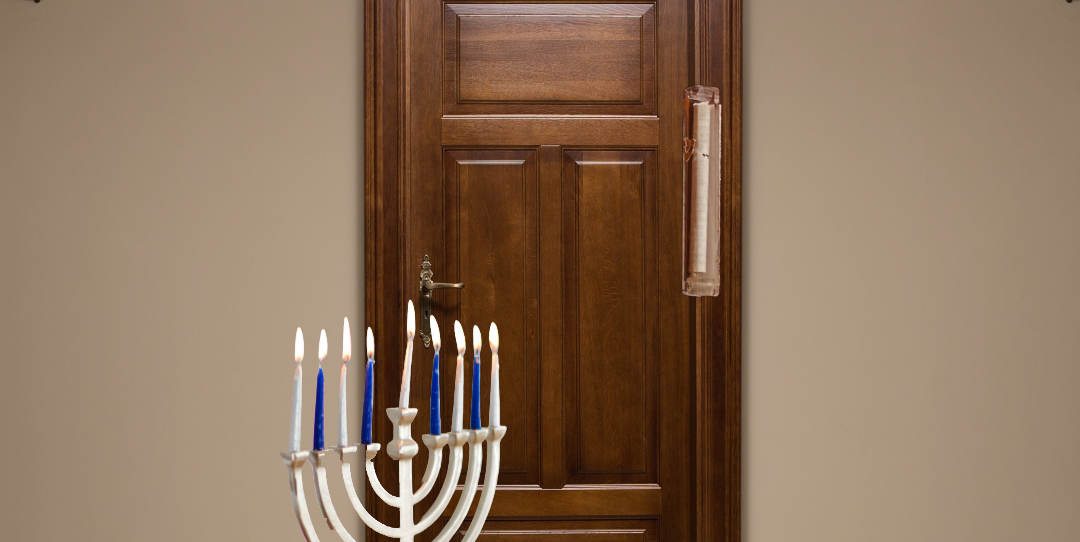
    As discussed in another post, most living outside eretz yisroel light their menoros indoors.

    Although chazal and the Shulchan Aruch rule that we should only light inside in times of danger, the Rema (672:2) states that the standard practice is to continue to light indoors.

    Above, we shared numerous approaches to this issue, ending with the words of Rav Moshe Shternbuch (Moadim U’zmnaim, vol. 2, p. 79) who suggests that just because we live in peace now does not mean that we should forget or abandon the concerns of the past, and that they may, l”a, revisit us at some future time, l”a.

    For obvious reasons, following the pogrom of October 7, 2023, his argument came to mind, and I repeated it in shul.

    After, a young boy asked, “Shouldn’t we also now cover our mezuzos?”

    Seeing the surprise on my face, he continued. “I understand that the obligation for a mezuzah is from the Torah, as opposed to Chanukah. But if the issue is sakana, why don’t we find chazal or poskim discussing covering or hiding it presence?”

    Sadly, it has not been only little boys wondering this:

    Do Not Take Down Your Mezuzos!” yelled the headline in The New York Times op-ed page right after the October 7th attacks. The article went on to state how some non-religious Jews were indeed taking theirs down due to fear.

    More positively, and on the other hand, reports have also been published of mezuzos being vandalized, R”l, causing a reaction to the other extreme: non-Jewish neighbors putting up (empty) mezuzos of their own! While potentially an issue of halacha, their intent is beautiful.

    I explained to this boy that there is a deeper significance here: The story of Chanukah is about surviving the culture around us. In our days, such chinuch, such light, must begin in the home. As we shall see below, I am not alone in this idea.

    Interestingly, Chanukah is in fact deeply rooted in the mitzvah of mezuzah.

    First, contemporaneously, relating to this just this year and the current eis tzara: I’ve heard from a very prominent sofer sta”m how there is now a shortage of klaf due to the fact that many Palestinian Arabs would do the stretching for the klaf and, obviously, are not now available (a frum yid always begins the ibud process lishmah, and with the Gentile there to hear, for more details, see Shulchan Aruch, siman 32:8 and Mishneh Berurua sif kattan 30).

    However, the connection to Chanukah and mezuzah runs far deeper.

    The gemara states:

    “Rabbah taught: ‘It is a mitzva to place one’s menorah within a tefach/handbreadth adjacent to the entrance.’ On which side does he place it? Rav Achah ben Rava said: ‘On the right;’ Rav Shmuel of Difti said: On the left. The halacha is to place it on the left, so that the menorah will be on the left and the mezuza on the right.” (shabbos 22a)

    Chazal are teaching that by placing one’s menorah opposite one’s mezuzah he will thereby be surrounded by mitzvos. Chazal here teach that by placing one’s menorah opposite one’s mezuzah, he will thereby be surrounded by mitzvos.

    Meseches sofrim expands on this:

    “…The mezuzah should be on the right, and the ner chanukah to the left. Thereby fulfilling the verse (Shir HaShirim 7:7) ‘mah yafis u’mah y’amt…-how fair and how beautiful-. ‘Mah yafis’ -is mezuzah; ‘u’mah y’amt’ is ner Chanukah.” (Sofrim 20:5; cf. Shir HaShirim Rabbah, 7:1)

    But why specifically mezuzah? What is its unique connection to Chanukah?

    The Shem M’Shmuel (mikeitz) shares that the goal of the menorah is m’bifnim l’chutz-to take the kedusha created in our homes and bring it to the outside world. Whereas the goal of mezuzah is in the opposite direction – serving as our home’s most vital ‘filtering’ system, placed based on our way of entering our homes from the streets of life; our cue to first strain any-and-all tumah.

    The Sefas Emes (Chanukah trn’t; see Sefer HaChinuch #423) explains that mezuzah ought to remind us of Hashem’s Torah u’mitzvos. After the yevanim wished for us to ‘forget Your Torah,’ we, dafka, wait until people are found in the street (tichleh regel) when they will then bear witness to the ner Chanukah and mezuzah – our constant symbiotic tools to succor our combat against the potent pull of regilos and tevious (culture and conditioning).

    As to connecting the leniency by danger in regard to Chanukah to that of mezuzah, the Shulchan Aruch shares that whoever is careful in mitzvas mezuzah will be protected for a long life; he and his family (yoreh deah, siman 285). In other words, there is a built-in structure of protection already. (Of course, and as the Aruch HaShulchan stresses, we do not keep this or any mitzvah due to any specified protection that it may bring, rather, and only, as a gezeira from Hashem.)

    In fact, it is not just ner Chanukah that we place opposite our mezuzos.

    Growing up, following sukkos, we would lean our lulavim on the left side of the doorway, opposite our mezuzah, until nissan when the dried lulavim fueled the burning of our chometz (see Rema, orach chaim, siman 664:9).

    Our mezuzos are uniquely empowered to bring an abundance of steady stimulus and koach, and also have the power to accentuate the other mitzvos performed in our homes (see further, Shir HaShirim Rabbah, ibid.).

    In fact, this is why we have the minhag to touch the mezuzah upon passing it. The Shulchan Aruch (see Rema, yoreh deah, siman 285:2) writes:

    “Some say that when one leaves a house/doorway, he should place his hand on the mezuzah…as well as when he enters.”

    One of the sources for this practice is the famous gemara (sanhedrin 11a), regarding the soldiers sent to bring Onkeles back to Rome (after his gerus). When they witnessed him touch his mezuzah, they asked for an explanation. Onkeles responded: “The way of the world is that a king of flesh and blood sits inside his palace while his servants stand guard outside; but with regard to Hashem, His servants sit inside their homes and He guards over them outside. As it is stated: ‘Hashem guards your going out and your coming in, now and always’ (tehillim 121:8).When kissing one’s mezuzah, it is brought, al pi kabbala, that one should use, specifically, his middle finger (‘amah’), kissing his finger after (Birkei Yosef, siman 285:2; see Taz, sif katan 5; see shu’t Rav Akiva Eiger 1:58 regarding touching the actual klaf).

    It is recorded, amazingly, how the Chasam Sofer once revoked a semicha after witnessing the young musmuch consistently ignoring the mezuzah when entering and leaving rooms (Maamer Mordechai [2007] p. 494)!

    May we, too, follow toras chazal and their guidelines in how to protect ourselves.

    May we have a safe and growing Chanukah, as we await the menorah of bayis shlishi!

  • Exploring Connections Between Joseph (Yosef) and Esther’s

    Peculiar Similarities Between Mechiras Yosef and Megillas Esther

    Many have written showing the connections between the parshiyos of Vayeishev, Mikeitz, Vayigash, and the story of Chanukah. However, what is most striking is that the story of Yosef does not read

    like any other in the Torah, in that this episode is laid out in over ten chapters, like a megillah. No other event or episode in the Torah is given this much Scriptural detail or space.

    Moreover, throughout the story of Yosef one can believe he is reading Megillas Esther—consider:

    • A king has trouble sleeping (41:4);
    • two men are punished for a crime against the king (40:1).1
    • A king’s party ensues, helping to lay out the foundation of as- tounding chains of events to come (40:20).
    • Someone was killed (by the order of the king) at said party because of their lack of proper respect for the king (sar ha’opheh, 40:22; although, in truth, Vashti’s death is only implied and is not written explicitly).
    • The protagonist is honored by becoming the ‘mishneh l’melech’ (see Ramban 41:43).
    • Also, he is repaid by being afforded the luxury of riding on the king’s horses while wearing the king’s clothing (41:42–43); Pharaoh removed his ring to place it on Yosef (41:42).
    • See Baal HaTurim 41:34, who makes a few grammatical and textual comparisons to Megillas Esther without further comment;
    • Yaakov, while “giving in” to an ultimate sacrifice, exclaims, “Ka’asher shacholti, shachalti” (43:14), which is strikingly and eerily familiar to Esther’s statement when she had to make the ultimate sacrifice, “V’cha’asher avadeti avadeti.” [Indeed, see Ramban (to 43:14), who also draws this comparison without further comment]
    • The Midrash Tehillim states: “You sold your brother, then sat down to eat…there will come a time when your descendants will be ‘sold’ by a feast as well (Esther 3:5), when Haman and Achashveirosh will partake in a feast and decide there to exterminate the Jews.”3
    • See Rav Hirsch on 43:32, that Yosef never revealed that he was a Jew, for that would have compromised his position. This is similar to Esther (as the megilla shares). (However, clearly, Pharaoh was aware that Yosef was Jewish – see Ramban to 41:45 where he explains the name Pharaoh gave Yosef as being from the Hebrew language, as a courtesy to this new leader. See, as well, 40:15, where it is apparent that Yosef revealed his lineage to the sar hamashkim, who in turn revealed it to Pharaoh there. We would be remiss not to mention that Yosef did not offer correction when he was called an “Ish Ivri“, and is indeed praised for this)
    • See Moshav Zekenim to 50:4, where he explains the need for Yosef to send a messenger to Pharaoh as being similar to Esther 4:2 (his comparison), that since Yosef, like Mordechai, was in sackcloth, it was not becoming for him to approach the king.
    • See Rashi to 37:3, where he correlates the meaning and translation of the kesones pasim (an essential element in Yosef’s story) to key words found in the Megillah; once we develop this connection between Purim and the story of Yosef, we can then investigate deeper into the story, so we even find drinking until the point of intoxication by the story of Yosef (43:34).
    • When Pharaoh is first introduced to us in Parashas Lech Lecha, we find Avraham hiding Sarah in order to save her from the king’s men discovering her beauty and reporting it to the king, exactly what happened in the story of Purim: both Mordechai and Avraham failed in this regard.
    • Both stories end with a seemingly unrelated recording of a mas (tax) levied on the populace of each story (see Rashi 47:25).
    • The Megillah ends with a pasuk (10:3) that says Mordechai was not loved by all. The Midrash explains this to mean that Mordechai was not universally loved because he was too involved in politics. The Gemara in Berachos 55a comments that Yosef died sooner than his brothers because he, too, dedicated too much time to politics.
    • See Megillah 16b, where verse 45:22 here—and Yosef’s favoritism to Binyamin as shown by giving him five times the clothing of his brothers—is explained to be an “homage” to the future grand- child of Binyamin, Mordechai, who would also wear five kingly garments (8:15). See also Ramban to 48:9. While I will leave it to the reader to darshen the true depths of these allusions, I share this in a Chanukah book so as to share the following: We have two Rabbinic holidays: Chanukah and Purim. How intriguing that we read the story of Yosef—along with its many shared Esther elements—during Chanukah, and we read the commandment of the Menorah at Purim time.

    NOTES

    1. This theme of two men and their plans or actions being of great consequence is a repeated theme: Moshe being confronted by Dasan and Aviram, who threatened to inform the king (Shemos 2:11); Mordechai, here; Yosef, here.
    2. As brought by Rabbi Meir Zlotowitz in his stupendous two-volume ‘Bereishis’ (ArtScroll, 1977), p. 1645, first column.
    3. Midrash Tehillim 10.
  • Halachos of Chanukah: A Basic Guide

    Halachos of Chanukah: A Basic Guide

    Rabbi Moshe Taub, 5786 -Written for YIH Membership

    Tonight, with the commencement of the 25th of Kislev, we begin celebrating the eight days of Chanukah.

    • These eight days were designated as Yamim Tovim (festivals) by the Sages, and Hallel is recited every morning.
    • Al Hanissim is inserted in the blessing of the Shemoneh Esreh and in the second blessing of Birkas Hamazon (Grace after Meals).[1] 
    • If Al Hanissim was omitted, the Shemoneh Esreh or Birkas Hamazon need not be repeated.
    • It is customary for women to avoid certain labors (actions avoided during chol hamoed) for the first half-hour time-period that the Chanukah lights must burn.

    The Lighting Obligation

    • All members of each household, who are above 12/13 years of age, share an equal obligation of lighting Chanukah lights.
    • The basic obligation is that each household kindles just one light on each night of Chanukah for all who live there.
    • Both men and women are equal in Chanukah’s lighting obligation and must make sure to light—or that Chanukah lights are lit—in their place of residence.
    • In this, Chanukah is no different from Shabbos whose basic law requires one to make sure that just one candle be lit in each home (chovas hadar). For Shabbos, we gift this mitzvah to women; on Chanukah, we gift this mitzvah to men. Although there is deep significance to this custom, the fact remains that men and women share the exact same obligation in both Shabbos and Chanukah candles.
    • Therefore, if there is no adult male (above the age of thirteen) in the household, the woman of the house must kindle. This is like Shabbos, where if there is no woman there, the man must still light.

    It is common practice that children kindle their own lights as well.

    Although one candle per night suffices, for centuries, it is common practice to follow the Talmud’s ‘Mehadrin min HaMehadrin‘/SuperBeautification method: starting with one candle on the first night and then adding one addition candle on each subsequent night.[2]

    When to Light

    • We should strive to kindle the lights about ten to twenty minutes after sunset.
    • The lights should burn for at least half an hour, but it is best if they remain lit until rush hour traffic ends, if possible, or until family dinner concludes (an hour or two).[3]

    Should one need to light LATER:

    In such cases, one should have an other member of the household light in the more-proper time. However, if this will harm shalom bayis or chinuch habanim then waiting to light later -when everyone is together-may be apt. A rav should be consulted.

    Assuming no one else is home during the proper lighting time, one may indeed light later[4].

    In extreme cases such as due to travel, etc., the lighting may be done at any point during the night, until daybreak, so long as others in the home are/will be awake. If one lives or is staying alone, or, if others in the home cannot be awakened for whatever reason, one may nevertheless light, and with the berachos.[5]

    Like with all other ‘passing mitzvos‘, one who is forced to light late must try not to eat a full meal before they light, or must at least create a shomer to remind them.

    If one needs to light EARLIER:

    • In cases of extreme need/circumstances (such as one who has a flight around lighting time), one may light as early as plag ha’minchah.
    • During this time of year, plag will come out to about 40 minutes before sundown. The exact timeframe should be checked on a website like: https://www.myzmanim.com/search.aspx
    • When lighting this early, one must still make sure that there is sufficient oil/wax for the light to burn for at least one-half hour past sundown.

    Friday/Motzai Shabbos

    • On Friday, the eve of Shabbos, the custom for well-over five-hundred years is to kindle the Chanukah lights prior to the kindling of the Shabbos candles.
    • One must make sure that at least one of the Chanukah lights will burn into Shabbos and through the entire half-hour period following sundown.
    • IN SHUL: Following Shemoneh Esrah at the conclusion of Shabbos Chanukah in shul, the Chanukah lights are kindled  before Havdalah.
    • AT HOME: one may follow the same order, or he may perform Havdalah first, whichever is the minhag of that house.

    Simply put: As opposed to in a shul, at home either order is fine (the reasons behind this are fascinating, yet beyond our scope here).

    Where to Place Lights

    Chazal demand that the lights be placed at or near the outer part of the doorway facing the street. The reason for this was to publicize the miracle.

    • HOWEVER…Nowadays, the accepted custom is to kindle the lights indoors, even on one’s kitchen table (!), so long as members of the home will see it.
    • In other words, the pirsumei nisa of today is fulfilled through those living in the home.
    • In fact, this was behind the motive for the minhag of Chanukah gelt –to keep the family inside awake whilst the flames are glowing (Avnei Nezer as brought in Siach Sarfei Kodosh; this would also explain ‘Chanukah gift-giving’. See also Emes L’Yaakov to siman 670, with footnote #582)
    • Nevertheless, it is appropriate and praiseworthy to place the lights where they will be visible from the street. Specifically, if possible, on the left side of an open doorway opposite the mezuzah or at least by a window facing the public domain.[6] 

    – One should not light outdoors in America (unless, of course, one has a specific custom otherwise) [6a] –

    • Ideally, the lights should be between 12 and 33 inches above the ground.

    To Recap:

    • Leaving the menorah on one’s kitchen table, etc., is sufficient.
    • The discussions of where to place the menorah (one’s window, door, etc.) are referring to a hiddur mitzvah (an extra beautification of the mitzvah).
    • While the ancient custom is for the kindling to be increased each subsequent night – one light on the first night, two on the second, etc. – in cases of need (like when in a hotel) the basic mitzvah can be performed by kindling just one light each night for an entire household, and this may be relied upon in cases of extreme need.

    The Procedure for Lighting

    • On the first night, one kindles the lamp at the extreme right of the menorah.
    • One adds one extra candle each night going to their left and begins lighting starting from there (the far left) and, from there, going right.

    Facing the menorah on, say, the fourth night, the left side of the menorah will be empty, and one starts with the candle on the far left and continues to the right until the first candle is lit.

    • There are alternative views regarding the order for placement and lighting that each home must follow. What is recorded above is simply the most common custom.

    What Type of Candle//the Myth of Olive Oil:

    • One may use any stable fuel or candle for the lights
    • While the Shulchan Aruch/Rema do suggeststhat some type of oil is preferred so as to recall the miracle, zecher l’ness [7], they do not mention Olive Oil.
    • While it is true that the Talmud teaches us that for both Shabbos lights and Chanukah olive oil is the most common and best stable fuel source, this law is omitted by the Shulchan Aruch (by hilchos Chanukah; he does indeed mention this regarding Shabbos -see my forthcoming sefer, iy”H, where all this is discussed).
    • Nevertheless, the common minhag today is to go out one’s way -when feasible – to use olive oil for Chanukah.
    • The Maharal suggests that using olive oil – and not just any oil – is an even greater zecher l’ness, although he is in the extreme minorty (see Dibros Moshe, shabbos who argues strongly against this position; See ‘Chanukah: Mysteries and Histories‘, Rabbi Moshe Taub, 2026, iy”H).
    • If olive oil is not available, any other oil which gives a steady and clear flame (that does not emit an offputting odor) may be used, due to the miracle happening through oil.[8]
    • Modern wax candles are also 100 percent permitted, so long as they will last through the times mentioned above.

    Sundry

    • As with any mitzvah that is dependent on time, once the time for kindling has arrived (around sundown), one must try to avoid excessive work, eating meals/washing, etc., before kindling the lights.
    • When lighting the menorah, the appropriate blessings are recited, with Shehecheyanu recited on the first night only.
    • Most Sefardim and Chassidim omit the word “shel” from the berachah of L’Hadlik Neir.[9]
    • Many Ashkenazim, however, keep that word as this is the version found in the gemara.
    • Each person should follow his custom. If one does not have a custom, either way of saying this berachah is fine, so long as a person seeks to remain consistent through the days of Chanukah.
    • One must light immediately following the berachos, without any talking or singing.
    • Therefore, even the recital of Haneiros Hallalu is only commenced after the first candle is lit.
    • Some have the custom to light all of the candles first before Haneiros Hallalu is begun. Either way, at least one candle must be lit right after the blessings, before speaking or singing.
    • The custom for close to eight hundred years is to sing Maoz Tzur following the lighting. This poem takes us on a journey through the many exiles of the Jewish People and speaks of our endurance and salvations at the hand of Hashem.[9a]
    • The period after the lighting is known as a special time for prayers, and we are encouraged to pray to Hashem for all of our needs.[10]

    If one misses a night of lighting, it can’t be made up, and one simply continues lighting the same number of lights as everyone else on the additional nights.

    • One may not derive any benefit from the burning lamps, and it is for this reason that we add the extra shamash candle, (i.e., in case we do benefit, it is considered to be from this shamash.)
    • Hallel and a special leining are recited each day of Chanukah during Shacharis.

    NOTES


    [1] See my forthcomingh sefer for several explanations why Chanukah is omitted from Mayan Shalosh.

    [2] This too will be discussed in detail in my forthcoming sefer, iy”H.

    [3] Kuntros Chanukah U’Megilah, in the name of the Brisker Rav, et al. Most poskim view this as merely a chumrah. Cf. Chazon Ish who would actually put out his Chanukah menorah after thirty minutes had passed (Neir Chanukah, os 17, in the name of Rav Chaim Kanievsky).

    [4] Shevet Halevi states that it is better for a person himself to light later than at the proper time through a shaliach.

    [5] See Shaarei Tzion, Orach Chaim 672:15 with Igros Moshe, Orach Chaim 4:105:7.

    [6] See link as to why in chutz la’aretz we made this change to light indoors.

    [6a] Ohr Zaruah 133:2; Sefer Ha’itur, Aseres Hadibros,Chanukah 114:2; See also Shu”t Minchas Yitzchak 6:67; Kovetz Shulchan Melachim,Kislev, 5766; see Yerech L’Moadim, p. 112; See Darkei Moshe, siman 671:9; See Chidushei Anshei Shem to Berachos 38a; See,Aruch Hashulchan 671:24 as well as Moadim U’Zemanim, vol. 2, siman 140, fn. 1; Cf. Shu”t Yaavetz 149, who allows, although does not urge, such encasements; See Shu”t Imrei Noam 2:22; Cf. Rav Elyashiv in Shu”t Kovetz Teshuvos 1:67, pp. 98–101.

    [7] See forthcoming sefer on this issue and its history.

    [8] See Mishnah Berurah 673:4,and chapter below.

    [9] See forthcoming sefer on this issue and its history.

    [9a] As to why we chose this pizmon for Chanukah, I would suggest two approaches: A) On a true chag one may not read or discuss sad events, B) Being the last of the established chagim of chazal, Chanukah can look back through history, C) On that theme, Chanukah was preview for-and is closest to -our the final galus, making it the appropriate time to look back at all prior exiles and their salvations, thus giving hope for our final salvation from our current exile.

    [10] This will be discussed in detail below .

  • Yehudis & Latkes: Solving Two Chanukah Mysteries

    For more on Chanukah see:

    Why We (still) Light the Menorah Indoors

    &

    Chanukah’s Absence from Mishneh & Brevity in the Talmud

    We are all taught as children about the heroine within the story of Chanukah, Yehudis. As we will show, there is a lot more here than meets the eye.

    I. THE KARTOFFEL KERFUFFLE
    Take a poll on what is the most common Chanukah food staple, and

    latkes would come in at number one, with sufganiyot nipping at their heels. However, fried potatoes are a very recent addition to Chanukah. While most assume that potatoes were first brought to Europe either

    by the sixteenth-century conquistadors or by Sir Walter Raleigh, either way they only reached widespread use during the mid-1700s. Indeed, the fact that most of us make the berachah Ha’adamah on potatoes proves how late potatoes entered Jewish kitchens.

    Briefly, some argue that the proper berachah should be Shehakol, like mushrooms. This is due to several halachic factors, and especially the fact that close to one thousand years ago the Aruch used an odd term to refer to these truffles: “tartfulls” (which I always assumed was simply a transliteration of “truffle.”)

    Some, especially early Chassidishe poskim, asserted that the Aruch was referring to a kartoffel, a term used for the lowly potato. While there are a number of reasons that most poskim argued with Shehakol being the berachah for potatoes, an important factor was the point that the Aruch could never have been referring to a potato, as he did not even know what they were back then.

    If latkes, while a nice minhag, do not and could not have any provenance in classic minhagei Yisrael—and are certainly not brought in the Shulchan Aruch—is there any truly halachic food on Chanukah? Yes, there is!

    II. CHEESE, PLEASE

    The Rama makes an interesting aside in the Shulchan Aruch.2 While discussing the lack of an official obligation to make a seudah on Chanukah, the Rama adds that there is an inyan to be marbeh b’seudos and to eat cheese on Chanukah. We have finally found a clear minhag relating to food on Chanukah.

    The explanation for this minhag is likely familiar to many. Cheese was one of the foods Yehudis fed the enemy so as to later trap and kill him. The Mishnah Berurah fills in the rest of the story: “Yehudis was the daughter of Yochanan Kohen Gadol and there was a law…so she fed cheese to a leading general so as to tire him. She chopped off his head [causing] the enemy to flee.”3 This is no small matter, and it is more than a story.

    The Gemara teaches that women are also obligated in mitzvas neir Chanukah because “they, too, were in this miracle.”4 While many Rishonim, like the Ritva,5 understand this simply to mean that they, like the rest of Klal Yisrael, were in turmoil, Rashi understands the reasoning differently. He explains that it means that they were at the center of our salvation. Without mentioning Yehudis by name, he gives us this same story as the reason that women are obligated in Chanukah lights.

    The Ran6 goes one step further, quoting an unknown Midrash. While he, too, does not mention her name, he does add to the story by claiming the heroine was the daughter of Yochanan Kohen Gadol. A few years later, the anonymous sefer Kol Bo puts it all together as we know the story today, resulting in the heroine being identified as Yehudis the daughter of Yochanan Kohen Gadol.

    In fact, Tosafos7 takes women’s centrality to Chanukah one step further. In the name of the Rashbam, it is stated that on both Chanukah and Purim, we were only saved because of the two famous women in each story, and for this reason, all women are obligated in these days, even though they are mitzvos bound by time. Rav Eliyahu Hakohen M’Izmir, the Orah V’Simchah, even wonders why, then, it doesn’t say in Al Hanissim

    Bimei Mattisyahu v’Yehudis”!8

    III. A CHANUKAH CHUMRA FOR WOMEN

    Because of the above, another halachah is codified. The Shulchan Aruch9 brings a minhag that women should refrain from doing melachah (accord- ing to most this only includes that which would also be forbidden on Chol Hamoed) during the first half hour that the Chanukah neiros are burning. Many wonder why this halachah/minhag is codified to apply specifically to women. While the Be’er Hagolah and many others simply explain that this is because it is more common that they are home at that time and therefore should have a reminder that they cannot benefit from these lights, others give another reason.

    The Mishnah Berurah explains: “This minhag is unique to women be- cause the neis happened through them!”10 Again, we see their centrality to this Yom Tov.11

    IV. WHO WAS YEHUDIS? WHO WAS YOCHANAN?

    If Yehudis was the daughter of Yochanan Kohen Gadol, would that not make Mattisyahu her brother? After all, we say in Al Hanissim, “Bimei Mattisyahu ben Yochanan Kohen Gadol.” In addition, which Yochanan is this? The Gemara teaches that one should not trust in himself until he dies, for Yochanan was a tzaddik and served as Kohen Gadol and then became a Tzeduki at the end of his life!12 Could this be the father of Mattisyahu, the father of Yehudis? If so, why would we mention him in a tefillah of praise? He left Toras Chazal!

    The Imrei Noam13 brings from the Vilna Gaon, and the same is brought in the Seder Hadoros, that in truth there were two Yochanans. The first is the one we mention in Al Hanissim. Mattisyahu would then have a grand- son that he would name after the baby’s great-grandfather, Yochanan. It was this second Yochanan who would go on to become a Tzeduki.14 There are still others15 who say that this Yochanan was indeed one and the same as the Tzeduki, and they each offer varying explanations as to why we still mention him by name in such a lofty tefillah recounting this neis.

    But the mystery is not yet over. Many wonder—like Rashi and others who assert that Yehudis’s story is so central to the neis—why Chazal do not mention it at all. It’s not even found in Megillas Antiochus. (Although, I would answer that the Ran indeed did seem to have a Midrash that discussed the story.)

    The Ben Ish Chai suggests that the story of Yehudis took place many years earlier and is only being remembered on Chanukah. This explana- tion requires further study, for it would make her father being named Yochanan Kohen Gadol a tremendous coincidence. It would also call into question Rashi’s view regarding the women’s obligation in mitzvas Chanukah being due to the story of Yehudis being so central to the neis. However, even the Ben Ish Chai still maintains that this story—although not during the classic Chanukah story—took place during the Greek rule over us.

    This is as opposed to Sefer Yehudis (of unclear origin, see below), which places her events in the time of Nevuchadnetzar. Indeed, Rav Yaakov Emden also states that this event took place during Bayis Rishon.16 Even if, according to other sources, this incident indeed took place during the Chanukah story, the piyut for the second Shabbos Chanukah names her Chanah, brother of Yehudah Hamacabi, continuing to add to the confusion.

    The Aruch Hashulchan combines many versions of these events and says that (as the first piyut for Shabbos Chanukah teaches) the Greek king was livid when he heard how the Jews killed his general after the wedding of the daughter of the Kohen Gadol; at a later time in the story, there was a woman named Yehudis who fed the enemy dairy. Like the Ben Ish Chai, he is asserting that these events did happen around the time of Chanukah, although not necessarily during the main events.

    In Megillas Taanis (the earliest work of Torah She’baal Peh), the story of Yehudis is recorded (by the date 17th of Elul) without her name, only describing the woman as the daughter of Yochanan Kohen Gadol. It also states that it was her brother Mattisyahu who avenged an evil act against her. This, to me, seems most authoritative and is also in line with the piyut mentioned by the Aruch Hashulchan. As for Yehudis, as he states, she must have been another woman who later took matters into her own hands.

    As we say each Chanukah and Purim when we delve into their various mysteries, there is so much more to minhag Yisrael than meets the eye. One thing is for sure: this Yom Tov, like Purim and geulas Mitzrayim, could not have ever occurred without nashim tzidkaniyos.

    NOTES

    2  Shulchan Aruch 670:2.

    3  Mishnah Berurah, ad loc., seif katan 10.

    4  Shabbos 23a.

    5  See also Tosafos to Pesachim 108b.

    6  Ad loc.  Megillah 4a.

    8  See also Yafeh L’Lev 5:682:2, as brought in Shiltei Gibborim to the Mordechai on the second perek of Shabbos.

    9  Shulchan Aruch, ad loc., seif 1.

    10  Mishnah Berurah, ad loc., seif katan 3.

    11  See also Pardes Yosef, Chanukah, pp. 149–50.12  Berachos 29a.

    13  Ibid.

    14  In a later chapter, “Chanukah’s Many Bracketed Words: Part II,” we further discuss who this Yochanan was and how his name—and perhaps more—can be included in our siddur.

    15  The B’nei Yissaschar as brought by the Klausenberger Rebbe in Divrei Yatziv, Orach Chaim 282; Divrei Shaul; Rav Sternbuch in Moadim U’Zemanim 2:137.Mor U’Ketziah 670.

    See Also:

  • Why We (still) Light the Menorah Indoors

    Why We (still) Light the Menorah Indoors

    December, 2023

    On Chanukah, unlike all other Yamim Tovim, there are no specific obligations throughout the day, such as matanos la’evyonim on Purim or a seudah on the Shalosh Regalim. There’s also no constant

    mitzvah like dwelling in the sukkah or refraining from chametz and no issur melachah like on Shavuos.1

    To this point, Rav Moshe Feinstein remarkably writes that outside the moment of lighting, one may not recite the berachah of Shehecheyanu during Chanukah because “these days of Chanukah have no greater kedushah than any day of the year…this, as opposed to, say, Yom Kippur, when we can say this berachah unconnected to a specific act because the day itself has special kedushah.”2It is therefore all the more peculiar that the one and only act unique to Chanukah—the lighting of the menorah—does not seem to be per- formed in the way initially designed. Let’s start at the beginning. The Gemara teaches:

    The Chanukah menorah is to be positioned by one’s doorway from the outside. If one lives on an upper floor, he should place it in a window that is adjacent to the public domain. In times of danger, it should be placed on his table and that is enough.3

    This is also precisely how the Shulchan Aruch records the halachah,4 indicating that when not in times of danger, like in, arguably, today’s America, one must light outside. However, later the Rama makes it clear that already in his days the standard practice was still to light indoors.5 This is largely the accepted practice, at least among Ashkenazim living outside of Eretz Yisrael.6

    Most Gedolim and their adherents still follow or followed this practice of lighting indoors. Is this still due to danger? And if so, would someone living in, say, Lakewood, with only frum neighbors, still have this same allowance? I cannot think of many other clear halachos found in Chazal for which our practice seems to veer from its basic structure.

    Even more confounding is that in every other element of this mitzvah, we perform it mehadrin min ha’mehadrin, adding one extra candle for each night instead of the basic one per night and having others in the house light in addition to the father.7 Moreover, Chanukah was always set apart with this precise unique quality in that its pirsumei nisa was to be done outside and in public, as opposed to the “inside” pirsum ha’neis of Purim done in shul.8 Why, then, would we agree to take this distinctivenessaway? The Brisker Rav, for example, was very careful to light outside, considering that to be an essential part of the mitzvah.9 In fact, if ever he had to light inside due to a concern, he would relight outside if that risk went away; in this, he saw the din comparable to mitzvas sukkah.

    Rav Elyashiv, too, strongly opposed the idea that nowadays, in locations where it is safe, we must still light indoors. For, if this is no longer the halachah, “for whom was that clear law in the Shulchan Aruch written? Even the Rama does not comment at that place.”10 Nevertheless, most poskim do not seem to take this strict approach, with Rav Moshe Feinstein even stating that today “it is not possible to light outdoors.”11

    Why should this still hold true? Some early Rishonim mention this minhag of not lighting outdoors, yet they often also urge one to at least light inside the doorframe of their home, facing the street.12 Nevertheless, the basic halachah allows one to simply light anywhere visible in their home—on a dining room table, for instance. Many approaches have been offered throughout the centuries to this question.

    Already in the twelfth century, the minhag among many was to light indoors, causing the Ohr Zarua to wonder, being that there are no longer any dangers, why should we not light outside?13 And this was nine hundred years ago. While he does not provide an answer, a few decades later, the Sefer Ha’itur does, writing, “U’meiachar she’nahagu al hasakanah, nahagu.”14 Meaning, seemingly, that although there may no longer be a danger, once we accepted this practice of lighting indoors, we retained it.15

    The words of the holy Baal Ha’itur are difficult to fathom. To give an extreme example to make the point, would we say that someone who worked at a truck stop as a teenager when he received an allowance not to wear his yarmulke due to safety concerns, still need not wear one twenty years later as a doctor on Madison Ave? Chalilah! Rav Yerucham Olshin offers a way to understand this Sefer Ha’itur based on how Rav Meir Soloveitchik would quote his father, the Brisker Rav: “Once our leaders were mesaken a new din of lighting indoors due to danger, this new takanah stands even when its reason ceases to exist!”16

    The Rama’s statement was based on the view of Rabbeinu Yerucham, who explained that the reason we light indoors is not just due to a physical sakanah but a monetary one as well, as thieves may steal one’s menorah.17 This concern would certainly still stand today. However, this reasoning would lead to an obvious question: Who said one must light with an expensive menorah? If indeed this is the reason for our present-day minhag, why not then light with Coke bottles (cleaned and stripped) so as to perform this mitzvah in its proper location?

    One may be tempted to suggest that the Rama in Darkei Moshe was concerned for the view of the Raavad who posits that hiddur mitzvah (i.e., using a silver menorah) is a Torah law,18 which would then, indeed, require one to light indoors with a nice menorah instead of outside with a makeshift menorah. This is because the Torah law of beautification eclipses the Rabbinic placement of the menorah. However, this would be a stretch, for the very mitzvah one is beautifying is a Rabbinic one, so how could the commandment to beautify it be Biblical?19

    Many others give a more technical approach to our still lighting indoors. While a sakanah may no longer exist, most Jews moved to northern countries where the weather during Chanukah is cold, windy, and wet. The Ritva quotes his rebbi as telling him that if it is windyoutside, one should light indoors;20 and the Ritva extends this to many other weather-based concerns.

    Rav Amram Gaon states the same. This would explain why many of those outside Israel, who indeed light outdoors, purchase special glass containers to protect their lights from the elements. The reader should, however, note that not all poskim allow for such encasements.21

    The Shu”t Imrei Noam22 finds an answer to our question from Chanukah’s original source: Megillas Taanis, a sefer written by the Tanna Rabbi Chananyah ben Chizkiyah, delineating more than thirty special dates and events we are to celebrate.23

    Amazingly, it states there: “Should one fear from leitzim [ridiculers], then one may light by the door inside one’s home.” Meaning, aside from the issue of sakanah, wind, and robbers, there is another concern: scoffers.

    From the B’nei Yissaschar,24 it would seem that these leitzim were cynical Jews who would challenge the propriety of either a public display of love for Hashem and for His Torah or, perhaps, our very fight against the Hellenistic forces. And so we light indoors. This is quite different from a concern for other nations.25

    Rav Moshe Sternbuch offers another powerful approach: The fact that there have been times, like today, when we live in relative peace does not mean that we should abandon the protections needed by others today (e.g., Iran) or that we may need at some future time, lo alenu.26 He cites a number of proofs to such halachic thinking, and also reminds the reader of Rav Yisrael Salanter who, during a cholera outbreak on Yom Kippur, urged everyone to eat so that those sick would then certainly eat some- thing. We see from here that sometimes we all must sacrifice halachah’s

    “best practices” so that it can be preserved for everyone’s future.
    For example, the Chanukah following the pogrom of Simchas Torah 5784, I was asked by many people if they may light on their kitchen table instead of by the window. In galus, we should never act with certainty.

    A final approach is one that I have often suggested. In preparation for this chapter, I was delighted to discover that Rav Yeruchum Olshin suggests something similar.27, 28

    This approach requires some brief context. Rashi gives an example of what Chazal mean by a sakanah that allows or forces our lighting indoors: when the Persians did not allow anyone to light candles outside the Persian batei avodah zarah. The Bach expresses amazement at this example. That decree applied equally to non-Jews, so it could not have been describing a time of shmad (when Jews must risk their lives for any mitzvah or social value). How, then, can this be Rashi’s paradigm case? For such a severe situation, we would be halachically dissuaded from even lighting indoors.

    This Rashi also seems redundant. Do we even need an example of “a danger”? Why does Rashi feel he needs to share an example for some-

    thing that we can all sense? I would therefore suggest that this Rashi is seeking to provide us with something far deeper than a simple example. Chazal share that following the Churban Bayis Sheini, we nullified the celebratory days found in Megillas Taanis, as we can’t be celebrating every other week while mourning our exile.

    To this, the Gemara asks a stunning question: Why, then, do we still celebrate Chanukah? After all, Chanukah’s origin is found in this same text. The Gemara offers only one reason for keeping only Chanukah out of all the holidays in Megillas Taanis: the people have accepted Chanukah and its mitzvos.29

    Perhaps what the Gemara is suggesting is that along with remembering the neis of Chanukah during these days, we also recall the affection and sacrifice that Klal Yisrael had for this mitzvah. And, for this same reason, we light even when in danger, albeit indoors. Rav Olshin takes this idea even further: Because the menorah represents the light of Torah (which is perhaps why the klal did not wish to forgo these days), we are obligatedto risk our lives for it. All of this would explain why Rashi chose Persian times as the example of sakanah rather than examples from the times of the Gemara or in his own lifetime, for example, the Crusades of 1096 that he composed Selichos for. Our still lighting the menorah indoors today is a surreptitious memorial of such “indoor lighting sacrifice” in times of historic danger. We are also commemorating lighting the Chanukah candles indoors in times of danger, even though that original sakanah allows us to forfeit lighting completely.

    Our present lighting indoors represents not a leniency but a great act of stringency. Thus, our retaining the minhag of lighting indoors is not simply to avoid a danger that no longer exists; on the contrary, it is to recall such mesirus nefesh for this mitzvah in times of danger, when we lit inside even though we didn’t have to light at all.

    The Gemara states that because Jews have always risked their lives for milah, it will always be observed.30 Indeed, even today, the not-yet-frum, as well as the frum, largely perform brissim. Perhaps the similar sacrifice for our past Chanukah lighting in times of danger (even if indoors) is why Chanukah, too, is kept by so many of the non-observant today.31 According to Pew Research, while 56 percent of all American Jews own a Seder plate, 81 percent own a menorah!32

    The Minchas Elazar mentions that the B’nei Yissaschar had a glass encase- ment ready for when Mashiach will come and he can again light outside.33

    May we see that day soon.

    NOTES

    1. Note that even on Purim, in addition to its many other obligations, they initially wished to restrict all melachah; see Megillah 5b.
    2. Igros Moshe, Orach Chaim 5:43:2, confirmed firsthand with the original handwritten letter to Rav Levovitz, with whom I spoke. We should note that with this p’sak, Rav Moshe acknowledges that he disagrees with the Chafetz Chaim as recorded in Shaar Hatzion, siman 676:3. We should also point out that the Meiri to Shabbos 23b would seem to support the Chafetz Chaim. Meiri there records a view that if someone is without the ability to light a menorah, he may still make the She’asah Nissim and Shehecheyanu berachos during the days of Chanukah. Some readers may assume that having a Rishon say this would mean that Rav Moshe, had he been aware, would have acquiesced in his position. However, this is not so simple to suggest. For one, Meiri is simply recording what others have said, and perhaps even he disagreed. Second, just because one Rishon takes a view does not mean that other Rishonim would have consented. But number three is most crucial: Rav Moshe, in a separate teshuvah (coincidentally, also about something found in a newly discovered Meiri), makes clear that newly published Rishonim must be carefully considered before utilizing them for actual p’sak halachah. This is not due to these specific Rishonim themselves, of course, but rather to the lack of critical study of these manuscripts over generations, as well as uncertainty as to who the many copyists were for all these years.
    3. Shabbos 21b.
    4. Siman 671:5.
    5. Siman 672:2. On the oddity of the Rama waiting until here to make this comment and his initial silence, see Rav Elyashiv, below.
    6. Cf. Rav Ovadia Yosef in Chazon Ovadia, Chanukah, p. 37.
    7. See Shabbos 21b.
    8. See D’rashos Chasam Sofer, 5592, Chanukah; see also Rav Soloveitchik, as brought in V’Dibarta Bam, Chanukah, p. 113; Inside Chanukah, pp. 190–91.
    9. See Kuntres Chanukah U’Purim 3:3; Yerech L’Moadim p. 107; see, however, his views as brought by others below.
    10. Shu”t Kovetz Teshuvos 1:67, pp. 98–101.
    11. Igros Moshe, Orach Chaim, 4:125.
    12. The significance of a doorframe will be discussed below, in the chapter titled “Are Our Mezuzahs Kosher?,” page 134.
    13. Ohr Zaruah 133:2.
    14. Sefer Ha’itur, Aseres Hadibros, Chanukah 114:2.
    15. See also Shu”t Minchas Yitzchak 6:67.
    16. Kovetz Shulchan Melachim, Kislev, 5766; see Yerech L’Moadim, p. 112.
    17. See Darkei Moshe, siman 671:9.
    18. See Chidushei Anshei Shem to Berachos 38a.
    19. See, however, Orech L’Neir to the first Mishnah in Makkos; see also Shabbos 23a that lighting neir Chanukah is a fulfillment of the verse “lo sassur,” which may mean that while the lighting is Rabbinic in nature, its beautification can still be a Biblical fulfillment.
    20. Shabbos 21b.
    21. See, e.g., Aruch Hashulchan 671:24 as well as Moadim U’Zemanim, vol. 2, siman 140, n. 1; Cf. Shu”t Yaavetz 149, who allows, although does not urge, such encasements.
    22. Shu”t Imrei Noam 2:22.
    23. This sefer will be discussed at length in the chapters that begin on pages 50, 82, and 106.
    24. As brought in a footnote to Piskei Teshuvos, siman 671.
    25. This is not a concern of the past. Indeed, one of the most celebrated public intellectuals of the twentieth century, Christopher Hitchens (who was a Jew who found out about his Jewish background at the age of forty, when his mother was lying on her deathbed), once horribly wrote against, of all holidays, Chanukah, based on this very cynical outlook of fighting the Hellenists: Jewish orthodoxy possesses the interesting feature of naming and combating the idea of the apikoros or “Epicurean”—the intellectual renegade who prefers Athens to Jerusalem and the schools of philosophy to the grim old routines of the Torah…the Greek or Epicurean style had begun to gain immense ground among the Jews of Syria and Palestine. The Seleucid Empire, an inheritance of Alexander the Great—Alexander still being a popular name among Jews—had weaned many people away from the sacrifices, the circumcisions, the belief in a special relation- ship with G-d…I quote (from a contemporary rabbi), “Along with Greek science and military prowess came a whole culture that celebrated beauty both in art and in the human body, presented the world with the triumph of rational thought in the works of Plato and Aristotle, and rejoiced in the complexities of life presented in the theater of Aeschylus, Euripides, and Aristophanes.” But away with all that. Let us instead celebrate the Maccabean peasants who wanted to destroy Hellenism and restore what they actually call “old-time religion.” Thus, to celebrate Hanukkah is to celebrate the triumph of tribal Jewish backwardness. A celebrated atheist, Mr. Hitchens would often debate faith and challenge his interlocutors, asking what possible virtue would be lost without religion or what could be gained with it that would not already be obvious to him. Aside from the false premise of this question—as his present morals were so obviously relying on the remnants of religious culture from whose crumbs America and the Magna Carta were formed—the above paragraph regarding Chanukah best displays the nakedness of his challenge. I refer to the bias of seeing inherent honor in the “new” versus the old, of allowing the nebulous winds of time and the capriciousness behind how “the vogue” takes hold and the arbitrary nature of who is given the power to introduce it, and the mysterious sociological quirks behind which fashions capture a time or place. Absent the safety net of a moral identity, to be untethered to a constitution, is precisely what leads to his article—of judging virtue on modern dress rather than thoughtful design, believing righteousness is found in the avant-garde rather than antiquity, and in the assumption that the peasantry must be as poor on the inside as they are on the outside. All this is anathema to Yiddishkeit. Yet, its pull becomes alluring to those unmoored from it. Truth is neither “old time” or “new”; it is unaffected by “tribal” acceptance or “tribal” neglect. Virtue is unbothered by new styles or last year’s fashion. Rather, truth is and will always remain simply that: truth. Judged not by time, unchanged by those who fail to embrace its legitimacy, it endures unperturbed by physical phenomena and social cues. Emes is emes.
    26. Moadim U’Zemanim, vol. 2, siman 140, p. 79.
    27. Ibid., p. 543.
    28. We will quote his words below.
    29. As explained by Rashi ad loc.
    30. Shabbos 130a.
    31. See chapter below, “Why Is There No Yom Tov Sheni on Chanukah Outside of Israel,” where the Pri Chadash draws an additional milah-Chanukah connection.
    32. Pew Research Center, “Jewish Americans in 2020,” May 11, 2021, https://www.pewresearch. org/religion/2021/05/11/jewish-americans-in-2020/.
    33. Nemukei Orach Chaim.
  • The ‘Secret’ Books of Chanukah: Megillas Taanis, Megillas Antioches, & the Books of Maccabees

    Rav Yosef Adler, zt”l, the Rosh Yeshiva of MTJ before Rav Moshe Feinstein. His version of Megillas Antioches is disccused below.

    December, 2022

    There is something about the story of Chanukah.

    Of all the events that we commemorate each year, there is no doubt that Chanukah is the one that many know the least about. As a child, I vividly recall my initial confusion when I first discovered that the events of Chanukah took place well after the story of Purim, and then, as I got older, discerning the dearth of a record of the events that are only passively recorded by chazal.

    It only became more confounding from there.

    Famously, the gemara only discusses, briefly, the ness of the oil (Shabbos 22b), while in al hanissim only the milchama is mentioned -and again, very pithily. Due to the ambiguity of these days in general, and its story in particular, we must ask regarding what the exact provenance is of the stories of Chanukah we do know.

    While in the last chapter we discussed why there no sefer in tanach detailing the events of Chanukah, and why chazal seemed to avoid detailing these days and its laws, here our focus is on what we do know and from where it comes.

    Let us start with a sefer mentioned many times in this volume: Megillas Taanis. This may be the earliest recording from our mesorah of the events of Chanukah.

    Megillas taanis was gathered, or written, or, completed during the time of the second beis hamikdosh, and then redacted, or canonized, or codified by the tanna Chananya ben Chizkiya.

    It delineates more than thirty joyous dates and salvations that our nation had witnessed.

    According to the Chasam Sofer, megillas taanis was written before torah sh’baal peh was chronicled in writing. This megillah was therefore only written akin to a luach, divided into the months of the year, with a sentence or two by certain dates.

    The Chasam Sofer goes on to explain that it was only later, during the period of the (later) tennaim, that the events behind these brief words were expounded upon in greater detail. For this reason, he explains, the gemara will quote from this megillah with the words ‘d’ksiv’ (as is written) – a phrase usually reserved for text from tanach or other such holy catalogues. However, he continues, when chazal quote from the fuller sections of this megillah, they use terms like ‘tanya,’ which is reserved for braissos and other tannaic/mishnaic writings.

    (See Chasam Sofer to rosh hashnah 18b; see Maharitz Chiyus, maamer Divrei Neviim, Divrei Kabala; see the introduction to the Oz V’Hadar ed. Megillas Taanis for other views.)

    With the words of the Chasam Sofer in mind, let us first read the earlier prose of Chanukah in megillas taanis.

    It reads simply as follows:

    “On the twenty fifth of the month is Chanukah, eight days on which we do not offer hespeidim.”

    Underneath this, in the section that according to the Chasam Sofer was added later by early chazal, we find more details added:

    When the Syrian-Greeks entered the heichel they made all the oil impure. Then, the chashmonaim overwhelmed them, and defeated them. They searched and could not find any [oil] but one container that rested with the kohein gadol’s seal, and that was not made impure. However, there was only enough for one day, yet a ness happened where it lasted for eight. The next year, they established this as a yom tov…At the time of the ness, they sang praises of thanksgiving…Since the Syrian-Greeks had defiled all the vessels, there was nothing with which to light. When the chashmoniam were victorious, they brought seven spits of iron and covered them with tin and began to light [as a makeshift menorah]…”

    It then goes on to record our obligation in the recital of hallel for each day of Chanukah, how we light the menorah outside of our homes, and the time frame of ‘mishetaka hachama ad sh’tichelh regel min hashuk.’

    According to the meforshim there, the few references in shas to Chanukah are taken directly from this text.

    However, readers may still not be satisfied, as they surely have heard more details regarding the Chanukah events than those recorded above.

    Where did those particulars come from?

    I recently learned the background of one of these mysterious sources of the Chanukah story, when a retired couple in my shul sold their empty-nest home after several decades in the neighborhood.

    They called me to kindly offer to look through any of their old books and sefarim before sending them to the trash/shaimos.

    I became like a kid in a candy store! I delighted in discovering disparate treasures: a first-issue record of Yosseleh Rosenblatt, several manuals for Jewish soldiers in World War II, and cheder rebbe-aid volumes from pre-war New York.

    One sefer in particular caught my eye. It was a pocket-size, black, very thin book -maybe fifty pages -in size. Its back jacket translated into English what was written on the front.

    “Megillas Antioches; Ness Chanukah – Scroll of Antioches -Miracle of Chanukah.”

    Now, many readers may be aware of this ‘megillah’, but what was even more fascinating about this edition is what was written underneath its title:

    ‘Mesivta Tiferes Yerushalim, 145-147 East Broadway New York City. 1936.’

    While most would associate this yeshiva with Rav Moshe Feinstein, this volume was published about twelve months before Rav Moshe would arrive in America (he would arrive the following kislev, in fact).

    The leader of MTJ at that time was Rav Yosef Adler. This gaon wrote a historical introduction to this volume for his yeshiva’s publication -what a find!

    Who was Rav Adler?

    A talmid of Volozhin, Rav Adler was a massive talmud chacham who arrived in America around 1910 (Toldos Anshe Shem, p. 1). While serving as a rav in New York, in 1924, he began teaching at Torah V’Daas. It was in 1931 when he was hired by MTJ. Soon before his shocking death in 1938 (by drowning, R”l), he hired Rav Moshe Feinstein, explaining to his talmidim, “No matter how much you continue to grow in your learning, you shall never surpass him!”

    In any event, he writes there (translated):

    “The chacham Tzvi Fillipowski discovered the manuscript of an Aramaic megilas antioches in the British Museum in London…Now the Mesivta Tifferes Yerushalim in New York accepted upon itself to distribute among the Jews this megillah in an Aramaic, lashon kodosh, and a new English translation. This so that we may know the true events of the miracle of Chanukah and the miracle of the oil from its most original source, from this megila whose ancient kedusha hovers above it. For it, and only it, has been seen through the eyes of our chazal…therefore it is a great mitzvah to print and publicize this volume, so that Jews do not follow the apocrypha…Perhaps it is due to the long-suffering exile, and our beaten down spirit, that this sefer is not known to most.”

    This ‘megilla’ opens with the familiar refrain borrowed, seemingly, from esther:

    Vayehi bi’mey antioches melech yavan, melech gadol v’chazak hayah v’sakif b’memshalto, v’chol ha’melachim yishm’u lo…”

    “And it came to pass in the days of Antiokhus, king of Greece, the great and mighty monarch, firm ruler over his dominion, to whom all kings hearkened…”

    While Rav Adler references a specific edition of this sefer (from Tzvi Hersh Filipowski, London), this ‘megillah’ had been known-and used-for millennia. In fact, its first known printing was in Spain in 1482 (see Antiochus, Natan Fried, 1966).  

    It was originally published in Aramaic, and according to many, it was first referenced in the ninth century in the gaonic work Halachos Gedolos (Warsaw ed., p. 174), where its authorship is attributed to none other than the yeshivos of Hillel and Shammai.

    A century earlier, the Behag had written the same thing about the megillah’s authorship (Hilchos Sofrim), although it is debated whether he was referring to the same work or to another Chanukah sefer (see below [MP3] for another ancient Chanukah sefer to which he may have been referring).

    In the tenth century, this ‘megillah’ is mentioned again by Rav Saadia Gaon (d. 942), who quotes from it under a different title: “Ksav Bnei Chashmonai.”

    Amazingly, he attributes its authorship to the protagonists of the story itself—the five sons of Mattisyahu!

    He writes:

    Kemo shekasvu bnei Chashmonai, Yehudah v’Shimon v’Yochanan v’Yonasan v’Elazar bnei Mattisyahu sefer b’mah she’avar aleihem”

    Like the sons of Mattisyahu, Yehudah, Shimon, Yochanan, Yonasan and Elazar wrote a sefer relating the events that occurred to them…”

    (Sefer Hagaluy)

    Although the sefer concludes with the destruction of bayis sheini – which would indicate that the heroes of the story couldn’t have possibly written it, at least not the entire volume – there are a number of possible resolutions to this.

    (See bava basra 14b-15 regarding some of the sifrei Tanach; see also ‘Inside Chanukah,’ note #571, for more possible solutions.)

    In any event, it would certainly make this the oldest mesorah for these events.

    The Tosfos Rid (d. 1250) refers to a minhag in his time to read this megillah publicly on Chanukah, but he asserts that no brachah should be made on it (his comments on Sukkah 44b, s.v. “v’chabit”).

    As for when it would be read, some older siddurim cite a minhag to read it on Shabbos at the end of minchah (after kaddish tiskabel), whereas others cite a custom to read it following the haftarah for Shabbos Chanukah. (For further study, see Kuntros Beis Aharon V’Yisrael, Kislev 1992, p. 111, Rav Nosson Fried.)

    What about the Book of the Maccabees? Do some of our stories of Chanukah derive from this work as well?

    First, it is interesting to note that the spelling and meaning of the word “Maccabee” is debated. Some say it comes from the Aramaic word meaning “hammer,” thereby describing their strength in battle.

    This would mean that we should spell it with a kuf (see Mishnah Bechoros 7:1).

    Others agree with this spelling but not with the meaning, arguing that the word is derived from Yeshayahu (62:2), where it means “to pronounce” or “to assert.”

    Another source for the name spelled with a kuf, explains its meaning as ‘hamatzvi’ or ‘the general.’

    Some then posit that, often, when translating into or from Greek, the tzadi is exchanged for a kuf.

    However, many spell it with a chaf, asserting that it is an acronym/backronym for “Mattisyahu Kohen ben Yochanan,.” Others posit that this spelling is to stand for “Mi kamocha b’keilim (Y)Hashem” (from shiras hayam, and which refers to the fact that Hashem is the director of all wars).

    While there are several books/sections to Books of the Maccabees, the first, and perhaps the second, may be reliable, or that are at the very least referred to in our sefarim.

    Some opine that this was the very ‘Sefer Chashmona’im’ to which the Behag was referring.

    Midrash Chanukah and other sefarim of mysterious origin are beyond the scope of our discussion here.

    There is still one final question to be answered: Why did chazal not simply choose to record the events of Chanukah more clearly?

    To this, I refer back a previous post where we shared the following two amazing ideas/sources:

    In his first maamar on Chanukah in Pachad Yitzchak, Rav Hutner shares a fascinating insight.

    Chazal ask, “Why is Esther compared to the morning (Tehillim 22:1)? They answer that this is to teach us that just as morning ends the night, so, too, Esther was the end of the period of miracles. In response to this, the Gemara wonders, ‘But what about Chanukah?’ The Gemara responds cryptically, ‘We mean to say that Purim was the last of the nissim to be recorded in writing’” (Yoma 29a).

    Here Rav Hutner finds an answer to our question. When the Gemara says that Chanukah was not intended to be written down, it is not describing, chas v’shalom, some sort of deficit in Chanukah; instead, it is defining its essence.

    The Greeks failed to defeat us. Although they sought to diminish the value of the Written Torah by watering it down with translation (the Septuagint) and their cultural influences (Hellenism), one can never take away the true secret of our survival—Torah Sheb’al Peh and mesorah. Because this is what saved us—and saves us still!—the story of Chanukah is transmitted largely by oral tradition, both in Tanach and in Mishnah! The Sfas Emes offers a similar idea (5684).

    Rav Yitzchak Sender offers a remarkable insight. The word “Chanukah” is given many meanings, such as “Chanu chaf hei, they rested (from war) on the 25th (of Kislev), but it also represents something deeper. There are 24 books in Tanach, and the canon “rested” when it came to the 25th book—the story of Chanukah!

    In fact, there is an even greater allusion to this idea. “Chanukah” stands for ches, eight (books) in nun, nine (neviim); vav, six (books) in chaf, nine (kesuvim); and finally, hei, five megillos!

    All of these ideas serve to explain why much about the events of Chanukah remains shrouded in mystery and why we rely on our mesorah for information about it more than with any other Yom Tov.

    May we embrace the mesorah and Torah Sheb’al Peh even more fully during these days.


  • Chanukah’s Absence from Mishneh & Brevity in the Talmud

    Many Approaches

    December, 2022

          Chanukah is most unique among our yearly yomim tovim.

              For instance, it is the only yom tov we have that was, at one point, annulled, only to later be reestablished – as the gemara in Rosh Hashana teaches (18b with Rashi). So much of the history and events surrounding Chanaukah are a mystery.

          We have covered many of these mysteries throughout the years, such as ‘who was Yehudis and in what era did she live?’ (a tremendous debate); is it true that Chanukah is the secret final day of Yom Kippur’s din?; what ness of Chanukah is our focus -the war or the oil? And, much, much more.

           But perhaps the one question relating to the mysterious nature of Chanukah that is most famous, and one that has vexed our gedolim greatly, is why Chanukah and its laws are entirely absent from mishnah. Unlike even Purim (another rabbinical festival) which has its own entire mesechta, Chanukah’s history and halacha is relegated to a few lines in the later gemara.

        Why?

         It may be tempting to some to dismiss this difficulty by asserting that Chanukah’s establishment took place after the codification and redaction of the mishneh, but this would be historically inaccurate. More peculiar,  the mishneh does, oddly, make references to Chanukah, although parenthetically. This fact only serves to strengthen our question -once we do talk about Chanukah, why not mention its special laws and mitzvos at all?!

         For example, the mishneh states that a store owner who places his lamp outside near the street is liable for any unforeseen damage caused. However, continues the mishneh, on Chanukah he would not be liable if his menorah enflames someone’s cargo (Bava Kama 6:6).

        Even when it comes to observant-adjacent halachos of Chanukah, there is some parenthetical references, here are some quick examples: one may bring bikkurim until Chanukah (Bikkurim 1:6); messengers are sent on certain months to let people know when rosh chodesh was, including kislev, due to their need to know when to begin Chanukah (Rosh Hashana 1:3); we do not establish fast-days on Chanukah (Taanis 2:10). Even more references are found in moed katan, megillah, and many toseftos.

         So then why not dedicate a whole mesechta on Chanukah, as we do for Purim? At the very least, why not mention any of Chanukah’s laws in any mishneh?!

        Many, many approaches have been offered, I will share some of the lesser-known and more fascinating ones:

    1. Rav Hutner’s Thesis

         My father shared with me last week how it was Rav Hutner’s yartzeit, and that he was reviewing the first maamer to Chanukah (Pachad Yitzchok, 1). There, Rav Hutner first asks an additional question: why didn’t the anshei knesses hagedolah allow parts of the story of Chanukah to be canonized in tanach?

        Some may feel that this question is far simpler to answer than our first: the books of tanach may only include those written in the era of nevuah. Since all prophecy ceased at the beginning of the second beis hamikdosh, there was no way to include the Chanukah narrative together with other sifrei kodesh written with nevuah/ruach hakodesh.

        Yet, Rav Hutner points out that it is deeper than that. Chazal tell us “Why is Esther compared to the morning (Tehillim 22:1)? To teach us that just as morning ends the night, so too Esther was the end of miracles.”  In response to this teaching, the gemara asks, “But what about Chanukah?” The gemara answers cryptically, “We meant to say that Purim was the last of the Nissim to be recorded in writing” (Yoma 29a).

          With this gemara, Rav Hutner answers both questions. When the gemara shares that Chanukah was not given to be written down, it is describing the very essence of this yom tov.     

            The Greeks failed because while one can try to besmirch the value of the written Torah by watering it down with their translation (the Septuagint) and with their cultural influences, one can never take away our true secret of survival –Torah sh’baal peh, and mesorah. Because this is the very element that saved us -saves us still! -we represent this fundamental part of the story of Chanukah by maintaining a largely oral tradition regarding its own events -both in tanach and in mishneh! The Sefas Emes has a similar idea (year ‘684)

          One of my father-in-law’s rebbeim in high school is the prolific Rav Yitzchak Sender. In one of his sefarim, he shares something remarkable.The term ‘Chanukah’ is given many meanings, such as chanu choff hei –they rested (from war) on the 25th (of kislev), however it also represents something deeper.

       There are twenty-four books in tanach, the anshei knesses hagedolah ‘rested’ for the 25th book -the story of Chanukah! In fact, there is even a greater allusion to this. ‘Chanukah’ stands for ‘cheis’, eight (books) in ‘nun’ nevium; ‘vav’, six (books) in ‘choff’  kesuvim, and finally, ‘hei’, five megillos!

        In any event, all of the above serves to explain why chazal wished to keep Chanukah limited in writing, both in tanach and shas.

    1. The Secret Mesechta

           We know that there are certain mesechtos of gemara in the Talmud Yerushlami that were written yet are no longer extant. In a similar vain, both the Vilna Gaon (in his son’s hakdama to Midrash Agadas Bereishis) and the Ben Ish Chai (hakdama to Rov Peolim) teach that there was a mesechta of mishnayos on Chanukah that has since been lost!

        On a related note, the Chida (Devarim Achadim, derasha 32) points out that megilas taanis -written before the mishneh and containing many celebratory dates along with their histories and practices -already shares with us the story and halachos of Chanukah. For this reason, there was no need to add its own tractate.

    1. Hidden Danger

       Many give a vastly different approach than the ones above. The Yerushalmi shares a story f a king whose daughter was born on Tisha B’av and he saw the Jews fasting. This daughter then died on Chanukah, and yet he saw us celebrating. He went out and killed Jews in response. Because of this incident – and also so as not to upset the then current Roman empire, or any galus home -we kept much of Chanukah to ourselves. (See, shu’t Tzitz Eliezar 19:26, and the shu’t Eidus B’Hayosef simam 15. Cf. Rav Reuvien Margolis in his Yesod Hamishen V’Arichta and shu’t Shoel V’Nishal 4:37 and shu’t Mikveh Mayim vol. 5 page 39 who focuses on the need to show outward fieldity to any host nation we are in, and the story of Chanukah nay be misunderstood by our Gentile neighbors)

    1. To State the Obvious

    For those who read the feature I wrote for the Sukkos issue on the history of Mechitzah in America, we stated there:

    “The following Chasam Sofer offers a fundamental rule of what chazal choseto explicate in greater detail when they regrettably had to write down the Torah sh’baal peh.   He writes (Chidushei Chasam Sofer, Gittin 78a) that chazal did not spend time on matters that were obvious and in full observance. He goes on to state some examples:                                                                                                                         ‘…in no place in the mishneh is it mentioned that we must put on teffilin, or that a four-cornered garment requires tzitzes…or the obligation on Chanukah to light candles…’”

    Although, many question why dafka Chanukah was known and obvious, and not a myriad of other dates and halachos that are explicated in the mishneh (see shu’t Beis Naftali 28, Yad Neaman to Shabbos 2a, and Iyun HaMoadim, chanukah, question #237)

    • The Famous Approach

    Although we quoted above an answer from the pen of the Chasam Sofer, he is also quoted as giving another explanation. The following is the most difficult of all the approaches, and yet the most famous. The sefer Taamei Haminhagim (chanukah, 847) quotes him as stating that this was due to the fact that the chashminoim, who were from Levi, took away the meluchah (kingship) from shevet Yehudah. Rebbe Yehudah Hanassi, known simply as Rebbe, who was the redactor/editor of the mishneh was a scion of Dovid hamelech and wished to ‘avenge’ their act of perfidy by omitting their events (see also shu’t Siach Yitzchak 359)!

       Some of the Chasam Sofer’s talmidim denied their rebbe said this (see, e.g. shu’t Mahariatz by Rav Yehoshua Aaron Weinberger, #78), as how can Rebbe simply omit Torah (see Horiyos 14a for the rules -from Rebbe himself-as to when to omit either someone’s Torah or their name)? However, many seek to find justification -and authenticity -in what the Chasam Sofer is quoted (see Kovetz Beis Ahron V’Yisroel, year 18, gilyon 104, p. 137).

       Some of the mysteries of Chanukah will have to wait to be answered when moshiach comes, when according to many Chanukah will still be observed (see Magid Meisharim from the Beis Yosef, parshas vayakhel).

       May we merit that day soon!

  • George Washington’s Menorah?

    George Washington’s Menorah?

    Not All Stories Are True

        A member of my shul was sitting shiva in Miami recently. When he returned, he shared that when he mentioned who his rav is, while many said “I read him in Ami” some others responded, “Oh, he is the one who writes about history”.

             Initially, I was slightly insulted by this. For ten months out of the year, this space is dedicated to halacha and rabbanus; why then would some only mention the summer series?

        However, the truth is, there is a lot in-common between halacha and, lh’aln, history, which is why I think I enjoy researching it over the summer.

         An example relating to Chanukah: several years ago, in the Chanukah issue, I wrote about the misconception many have in assuming that we seek to use olive oil for the menorah because it was part of the ness. However, we explained -based on Rav Moshe and many others – when one traces the true source for using olive oil, while the above reason is a nice idea, it is not at its center. It may surprise some to learn that the Shulchan Aruch (siman 673) never mentions using olive oil for the menorah at all, let alone as a remembrance of the ness! While the Rama (ad loc.) cites the view of lighting with olive oil, he does not give the popular inspiration behind the practice. In fact, the two early Rishonim who also mention using olive oil – the Mordechai and the Rokeach (cf. Kolbo) – never say that the reason is to commemorate the miracle. The Chofetz Chaim quotes the shu”t Mahari Bruna, recommending that we light with some type of oil since oil better represents the ness. Neither the Chofetz Chaim nor the Mahari Bruna mention olive oil specifically at all! See Dibros Moshe, Shabbos, perek 2, ha’orah 23 at length.

        Lahavdil, history too has similar misconceptions, that once repeated take on a life of their own. “Hamilton may have been Jewish” (not true) is a popular one, as is “RJJ was America’s first rav” (also, not true).

       Surprisingly, many books on American history often repeat from other books without tracing the legitimacy of an event. Unless a historian is a navi, or has a built a time-machine, everything they write must have some original source. I have therefore found it a wonderful exercise in being mevakesh haemes to write about history.     

         In addition, when one learns to keep tracing sources back to the original it can allow for new findings, as well as dispel old ones.

        A great example of this is the story of George Washington and Chanukah. In 2007 the Sydney Taylor Book Prize went to a children’s book titled ‘Hanukkah at Valley Forge’, by Stephan Krensky.

         The back flap of this book states: “This story…is based on facts…it is known that in December of 1778, Washington had lunch at the home of Michael Hart, a Jewish merchant in Easton, Pennsylvania. It was in the middle of Hanukkah, and when Hart began to explain the holiday to the general, Washingon replied that he knew already…”

       How did Washington know of Chanukah? The Jerusalem Post writes (December 7, 2016) about the winter one-year earlier:

        “The winter of 1777 was harsh…The soldiers stationed at Valley Forge had no inkling why they were there. In their midst was one Jewish soldier and it was the first night of Chanukah…he took out his menorah and lit one candle, recited the blessings…”

       It was also the eve of the Christian holiday.

        “The general [Washington], in person, stood by his side. He looked at him and said gently, ‘Why are you weeping? Are you cold my friend?’ The soldiear jumped to his feet and saluted. Then he said quietly, ‘I am weeping before my Father in Heaven…He controls the fate of millions… I came to this country because I was fleeing the persecution of tyrants who have forever oppressed my family, my townspeople and my nation. The despots will fall, sir, but you will be victorious!” 

    “Thank you, soldier!” The General replied heartily, and sat himself on the ground before the menorah. And what have we here?” he asked, full of curiosity. This is a Candelabra. Jews all over the world are lighting the first candle of our festival, Chanukah, tonight. This serves to commemorate a great miracle that occurred to our ancestors. They were only a handful compared to the massive armies, but they held out, thanks to their faith in G-d, and were granted a miracle

       The bright flame ignited a flame of hope in the weary General’s eyes and he cried out joyfully, “You are a Jew? Then you are descended from a people of Prophets! And you say that we will win the war?” “Yes, sir!” he replied confidently. The General rose, his face glowing with renewed hope. They shook hands heartily. Washington asked the soldier for his name and address and disappeared into the night.”

        Now a year later at the Hart’s home:

    The first Hanukah light was burning brightly on his [Hart’s] windowsill. Suddenly, there was a knock on the door. His wife rose to open it wide. To her astonishment, there stood President Washington. 

    ‘There is that fabulous light, the Chanukah light,’ he cried out happily, spotting the candle by the window. ‘That flame, and your remarkable words, kindled a light in my heart on that dark and bitter night,’ he reminisced. ‘We were in a tight situation then, and your words encouraged me so! They spurred me on with new hope.  

     ‘You will soon be awarded a Medal of Honor from the United States of America for your bravery in Valley Forge, but tonight you will receive a personal memento from me.’ With these words he placed on the table a gold medal upon which was engraved a Chanukah menorah with one light burning. Upon this medal was inscribed: ‘As a sign of thanks for the light of your candle. George Washington.’”

        Is this story true?

          Well, the first night of Chanukah in 1777 did fall out on the eve of their holiday. And…that is all I was able to confirm!

       Michael Hart was indeed  a frum Jew, indeed a local shochet. His daughter -from whom the fact that Washington once visited their home derives (although she makes no mention of Chanukah) -does describe her father: “Let it be remembered that Michael Hart was a Jew, practically, pious, a Jew reverencing and strictly observant of the Sabbath and Festivals; dietary laws were also adhered to, although he was compelled to be his own Shochet.”

       She also states, “Mark well that he, Washington, the then honored as first in peace, first in war, and first in the hearts of his countrymen, even during a short sojourn became for the hour the guest of the worthy Jew”.

       But, again, did this story take place -either in 1777 on the field of battle, or in a frum home the next year?

        First, the daughter from whose diary the above quote comes, was born in 1803 -four years after the death of Washington!

       In the 1888 book ‘Jews of Philadelphia’ it is recorded that the chair Washington sat in at the Hart home was preserved. This is also recorded in 1895’s ‘American Jew as a Patriot, Soldier, and Citizen’. However, none of these early writings make any mention of Chanukah (see also, ‘Hanukkah in America: A History’, A. Ashton, NYU Press).

        The story has expanded even more with time -an impossibility with true history. In I. Harold Sharfman’s ‘Jews of the Frontier’ the author writes, “Michael Hart’s wife, Leah, prepared a kosher meal…complete with latkes…it being the sixth day of the festival…” Wow! This story is getting better and better!

        While books such as ‘Consider the Years: The Story of the Jewish Community of Easton’, surmises that latkes were served, by the time  Sharfman tells the story it begins to snowball: “Michael wished the general well, expressing his hope the he, like the Macabees of old, would hammer and level the enemy as symbolized in the flattened pancakes enjoyed on this holiday…The commander-in-chief  presented the three hart boys with silver coins…”

       Now there is Chanukah gelt in the story?!

          Like latkes and Chanukah itself -as potatoes were only recently brought to West (cf. Ri Migash and the article we once wrote about the halachik history of fried foods on Chanukah) -the true connection between Washington and Chanukah is minimal at best.

        We do not need to embellish the past; our history is rich enough. And, the true history Chanukah is a powerful enough reason to enhance our dveykus to Hashem during these days.

  • Why Do We Light the Menorah In Shul?

    Why Do We Light the Menorah In Shul?

    Secember, 2020

    I.

    The Question

    Over the years, we have, b’chasdei Hashem, dedicated this space during Chanukah to share and uncover secrets, mysteries and enigmas relating to these days.

    These have varied from the complex – e.g. why there is no mention of Chanukah in al hamichya; the historical –e.g. sourcing the story of Yehudis; and even the mystical –e.g. is there really an issur of blowing out candles?

    This year, I wish to share the background to another puzzling element of Chanukah, one that speaks directly to the purpose, and name, of this column.

    Every yom tov has a ‘Shul’, or communal, element peculiar to it alone. For example, the first days’ nightly hallel’s recital –reserved for the hagada – is said by many in Shul as well as a part of, or following, maariv; only on Sukkos do we find a yom tov’s special mitzvah (the daled minim) carry an element that can only be done in a shul (the hakafos; on Shavous our batei midrashim are filled with the sound of, and the morning’s re-acceptance in, Hashem’s Torah.

    Chanukah is no exception to this pattern.

    Imagine if on Pesach night, after davening, the rav announces that the shul will say the hagada together first, before we all go home and perform it as a family.

    How odd this would be! The mitzvah on Pesach night is hagadita l’bincha –to say over the story at home, with one’s children – not in shul to ourselves!

    Why then on Chanukah –whose lighting requirement is ner ish u’beiso, davka on the home – do we light the menorah in shul?

    There is an important corollary to our question. Chazal state (Sukkah 44b) that although we can make a beracha on a mitzvah/chiyuv derabanan (Shabbos 23a) we do not –and can not –make a beracha on a minhag.

    This minhag of lighting in shul in not even found in the gemara. While the rishonim make clear that lighting in shul is a “minhag vasikin –a devout/precious custom” (shu’t Rivash 111, see below) – would not its beracha be a beracha l’vatala?!

    Let us explore the background to this unusual minhag, and the numerous explanations for it that have been given through the centuries.

    II.

    The History

    While I do not know precisely when this minhag began, I can surmise that it first became universal at some point after the mid 1300’s. In the late 14th century, the rav of Granada, Spain, Rav Amram, wrote to Rav Yitzchak ben Sheshes (d.1408) with eighteen questions. These shalios ran the gamut from queries relating to serious matters of marriage, money and death (shu’t Rivah 102-119).

    His tenth question was this rav’s concern over the minhag of lighting the menorah in shul, and with a beracha. We will quote the Rivash’s response below.

    It is then likely that this minhag, although peformed by some some time before this, was just then becoming popular.

    III.

    The Reasons and their Complications

    Rav Yosef Karo, in his Beis Yosef (siman 671), bring several ways to explain this minhag of lighting the menorah in shul –and with a beracha – including the answer the Rivash provided to Rav Amram.

    We will list each of his reasons –as well as further suggestions brought by other poskim –below, along with some of the difficulties in each:

    1. – Two years before Rav Yosef Karo was born in 1488, a likut of halacha, titled Kol Bo was published, whose author is today unknown. Rav Karo brings from here (siman 44) that there is nothing so novel about this minhag. Similar to how chazal instruct us to make kiddush Friday night in shul (Pesachim 100b) for the orchim (guests) and the aniyim (poor), we do the same for them in shul on Chanukah. The Levush (ibid.), Tanya Rabasi (35) and the Shiblei Haleket (185) also give this reason.

    There are many difficulties with this approach. First, when it comes to the comparison to kiddush in shul Friday night, Rav Karo himself rules (siman 407:2) that on Pesach night we do not make kiddush in shul because the community is required to provide every poor person with wine to perform this mitzvah at home. The same would apply to Chanukah whose mitzvah is at home! In fact, Rav Amram and the Rivash –although living before the Shulchan Aruch – both make this argument so as to dismiss this first approach!

    However, if one looks at some of the sources who offer this approach to the minhag the they add the fact that these poor people are sleeping in the shul, making it their guest-house for the nights of Chanukah. This explains not just why we light, but why a beracha is would be required.

    But this begs the question: today, when there are no guests in shul, why do we still light?

    This same question is asked by many regarding kiddush in shul Friday night: since there are no longer poor people or guests staying in the shul, how is this Kiddush -with no seudah to follow –still being performed?

    However, the poskim (see, e.g. Mishna Berrura 269:5, inter alia) offer a number of rationales for this practice. Amazingly, the 13th century shu’t Min Hashamoyim (siman 25) compares our ability to still make kiddush in shul with our ability to also light Chanukah lights with a beracha even though, in both cases there are no guests who need it!

    2- Next, Rav Yosef Karo brings another answer from the Kol Bo. We light in shul, and with berachos, to lay before the congregation the way to light and the order of the berachos.

    The fact that we would be allowed to recite a Beracha for such a need would make sense, similar to teaching a child to make a Beracha where Hashem’s name may be used (see, e.g. Shulchan Aruch 196:19).

    3-Finally, he brings the answer that the Rivash gave to Rav Amram: the reader may recall that last year we dedicated this space to discuss the minhag to still light indoors even though the danger seems to have passed. The Rivash suggests, that whatever the reason we no longer light outside, we still need a public display, a true pirsum haness, and shul provides this.

    This explanation brings with it many questions that are beyond the scope of this column (see, e.g. Igros Moshe oh’c 1:107 and Minchas Shlomo 2:51), but the most salient issue with this response is why make a Beracha? It is still but a minhag –even if to be mefarsem haness! To make matters even more confounding, the Shulchan Aruch itself rules (siman 422:2) –as is the minhag sefardim – that on Rosh Chodesh one does not make a Beracha on hallel as it is but a minhag!

    Rav Yaakov Emdin (Mor U’Ketzia siman 672) answers that on Chanukah the berachos themselves are a part of the mitzvah of pirsum haness!

    The rosh yeshiva of Lakewood, Rav Yerushum Olshin (Yerach l’Moadim, p. 194-195) gives an additional explanation how according to the view that we light in shuls simply because of the extra minhag of pirssum haness we can then also make a beracha. Based on the words of the Brisker Rav, he demonstrates that only a stand-alone minhag (like aravah) do we not a beracha on; however, a minhag that is represented by the action of a pre-existing mitzvah (such as lighting the menorah), we can!

    This explanation would seem to fit with the words of the Vilna Gaon. He explains our lighting with a beracha in shul on Chanukah as being similar to ur making a Beracha on hallel on Pesach night in shul. We may explain this connection as both hallel and hadlakos neros chanukah as being a cheftza shel mitzvah –a pre-existing commandment, even if now we are doing that same action/recital as a minhag.

    • –Finally -but by no means exhaustive! – Rav Moshe Shternbuch (Moadim U’Zmanim 8:89) suggests a novel understanding of this minhag of lighting in shul. Originally, the gezeira for Chanukah was just to hodos u’l’hallel. Indeed, in maoz tzur there is no mention of our lighting. Only later, when the beis hamikdosh was destroyed did chazal then institute a public lighting outside our homes. However, due to danger, we had to move that lighting inside. And so, as to retain a semblance of a public lighting –as chazal first established after the churban –did we then also choose to light in shul so as to retain a veneer of the original, public, mitzvah.

    There is much more to say on this topic –many more explanations to the minhag, and many more ramifications to each approach.

    But for now, let us end as we always end the Chanukah column –there are so many secrets in even the minhagim of klal yisreol!

    Wishing everyone a frelichin Chanukah!