Author: Moshe Taub

  • What Is Our Most Often Recited Pasuk?

    What Is Our Most Often Recited Pasuk?

    & The Sincerity of Converts

    July 2025

    Rabbi Moshe Taub

        A renown book on the in English language shares:

        “One writer laments the decline of spelling by noting: ‘An English examination at New Jersey’s Fairleigh Dickenson University disclosed that less than one quarter of the freshmen class could spell professor correctly’. I wonder, for my part, how many of them could spell freshman class? Just as a quick test, see if you can tell which of the following words are mispelled. Supercede; Conceed; Procede; Idiosyncracy; Concensus; Accommodate; Irresistable; Rhythym; Opthalmologist; Diptheria; Anamoly; Afficianado; Caeserian; Grafitti.

     “In fact, they all are. So was misspelled at the end of the preceeding paragraph. So is proceeding just there. I’m sorry, I will stop”

    (Bill Bryrson, The Mother Tounge-English and How It Got That Way)

        This brings me to a fascinating conversation I had with a beis din gerus candidate last week.

         Some of my favorite questions come from those on their path toward yiddeshkeit. We once had such a person, who grew up in the south as a deeply religious Christian, at our Shabbos seuda. After asking if there was any mystical or halachic significance to the small piece of carrot always found on top of gefilte fish (a smart observation, indeed!), he then announced, “I believe with every fiber of my soul that everything is found or alluded to in the Torah. Throughout history, Jews turned to Tanach to remind themselves how to deal with secular, sometimes evil, monarchies, how to maintain a Torah kingship, and reminding the Jewish nation not to put their faith in military might alone or in any powerful human coalition”.

       We all politely nodded in agreement. But he then shared his kicker: “But today, instead of kings, we have the spread of democracies. Too many Jews are putting their faith solely in political movements and parties instead of the Torah, (Rachama l’tzlan). Of course, democratically elected politicians are rarely to be trusted. So, my question is: Shouldn’t this be hinted to somewhere in Tanach?”

         Before we could suggest a response, he quickly answered his own question:

        “I recently learned that the colloquial term for a swindler, for deceit and subterfuge is ‘Bais Lavan’ (the house of Lavan). I asked my study partner what the literal translation of those words are and was astounded to discover that they literally translates to ‘White House’!”

         The famous words of Tosefes come to mind (yevamus, 47b, s.v. kashin), how the sincerity and carefulness in Torah and mitzvos found among gerim can, at times, even cause Hashem to judge the rest of us more punitively.

      This sincerity of faith allows for new insights and thoughts.

        A similar request for translation arose recently. I brought up that now that we met with the beis din again, we were at the point when he needed to learn lashon kodesh. Learning a new language is always intimidating and, often, was not on the convert’s radar.

       I explained that for now, “We only want you to be able to read Hebrew, so that soon you will to be able to recite shema, berachos, teffilah, etc.”

        I explained that it is better to daven in Hebrew – even if their understanding is not there for the most part- than in English or any another language (see Mishneh Berura, siman 62:3).

        “Don’t worry. Sadly, you will not be alone at the beginning. Even some Jews do not know the meaning of every word they are saying” (something the poskim lament).

         He was genuinely shocked at this discovery.

         After a thoughtful pause, he made the following brilliant observation: “The reason why many struggle with spelling in English is not because of some congenital human flaw, rather it is due to the simple fact that most native speakers are just that – speakers. Reading is not the most common relationship one has with English. So, rabbi, if you are correct that most read Hebrew even if they do not understand or speak it, that would mean that some Jews will know how to spell the words of Shemoneh Esreh even though they may not be able to translate them!”

          “I guess that is true”, I responded, “Although they certainly know the meaning of the most important teffilos”.

    But he wasn’t done.

        A few weeks later, after getting his feet wet in his Hebrew reading, he called to ask me the following:

    “I am certain then that there are some sentences or words that you or halacha feel I should know the translation for…”

       “Yes” I replied, “The opening to shema would be a very good start. But, again, let’s focus for now on you be able just to read”.

        A few more weeks passed, and he was getting anxious to practice his Hebrew in a siddur.

        “I know it would take me too many hours to say all the proper daily prayers. But maybe there are there certain words that come up most frequently? Perhaps we can start with those. This way, at least at the start, the little I say, I would understand.”

         I explained that even if he knew what those two or five most common words meant, this would not aid him in the context of a pasuk being quoted.

       “Oh, so verses from Tanach are used in our prayers?”

    “Sure. In fact, aside from what the Men of the Great Assembly composed, I would venture that over eighty percent of the siddur is made up by verses of Tanach”.

          “Ok, I understand. I started practicing the shema and the first blessing of shemoneh esreh in Hebrew each day”.

       “Good, I’m proud of you!” I earnestly shared, “It must be challenging to learn to read in a new language”.

        A few more weeks go by, erev Shavuos, and he called again. He asked a question that has been on my mind ever since.

    “Rabbi, can you share the most common verse in davening? I would learn how to say it, along with its meaning”.

        I said I would get back to him with the verse/answer.

    At first, I thought it was, “V’hu rachum yechaper avon v’lo yashchis, v’hirbah l’hushiv apo, v’lo irah kol chamoso//As for Hashem, He is merciful, He forgives iniquity and does not destroy, He consistently restrains His wrath, and does not fully awaken His fury”…” (tehillim 78:38). This pasuk is said in hodu, yehi kavod, Monday and Thurday’s tachanun, the daily uvah l’tzion, daily maariv, andmotzai Shabbos maariv. So, at least four times a day!

       But there is another pasuk said even more frequently. In fact, this pasuk is from the Torah itself. It can be said at least seven times daily.

        It is also said in yehi kavod, and said in birchas krias shema of both shachris and maariv. It is again repeated in uvah l’tzion, as well the daily maariv and, an extra time inthe motzai Shabbos maariv. It is also said every time we say aleinu. It is said once more daily in krias shema al hamita.

       This was the perfect first pasuk to tach this soon-to-be-ger, and not just because of its frequency.

        Indeed, this one pasuk encapsulates Yiddeshkeit, which may be why it is said with greater frequency than any other.

       The pasuk?

        It comes from the shiras yam suf, Shemos 15:18: “Hashem Yimloch l’olam va’ed//Hashem will reign for all eternity!”

         He could not have been more delighted with my answer.

  • May Paper/Plastic Cups Be Used For Kiddush?

    May Paper/Plastic Cups Be Used For Kiddush?

    Doubled Kiddush Cups and Vacation Sundry

    Rabbi Moshe Taub

    January, 2024

           “Can one toivel a new utensil in the various lakes surrounding Champions Gate in Orlando?”

          I get this question at least once every ‘Yeshiva Week’.

       For those unfamiliar with the above neologistic term for winter vacation -as I was when I first arrived in Queens- do not fret, as it has its own Wikipedia entry!

    “Yeshiva Week is the informal term for a vacation period occurring annually in mid to late January, in which many Jewish day schools and yeshivas afford time off to their students. It is primarily a North American phenomenon…

        Rabbanim could give weeks’ worth of shiurim focusing only on the most common ‘vacation’ shailos.

    From the common:

         “We are driving to Florida and will be breaking up the trip with a hiking trail/park where we will also be spending the night. Would a new teffilas haderech be required the next morning when we get back on the road toward Florida?”

    To this classic:

        “May I ask or hint to hotel staff to open my hotel room door on Shabbos?” [See this author’s article in the yarchon HaEmek, 2005, “Ha’Milon B’Halacha” (hotels in halacha)]

         When I lived in Buffalo, the most common shailah among visitors was:

    “Does one make the beracha oseh maaseh bereishis upon seeing Niagara Falls?”

        I had the good fortune to discuss this latter shailah with many poskim who would frequent that shul, such as Rav Belsky and, lhbchl”ch, Rav Shlomo Miller.

    Rav Asher Weiss was once davening by us and chose this question as his topic when he spoke to the shul following shacharis.

          A summer guest visiting Buffalo once shared the following story:

        Rav Dovid Feinstein and Rav Meir Zlotowitz were once travelling together, and arrived at the Grand Canyon. Rav Dovid expressed uncertainty if this same beracha of maaseh bereishis may be made. As they were conversing about the intricacies of the question, the sky precipitously darkened and suddenly began to grumble. A crash of lightning ignited the darkened atmosphere, if for a moment. That was enough time to be able to say the beracha (on the lightning) and have the Grand Canyon in mind!

          One may think that there is a need for a unique sefer focusing only on the myriad potential as the most common vacation shailos, if not for the fact that some sefarim already include sections on that topic. For example, one of the chelakim of ‘Shoshanas Yisroel’ (Toronto, 2021), by Rav Mordechai Kanner, has an entire subsection dedicated to inyanei chofesh, along with the psakim of Rav Shlomo Miller.

           In this post we will focus mainly on just one ‘vacation shailah’. I am choosing this question because it is not only common when away for a Shabbos, but also arises from time-to-time even when at home.

        This shaliah may also serve as a lesson in other ways, as we shall see.

           May a disposable cup be used for kiddush on Shabbos? What about glass cups found in one’s hotel room/rented vacation home?

         There are many issues here to unpack – pun intended – and we will seek both clarity and brevity.

    However, we must start at the beginning:

         The Shulchan Aruch (siman 271:10) rules that the kos kiddush shares its rules with the halachos for the kos of bentching (siman 183).

     Among other rules, this would. mean that the kos for kiddush mustn’t be:

    • cracked
    • chipped
    • have holes

        While a wobbly base may be fine, it is best to use another nice kos if available.

    If no other kos is available, many posit that one may then use a damaged one, so long as it fulfills the most basic requirement of kiddush:

    • It must securely hold a reviis of wine (between 3.5 and 5.5oz), without leaking.

        If even this is unattainable, then I suggest that one should simply make kiddush on the actual bottle of wine! (I infer this from the words of Rav Vosner, Kovetz M’Beis Levi, vol. 3, p. 70; this is also explicitly stated in Piskei Teshuvos, siman 271 note 246; Rav Scheinberg is also quoted saying the same by Rabbi Simcha Bunim Cohen, The Radiance of Shabbos, p.82 note 4).

         While all normal cup material (e.g. glass, ceramic, plastic, etc.) would be acceptable, it must be a serviceable utensil; a usable kos. Of course, there is a hiddur mitzvah -as with many mitzvos – to seek silver.

    Relating to the popularity of using silver for mitzvos, a quick-yet-fascinating aside: Why is silver sought, and not the more prominent gold? Why aren’t there ‘Gold Stores’ in Lakewood and Yerushalaim?

        Some explain this ‘silver custom’ as stemming from the fact that ‘kos’ is the same gematria as ‘elokim’, a name of Hashem that represents His din/strict justice. To balance this, we avoid gold which too represents din due to the chet of the egel hazahav/golden calf. In addition, silver balances the ‘din’, as it represents rachamim/mercy (see Kaf Hachaim; perhaps this is due to the mitzvos that are performed through silver, e.g. pidyon haben).

          Indeed, the Chovas Yair states that while all ordinary materials are fine, if one had a choice between silver or glass, silver should be chosen.

    Surprisingly, Rav Yaakov Emden quotes his father the Chacham Tzvi that when one is faced with such a choice – glass is preferred! Although the latter is a minority opinion, it is based on a chazal (berachos 51) and a halacha (271:10) that urges one to gaze at the kos shel beracha during kiddush (in addition to looking at the Shabbos neros). The Chacham Tzvi understands this as meaning looking at the actual wine inside the kos (see Kovetz Halachos, Shabbos vol. 1, p. 387 note 23 for more sources).1

         Either way, glass (and all common materials) would certainly be acceptable for kiddush, and almost all hotels and vacation homes have glass cups. Could these, possibly-treif, cups be used for kiddush?

        Without getting into the minutia, many respected vaadim allow caterers to utilize a hotels’ (cleaned) glassware for cold items and beverages. If you’ve ever attended a kosher gala or event at a fancy location the chances are high that you drank from such a glass (and sefardim are even more lenient regarding glass).

           But assuming such glasses aren’t available, or if one’s rav says they should be avoided (perhaps due to wine/whiskey’s charif status), could disposable plastic cups be utilized?

    Plastic’ or ‘Paper’ is not the issue; rather it its intended disposability.

    Is a one-time use cup considered a halachic ‘cup/utensil’?

          The same question would be true for those new ‘fancy’ kos-like disposables, that are made to look like silver kosos, are cheap plastic, and come in packs of twenty.

    Never mind their look, if the driving intention of both its manufacturer and the consumer is for one-time use, these ‘fancy plastics’ may be no different than cups from Walmart.

      (Our question is not to include those flimsy paper cups found by water coolers which are most certainly unacceptable – as it can’t hold liquid with any confidence).

        In 1968, Rav Moshe Feinstein confirmed (Igros Moshe, oh”c, 3:39) that he indeed doesn’t allow even the stronger disposables for kiddush. Although, he writes, if one is stuck one “…may have reason to be lenient”.

       Others, such as Rav Nissan Karelitz, are more pragmatic, stating that if in one’s region such cups are at times used more than once (like on vacation, perhaps) then conceivably they may be used for kiddush (Chut Shani, shabbos, vol. 4 p. 95).

       Others, such as Rav Scheinberg, fully allow plastic throwaways to be used for kiddush, stating that they have the status of a full-fledged utensil.

         If one is stuck it would seem best to use either the hotel glass cup or a non-paper disposable cup.

         What about those who we see double-up a plastic cup and then make kiddush? Does this help in any way?

    I would contend that this practice is derived from a misplaced halachic memory; a remnant from the days of cheap paper cups, when, in a situation where one had to rely on disposables, one would have to double-it; just so it wouldn’t leak the shiur!

    It seems to me, la”d, that this has no relevance to our stronger disposables (however, some talmidei chachamim may still be doubling up plastic disposables for another reason: in case those watching will copy him one day, and do so with flimsy cups. By showing them the doubling option, he is saving them of a potential future halachic dilemma)

         There is a deeper message in all of this: being consistent in halacha.

        While it may appear as a chumrah to say one should avoid, if possible, disposable cups for kiddush, this psak also contains a kulah. The reason why most don’t toivel (aluminum) disposable pans is because their very disposability blocks its status as a true kli/utensil! (Although, there’s a way to make both these leniencies compatible – as a pan cannot easily be used a second time after a baking/roasting, as opposed to a cup which is easily washable).

    One can’t enjoy the benefits of its non-kli status by hilchos tevila, while also enjoying its kli status for kiddush!

          Halacha is not about leniency or stringency, just consistency.

    1. Once, when sharing these halachos to 12th grade Bais Yaakov girls, one student made a haunting suggestion: “Perhaps we use silver and not gold because silver tarnishes. This is a reminder that frequent mitzvos need to be ‘polished’ from time-to-time, so as not to become stale. ↩︎
  • Hagbah’s Half-Pesuk

    Hagbah’s Half-Pesuk

    Saying Half-verses & Another Siddur Mystery

    January, 2026

       It is always a delight when a reader introduces themselves and shares a thought on something I had written or on a matter related to our many topics.

      As it relates to our perennial topic of siddur imponderables, I will share an email Ami received, as well as some possible solutions to the question this reader raised. Let us hope that his question galvanizes each of us to pay more attention to the siddur!

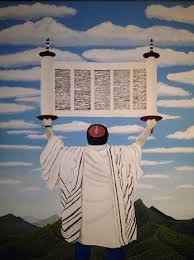
       The difficulty pertains to the holy moment of hagbah, when the Torah is lifted for all to see. We will soon discover that the vitality of hagbah may date to the times of Moshe rabbeinu.

       Not only is this a time mesugal for ruchniyos growth (see Magen Avraham that when looking at the ksav one can receive an ‘ohr gadol’), it is also a rare occasion where halacha goes out of its way to demand of us to be mindful of the women who are in shul.
    The Shulchan Aruch states (siman 134):

    “One shows the ksav of the Torah to those standing to one’s right and left, to those in front and behind, for it is a mitzvah for all the men and women to see the writing and to bow and to say ‘v’zos Hatorah…’.

       With this brief background, let us share what this reader noticed, and that many of us missed:

    Dear AMI,
      I hope this note finds you well. I’m writing with a question related to tefilah and minhag, and I was hoping you might be willing to forward it to Rabbi Moshe Taub.
    This is a question that people in my circles haven’t been able to answer.
    When we lift the Torah during hagbah, we say ‘v’zos haTorah asher sam Moshe lifnei Bnei Yisrael’ (devarim 4:44), and then add ‘al pi Hashem b’yad Moshe”’(bamidbar 9:23), creating a stitched pasuk.
        While the minhag to recite ‘v’zos haTorah’ appears in maseches soferim 14:14, there’s no mention of this bamidbar fragment.
    This Shulchan Aruch also does not mention it. While this addition does appear in the siddur of the Shelah ha-Kadosh (1565–1630 CE), and from my understanding, the Shelah ha-Kadosh would have had access to the Shulchan Aruch.
    Does anyone know of a primary source that addresses who instituted this addition, where it originated, and why ‘al pi Hashem b’yad Moshe’ was added to ‘v’zos ha-Torah’?
    T.T., Toronto Canada”

         This is indeed a fascinating question, and good on him for noticing this oddity!

      It is critical for the reader to note that, as a rule, we are never to recite an incomplete pasuk (berachos 12b)- especially out loud, so to have this minhag develop and accepted is indeed odd.

       One may now wonder, “Don’t our teffilos include many stitched-together pesukim from across Tanach? However, those are largely whole pesukim, or, at times, simply borrowed terms utilized by the anshei knesses hagedolah (often, Artscroll, in their shrewd decision to share the sources for many of the phrases found in our siddur, Selichos, etc. may have inadvertently caused some to miss that many of these are mere paraphrases).

       This email can be broken down to four mysteries:

    • Why do we have to add to meseches soferim’s suggested verse – V’Zos HaTorah – at all?
    • Whatever the reason for this addition, why did we choose this verse specifically?
    • How are we allowed to recite this partial pasuk?
    • Finally, and not mentioned in the email: the mystery of this half pasuk only widens when we consider that there are several pesukim that state ‘al pi Hashem b’yad Moshe’, including even from tanach (yehoshua, 22:9)! in Bamidbar alone, at least four Pesukim have the phrase of “al pi Hashem, begging the question: From which verse is this being taken?!

       To unpack all of this, we must first understand the source for hagbah.

    By the kelelos of sefer Devarim, the pasuk curses those who do not uphold the Torah. The Ramban interrupts this to being referring to the shul/chazan who does not literally hold up the Torah for all to see (27:26; see Beis Yosef).

    The Be’er Hagoleh to the Shulchan Aruch (ibid.) brings this Ramban as one of the main sources of our hagbah.

     In other words, hagbah is our fulfillment of a Torah protection against one of the arrurim!

    The goal of this public display of the Torah is to demonstrate our safeguarding for an unchanging Torah; showing off it un-manipulated state. It now makes perfect sense why chazal urge is to make a battlecry at this moment- declaring in words-after-action how our Torah is intact and remains identical to the Torah from the days of Moshe.

    Hence: ‘V’zos hatorah asher sam Moshe…’.

      So fundamental is the act of hagbah, and this declaration that went along with it, that basic halacha desired it to be performed before krias HaTorah! Indeed, this is how the Shulchan Aruch rules.

    The ashkanazi minhag to perform hagbah only after leining was due to a past concern regarding the more-simple Jews. Often, these unsophisticated Jews saw hagbah as the main event -as opposed to the leining – and would therefore not even stay after for the actual kriah.

    So, Ashkanazim we switched it until after kriah.

       Now that we know hagbah’s purpose and halachic history- as well as the likely reason chazal have us recite this pasuk (V’zos…)- we can now resolve our remaining questions.

    As to the concept of reciting additional pesukim by hagbah, some versions of meseches soferim indeed bring the addition of “Toras Hashem temmima…”.

    However, many, including the Vilna Gaon, argue that this was a later addition, not part of the authoritative girsa.

     While the email-er is correct that we already find our addition of “Al Pi…” in the Siddur HaShelah, however, the Tzelusa D’Avraham wisely notes that the Shelah makes no reference to it in his commentary. In other words, it may just be a printers’ addition due to it already being a widespread custom.

     The questions remaining:

    • Which pasuk of “al pi Hashem” is being referenced?
    • How are we allowed to recite a half pasuk?
    • Why do we add to the pesuk of “Al Pi Hashem…” at all?

    Rav Chaim Volozioner resolves some of these questions.

    He posits that the half-verse being referenced is from bamidbar 9:22, describing our journeys in the midbar.

    More, he argues that it must be said in its entirety (Shaarei Rachamim, siddur HaGra; Dover Shalom in Otzar Hatefillos).

       Nevertheless, the minhag of the majority seems to be to only recite the half pasuk.

    The Aruch Hashulchan is very bothered by this, leaving that question unanswered. 

       However, we could answer the half-pasuk issue by math soaking the many sources who posit that such recitals are not always a concern. This can be evidenced by those who start their Friday night kiddush with the words yom hashishi or va’yehi erev, neither of which are at the start of the pasuk!

    This is explained by many as follows: when we are reciting an incomplete verse in a teffila or a praise it is of no concern, especially when the context is clear (see, e.g., shu”t Maharam Shik 124).  

    Such an approach however may feel unsatisfying in our case, as not all concur with this lenient approach to half verses (see, e.g., shu”t Chasam, Sofer 10; e.g. that that begin kiddush at the start of the pasuk) yet most ashkanazim still say this half pasuk by hagbah.

        I would therefore suggest the following approach to all of our questions, lulei d’mistapinah.

    While the provenance of our adding ‘al pi Hashem’ is unclear, we have sources for many other (full) pesukim that were added through the generations, including ‘Toras Hashem temima’ as alluded to above (a full list of these verses can be found in Encylpodia Talmudis, 8, p. 170).

       Each of these added pesukim have one common denominator: they highlight that our Torah is from Hashem.

       If, as the Ramban stated, hagbah’s goal is to make us alacritous to the kiyum/continuation of the Torah-indeed one of our Ani Maamins– then we run into a frightening risk.

    As we saw above, the simple of the ashkanazim would leave after hagbah, which is why it was moved to the end. For such people who often only knew Torah – ceremony and content-through this proclamation, we may have been concerned for another of the ani maamins: that the Torah was written directly from the word of Hashem.

    Why?

    Because the verse chazal share-V’zos HaTorah- only mentions Moshe’s writing!

       Since the goal is to aid the simple in accepting and celebrating our Torah, we were cognizant of corrupting their emunah, chalila.

      This may be why some added ’Toras HASHEM Temimma…

       Bear in mind that before the advent of the printing press, everything was said by heart and many could not even read. It therefore became far easier to just add these three word “al-pi-Hashem” to stave off this very real concern. 

       Indeed, Lulei D’Mistapina, I would posit that perhaps this phrase (al pi Hashemis not even referencing a Pasuk at all!! Rather it is a kinuy, a maxim, (see nedarim 10a).

     Such kinnuyim may be done so long as Hashem’s name follows two words prior (see Tzelusa D’Avraham p.371-372; this would seem especially true during davening when Hashem’s name is used even outside of pesukim.

    One thing I know for certain: so much Torah is hidden in our siddurim and minhagim!

  • Yartzeit: Its Purpose & Meaning Over Time

    Yartzeit: Its Purpose & Meaning Over Time

    October 2025

    Rabbi Moshe Taub

        This is the week of my mother’s, a”h, yartzeit.

       Losing a loved one is painful, yet chazal share how Hashem gifted us with the power of shikcha, the ability to, if not forget, to move on. With time we learn to live with the absence, to navigate the pain.

       In fact, Rav Moshe Feinstein explains that the reason why many have the minhag to avoid reciting yizkar the first year of mourning is precisely due to its freshness. On yom tov we are not supposed to cry –yom tov hi mi’lizok – and the newness of this lost, combined with reciting their name among the dead may be too jarring for the simchas hachag.

       A few months ago, a member approached me with an interesting question. At first, I dismissed his query as silly, yet I couldn’t shake it, and certainly didn’t know the most tactful way to answer him.

       “Rabbi, this has always bothered me. If the olam ha’emes is beyond space and time, why would the loss of a neshama be minimized with time?”

      How would you answer this question, as well as the many others that arise at this time?

    (In the past, I would call Rav Ahron Levine z”l)

        Recently however, in preparation for my mother’s yartzeit, I was reminded of a fascinating idea (see Kol Bo L’Yartzeit, volume 1 p. 59-60, and Das VaDin p. 76).

       First, let us review the history behind ‘yartzeits’:

       Although codified in the Shulchan Aruch, the minhag of yartzeit is of dubious origin. The most logical historical explanation for its provenance is that it was the chachmei ashkenaz whocreated this day at some point after the 800’s C.E (some say that it was institutionalized by Rav Hai Gaon). Even Rav Yosef Karo, the author of the Shulchan Aruch, and himself of sefardi descent, quotes ashkenazi sources as his support for establishing halachos for this day (oh’c siman 621).

      Others point to tanach (see shoftim 11:40; II divrei hayamim 32:33; II shmuel 1:12), although most dismiss these as being the source for our current minhag.

        Even the minhag of simply reciting kaddish on a yartzeit is without a clear source. While some claim it too was a takana from ashkanaz (see Keser Shem Tov vol. one p. 101 and Otzar HaGeonim, mashkin, p. 79).

        Whatever its source, we must wonder what precise purpose it serves.

    • The gemara teaches us that the mitzvah of kibbud av v’em applies even after a parent’s death (kiddushin 31b), and based on this the Torah Temima states, “There is no greater failure in proper kavod (for one’s parent) than forgetting them and their memory after their demise, for this demonstrates that (the child) lacks recognition as to their importance and feelings of love toward them…and since chazal state that forgetfulness begins after twelve months…we establish such a day every year (every twelve months)…” (Mekor Baruch 2:15; see also Sefer Chasidim #231).
    • Others explain that the minhag of a yartzeit is due to the fact that each neshama is judged on the day they departed from this fleeting world to see if it should be granted an even higher position in shomayim. Their progeny therefore performs special acts, and certain mitzvos, in their zechus (see Panim Yaffos to parshas Bahaloschah).
    • Some take an entirely different approach. Because the day one commemorates a parent’s yartzeit is a day of ‘reyah d’mazlei -bad mazal’(one commemorating a yartzeit avoids travel etc.), and therefore the child spends the day in taanis and teffila in order to protect themselves. Indeed, the Chasam Sofer writes that such days should be considered as yimey teshuvah for the rest of one’s lives (shu’t Chasam Sofer, y’d 156).

    There are many more approaches, but there is one final one I wish to share, as it had a tremendous impact on those in my in shul with whom I shared it. Kol Bo L’Yartzeit brings from Rav Dovid Asaf (sefer Yalkut Das V’Din, p. 76) that the goal of and the particular sadness we feel on a yartzeit is due to the fact that we are victims of our own success. Every mitzvah we perform, any chesed we do and all the Torah that we learn is all due to those who raised us. These zechusim cause our parents to ascend even higher into heights of shomayim. Therefore, since it is on the yartzeit when they receive their new elevated status (see below for more details), each year we become more and more distant from them, as they ascend. We are mournful of the now even greater distance between us!

          Perhaps, then, as we grow in Torah and chesed year-after-year,as we continue in the ways of those who raised us, we feel more distant because we are!

        This reminds me of what Rav Yaakov Kamanetzky shared at a yartzeit event for Rav Aaron Kotler. He pointed out how Rashi seems to compare a yartzeit to a ‘regel’ (yevamus 122a). He explained that the on each festival we are to go to Yerushalaim ‘l’roaos u’lhiharos’ –to see the makom hamikdosh and to be seen by Hashem. Rav Yaakov suggested that just like on yom tov -when we travel to stand before Hashem -so too on a yartzeit we are to imagine standing before the niftar. How will they look at us? What will they say to us? Where would they want us to improve? What will they think about the way we have been navigating our lives? (Rebbe Yaakov, p. 479).

        Rav Pinkus writes that today without a mikdosh, on each yom tov we stand before Hashem and say, “Look at us” (Sichos, p. 149).

       Lahavdil, one of the reasons we visit cemeteries (see Rav Chaim Paltiel as quoted by the Bach in yoreh deah, siman 217) is not chalila to be doreish el hamaisim, rather to to look at their matzeiva, remind ourselves of their lives, what they stood for, and be galvanized to change for the better.

        It is said that Rav Elchanan Wasserman would encourage his students to visit gedolim. “In this world, for a little money, one could take a train to Radin and see the Chofetz Chaim. Do it! Because in the next world, these gedolim will be at a station unattainable to us!”

       However, when is comes to our loved ones, as we increase their station we simultaneously increase ours as well…so that we will be reunited either acher meah v’esrim, or b’yimon homoshaich, sh’yavo b’mehera!

  • R’ Julius Berman, z”l: An  Architect of Jewish America

    R’ Julius Berman, z”l: An Architect of Jewish America

    Ami Magazine//2025//Rabbi Moshe Taub

    1. Known Unknowns   

       Few precious physical things last forever.

    Prizes and awards, diplomas and marriage contracts – they are all fated to fade with time; to be discarded or lost; often losing value in the eyes of those to whom they were bequeathed.

      While the above is common regarding physical objects, it is unheard of regarding our ruchniyos creations -we never allow ourselves to forget our builders of Torah and our askanim for the klal.

       Beyond basic hakaras hatov, our reminiscence of such men and deeds also fortifies our emunah. For, by noting who Hashem chose for the mighty task of fighting for our collective future we thereby become more keenly observant to Gd’s chochma in and direction of the world around us.

       These thoughts rushed through my mind when I read the following email last week:

    “We regret to announce the passing of our distinguished chaver R. Julius Berman, z”l. The levaya will take place…”

       My heart sank. Aside for being a leading askan for klal yisroel, R. Julius Berman also lived in our neighborhood.

    This was a loss for the klal…and for our shechuna.

      While certainly celebrated while he was alive, and although ninety at the time of his petira, I wondered if most ‘under-fifties’ were aware of the sheer profundity of his loss.

    His petira, in many ways, brings an end to an era.

        Several years ago, after writing a feature about Rav Nota Greenblatt following his petira, I was shocked to hear from many bnei Torah how they were, then, unfamiliar with his name. I had a similar experience after writing about Rabbi Pinchas Stolper several years ago. Even writing after the passing of a known figure such as Rav Avraham Ausband allowed a deepening of appreciatation.

        People simply do not know that which they do not know.

    Like R’ Marvin Shick and Ronnie Greenwald, R’ Julius Berman was an askan of stupendous consequence during a time and in a place where there was no rulebook to follow; theirs would be the first generation tasked with creating-and-securing a Torah world within freedom and democracy.

      Just as Yehudah had the powerful Yosef as a bureaucratic buffer and aid in the establishment of yeshivos across Goshen, the litvish gedolim who arrived to these shores had their own Yosefs; pikchim who counseled their navigation through a byzantine landscape.

        Serendipitously, it was from Litta where Julius arrived.

    II. The Birth of a Legend

    In 1940, when Julius was five years old, he moved from Lithuania to America (by way of Sweden). His father had already moved to America some time earlier, starting as a rav in Newport, Connecticut and eventually moving to Hartford where he served as a shochet. Julius would be in the first graduating class of the Yeshiva of Hartford.

       Julius’ father was a respected talmud chacham, evidenced by the fact that Rav Moshe Feinstein would vacation in their home during the summers. These summers gave birth to a lifelong relationship between a young Julius and this gadol.

         For high school, Julius went to Torah V’Daas. There he would often dine at the home of Rav Zelig Epstein, with whom he drew a close bond, as well as at the home of his cousin, the menehel, Rav Dovid Bender.

       After graduation, Julius made a decision that would shape his life.

     “I was going to be bar mitzvah that summer. Reb Dovid’s father, Reb Avrohom Bender, wrote my father a letter from Eretz Yisrael and sent me some sefarim. He wrote that he would send me a full set of Shas ‘when I got into Rav Chazzan’s shiur (in Torah Vodaath) or into Rav Yoshe Ber’s [the Rav’s] shiur (In RIETS).’ That was the beginning. For high school I stayed in Torah Vodaath, and then I went to RIETS.”

     He would go on to receive semicha from YU while simultaneously enrolled in law school.

    More saliently, this was also the start of his tutelage under and stewardship toward his rebbe muvhah, Rav Soloveitchik. 

        In time, Julius not only succeeded in Rav Bender’s hope of his joining Rav Soloveitchik’s shiur, but would soon be seated right next to his rebbe’s desk.

    “I was sitting right next to the Rav’s desk. The first day, everyone was sitting and holding their breath. In walks the Rav and sits down. We were learning Maseches Shabbos. He asked, ‘Ver vill zuggen?—Who wants to say?’ He looked up and everyone put their heads down to avoid his eyes. ‘Nu, ver vill zuggen?’ He got a little frustrated and began looking for his roll book. He couldn’t find it, so I pointed to where it was. He said, ‘Oh, du vilst zuggen?’ He learned my name and from then on he asked me to ‘zug’ every day. I got to be very close to him.”

    This rebbe-talmud relationship did not diminish once Julius left yeshiva.

    “After I finished there I got a call from his daughter Tova, saying her father wanted to talk to me. He asked me to do him a favor, and then he started calling me more often, and then we started meeting in his apartment every Wednesday. I also continued to go to his shiur for the next 30 years, Tuesday nights in Moriah on the Upper East Side.”

    III. Bein Ha’Amim

         Julius’ time practicing law was colored with a constant flow of a ribbuy kiddush shomayim.

    He worked for the respected international law firm of Kaye Scholer, serving as a partner since 1967.

    A story I heard during shiva was one I was later able to discover in Julius’ own words:

        “It was a much smaller firm then. In those days, the goyim didn’t want to take the Jews, so this firm had a lock on the Jewish market. Alan Der- showitz worked here one summer. So did Nat Lewin. This is not like today (2012) when we have around 500 partners, with offices in Chicago, Washington, California, London, Frankfort, and Shanghai. Today, a lot of frum people come in here. We have a 2 p.m. Minchah in my office with a hoiche kedusha. Years ago, we started doing a little mishnayos once a week. We ordered cold cut platters and learned mishnayos. One day, Milton, one of the partners who wasn’t frum, walked in and wanted to hear what it was about and joined the group. After that session, we wondered if we should ask him to wear a yarmulke while we were learning. I called the Rav to ask and he said, ‘Don’t tell him anything. He’ll do it on his own.’ Sure enough, he started wearing a yarmulke. One day, his wife Joan called me up and asked me, ‘Jules, what’s a misnas?’ I realized she meant mishnayos, and asked why she wanted to know. ‘Because Milton said he wants a misnas for Father’s Day.’  

        While we may take it for granted today, in the 1960’s being a frum lawyer came with unique challenges.

    Julius shared:

    “My first trial was in Staten Island on a Friday morning. The judge’s name was Constantino. He was doing divorce cases and they were taking a long time. There was no ‘default’ in those days. It was winter and it was already 11 a.m. and I was getting nervous. The judge announced a break. I chased after him into the ‘robing room’ and told him I was a Shabbos observer and lived in Queens, and asked if we could work through lunch until 3 and get in a full session. He smiled and said, ‘I respect that! We’ll stop now!’

    “The one time I had a problem was with a Jewish judge who even spoke with a Lower East Side accent. We were representing RCA Records and got a notice that our trial was on the first day of Shavuos. We asked to reschedule and they pushed it off for two weeks, but the date wasn’t good for the other side. I got a call from the judge to come see him. He ripped into me and said, ‘I should never have given you that first adjournment! We could have stopped for 15 minutes for you to run out and say Yizkor and then come back!’ I had no problem with Constantino, but I had a problem with this Jewish judge!

        “We had a shmiras Shabbos case with IBM. We sent letters. I got a letter from Watson [chairman of IBM] in South America, saying that he straightened out the problem, and in the future, I should go directly to him and not bother with the personnel.

    “We had a problem, if I recall correctly, with American Express. The head there was a Jew. He burst into the room and showed off all the plaques he had gotten from the various Jewish organizations. He said, ‘I don’t recognize Shabbos. There’s a uniform work day from 9-5, every day!’”

      His middos were impeccable. Julius did not overwhelm a room through garishness. Rather he won people over with his soft brilliance.

       He personified the ideal -taught to me by my daughter Racheli- that ‘respect should be commanded, not demanded‘.

     Julius’ nature, clarity, and humility may be best expressed through another story I heard at his shiva.

    R’ Moshe Reichman once arrived at Kay Scholer seeking counsel regarding perspective city projects. The firm felt that Julius would be the best person with whom he should first speak (aside for his brilliance in the law, perhaps they also felt that this potential client would be most comfortable with a partner that ‘looked’ more like him).

      After a long and productive meeting, Moshe Reichman was impressed with Julius’ sound advice and calm demeanor. He asked Julius if, going forward, he would be his personal lawyer for all of his future city projects.

    While no doubt flattered, Julius declined, explaining that he was not a real estate attorney, adding, “To be honest, we are not the cheapest firm. Your project will take many years. Are you not worried about the accrued costs should you retain me through this firm? Perhaps it would be wiser if you save a little bit of money by going with a smaller firm. This may also help you with capital for some of your perceived projects”.

    Somehow Julius missed the name of this client in the initial introductions!

    Meaning, all that time he spent with this ‘client’, and all that free advice he provided, was not due to this being a ‘Big Whale’ client, rather it was for a ‘stam’ Jew in need of counsel!

    Realizing the confusion, Moshe Reichman reintroduced himself, explaining that, b’chasdei Hashem, for the proper counsel money should not be a concern.

    I love that story, as it highlights that to be a true askan one first must demonstrate love and care for every Jew -no matter the return.

    IV. Enter Askanus

        Julius’ time in askanas was the stuff of legends. It would be an exhausting exercise to even transcribe a partial listing of all the organizations he led, advised, or founded.  

        Some Selected Highlights:

    • He served as president for the National Jewish Commission of Law and Public Affairs
    • He was president of the JTA, Jewish Telegraphic Agency
    • He was the chairman of the Board of REITS, Rabbi Isaac Elchanan Theological Seminary
    • He was chairman for the Conference on Jewish Material Claims Against Germany
    • He served as the president for the Council of Presidents of Major Jewish Organizations
    • He served as president of the OU, the Orthodox Union, from the late 1970’s through the early 1980’s

        When I first moved to his area of Queens, although he did not daven in my shul, R’ Julius knocked on my door to share and explain some personal files from his days at the OU, as he thought they would be of interest, partially due to my many years in kashrus.

    But there was also a deeper reason behind that generous visit, as we also had a personal history:

    Julius was my father’s president when my father, Rav Baruch Taub, served as the National Director of NCSY.

       My father fondly recalls his time with Julius with profound admiration and deep kavod.

    “All the amazing attributes that you have heard about him are without exaggeration”, my father shared.

    “But what struck me above all else was something that was a rarity among such leaders: Julius was not only a talmud chacham, but he was also, and always, ‘holding in learning’”.

       We see that beyond our gratitude for his past accomplishments, there is much to still learn from how Julius approached his role in askanus. True, he had profound pikchus, but he also never veered from hi personal growth in Torah. Yes, his worldly knowledge was second to none, but, as well, his fidelity to halacha was unmatched.

    His methods must remain as a lighthouse for askanim today.

        He once reminisced:

    “When I was chairman of the Conference of Presidents, I had a Friday afternoon meeting with the King of Morocco. I came a little before 2 and started to wait. By 3 o’clock I was getting fidgety. Someone said, ‘Don’t you realize that he’s a king? When he says 2 o’clock it can mean 4 or 5.’ So I picked myself up and went home.”

        What a kiddush Hashem!

          Upon entering the shiva, one would be struck by two things. The first is a painting of his rebbe, Rav Soloveitchik. This is no ordinary painting, rather one commissioned by Rav Soloveitchik’s rebbetzin upon his turning fifty. From its size and overall oeuvre, one immediately senses that this is a profound work of art. How Julius and his wife Dotty came to own it is a longer story that would be best left for for the Berman family to share, however the mere fact that it resides in their living room encapsulates how he was not just a talmid, but also as a son to his rebbe.

      Indeed, many share how, in his later years, Julius could not mention Torah from his rebbe without crying.

    When I served as menahel in Telshe Riverdale, we had a meeting in the rosh hayshiva’s, Rav Avraham Ausband, office during a process of making a hire [by ‘we’ I mean only that the few of us there briefly gave our thoughts, followed by the rosh hayeshiva sharing his wise logic and final analysis]. The rosh hayeshiva then shared something that reverberates in my ears till this day:

    One could never fully trust an individual who doesn’t have a rosh yeshiva in his life; no matter how many years he has been out of yeshiva

    Julius was a man who always had a rosh yeshiva; whose voice he could still marshal long after Rav Soloveitchik passed.

        The second striking element at the shiva was a living space at the end of a hall which is adorned with pictures and plaques from all over the world. In one, Julius is sitting with Hosni Mubarak, the King Egypt, in another he is with Yitzchak Shamir, Prime Minister of Israel.

    One particular framed letter caught my eye:

     “April 2, 1982

    “Dear Mr. Berman, Elizbeth Dole has kindly passed along to me the handsome container of kosher jellybeans which you sent to her, along with your thoughtful letter I appreciate your gesture of goodwill in providing these particular jellybeans. Now I’ll be able to say I’ve truly tried them all. Again, with my heartfelt thanks, and warm best wishes to you and your associates,

    Sincerely,

    Ronald Reagan”

    While I do not know which klal issue was being advocated for in the spring of 1982, I do know that it takes a pikeach to first satisfy a leader’s sweet tooth…or to be aware he has one!

         The term ‘askan’ is peculiar. After all, are we not all ‘eisek’ in one matter or another – be it in our jobs, our families… or even rest? It would be akin to the oddity of calling someone who loves food an ‘ochlun’, when everyone eats.

       I would posit that our imprimatur and designation of the term ‘askan’ alludes to something far deeper than simple ‘busy-ness’. It also speaks to something that goes beyond the fact that such individuals ‘busy’ themselves with matters that are not personal in nature.

    True, we are all ‘eisek’ in matters (mostly personal) should they arise, and, it is equally true that klal yisroel has many individuals who busy themselves with Hatzala, tzedaka and chesed organizations, boards, etc. However an ‘askan is how we describe someone who searches for these needs; one whose ‘askanus‘ is not simply because something arose, rather it is due to this –askanus– being their mahus, their very being, their lifeblood.

    An askan is a ‘mevakshei eisek‘ – a searcher for matters to tackle, issues to resolve, and issues to tackle.

    They are also, often, victims of their own success. Precisely because such askanim can sense matters of import before they metastasize, and defeat them before the cause becomes known, much of their legacy will remain a secret.

    So we describe them simply as ‘askanim‘, for the full details of what consumed their busy-ness, as well as what they therby prevented, will only be known to them and Hashem, ‘HaZocher Kol HaNishkachos‘.

        While the fuller story of R. Julius Berman’s life and legend will be written by those who knew him best, what even I can confidently offer the reader is this: the American Jewry we see today was shaped by R’ Julius Berman.

       Of course, he would not have accomplished so much for the klal without his wife Dotty by his side; an anchor for him and their children, always.

    Sh’lo V’Shilanu, Sh’lahWhat is his, and what is ours -is all from her.

       From the kosher food on our table to the safety & comfort of our familes at home & abroad – and for so much more that we will never know – we owe R’ Julius Berman our deepest hakara.

       Yehi Zichro Baruch.

    OTHER IN MEMORIAMS:

    RAV NOTA GREENBLATT, ZT”L

    Rav Avraham Ausband, zt”l

    Rav Pinchos Stolper

    Jackie Mason’s Last Interview?

  • Why Doe We (Often) Change Tunes/Niggun In the Middle of Lecha Dodi?

    Why Doe We (Often) Change Tunes/Niggun In the Middle of Lecha Dodi?

    What is the source and meaning behind the Minhag to switch Niggunim in the middle of Lecha Dodi, specifically by Lo Sovoshi?

    May, 2023

    Rabbi Moshe Taub

    There are certain minhagim that we scarcely notice until they are brought to our attention. A few weeks ago, a shul member approached me and said with concern, “Rabbi, whenever Mr. X davens at the amud Friday night, he uses the same niggun for the entire Lecha Dodi! Maybe we can explain to him that he is supposed to switch the niggun at Lo Seivoshi.”

    People may dismiss such a complaint on the grounds that this change in niggun is not a halachah and that the  minhag is not universal; in fact, some have the minhag not to sing Lecha Dodi at all! (For a complete list of minhagim for Lecha Dodi, see Kovetz Beis Aharon V’Yisrael, 70, pp. 135-138.)

    Although certainly not a reason to reprimand a chazzan, the fact that this change in niggun is a popular minhag Yisrael should give us pause, especially since the premise for niggunei Shabbos is rooted in basic halachah. (See posts on other other ‘siddur mysteries’)

    The Rema states a halachah in Shulchan Aruch (siman 281) that we should add melodies to our davening on Shabbos to lengthen the tefillah and make it sweeter.

    The Arugas Habosem comments, “Since on Shabbos there is a great need to daven with complete joy and energy, and because niggun awakens the heart to the joy in mitzvos Hashem, I will quote from the Maavar Yabok [d. 1639]: ‘The Zohar teaches of a special sanctuary in Shamayim that is only opened through song… The song of the chazzan who sings is brought up to the highest realms… And for this reason there is a minhag for the mispallelim in shul to sing [with the chazzan] on Shabbos and Yom Tov” (Otzar Hatefillos, p. 331, and Maavar Yabok, sifsei tzedek, ch. 31; for more sources in halachah for the importance of singing during davening on Shabbos, see Kovetz Halachos, Shabbos, Vol. 1, p. 297, note #5; see also Asifas Gershon L’Shabbos and Piskei Teshuvos, siman 267, notes 35-38).

    There are several suggested reasons for the Lo Seivoshi niggun change, but first, some brief background on Lecha Dodi.

    Chazal state that on Erev Shabbos, Rabi Chanina would dress in his finery, stand and declare, “Let us go out to greet the Shabbos Malkah.” Rav Yannai would put on his Shabbos clothes and declare, “Bo’i kallah bo’i kallah” (Shabbos 119a and Bava Kama 32b; see also Shabbos 26b).

    The pronouncement “Lecha Dodi”is not given in this Chazal; the expression comes from Shir Hashirim: “Lecha Dodi…come, my beloved, let us go out to the field, let us lodge in the villages” (7:12). Based on this and other sources, Rav Shlomo Alkabetz composed the words to the piyut Lecha Dodi in the 1570s or 1580s.

    Some posit that we should omit the phrase Lecha Dodi altogethersince we no longer go outside to greet Shabbos (Yosef Ometz, siman 589).

    The author of the Shulchan Aruch, Rav Yosef Karo, who was a contemporary of Rav Alkabetz, writes, “One should wear nice clothes and celebrate the arrival of Shabbos as one would to greet a king or a bride and groom. Rabi Chanina would wrap himself (in finery) and stand waiting in the evening as Shabbos was approaching and say, ‘Come and go out to greet the Shabbos Queen,’ and Rabi Yannai would say, ‘Bo’i kallah bo’i kallah’” (Shulchan Aruch, siman 262:2).

    Anyone familiar with the Shulchan Aruch knows that it is rare for the author to quote directly from the primary source, as he does here. It is likely that the piyut of Lecha Dodi was already well accepted at the time of this writing.

    A friend shared with me an email from Rav Zilberstein’s kollel, in which he explained that the change in niggun at Lo Seivoshi is based on our relationship to the Shabbos “bride.” In the piyut, we follow the pattern of the two steps of halachic marriage—eirusin and nisuin. At weddings nowadays, we do both of these steps under the chuppah back to back, separating them with the reading of the kesubah. On Shabbos, we separate these two stages of our relationship with Shabbos by changing the melody.

    There are even earlier discussions of this practice. Rav Shlomo Zalman Geiger (d. 1878) was a rav in Frankfurt at the time of Rav Samson Raphael Hirsch. Partly due to his disagreement with Rav Hirsch’s perceived change in certain practices, Rav Geiger composed a sefer comprising the shul minhagim for Frankfurt throughout the year in a sefer titled Divrei Kehillah. Since he was also a baal tefillah, he cites many of their niggun practices as well.

    There we find this custom, although with a slight variation. The minhag in Frankfurt was to change the niggun, but not at Lo Seivoshi, the sixth stanza; it was changed at the fifth stanza, Hisoreri. This was because the initial letters of the first four stanzas spell “Shlomo.” This is an allusion not only to the author’s name, but also to “Ben Shlomo”—Moshiach (see Rambam, who describes him as Ben Shlomo in his 13 Ikkarim, Peirush Hamishnayos, Sanhedrin; see also Divrei Hayamim, 1:22:9-1). Indeed, the stanza before Hisoreri mentions Ben Yishai.

    Rav Geiger writes that in Frankfurt, they would sing a simpler tune until Hisoreri, and then switch to a celebratory niggun, alluding to the complete geulah. They would then return to the original niggun at Bo’i Kallah (ibid., p. 61).

    As for the current practice of changing the melody at Lo Seivoshi, some suggest that until that point, the piyut describes our hope for geulah, and from Lo Seivoshi onward it describes that era.

    Nevertheless, some still suggest changing the melody earlier, as they did in Frankfurt, so that the four stanzas that spell “Shlomo” can be sung with the same melody, and the next four stanzas, whose initial letters spell “Halevi,” can be completed with its own melody.

    Over 25 years ago, in the well-known Torah journal Beis Aharon V’Yisrael (Vol. 84, pp. 131-132), Rav Aryeh Butbul requested from its knowledgeable readership the source for this change in niggun, and many talmidei chachamim wrote back with sources and suggestions.

    One respondent cited the sefer Mekor Hatefillos, which states that we change the melody simply because in larger shuls some mispallelim may get lost and not know which stanza the shul is up to! The niggun change aides them in resuming unified singing (ibid., Vol. 86, pp. 142-143).

    It should be noted that some consider the possibility that people will lose the place as a reason to avoid this minhag altogether since a chazzan may struggle to finding his second niggun (Ha’admor Rav Dovid of Luluv; see Mekurei Tefillah, 4:52)

    Another respondent told an amazing story that demonstrates deference for this minhag (ibid., Vol. 87, pp. 116-117).

    When the third Rebbe of Vizhnitz, the Ahavas Yisrael, was escaping the town of Vizhnitz during the First World War, he wound up in another town for Shabbos. The gabbai honored him with the amud on Friday night. Although the minhag in Vizhnitz was not to sing Lecha Dodi, the Rebbe acquiesced to the local custom.

    However, when it came to Lo Seivoshi, the Rebbecontinued with the same niggun with which he had begun, causing a minor tumult. The gabbai explained the issue, and the Rebbe changed to a different melody at the next stanza, V’hayu Limshisa.

    Rav Geiger concludes that this is why Vizhnitz still has the minhag to change the niggun at V’hayu Limshisa!

    Although we have only scratched the surface of this piyut, it is enough to realize that we should not reject out of hand any minhagim regarding the way it is recited. Minhagim are important! ●

  • Buffalo’s Rabbinical History 1847-1927

    Buffalo’s Rabbinical History 1847-1927

    Including Fascinating Information Regarding:

    • – The First Rebbe in America
    • Coca-Cola Kashrus Secrets
    • The Birth of YU
    • America’s ‘New Jerusalem’
    • The Mussar of Benjamin Franklin

    ….And Much More…

    Published In Weekly Installments in Ami Magazine Over the Summer of 2023. By Rabbi Moshe Taub

    Welcome to Buffalo

    Rav Yona Landau is a fascinating individual who I first met when I was a rav in Buffalo. The shul would see many daily visitors, so, at first, seeing someone in his chassideshe levush did not bring any specific attention. After davening, he approached and gifted me with a sefer he had written. I still have this Yiddish volume, about the ‘early’ rabbanim and shuls of America. At the time, this topic was not even remotely on my radar. For whatever regretful reason -likely due to many other guests there- I did not ask him why he was in town. However, serendipity would soon take care of that.

    Several weeks later, while driving home from a meeting, sudden horrid blizzard conditions began to deluge my car (not a surprise for Buffalo!). The storm caused such low visibility that I became utterly lost, finding myself in the township of Cheektowaga. This was around 2004, so I pulled out my trusty, printed (!) New York State map and worked-out a route home through safer sideroads. As I was driving in this remote area, suddenly, through the furious flurry, I saw what appeared to be a chassideshe yid -not a common site in these parts!

    The certainty that my eyes were deceiving me was quickly dashed when I then saw another such yid, and then another. I began to pull over – to ask if they need help, and, to quench my curiosity as to why they were there – when I noticed this street aligned a cemetery. As a kohein, I had to park up the road on the other side of the street, get out of my car and walk through the intense sleet that was smacking my face, all the while calling out to them. “Are you here on business and now lost? Or, do you have a great-grandparent buried here?”

    It was only at this moment when I became informed that this was the cemetery which housed the ohel of the holy Rav Eliyahu Yosef Rabinowitz (again, I am a kohein). Rav Yonah Landau is responsible for bringing this burial spot to broad public attention. Since his own group- trips began, pilgrimages to this site have been made by tens of thousands across all streams of the Torah world -from cholim, to those in need of a zivug or parnasah.

    Even before this, my shul in Buffalo had a flyer for visitors to take which had information regarding kashrus, the eruv and mikveh, as well as other useful information for visitors. This flyer also contained some brief information about Buffalo’s Jewish history, including an image of a contemporaneous announcement of this Rav Rabinowitz’s petirah.

    The American Hebrew & Jewish Messenger was a national Jewish magazine which began in 1879, and which still exist today (after various exchanges and transactions) as The Washington Jewish Examiner. In its November of 1910 edition, in their ‘Buffalo’ section, they wrote:

    Rabbi Joseph Rabinowitz, of the congregation Brith Sholom, Anshe, Russia, died last year at the age of fifty-four years. His death has caused a great deal of grief in the orthodox community, for the deceased rabbi was beloved by a large circle of friends, and was noted for his piety, his modesty, and his exceptional learning. He was officially connected with B’rith Sholem congregation, but was also greatly interested in the general religious and educational welfare of the Jews of his section. Although only a few years in Buffalo, he at once made his influence felt in many directions.
    “Rabbi Rabinowitz was born in Justingrad, province of Kiev in 1856. His father was a famous rabbi. He came to Buffalo in 1908 and at once became popular and beloved by all the Jews in the city. He passed away Monday evening November 14, at his home, number 67 Walnut Street
    .”

    In the next chapter we will iy”H share more about Rav Rabinowitz’s amazing life and his present-day connections to Buffalo.

    Additionally, we will share other ‘secret’ burial spots in America that may surprise even the history-literate reader.

    Family Trees & the Steipler Gaon The First Rebbe in America

    In the last chapter we wrote about the first rebbe to reside in America, Rav Eliyahu Yisef Rabinowitz. Let us first pick up from there.

    While a rav in Buffalo, I once received the following email:

    Dear Rabbi Taub,

    I am travelling to Buffalo and heard that there is an ohel for one Rabbi

    Eliyahu Yosef Rabinowitz. I was told he was a rebbe, perhaps the first in

    our country. Is this true? Was he really a rebbe? How do we define that

    term? And, how do we know he indeed was one?”

    Ah, the questions rabbis receive!

    Let us start with his amazing yichus, which is a story of galus:

    One of the Baal Shem Tov’s prime disciples, of course, was Rav Yaakov Yosef (d. 1781). His sefer Toldos Yaakov Yosef is one of the main sources for the Torah of his rebbe and founder of chassidus.

    One of Rav Yakov Yosef’s students -and a student of the Maggid of Mezritch as well, another pupil of the Baal Shem Tov -was Rav Gedalya of Linitz (d. 1804). Rav Gedalya himself was the son of a dayan, and was a great-great grandson of the Maharsha (His great grandmother was the Maharsha’s daughter, see source in the sefer Toras Avos below).

    Many stories known today about the Baal Shem Tov were transmitted through Rav Gedalya (see, e.g., Shivchei Baal Shem Tov).

    He himself authored the sefer Teshuas Chein.

    When Rav Gedalya was niftar, his son, Rav Shmuel Yehudah Leib, took over as admor of Linitz. He was niftar in 1818, at just forty-six years of age.

    His brother, Rav Yitzchak Yoel, assumed the role of admor next. He had learned under the holy Apter Rav (d.1825) together with ‘Der Heiliger Ruzhiner’, Rav Yisroel (d. 1850), who said about Rav Yitzchok Yoel, “If one desires yiras shomayim, go to him” (Toras Avos, p. 24 note 13). Rav Yitzchak Yoel was niftar in 1828.

    He was followed by his son, Rav Gedalya Aaron who was married to the daughter of Rav Shmuel Abba, the grandson of Rav Pinchos Koritzer, a disciple of the Baal Shem Tov. It seems that he only accepted becoming admor in 1840, a dozen years since his father was niftar.

    With this background, we can now begin to zoom-in a little.

    For unknown reasons, in 1848, he would move his court to the town of Sokolivka, at the outskirts of the city of Linitz (known today as Illinitsy), both just about thirty-five miles from Uman.

    As his fame grew, he would soon need to hide from the Russian authorities, escaping to the Romanian town of Podu Iloaiei. The last ten years of his lilfe was spent here. It is here where his talmid Rav Eliyahu Rosenthal would publish his rebbe’ s teachings in the sefer Chen Aaron.

    Now away from their holy father, it is likely at this point that his four sons began to adopt the last name ‘Rabinowitz’, which is Slavic for ‘the son of the rabbi’. It seems probable that this surname was then pronounced as its Russian equivalent, Rabinovitch.

    His eldest remaining son was Rav Yitzchak Yoel – who initially took over as admor, yet sadly was niftar at forty-five, in 1885, just eight years after his father’s petira.

    His brother, Rav Pinchos, then took over as the rav and rebbe of Sokolivka. Rav Pinchos was tragiclly killed al kiddush Hashem in the pogrom on zayin av, 1918, hashem yinkom domo.

    Chayah Shuman, whose four brothers were among those killed, recalled, “The Gentiles refused to bring the [dead] bodies to the shtetl.

    The Jewish population rented horses and wagons from them, and themselves brought back the dead. My father was among those digging graves for my brothers. Nachum the apothecary tried to help him digging. My father said to him, ‘Take it easy, Nachum; let me take care of my children.’ My brother Baruch who was killed was married and the father of a little boy. Reb Pinchas was seventy-six at the time he was murdered.”

    {Her grandson, Rav Avraham Meir Shuman, lives in Buffalo today, and makes a siyum every year on that date l’zecher nishmasum}

    The next brother was Rav Eliyahu Yosef, who would soon arrive in Buffalo, NY.

    Rav Eliyahu Yosef would marry the daughter of Rav Meshulam Zusha Aurbach. Rav Aurbach’s son -the Buffalo rebbe’s brother-in- law!- was the famed Rav Mordechai Dov Twersky, the Hornesteipler Gaon.

    That the Hornesteipler took his mother’s -Rebbitzen Shterna Feigeh – maiden name was not uncommon of many Jews of the time (see my post regarding Jewish surnames -the history and logic behind this practice).

    For the litvaks, like myself, who are reading, take note of the following: Rav Yaakov Yisroel Kinievsky -the father of Rav Chaim Kinievsky – was also known as the ‘Steipler’ or the ‘Steipler gaon’, a name that comes from that same town. Indeed, the Steipler’s parents were chassidim of Rav Mordechai Dov Twesky, and named him Yaakov Yisroel after Rav Mordechai Dov’s grandfather, Rebbitzen Shterna’s father – the Magid Meisharim, Rav Yaakov Yisroel Twersky (d.1876).

    Rav Mordechai Dov’s son, the Buffalo rebbe’s nephew, was Rav Bentzion Yehudah Leib would take over as the official admor of Linitz.

    His son, the Buffalo rebbe’s great nephew, was Rav Yaakov Yisroel Twersky -named for the same zaide as was the Steipler! -would famously move to Milwaukee, Wisconsin in 1927.

    After arriving to the Lower East Side in 1899, he soon discovered that many of his brother’s mispallilim had relocated to Buffalo. It was only a matter of time until they excitedly invited him to be their rav, in the Jefferson Street shul. The reader should keep in mind that Buffalo was one of the largest cities in the country at the turn of the century.

    He arrived there just a few years after President McKinley was assassinated at the world fair held in Buffalo.

    His kever at the Pine Ridge cemetery was beautifully redone with an ohel and a special room for kohanim. A plaque was installed giving special honor to those killed al kiddush Hashem from his hometown.

    Thousands of yearly visitors come to daven at his kever.

    So… was he a ‘rebbe’? Of course!

    Yiddish Kezetzung, November 25, 1910

    Gaons, Goons and Designations
    &
    The 13 Middos of…Benjamin Franklin?!

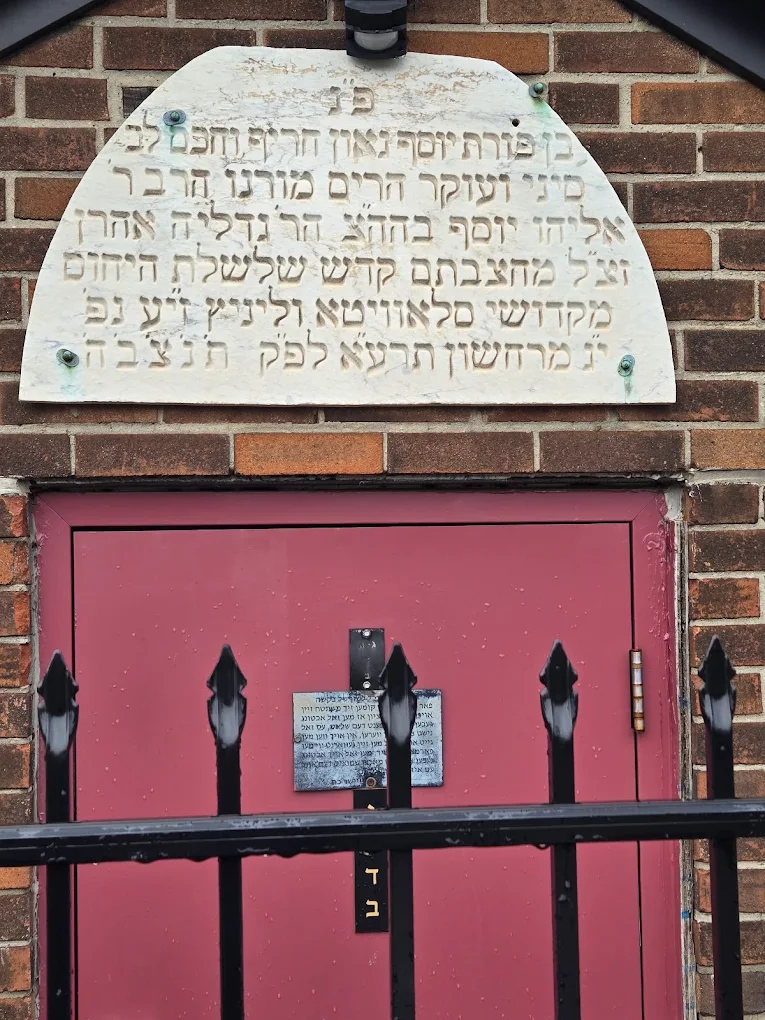
    As a kohein, I have never been to Rav Rabinowitz’s ohel near Buffalo. When I asked a friend to share its image with me, he also shared an additional image of another matzeiva, asking “Have you ever heard of this rav?”

    The matzeiva in the image read as follows [translation]:

    “A man great amongst his brethren// A shepherd of a holy flock// a posek, advisor, and orator// Who judged and was charitable to his nation// Harav Hagaon Avraham Meir [bar Yitzchak Zev] Franklin// Av beis din of Buffalo and before this outside of Vilna (!)// Niftar 4th of cheshvon …[born] tuff reish chuff kimmel (1882/3)- [niftar] tuff reish tzadi gimmel (1932)”.

    I was not immediately familiar with this rav, and initially wondered, “A rav with an American-sounding name such as ‘Franklin’ was formerly a rav outside of Vilna?!”

    I would soon discover that his surname was originally ‘Frankel’, and later Americanized to Franklin.

    Such a change -especially in a surname – is not new in our long galus, especialy when showing gratitude (see Eicha Rabbasi, 2:13, with Beis Ahron, chelek beis, p. 519).

    But why choose, specificly, Benjamin ‘Franklin’ to honor?,

    To answer this question, I will share something extraordinary with the reader:

    Reminding us that they don’t make politicians like they used to, Benjamin Franklin’s writes in his autobiography:

    I conceiv’d the bold and arduous Project of arriving at moral Perfection. I wish’d to live without committing any Fault at any time; Habit took the Advantage of Inattention. Inclination was sometimes too strong for Reason. I concluded …that it was our Interest to be completely virtuous, was not sufficient to prevent our Slipping, and that the contrary Habits must be broken and good ones acquired and established,…

    I propos’d to myself… Thirteen Names of Virtues…

    1. Temperance-Eat not to dullness; drink not to elevation. 2. Silence- Speak not but what may benefit others or yourself; avoid trifling conversation. 3. Order -Let all your things have their places; let each part of your business have its time. 4. Resolution-Resolve to perform what you ought; perform without fail what you resolve. 5.-Frugality – i.e., waste nothing. 6.Industry-Lose no time; cut off all unnecessary actions. 7. Sincerity- Use no hurtful deceit; 8. Justice-Wrong none by doing injuries or omitting the benefits that are your duty. 9. Moderation- forbear resenting injuries so much as you think they deserve. 10. Cleanliness 11. Tranquillity- Be not disturbed at trifles. 12. Chastity- Rarely use venery. 13.Humility…”

    Many who went to litvishe yeshivos may find this list very similar to the ubiquitous “Thirteen Middos of Rav Yisroel Salanter” chart that used to hang in the back of many classrooms.

    It is possible -if not likely-that this list was composed not by Rav Salanter, but rather Franklin himself!

    I will now very briefly explain:
    In 1812 -twenty years after Franklin published his list – a famous sefer was first published –Cheshbon HaNefesh.
    Its author explained that he borrowed the idea of 13 middos from a ‘secular moralist’, writing:

    Recently, a new and pleasing method was discovered, this invention innovation will spread quickly im yirtz Hashem”

    Cheshbon HanefeshMerkaz hasefer ed., p. 31
    (See also article by Rav Nissan Waxman, Sinai, 1961, as well as a 5780 monograph by Shai Asafi).

    In a recent edition of this sefer, Rav Mordechai Shmuel Edelstein writes a hakdama where he mentions this list’s original source coming from “The gentile sage […] Benjamin Franklin [in whom] there arose a powerful yearning to reach moral perfection,” (translation; see Asafi, ibid.).

    This is not, chalila, to minimize the value of this list, which can be of great value, irrespective of its origin. Indeed the 1812 mechaber sought to improve upon Franklin’s list by changing its order, as well as modifying some of the middos themselves -i.e. omitting Franklin’s #1 and #12 for and exchanging them kavod and savlanus.

    So, how did the provenence of this list become misplaced, and, how did this list become so popular in the litvish world?

    When R. Yizchok Blazer zt”l (Peterburger) published Ohr Yisroel – the celebrated collection of writings and letters from his rebbe, Rav Yisroel Salanter zt”l, he makes no mention of these thirteen principles. However, in an 1845 edition of the 1812 Cheshbon HaNefesh the publisher mentions in his introduction how Rav Slanter urged this re- issue and (according to my friend Reb Moshe Friedman of Toronto, who shared this theory with many gedolim), this caused readers to assume this false attribution to both the sefer and its list.

    Back to Rav Franklin:

    In the archives of The New York Times from November 5th, 1932 we find on page 1 that they report on Rav Franklin’s death on page 15. Exasperatingly, their archoves were incomplete and, at first, all I could access was with this odd and confusing headline (emphasis mine):

    “BUFFALO CHIEF RABBI, A. M. FRANKLIN, DIES-Descendant of ‘The Great Man of Goon’ – Was an Official of Rabbinical Association”

    Great man of…what?! Later, when looking at the actual microfilmed image I discovered that the digitizer made an error. The headline actually reads:

    “…Descendent of the great man of Gaon

    While clarifying the word ‘Goon’, their sentence still made little sense. However, the explanation may be simple: They erroneously transposed the translations of the words Vilna and gaon, assuming ‘vilna’ meant great man/genius, and that ‘gaon’ referred to his city!

    Perhaps this error is due to the fact that ‘Vilnius’ -and not Vilna – is how gentiles refer to this city (although, see below where they use the term ‘Wilno’).

    As a fascinating aside, the word gaon, meaning genius, is not found anywhere in Tanach! There, it always means ‘pride’ or ‘heights’, etc. It was only in the Geonic era (700-1000) when ‘gaon’ took on this new connotation (see e.g. Halachos Gedolos, 31).

    It is interesting to consider how this came to be. Some suggest that in the late middle-ages we crowned our rabbanim with gaon based on the pasuk gaon yaakov-pride of Jacob’ (Tehillim 47:4). Others posit that their given title was actually ‘reish kalla’ (leader of the shiurim), or aluf (meaning general/leader –perhaps the etymology for the English word ‘aloof’), and that gaon was simply a sobriquet. This is because gaon’s gematria equals sixty -in that they comprehended all sixty mesechtos of shas!

    Back to Rav Franklin…
    Here is the rest if their memorial (brackets are mine):

    The Rev. Abraham Mayer Franklin, chief rabbi of Buffalo, died last night at Buffalo General Hospital after several weeks’ illness…Rabbi Franklin was born in Wilno, Poland seventy-two years ago. At the age of six he began studies under Rabbi Isaac Elohanan [Rav Yitzchak Elchanan Spekter], one of the greatest of the modern rabbis, and from him he received his degree and diploma [semicha] after examinations lasting several days, an honor given to few men.
    Rabbi Franklin was a descendent of the Vilna Gaon, ‘The Great Man of Gaon’, a rabbi revered for his piety and his wisdom.
    He and his wife came to Buffalo at the turn of the century. There were several congregations in the city at that time and Rabbi Franklin was made chief rabbi, going from one to another each week…
    In 1930 he was elected vice president of the Rabbinical Association of America. He was offered a post recently by the Beth Hamidrosh Hagodol in New York but declined it.”

    We discussed a few years ago how the term ‘Chief Rabbi’ was commonly used for a number of rabbanim of major American cities, and became a contentious matter. To be sure, such a title was not taken by Rav Franklin, or, for that matter, even voted upon, rather it was thrusted upon him, likely by the press (see ‘From Ararat to Suburbia: The History of the Jewish Community of Buffalo’ Adler, 1960, p. 220).

    When Emenuel Chaim Nachman -later known as Leon Dryer – wished to give his rav, Rav Rice of Baltimore, this same imprimatur, it caused an uproar, although, to be fair, he demanded the title ‘Chief Rabbi of the United States’! Leon Dyer even made a special banquet in honor of Rav Rice’s new title and invited the press to participate. He and his board meant well, appropriating this title only to offset the rising threat from the reformers. Indeed, when The Baltimore Sun and the New York Herald obliged, some in the burgeoning reform movement were livid.

    One reformer wrote to the Baltimore Sun:

    There is reason of suspicion that some busy-body [Leon Dyer], ignorant meddler of said society has mislead the editors into this most inconsistent and ridiculous idea of a Grand Rabbi or Chief Rabbi of the United States. The fact is that Mr. [!!] A. Rice in not a Grand Rabbi of the United States, or the several societies of this city, but in truth not even a rabbi official of this very society where it represented that he was officiating…”

    Other communities gave this designation even more freely. On Purim in 1839, the kehilla in New Orleans asked one ‘Rolly Marks’ to lein the megillah. A local actor and fireman, he was the only one who knew how to read Hebrew. Soon, he was elected as the ‘Reader of Prayers’, then became known as ‘Rabbi’, and soon enough many–Jew and Gentile alike – referred to him as ‘Chief Rabbi’ of the city (refer to The First Rabbi, p. 67)!

    In 1845 we even find this term by none other than famous reformer Max Lilienthal (a man discussed at length in past summer series).

    It was not until the late 1850’s through the late 1870’s when the desire to create a serious, substantial, and sustainable office of Chief Rabbi (of New York) reached a critical mass.

    One of the leaders of Reform wrote contemptuously of this idea:

    “The Jewish Messenger of New York wants a Chief Rabbi, a sort ofAmerican Jewish pope, or something like it…”

    Ignoring the cynics, R’ Hirsh Shuck (Chuck), president of Beis Medresh Hagadol, would soon form an official committee for this cause. Eventually, this job would go to the Malbim. It was only when the Malbim sadly-and-suddenly predeceased his move to New York, that the job would go to RJJ, Rav Yaakov Yosef (see bleow regarding his last name).

    We have so much more to discuss about Rav Franklin, including how Coca-Cola ties into all of this!

    In the next chapter we will finally arrive at that part of the story.

    The Yeshiva Bochor &
    The Fainting Stranger

    In the last chapter we began to examine the life of Rav Avraham Meir Franklin who, after serving as a rav in Vilna, became a rav in Buffalo, New York until his passing in 1932.

    We concluded with The New York Times’ obituary for him, and their description of his title as ‘Chief Rabbi’ of Buffalo. Let’s pick up from there.

    The sefer Ohalei Sheim was first published in Pinsk in 1912 and bears the haskamos of Rav Chaim Soloveitchik, Rav Chaim Ozer, and Rav Dovid Karliner. This fascinating sefer chronicles cities and their rabbanim. It is in here (p. 295) that I discovered that Rav Franklin not only received semicha from Rav Yitzchak Elchanan Spector -as the NYT had correctly reported -but also from Rav Shlomo HaKohein of Vilna!

    It should be no surprise that they shared this prized talmud, as these two gedolim were extremely close. Once, when Rav Yitzchak Elchanon turned seventy-five, Rav Shlomo sent him a letter (the topic of commemorating birthdays was discussed in a prior column). It stated: ‘Birchas kohein l’kohein-one kohein’s blessing to another kohein’. When Rav Yitzchok Elchanan’s students read this note, they thought it peculiar, as their rebbe was not a kohein! Their rebbe smiled and said, “You have to understand his language –‘kohein’ is gematria seventy- five!”

    As opposed to the NYT, The Buffalo News had a more accurate description of Rav Franklin’s life in Vilna (emphasis mine): “He was one of Vilna’s famous sons. At the age of six, and for the next twenty years, he studied as a yeshiva bochor [!!!]”. This may be the first time that term had been written in English press!

    Rav Franklin served as the rav of Kehillas Anshe Emes on Buffalo’s East Side, which was founded by Russian expatriates of chassidesh stock and nusach. Interestingly, it was, of all places, the Buffalo Evening News that pointed out the irony of a Lithuanian rabbi serving a shul with chassideshe leanings (November 4th 1932)!

    In 1912 they purchased a larger building and Anshe Emes became known as the ‘Little Hickory Shul’. In 1918, their president, Morris Simon (1880- 1952), helped establish a committee of all the Buffalo frum shuls called ‘The Jewish Kehillah of Buffalo’ whose mission was to support other Jewish organizations and charities, most notably the Rosa Coplon Jewish Old Folks Home, which is still in existence today (under a larger umbrella group).

    I quietly chuckled to myself when I read how Morris served as shul president for his eleventh term when Rav Franklin was niftar, and how he was incessantly elected to this role until his own passing in 1956 (Adler, From Ararat to Suburbia, 1960, p.196). I wasn’t being crass in my amused reaction, rather my quiet laughter was elicited due to my own Buffalo memory and experience: When I arrived in Buffalo, Richard Berger was our shul’s president…and he still is today! When an assembly finds someone worthy, why take it away from him?

    To understand the need for such a unified group for tzedakah, the reader should note that the number of Jews who arrived in America from 1815-1930 was larger than the total population of world Jewry at the time of George Washington (The Writings of American Jewish History, 1957, 366-403)! The city of Buffalo, specifically, was going through its own unique Jewish growing pains in the eyes of the Gentile public (The Foreign Population Problem in Buffalo, 1908, pamphlet). Therefore, an organization that could represent these new immigrants was vital.

    One humorous tale that speaks to this need goes back to Buffalo in 1847. It was Yom Kippur, and so the twenty-four, or so, Jewish families in town rented an office area and spent the day in teffila –its first such minyan (for my number of ‘twenty-four’, see ‘The Forerunners: Dutch Jewry in the North American Diaspora’, p. 340-352)

    It was the Day of Atonement Itzeg Moses Slatsky stood in the synagogue the whole day in his white linen robe and white cap, and with a white girdle. Toward dusk he began to officiate. The congregation could no longer read without lights; but it being strictly forbidden for the Israellites of the Orthodox school to kindle a light or touch a candlestick on such a day, they sent for a non-Israelite to light their hall {leaving aside if this was or was not allowed}. He {the Gentile}, upon entering the synagogue and seeing Mr. Slatsky with his pallid face and long white beard, in full keeping with his white attire…was seized with terror- he {the Gentile} ran out as quickly as he could- and reaching the stairs, fell headlong down the whole flight, causing quite a sensation by his precipitate exit”! (Adler, ibid. p. 56).

    I have been unable to discover more about this one ‘Itzeg Slatsky’ (see ibid. p. 58), other than that he served as a mohel, baal koreh, chazzan and shochet in Buffalo for an annual salary of $200 (about $8000 today). It is also reported (in 1860) that he would stay up to ‘watch the dead’, i.e. act as a shomer. He died in 1875. It also seems he was fired and rehired numerous times. Today, this temple -Beth El -is reform, and my guess is that they could not withstand his orthodoxy.

    Such committees that Morris wished to start were also beneficial for the yidden as well. When Rav Aaron Selig arrived in America to collect for the poor of eretz Yisroel, Sir Moses Montifure had already sent hamlatzos to some of the wealthier communities anticipating his arrival and encouraging them to take part in this holy collection.

    However, upon arriving in Albany, their reform leader, Isaac Meyer Wise -the first in our history to allow for mixed seating, a story we told in detail in an Ami sukkos feature, 5782 – wrote him a glowing letter, and that is all (see The First Rabbi, p. 503). Lamentably, banks do not accept that as currency.

    These collections would improve with time. For example, the president of a shul in Sacramento, California -one Colonel Abraham Andrews -wrote the following note accompanying his shul’s donation of $250 (about ten-thousand dollars in today’s currency!):

    Our little congregation has been painfully impressed by an appeal from Jerusalem…It will not be overlooked by our brethren at home, that we have been peculiarly sufferers in the floods and flames which have so often desolated our own city {likely referring to the flood of January 1850, and to the fire of November 4, 1852 which destroyed close to ninety percent of Sacramento}…the suffering of Jerusalem, Hebron, and Tiberius. This bitter time for Israel will pass, and the people shall be gathered together and Messiah will come…”

    The Jews of Buffalo, and Rav Franklin in particular, may have seen the need for such a committee after the pogroms of April 19, 1903 – Easter for Christians – and the last day of Pesach for us. In the towns of Kishineff and Bessarabia forty-seven Jews were killed, hy”d; the result of a ghastly Passover blood-libel.

    In response to this news, Rav Frankel(lin) held a mass meeting at the Pine Street Shul on Sunday, May 17th. Rav Franklin spoke in yiddish and the Europeans in the audience wept (The Buffalo Express, May 18th).

    But then Rev. Israel Aron -a reform leader at Buffalo’s Beth Zedek, and a graduate of Hebrew Union College in Cincinnati -entered the assembly. He began to shout in English how there is only one refuge for the Jew -America. He oddly argued that these Jews should just arrive on these shores to save themselves.

    A direct quote from his speech: “The highest ambition for a Jew is to be an American citizen”! He concluded by maintaining that American Jews should not get involved in foreign matters!

    Yet, ironically, it will be Rav Franklin, the rav from Vilna, who would both stand for Torah and mesorah…and to be the one to help secure one of the most American of things for the future.

    As we will see in the next chapter.

    A Coke and a Smile …and a Hechsher

    More on the Life of Rav Franklin

    One encounters odd protest and objections when operating a vaad hakashrus.

    I was once contacted by a small local upstart. Their focus was on producing one specific famous condiment, a kitchen staple, and one with many brands already saturating the market. So, as to level the playing field with their many national competitors, they were investigating the feasibility of becoming certified.

    I answered their many questions, giving them basic primer of what such certification may entail. We then set-up an in-person consultation at their plant. After waiting in their lobby for over an hour -those in kashrus know the unique discomfort of long-term wearing of those hair and beard nets – the two owners finally came out. They had clearly been intensely discussing a particular matter for some time and came out looking defeated.

    They got right to the point. “Rabbi, you won’t be seeing the production area after all”

    “Why not? Is this not why I’m here?” I asked.

    “Rabbi, we have reconsidered becoming kosher. You see, our product is so unique [it wasn’t] and special [again, no]. We fear sharing our secret formula with you and your organization. We simply cannot risk it getting out.” While corporate spying is a reality, this small operation in North Tonawanda had nothing to fear.

    I tried assuaging their distrust. “In the history of kashrus, proprietary material has never been broken.”, to my knowledge.

    They remained incredulous, and after a tiresome back-and-forth, I gave up, saying:

    “Look, my job isn’t to persuade you or any factory/company to convert to kosher; in this regard, I operate as a service, not a business. However, I feel compelled to remind you of something, in defense of my industry.

    ©Moshe Taub//2023//moshemtaub@gmail.com

    “The greatest secret within the food industry – a mystery that has reached almost mythical status – remains the veiled formula to Coca- Cola. They have been kosher certified for close to one hundred years without their secret(s) ever once being betrayed”.

    The condiment company still didn’t budge, and today their product no longer exits – thus assuring their great secret remain forever secure and protected from both mind and mouth.

    On January 3, 1992, the Jewish Telegraph Agency blared the headline: ‘Israeli Rabbi Learns What It is That Makes Coke the ‘real Thing

    The giant Coca-Cola Corp. has yielded to an Israeli rabbi a secret hitherto known only to the soft drink’s founding family and a handful of the corporation’s most trusted executives: the formula for making Coke. ‘There was a need to know’, says Rabbi Moshe Landau of Bnei Brak”.

    The kashrus history of Coca-Cola has been well-documented, and it seems that every several years at least one Jewish publication will include a feature on this remarkable story.

    Even the secular press -from The New York Times (April 22, 2011) to The History of Science Institute (Distillations -Unexpected Stories from Science’s Past, January 2013 issue), is charmed by this tale. Although, sometimes, they venture beyond their breadth-of-ken, like when the latter states:

    [A]n important kosher principle known as blios—literally, taste—that applies to the materials touched by food and food ingredients”.

    To be sure, blios doesn’t mean taste – a more accurate translation would be ‘infused transfer’; and ‘touching’ alone doesn’t, regularly, cause blios.

    But beyond this, even their history portion is incomplete.

    In fact, virtually all the articles about Coke’s kashrus miss one component of the story. They all, rightly, hail Rav Geffen of Atlanta for making this product kosher year-round and for Pesach, in 1935 (see Karnei HaHod, ‘Teshuva Concerning Coca-Cola’).

    But there is more to this story, and in fact, the story of Coca-Cola becoming kosher is a who’s-who of the rabbanim in America of the time. (see Adam Mintz’s Is Coca-Cola Kosher; Rav Yehudah Spitz’s article at Ohr Sameach on the subject).

    Back in 1925 antisemitism was on the rise -largely due to the Leo Frank affair (a painful episode, for another time).

    Remarkably, this was when one of America’s newly iconic brands certified many of its products as kosher. “

    The first major coup scored by OU Kosher was its agreement with Heinz that its vegetarian baked beans, and twenty-five more of its famous 57 varieties, merited the kosher stamp of approval.”

    Although it is now reported that Heinz’s made-up the 57 number as a marketing ploy (e.g., CNN, Feb, 2022), I was able to locate an advertisement from around that time where Heinz itemized all of their 57 offerings (The Birmingham News, May 22, 1925, inter alia)! In fact, had Joe DiMaggio’s still unbeaten 1941 56 game hitting- streak extended just one more game -to 57 -Heinz promised a $10,000 prize!

    In any event, kosher was now in vogue, with Heinz reportedly even helping the OU design their now ubiquitous, simple – and importantly to Heinz, Hebrew-less – logo (see How Heinz and Coca-Cola Made America More Kosher, by Nicholas Mancall-Bittel, in Taste).

    Now it was Coca-Cola’s turn.

    Some already assumed this beverage was kosher, and it is reported that due to prohibition – when even cheap wine was not easy to come by –some were using Coca-Cola for kiddush/havdala (ibid.; As to its halachic status, see Igros Moshe, oh”c 2:75)!

    Well before Rav Geffen’s 1935 teshuva certifying Coke, rabbannim from around the country -such as Rav Elihu Kochin of Pittsburgh- would petition Rav Geffen, asking for his opinion -as he lived in Atlanta, near Coke’s headquarters. Rav Geffen maintained it was not kosher due to certain problematic ingredients.

    But, strikingly, Rav Shmuel Aaron Pardes of Chicago had already publicly announced Coke’s kosher status in his renowned yarchon HaPardes…in 1930!

    It would be another five years until Rav Geffen’s famous Coke hashgacha would be born!

    So, we are left with two questions:

    • What information could Rav Pardes have had to assert Coke was kosher five years before Rav Geffen’s 1935 detailed teshuva?
    • What does any of this have to do with Rav Franklin in Buffalo?!

    Rabbi Yaakov Bienenfeld, rav of the Young Israel of Harrison, NYwas recently by my office. He is a sixth generation American rav (!).

    Among his many collections was a bottlecap. But it wasn’t just any bottlecap. It was a Coca-Cola kosher for Pesach cap…from 1931! (See Image Below)

    The plot now thickens!

    Rabbi Bienenfeld then shared a page The American Heritage Haggadah whose author was granted access to Coco-Cola’s vaults (a grandson of Rav Geffen). Gathered on one page are any number of early certifications for Coca-Cola, interlacing each other.

    The earliest is from 1931, stating, (translation) “Enjoy every seudah

    this Pesach with Coca-Cola! Only if the bottle cap says Kosher for Pesach, J.B., 1931…under the certification of Rav Yaakov Bienenfeld

    This was Rabbi Bienenfeld own grandfather and namesake!

    (See Pic)

    In any event, it now becomes clear how Rav Pardes could state it was kosher:

    Rav Bienenfeld, a native English speaker, was easily able to converse with the manufacture and owners of Coca-Cola so as to collect the needed information. Rav Pardes, whose yarchon began in pre-WW1

    Europe, was far from a native speaker, but was able to take this information and write to Rav Chaim Ozer Grodzensky, asking about its then treif glycerin.

    Now for the crescendo of all this information: If one looks even closer on that page they will see another stamp of kashrus approval, also from 1931, from the vaad of Rochester, New York…and Rav Franklin of Buffalo! (See Pic)

    Meaning, Buffalo and their rav Rav Franklin -along with Rochester -were the very first city vaadim in the world to officially certify their local Coca-Cola plants, four years before Rav Geffen.

    ©Moshe Taub//2023//moshemtaub@gmail.com

    ©Moshe Taub//2023//moshemtaub@gmail.com

    ©Moshe Taub//2023//moshemtaub@gmail.com

    ©Moshe Taub//2023//moshemtaub@gmail.com

    A Tale of Two Mordechais

    History is a long and interlacing fabric. Nothing ever stands alone, and every element is tethered to another. We will see this play out in this chapter.

    We opened this monograph discussing the fascinating life-and-times of the first rebbe in America – Rav Eliyahu Yosef Rabinowitz of Buffalo (d.1910) – which then led us to discover Rav Avraham Meir Franklin from Vilna (d. 1932) – whose tenure in that same city overlapped with the rebbe’s – all culminating with last chapter’s discovery that the city’s vaad made their Coca-Cola plant kosher and Pesach certified already in 1931 (under guidance from Rav Chaim Ozer) -several years before Rav Geffen of Atlanta gave his famous imprimatur.

    Long before these rabbanim arrived to this area, a major American Jewish episode took place within miles of Buffalo. We would be remiss to ignore this story, iy”H returning to other prominent early rabbanim following our chronicling of this event.

    The first recorded mention of Buffalo among Jews may be from 1814, made in a sermon delivered by Hazzan Gershom Seixes, the first native- born Shul leader. Gershom’s father Yitzchak came to the New World from Lisbon, Portugal, settling in Rhode Island. Already at the tender age of five, young Gershom gave a derasha in shul! (The American Jewish Year Book, Vol. 6, ‘Biographical Sketches, 1904-1905 /5665, p. 40-51; see also Otzar Zechronosi, Eisenstein, p. 12). At the young age of just twenty-one (some historians posit he was twenty-four) young Gershom became the leader of the famed Spanish-Portuguese Synagogue in New York City.

    In 1814, during the ‘War-of-1812’, Toronto -then known as York – was captured by the Americans, while the-then village of Buffalo was destroyed by the British.

    In response to this, R’ Gershom gave a derasha appealing to his congregants to donate funds to help their brethren in Buffalo. He spoke of “the distressed situation of our fellow citizens in the northern boundaries of our state” and emphasized the “piercing cold” of Buffalo. Its good to know even back then Buffalo was made fun of nfor its weather! R’ Seixes then declared that the shul would commence of special teffilos/Tehillim to be said daily on their behalf after mincha.

    Remarkably, during that war, a frum soldier was stationed just outside of Buffalo.

    From his barracks, this soldier wrote to his friend Naphtali Phillips. Naphtali was the son (one of twenty-one siblings) of Jonas Phillips (d. 1803), among the founders of the famed Mikveh Yisroel shul in Philadelphia, and fought valiantly in the American Revolutionary War. In fact, on July 28, 1776, Jonas wrote a letter from Philadelphia –talk about a time and place in history! -to his friend Gimple Samson in Amsterdam where he described the war and wrote the entire Declaration of Independence in Yiddish! He assumed the British would not intercept such a prejudicial dispatch if written in this language. Sadly, that ploy did not work, which is why we have this letter today.

    His son Naphtali was a childhood friend of Mordechai Myers, who was born in 1776. In 1813, the now twenty-three-year-old Mordechai was stationed with his troop near Niagara Falls and wrote the following (I have retained, with great reluctance, his spelling and syntax):

    Naph,
    I find I am Indebted…It being marked Kasher induces me to believe you are one of the Proprioters. If so please continue to send it to me…the time has arrived when the nation requirs all its advocats. Sum must spill there blud and others there ink. I expect to be amongst the former and I hop you are amongst the latter…I have wrieten you a long letter from Buffalo in February I shuld feel a grate plausure to here from you of all
    occurences since I left the city …It is a fine thing to abandon the persute of welth, I never ware hapy in Persute of Riches and now that I have abandoned it I am much more contented. My Situation is not unpleasant…I am considered in a favorable light by my superior officers and Treated with respect by my Equals and Inferiors. I have a Compy that both respect & fear me. I keep but little Compy, give my whole attention to Duty… the most our trups being at Buffalo and Black Rock; a grate man once sayed he would rether be the first in a small viledge then second in rome. …My best respects to Mrs P and all the children, remember me to all friends.

    Yours Truley,

    M. Myers

    This same Naphtali, to whom Mordechai Myers was writing, was connected to another, more famous, American Mordechai. Naphtali had a sister named Tziporra who, in 1784, would marry a German expatriate named Manual Noah. Noah had fought in the Pennsylvania Militia during the Revolutionary War. In July of 1785 their bachor, Mordechai Menachem (Manual) Noah, was born. Sadly, his mother was niftarah when he was just seven years old, in 1792, and with his father eking out a living in the deep-south, young Mordechai was raised by his grandparents -Naphtali’s parents – Jonas and Rivka Phillips.

    We have mentioned Mordechai Noah in passing several times in past summer series, and now is the time to illuminate to the reader how he played a prominent, although curious, role in Jewish American history, and how he related to this same area where Mr. Myers was stationed.

    As Mordechai Noah matured into a young man, he began to long to create a Jewish haven and settlement. He would eventually settle his gaze upon Grand Island, New York, the third largest island in the State, sitting at about 28 square miles.

    Any reader who has driven to Toronto, or even to Niagara Falls, would have had to have driven through/over this island, on Highway 190.

    In 1815 -just a year after the above letter was sent!- the Americans purchased this island from the Native Americans, and allowed Mordechai Noah to purchase a third of it, with an option to buy more. By Tishrei of 1825, Mordechai Noah led a procession through Buffalo and into Grand Island, where he laid the cornerstone -still there till this day – that states:

    “‘Shemah Yisroel Hashem Elokeinu Hashem Echad’.

    Ararat: A City of Refuge for the Jews.

    Founded by Mordecai Manuel Noah, in the month Tishrei, September

    1825, and in the 50th year of American Independence.”

    He chose the name Ararat due to his own last name, Noah. The pasukstates: “And the tevah came to rest in the seventh month, on the seventeenth day of the month, on the mountains of Ararat(Bereishis 8:4).

    We could only imagine the significance Mordechai likely placed on the serendipity of the month of Ararat’s founding, being that Noach’s tevah also came to rest in the month of tishrei (see, machlokos, in Rosh Hashana 10b ff).

    Who was this Mordechai Noah exactly? Did the non-Jews or the American govenrmnet support his plan for a Jewish State? Was it met with any success? We will answer these questions in the next chapter.

    In addition to independent research, much information found above was garnered from the following two books:

    ‘From Ararat to Suburbia’

    1960

    by Selig Adler and Thomas E. Connely

    &

    ‘Jacksonian Jew’,

    1981,

    by the inimitable Jonathan Sarna.

    Mordechai Noah

    To best understand Mordechai’s passions and goals we need to understand who raised him -his grandparents Jonas and Rivkeh Phillips (after his mother’s early death). We already mentioned Jonas’ fighting in the Revolutionary War as well as his Yiddish translation of the Declaration of Independence. Let us now share his letter to none other than George Washington.

    Jonas was deeply troubled concerning a Pennsylvania law demanding an oath on any and all official government business and/or hires. This pledge forced a statement of legitimacy to the ‘New Testament’, R”l. (I kept Jonas’ spelling, only hyphenating names for Hashem):

    Philadelphia,
    24th Ellul 5547 or Sepr 7th 1787
    …I being one of the people called Jews, of the City of Philadelphia, a people scattered and despersed among all nations, do behold with Concern that among the laws in the Constitution of Pennsylvania… By the above law a Jew is deprived of holding any public office or place of Government which is a contradectory to the Bill of Rights that all men have a natural and inalienable right to worship A-mighty G-d according to the dictates of their own conscience and understanding…
    It is well known among all the citizens of the 13 united states that the Jews…have been foremost in aiding and assisting the states with their lifes and fortunes, they have supported the cause, have bravely fought and bleed for Liberty which they can not enjoy.
    Therefore if the honourable Convention shall in their Wisdom think fit and alter the said oath…then the Israelites will think themself happy toive under a government where all Religious societys are on an Eaquel footing…
    My prayer is unto the L-rd—May the people of this states rise up as a great and young lion, may they prevail against their enemies, may the degrees of honour of his Exceellency the president of the Convention George Washington raise up, may everyone speak of his glorious Exploits—may G-d prolong his days among us in this land of Liberty— may he lead the armies against his enemys as he has done hereuntofore, may G-d Extend peace unto the united States…May the almighty G-d of our father Abraham Isaac and Jacob endue this Noble Assembly with wisdom, judgement and unamity in their Councills… the ardent prayer of Your Most devoted obed. servant,
    Jonas Phillips

    Jonas led a life of influence, and young Mordechai would demand no less of himself.

    While Mordechai would become a famous character in the annals of American Jewish history, many historians incorrectly assert that Mordechai’s Jewish/real middle name was Emmanuel – due his English middle name, Manuel – with some contemporaneous newspaper accounts using the middle name Menashe (e.g.The Whig Standard, June 11, 1884; Vermont Telegraph, May 11, 1842, et al.). However, Mordechai signed his name in lashon hakodesh Mordechai Menachem’, in the one extant of such documents (Sarna, ibid. notes, 162:3).

    His burning desire to live a life of consequence was also aided by his uncle, Ephraim Hart – one of the founders of the New York Stock Exchange (then the ‘Board of Stock-Brokers’; Ephraim was married to Mordechai’s father’s sister). Ephraim would even write to President Madison on his nephew’s behalf.

    Mordechai himself was an imposing figure. Grover Cleveland’s uncle, Lewis F. Allen, described him as:

    A man of large muscular frame, rotund, with a benignant face and portly bearing…the lineaments of his race were impressed upon his features. He was a Jew, through and thorough and accomplished”. (Publication of the Buffalo Historical Society, 1879, p. 305-328)

    At twenty-eight old, Mordechai would borrow money from his other uncle, Naphtali Phi Phillips from the last chapter, and head to Washington to meet with President Madison face-to-face. Mordechai supposed it significant to “prove to foreign powers that our government is not regulated in their appointment of their officers by religious distinction” and that if Jews of foreign lands witnessed “one of their persuasion appointed to an honorable office” would lead Jews of other lands to emigrate to America.

    Madison would indeed appoint young Mordechai as consul to Tunisia, in their capitol city of Tunis in late March of 1813 (not 1811, which many biographical resources claim).

    Once he arrived in Tunis, much of his energy was spent with the local Jewish community, which, according to him, made-up one-fifth of Tunis’s one-hundred thousand citizens.

    After many successes -and some failures -Madison’s Secretary of State, James Monroe, revoked Mordechai’s consul duties two years later, on April 25th 1815. The reason James Monroe offered Mordechai for his discharge has baffled historians:

    “…It is known that the religion which you profess would form an obstacle to the exercise of your Consular functions…”!

    It’s entirely conceivable that the Madison administration took note of the time Mordechai dedicated in dealing with and aiding the local Jewish population.

    However, this letter would soon haunt James Monroe. The next year Monroe would be running for (and win) the presidency, and this letter, and Mordechai’s anger, could potentially harm his chances with both the Jewish and concerned-citizen’s vote. No less than both Thomas Jefferson and John Adams already shared their disgust that religion was the stated cause for Mordechai’s dismissal.

    Monroe reversed himself, telling Naphtali, “The religion of Mr. Noah, so far as related to this government, formed no part in the motive of his recall”.

    For his part, and to protect his reputation, Mordechai published “Travels in England, France, Spain, and the Barberry States, 1813- 1815”, a book praised by the secular press then, and prized today by yidden for its description of Jews of that time.

    Mordechai would move to New York where he founded a number of newspapers. This too opened him up to attacks (this time from his competitors), which became viciously antisemitic – a list of examples would take up many pages. Unlike others of his time who have faced this scourge, Mordechai never denied his faith, rather viewed it as a badge of honor.

    In 1817 he bravely openly attacked missionary efforts in Russia, and in 1820 would do the same concerning a missionary society and movement founded in America.

    It is only with this background that we can venture to understand what Mordechai proposed to do next.

    In the summer of 1825, Mordechai turned thirty-five years old. He accomplished more than most by this young age, but he also observed more – from the Muslim treatment of Jews in Tunisia to his own government’s – as well as private and public – antisemitism in the land- of-the-free; all conspiring with his unique personality to develop a radical plan.

    On January 16, 1820, Mordechai travelled to Albany and shared with the Legislator his scheme:

    The island of Grand Island, New York (nesteled between Buffalo and Niagara) – should be sold to him so as to fashion there a new refuge and safe haven for the Jews of the world; a secure colony built by-and- for this tired nation!

    As one historian points out (Sarna, ibid. p. 62), Mordechai could have just requested acquisition of this land without revealing his ultimate goal. However, Mordechai was a wizard at publicity, even if it meant infamy. He understood that for this proposal to triumph ‘the street’ had to be in on it, and, for the idea to spread b’arba kanfos -to Jews everywhere – he needed as much free press he could muster.

    The ‘City of Refuge for the Jews’

    For this final installment of Noah’ s story, we arrive in 1825, Noah’ s fortieth year, when he designed to create a colony for all the world’s

    Jews… on Grand Island, New York, which sits between Buffalo and Niagara Falls.

    He called this refuge ‘Ararat’,
    We will now conclude this beguiling chapter of American Jewish history.

    One of the earliest examinations into Noah’s life and this plan was delivered on March 5th, 1866 by Lewis F. Allen, speaking before the Buffalo Historical Society, where, intriguingly, many distinguished individuals were likely in attendance:

    Millard Filmore – the twelfth President of the United States – had retired to Buffalo a decade earlier, and was honored with giving this society’s opening address (see Publications of the Buffalo Historical Society, 1876, volume 1, pp. 1-15).

    In addition, this Lewis F. Allen was the uncle to Grover Cleveland – soon become the twenty-second and twenty-fourth President of the United States. In 1855, eighteen-year-old Grover moved to Buffalo from New York to live with his Uncle Lewis. Lewis found Grover a job at the very same law firm for which President Filmore worked! Incredibly, by 1882, Grover would become Buffalo’s mayor; a year later he would become the Governor of New York; and one year after that he would be elected as President of the United States!

    With his likely audience now illuminated, here is what Lewis shared:

    “{Noah] had warm attachments and few hates…was a pundit in Hebrew law, traditions, and customs. He was loyal to his religion; and no argument or sophistry could swerve him from his fidelity or uproot his hereditary faith”. due to Noach who found rest for his teva on ‘har ararat’ (Bereishis 8:4).

    Lewis shares a story of a Christian who had written Noah seeking his opinion about a new missionary movement whose goal was converting Jews, R”l. Lewis admiringly describes Noah’s response:

    He replied, elaborately setting forth the principles, faith, and the policy of the Jewish people, their ancient hereditary traditions, their venerable history, their hope in the coming of the Messiah; and concluding by expressing the possibility that the modern Gentiles would sooner be converted to Jewish faith, then the Jews would convert to theirs”.

    This was a stunning statement for the time, when, lamentably, so many married and ‘converted’ outside the faith. Mordechai Meyers, mentioned in the last chapter, sadly took this path, and his children even took the their mother’s last name -becoming Bailey-Myers –so as to appear more Americanized (Ararat to Suburbia, p. 6).

    After painstakingly detailing the events leading to Noah’s plan, and relating the events on the day Ararat’s foundation stone was laid, Lewis shares the text of Noah’s proclamation. Here are excerpts, enough to get a sense of Noah’s heart, but also his naïveté:

    “…announcing to the Jews throughout the world, that an asylum is prepared… an asylum in a free and powerful country, where ample protection is secured to their persons, their property, and religious rights; an asylum in a country remarkable for its vast resources…where industry Is encouraged, education promoted, and good faith rewarded “….The asylum referred to is in the state of New York, the greatest state in the American confederacy… The desired spot …is called Grand Island, to be called ARARAT…It is my will that a census of the Jews throughout the world be taken… Those who prefer remaining in the several parts of the world …are permitted to do so. It is, however, expected, that they will aid and encourage the emigration of the young and enterprising…

    “The annual gifts which, for many centuries, have been afforded to our pious brethren in our holy city of Jerusalem, to which may God speedily restore us, are to continue with unabated liberality; our seminaries of learning and institutions of charity in every part of the world, are to be increased, in order that wisdom and virtue may permanently prevail among the chosen people. …

    “A capitation tax of three shekels in silver per annum, or one Spanish dollar, is hereby levied upon each Jew throughout the world… for the purpose of defraying the various expenses …

    “A judge of Israel shall be chosen once in every four years …I do hereby name the most learned and pious Abraham de Cologna, knight of the Iron Crown of Lombardy, grand Rabbi of the Jews, and president of the consistory of Paris, likewise the grand Rabbi Andrade of Bordeaux, and also our estimable grand Rabbis of the German and Portugal Jews, in London, Rabbis Herschell and Mendoza…

    “… ‘Keep the charge of the Lrd thy Gd, to walk in His ways, to keep his statutes and commandments, judgments, and testimonies, as it is written in the laws of Moses, that thou mayest prosper in all thou doest, and whithersoever thou turnest thyself’ {from Melachim 1, 2:3}…Given at Buffalo…Second day of Tishri, in the year of the world 5586, corresponding with the fifteenth day of September, 1825, and in the fiftieth year of American independence. A. B. Seixes, Sec’y. pro. tem.

    Noah’s signing secretary, Avraham Binyamin Seixas, was Chazan Gershom Seixes’ nephew. Both he and Mordechai grew up listening to Reb Gershom derashos where he commonly reminded the audience of our one true refuge. Although a celebrated American patriot, Reb Gershom affirmed this many times, e.g., in a 1789 derasha, he said:

    We are still in captivity among the different nations of earth. And though we are -through Divine goodness- made equal partakers of the government in these States, still we cannot but view ourselves as captives in comparison to what we were formally and expect to be hereafter…gathered together, as its says in Yishayahu 27:13 (‘Beholdon that day, a great shofar shall blast, those lost in the land of Assyria and those exiled in Egypt shall come and prostrate themselves before the Hashem on the holy mount in Yerushaklim’)”. (For more of such derashos of Reb Gershom, see Louis Ruchames, American Jewish Quarterly, vol. 64, 1975, pp. 201-203).

    In fact, this same pasuk was consistently repeated in their shul, in

    their teffila for the government, composed by Rabbi Hendla Yochanan van Oettingen, a local shochet from Amsterdam:

    “…As Thou hast granted to these thirteen States of America everlasting freedom,

    so mayst Thou bring us forth once again from bondage into

    freedom, and mayst Thou sound the great horn for our freedom [Isaiah 27:13] . . . May the Holy One, blessed be He, restore the presence of Zion and the order of service to Jerusalem. And may we be granted to gaze on the beauty of the Lrd and to behold His sanctuary…”

    Noah’s plan would ultimately fail, within months from its establishment. Grand Island was then purchased by…Lewis F. Allen!

    Noah mentions one Rabbi Avraham de Colgona, who served as Napoleon’s chief rabbi (successor to the Yad Dovid, Rav Joseph David Sinzheim, who once held this same Napoleonic position -a story for another time). However, Rav Colgona warned that while Noah was a “visionary of good intentions” his idea was “an act of high treason against the Divine Majesty”.

    While some in America were intrigued by the idea, many laughed it off. The Charleston Mercury (October, 4, 1825) published a blistering critique of Noah’s plan, signed it ‘Common Sense’, and thereafter this editorial was published in many other papers. Opening with a quote from the Merchant of Venice (a bad sign) and ending with the incongruousness of Noah wishing for both a refuge in America yet also praying for the restoration of Jerusalem – it seems the toxic idea of ‘dual- loyalty’ now entered American thought.

    Today, all that remains from that day in 1825 is the three-hundred- pound cornerstone. The frum historian, Dr. Sarna, succinctly concludes this odd chapter of American history by sharing how the “glass cover which (now) ‘protects’ the stone is also symbolic. It bespeaks the chimerical unreality and deep inner contradictions which doomed Ararat from the start” (Jacksonian Jew, p. 75).


    YOUston, HOWston, We All Scream for Houston!

    Gittin: A Map of History

    Yom chamishi of parshas emor, 5688 (1928),
    “To my dear friend Rav Yechezkal Abramsky, shlita, the av beis din of

    Slutzk:

    “I have received the get from the city of Houston in America on behalf of an agunah here [in Rav Moshe Feinstein’s town of Luban]. This get has many problems…”

    After seeking and finding an allowance for this questionable get, Rav Moshe concludes:

    “Nevertheless, there is still what to investigate, as it is clear that this rav is not proficient in these halachos…I am sending this rav (in Houston) a basic primer on hilchos gittin, for I fear that perhaps some/many other American rabbanim do not know the halachos of correct gittin…Your dear friend, Moshe Feinstein”
    (shu”t Igros Moshe, ev”h, 1:142)

    Rav Moshe then shared with Rav Abramsky a sharp letter he – Rav Moshe – composed and sent to this rabbi in Houston (ibid. 143):

    “ To Harav…of Houston, Texas, shlita

    “I received the get, yet I have yet to deliver it for [quoting from mishlei, 24:31]

    thistles had grown all over it; nettles had covered its face

    regarding matters where one should be more careful…but for an agunah

    we may perhaps allow it bdieved…I will judge you lkaf zechus, excused

    ©Moshe Taub//2023//moshemtaub@gmail.com

    due to not having a proficient sofer nearby, and perhaps there are other

    reasons…but I’m confused in that you honor yourself as a ‘baki’

    (proficient) in gittin’ yet still asked that I send you a primer of its basic

    laws and then treat it as a joke, clearly [from the get Rav Moshe later

    received] not even looking at it…”

    Rav Moshe then methodically shares with this rabbi each of the many

    halachic concerns with this get, including how even some of the names

    in the get were spelled incorrectly.

    Rav Moshe concludes the printed teshuva with a rare afterward:

    “After waiting a long time -until adar of 5689/1929 -and never receiving

    [anything from this rabbi], because she is an agunah, I relied on what I

    wrote [to Rav Abramsky]…and she may now marry…may Hashem aid

    me in never stumbling, heaven forfend, in a matter of halacha, ever”

    A noted posek shared with me a fascinating postscript to the above. Rav Nota Greenblatt, himself a talmud muvhak of Rav Moshe, told this posek that this Houston rav Iz nit gevein ah katil kanya (see Shabbos 95a); eir iz geven ah gantz feiner Talmud chacham -he was no simpleton, but a real talmud chacham”.

    Issues with gittin and local rabbanim can still arise. In 2008, I composed the following invitation to all Young Israel rabbanim:

    Rabbanim Chashuvim,
    It is a seminal moment for a young rav when HaRav Nota

    Greenblatt is called upon to assist in a get…having a competent posek on ‘standby’ -willing to fly out at a moment’s notice – is an invaluable resource…one small error on our part can, for example, create a get me’usah, R”l.

    “…We have arranged a ‘shiur klali’ on the topic of ‘Gittin L’Maaseh’ to be delivered by Rav Greenblatt, and open only to rabbannim…primarily focusing on matters critical for the ‘local rav’. This is an exceptional opportunity…”

    Aside for the obvious, the patient reader will be rewarded with a deeper connection the above -and what follows – has with the history of our early rabbanim.

    ©Moshe Taub//2023//moshemtaub@gmail.com

    In gittin, exactitude and meticulousness are indispensable; an error of omission or commission in any number of details can void the divorce contract in its entirety, possibly leading to the sullying of kedushas Yisroel, R”l.

    Simply determining the name(s) and spelling(s) can be mystifying to even the most erudite masmid.

    For instance, does ‘Monsey’ derive from the Munsee Indians (thereby necessitating an aleph)? Why is Muncie, Indiana spelled differently? (For the full story behind Monsey’s first get, The Jewish Observer, kislev 1976, by Rav Aryeh Kaplan, ‘A Get In Monsey’, p. 15- 19)

    Related confusion was found in Brisk, which was known by three different names! (On Brisk, see Pischei Teshuva, even haezer, siman, 128:31)

    It is astonishing to consider that even the uncommon expertise of ‘historical etymology’ becomes indispensable in writing gittin – ‘hufuch buh’, indeed!

    I will share two examples, which will both show its complexity and serve the reader in understanding the connection these halachos have with our history.

    A get will include both a city’s name and the name(s) of its water sources (see shu”t HaRan 42 with Shulchan Aruch, ibid.; cf. shu”t HaRosh 45;21). Not only does this remove the concern of confusing a get with that of another other city of the same name, but also because of consistency, as water sources will often maintain their original designations, even if/when its nearby city changes its name in the future.

    Nevertheless, shailos abound, for instance, Queens and Brooklyn include the phrase ‘…al nehar east river…’EDITOR-keep ellipses, as more waters are named before and after. While this seems redundant – as ‘nehar’ already means river or lake, thus translating to ‘East River river’, Rav Moshe Feinstein asserts that ‘east’ is not seen as a descriptive alone, but part of its title (Igros Moshe, even haezer 4:101, end).

    What about Houston, Texas -the city Rav Moshe mentioned above, in 1928? On the one hand, its pronounced youston, so yud, vav, samech, tes, nun would be its get spelling. On the other hand, on the Lower East Side is the famed ‘Houston Street’, which is pronounced howston! This shift in pronunciation derives from their two distinct origins. The street is named for one of America’s founding fathers, George Houston (d. 1813), who indeed pronounced it howston. The southern city is named for the Texas revolutionary general Sam Houston (d. 1863), who pronounced it youston!

    While we spell it in a get ‘youston’ (yud, vav, samech…), in Rav Moshe’s first teshuva above he first spells it ‘howston’ (hei, vav, yud…), switching in a later teshuva to the way we spell it today.

    In the sefer Ha’aretz L’Areha, the posek and get expert Rav Menachem Mendel Senderovic, shlita, shares a 1963 get from Houston still spelling it ‘howston, although he agrees with the ‘you’ spelling utilized today (p. 36, s.v. ‘houston’).

    All of the above should make the point that to discover who the early talmidei chachamim were in any given city, one can start by discovering said city’s earliest get. Indeed, this sefer is one of my ‘go-to’ references for this summer series.

    In Buffalo -the city we have spent this summer discussing – some of the earliest gittin were written by Rav Dov Ber Zuckerman (see ibid. p. 9, s.v. ‘buffalo’).

    Who was this gaon? And who were the others that served this city after the passing of the already discussed rebbe, Rav Rabinovitch, and Vilna’s Rav Franklin?

    The reader may be surprised…

    Kotler/Kotler, Singer/Singer
    The Cycles of History & Men of Mystery

    “‘Singer’ iz g’bleibin en ‘Sing Sing’”
    (‘Singer’ is now in Sing-Sing [a New York prison]) (February 26, 1935 edition of Der Morgon Journal)

    The above is one of the quirkiest headlines I have come across, and signifying the perils encountered when researching records. This ‘Singer’ is not the Rav Singer about whom we will be discussing below. Similar sounding names from a focused time-period can often lead to error or confusion.

    I was researching one R’ Yehoshua Heschel (Halbert) Singer, a chazan from Riga who arrived in Buffalo, New York in the 1890’s, where he served as chazan in the Bnei Brith Shul on Hickory Street (Buffalo Jewish Review, September 30th 1931, p. 48).

    Why research a turn-of-the-century Buffalo chazzan? Well, as we shall see, R’ Singer was a massive talmud chacham, publishing amazing sefarim during his Buffalo tenure. Additionally, these sefarim had haskamos from the likes of the Aderes and Rav Shlomo Nosson Kotler (more on the latter below).

    We seem to encounter a version of ‘maaseh avos siman l’banim’ when learning about our Torah history, and poignantly this is not the first ‘Cantor Singer’ and a ‘Rav Kotler’ we have examined. Three years ago, I had the privilege to write a cover feature for Ami about Rav Shlomo Singer, familiar to any talmud of HaRav Meir Stern, zol gezunt zein, as this retired ‘cantor’ -today the rosh yeshiva of PTI in Passaic – would attend every shiur. I shared how he and Rav Shneur Kotler found a reel-to-reel recorder, created a surreptitious hole in the ceiling, and

    ©Moshe Taub//2023//moshemtaub@gmail.com

    lowered a microphone into Rav Aron’s shiur room – allowing bachurim the amazing opportunity to chazer until they ‘got it’. A plan was conceived to let the rosh yeshiva know about these recordings. On Purim, with Rav Aron in attendance, a bachur delivered a shiur mimicking the rosh yeshiva’ s style and speech patterns (all in good humor). What Rav Aron didn’t know is that instead of speaking this bachur was mouthing a recording of Rav Aron from a covertly recorded shiur! Rav Aron commented that this was far from ‘Purim Torah’, rather substantive material! Coming from Kletzk, such technology wasn’t on his holy mind. The bachurim watched as it suddenly it dawned on their rosh yeshiva that he was listening to himself! Rav Aron didn’t get upset, rather had them assure him that they would protect all such recordings. It is from these reel-to-reel tapes that BMG publishes much of Rav Aron’s writings (i.e. Mishnas Rav Aaron)!

    I find it amazing, maybe Providential, that seventy-years earlier, another Cantor Singer and Rav Kotler helped Torah flourish in America.

    Before Buffalo, our turn-of-the-century R’ Singer spent significant time in the city of Poneviztch. Rav Eliyahu Dovid Rabinowitz-Teumim, known by his acronym the ‘Aderes’ shares this fact in his glowing 1903 haskama to R’ Singer’s sefer Mishneh Zikaron. The Aderes was then living in Yerushalaim, serving as the sgan to Rav Shmuel Salant. Woefully, although the Aderes arrived to eventually take over for the aging Rav Salant, he would pre-decease him; niftar at just sixty-two years old, in 1905.

    The Aderes there writes:
    “Although I do not write haskamos for works on derush and agada -as they demand serious review and I do not have that time -I have here made an exception…for the great darshan and one crowned with a good reputation, Rav Yehoshua Heshel Singer, now serving as chazan in the city of Buffalo, in America. I know him and his family as yorei shomyaim from my time in Ponevitzch, where I served for thirty-three years…What I have seen from this volume is sweet and his insights distinctive … this sefer’ s goal is to bring our brethren close to avinu
    sh’ bshomayim
    …”

    Several years earlier, he published another sefer from Buffalo titled Zikaron B’ sefer,, where one of the haskamos came from Rav Shlomo Nosson Kotler (d. 1945), who HaRav Lazer Gordon of Telz called the ‘Ketzos’ of our generation.

    Even more peculiar -and surprising that no one points out – is that in 1896 this Rav ‘Kotler’ would become the first rosh yeshiva of… Yeshivas Yitzchak Elchonon! Rav Spector was niftar in the early spring of 1896, and the graduates of Yeshivas Eitz Chaim (an elementary school) wanted to continue their learning in a formal setting, and deciding to name their new yeshiva in this gadol’ s name.

    That two major institutions in America had a founding rosh yeshiva by the same rare surname is…odd? Serendipitous? Coincidental? Meaningless?

    Before that, and at the time of his haskama, Rav S.N. Kotler moved from Lita to New York to serve as the sgan for Rav Yaakov Yosef. Speaking of last names, Rav Kotler writes the following in his haskama for R’ Singer’s fist Buffalo sefer:

    “Behold, I come as the messenger for the great gaon Rav Yaakov ‘Yozuhf’, the rav hakollel of the state of New York”. Rav Kotler’s odd spelling of Rav Yaakov ‘Yosef’ may resolve a question I’ve had for years: what was RJJ’s last name? R’ Kotler’s spelling ‘Yosef’ as yud, aleph, zayin, ayin, peh – יאזעף – may demonstrate that ‘Yosef/Yozuhf was his last name: Yosuhf, Rav Yaakov!)

    R’ Kotler mentions that Rav Singer was a chazan in Buffalo, and then writes that this sefer will “…inspire/light the hearts of bnei yisroel toward avinu sheboshamiym”.

    Rav Kotler then displays his own lomdus. “To prove that I perused this volume, I will share a thought on Rav Singer’s theory as to why eat dairy on Shavuos -suggesting it’s because until matan Torah dairy was forbidden, considered eiver min hachai. This is ostensibly, a brilliant peshat.

    He then proceeds to uproot this theory, demonstrating a tautology in Rav Singer’s assertion:

    “But the truth is that even before matan torah dairy would be allowed, for the entire discussion in the gemara (bechoros 5bff) of ‘kol hayotzei min hatmaei etc’ (what comes from a non-kosher animal is not kosher, and what comes from a kosher animal is kosher) is only learned from the Torah itself, and is the very rule that could cause one to even condsider milk as an eiver …meaning that only before mattan Torah was its permissibility clear”!

    I was unable to discover more about Rav Singer. He was niftar on the 8th of teves 5685 (1925) and is buried near the Buffalo rebbe. (As for the life of Rav Shlomo Nosson Kotler, this will have to wait for another time, iy”H)

    Another Buffalo personage from around this period is one R’ Aron Yosef Bloch, who also wrote several sefarim in Buffalo, and is a mystery. His sefarim are powerful and poetic. In 1924 the shaar blatt to his sefer Hamavchin states that he has dwelled in America already for thirty-two years!

    Before this sefer he wrote an anonymous sefer titled Likutei R”iav (an acronym for Rav Aron Yosef Bloch).

    Rav Heschel Greenberg, who has served as a shliach in Buffalo for the past fifty years, showed me from his vast library another sefer written by this same Rav Bloch. It’s an edition of the Chayay Adam by Rav Danzig with Rav Bloch’s commentary, titled Lev Adam. I have been unable to find this sefer anywhere else, nor have I been able to discover any more information about this enigmatic Rav Bloch.

    While this column’s circles of history have been exorbitant enough, I would be remiss not to point out the fortuitousness that Rav Greenberg’s library aided me in writing this chapter. In the 1930’s, Rav Greenberg’s father, the gaon Rav Meir Greenberg zt”l, contacted the-then Scranton-living Rav Dovid Yehudah Singer – the father of presnt-day’s, Rav Singer, shlita of Passaic- urging him to move to a makom Torah so that his children can become bnei Torah!

    It all comes full circle!
    While we have not yet arrived at the more recent rabbanim of Buffalo-and the mesadrei gittin alluded to in the last chapter -this will have to wait until the next monograph, iy”H,


  • Is A Post Tisha B’av Kiddush Levana An Halachic Myth?

    Is A Post Tisha B’av Kiddush Levana An Halachic Myth?

    We all have memories of reciting Kidush Levana right after Maariv Motzai Tisha B’Av -do all agre with this practice?


    Let’s examine the surprisingly controversial minhag of reciting kiddush levana immediately after maariv following Tisha b”av.
    One of the many jobs of a rabbi that often gets overlooked is his monthly creation of a luach and calendar. While technology has made this task seem simple, the truth is that many rabbanim create their monthly calendars the old-fashioned way. In fact, each year in Beis Yaakov 12th grade halacha final, a giove the same final question as extra credit. “If dawn is at 7:16am and sunset is at 6:02, whe is the earliest time one may acceoct an early Shabbos? Please show math.” While today we have myzemanim, I di think it is essential that every frum household has one member who can approximate zemanim.
    Yet, for a rav, irrespective of how he arrives at their times, dates and zemanim, there is almost always some politics involved.
    When I arrived at one my shuls, I increased the time of Shabbos by a few minutes. Many complained. I must state that I have never made changes to any shul minhag without first speaking to the prior rabbanim. I need not here, and again, repeat the story of the Rema and his shamash, and the dangers in leaders assuming historical reasoning and then arguing on, and changing from, that mere hypothesis.
    The president approached me, “Rabbi, I think the issue some have with this is not so much that you changed the time, but that the other shuls in the area have not gone along with this, making it confusing to many who use both luachs”. I explained that my change is based on halacha -about which I can’t, nor would they want me to, compromise. That closed the conversation, as I have been blessed, always, with wonderful and understanding presidents.
    However, I couldn’t resist calling him back to point out, “You know, I also shortened the zman for taanisim. Did anyone complain about that?” I am not belittling concerns and complaints -and, the truth is, I very often make errors or overlook a serious concerns or conflicts, such as legal holidays, seasonal changes, times for selichos -it is hard to keep track of it all. A classic example: “Should shachris during the weekdays of Chanukah be at a rosh chodesh’ s time, or that of a regular Monday and Thursday?”. One the one hand, Chanukah also has leining and hallel; but on the other hand, unlike rosh chodesh, there’s no mussaf; but on the other hand, hallel on Chanukah is longer, etc.
    It may sound amusing, but this one enquiry-and others like it – often leads to many heated -although respectful-arguments. As I often point out in shul, “That halacha can be precise to the second is not unique, and we indeed see from these debates that we all care about just a few minutes when it comes to sleep, catching our bus, traffic, etc.”
    I can spend a whole series discussing just this one area of the rabbinate. Perhaps some time, iy”H, we will. But for now, let us discuss an issue that comes up year-after-year when I make the schedule for the month of av.
    In addition to zmanei krias shma, teffila, etc., the secretary will send me a list of times that need to be filled for a particular month, and a day like tisha b”av, such as the taanis’ s start and end, eichah, kinnos, shiurim, chatzos yom, etc.
    But there is one space I am asked to fill that is always a concern: “Kiddush levana following Tisha B’av, not before: Time X”.
    To most, this may seem innocuous. We all have memories of leaving shul after the taanis with the kiddush levana cards in hand; of pushing through our hunger and dancing afterward while tired.
    But this is not so simple.
    In hilchos kiddush levana (siman 426:2), after stating that one should be dressed nicely and in good spirits when performing kiddush levana, the Rema in the Shulchan Aruch, states,: “We do not perform kiddush levana before Tisha B”av or before Yom Kippur. However, one may perform this motzai yom kippur -as one is then infused with joy then. However, one may not do so after Tisha B’av or any other taanis (as one is not in the best of moods or in the best of cleanness or clothing)”
    The Mishne Berrua adds that even in a year like this one when Tisha B”av falls on Thursday, we would still delay kiddush levana until motzai Shabbos, 12th of av.
    So then why does it seem that this is not followed? Should I omit this recital from my shul’s luach?
    The Mishneh Berrura does say that if one eats and/or drinks a little following Tisha b”av then according to many one can indeed say it. This would also be conditional ,he writes, on them wearing (real) shoes.
    But, still, it doesn’t seem that many are careful to do these first.
    This brings us to Toras hanistar.
    A little later, in the laws of Tisha B”av, (siman 551:8) the Rema seems to contradict himself, writing, “the custom is not to perform kiddush levana until after Tisha b”av”, implying that one may do so immediately following this fast!
    The Be’er Heitiv (#25) clarifies: “See siman 426:2 [however, this contradiction is explained] since the Ari”zal states that one should do kiddush levana motzai Tisha b”av since on this day moshiach will be born…”.
    So that al pi kabbala there is a direct reason to perform this mitzvah at this time, while according to nigleh (reveled, basic halacha) this taanis and all others are the same: one mustn’t say kiddush levana then, with the caveat that, according to some, exchanging to normal shoes and have already eaten would then allow for it.
    For the confused reader, the Chofetz Chaim adds (Shaar Hatzion, 426:9) that if one wishes to follow the basic halacha and delay his recital, and has also not eaten nor exchanged shoes, but his shul is reciting it following the taanis, he may join them if the alternative is to say it alone at a later date. Meaning, performing this mitzvah with a multitude of people (b’rom am) trumps the other concern of being in an unbecoming state for this beracha.
    We should also point out that the Vilna Gaon and others disagree with the while idea of waiting to begin with. Why delay a mitzvah until after any date? Rather one should perform this mitzvah as soon as it becomes available!
    The minhag is to conclude kiddush levana by singing “tovim meoros shebara elokeinu yatzarum b’daas b’vina ubahskeil -wonderful are the lumineires that Hashem created, He formed these with wisdom, insight and discernment”. This is taken from the teffila kel adon, said Shabbos morning, that dates back to the days of chazal.
    Our greatest luminaires on earth are our gedolim whom we follow, and who create our calander. Shul rabbanim are but like the moon, only reflecting the light of the poskim and gedolim – our ‘sun’.
    The goal of this article was to examine an area of halacha about which few may be aware, and not to cause machlokos. We will all follow whatever our rabbanim tell us, as they guide us in present-day minhag yisroel, reflected off the actions of our gedolim.
    May our learning of this topic, and the acceptance of whichever minhag our shul follows, allow that this be the year when ben Dovid reveal the ultimate light upon the world.

  • When To Leave: Safety & American Jewry

    When To Leave: Safety & American Jewry

    The above picture depicts the American flag which was presented to Abraham Lincoln a few weeks before his inauguration by Abraham Kohn. It was embroidered with original Hebrew verses. See footnote for more of its background.[1]

    “When things go badly for Jews in Britain, they can go to Israel. When things go badly for me in Britain — where do I go?” -Douglas Murray

         A member of my shul was annoyed with me. I could sense it.

    To his credit, he soon approached me to share his frustration.

       “I was very unhappy with a recent drasha. The first part was fine…but how you ended shocked me”.

       He was referring to my drasha for Shabbos Chayay Sarah (Genesis 33ff), having taken place right after Mamdani was elected our next mayor.  

        For context, a brief synopsis:

    I opened with the classic scene of two Jews meeting at an airport – an American moving to Israel, and an Israeli moving to America. Each thought the other one was foolish for their respective choice.

    “Which one is correct. Who among these two is being more realistic”, I asked.

    Letting that rhetorical question breath, I then shared a famous speech of the Mir rosh yeshiva, Rav Chaim Shmuelevitz (d. 1979):

    He began by asking how we are to understand the fact that Avraham (Abraham) responded to the idea of sacrificing his son with alacrity, while Sarah reacted with death-through-shock (As the Talmud teaches)?

    Rav Chaim finds the solution in a seemingly unrelated midrash (biblical exposition/tradition from the rabbis of the Talmud), where Esav astonishingly arrives at the burial for Yaakov (Jacob). He soon begins to complain, adamant that maaras hamachpeila (cave of the patriarchs) belonged to him. Naftali is immediately dispatched to swiftly retrieve the deed and prove his uncle mistaken. In the meantimes, Chushim the son of Dan – being a deaf/mute – was confused by all the tumult, seemingly unaware of the situation and what lead up to it.

    Chushim is quickly informed of all of the events…and responds by immediately decapitating Esav, which caused his head to roll into the cave where it remains until today.

    This midrash begs many questions. For one, and assuming Chushim’s act was just, weren’t Shimon, Yehudah, and Levi warriors?! How could they sit idle? How was it that only Chushim responded with such righteous anger?

    Rav Chaim explains that the reason Chushim alone responded appropriately was due to that one feature we know about him:

    He was a deaf/mute.

    This deafness separated him from all the others who slowly adapted to the ever-changing situation and acclimated themselves to their new reality:

    “Oh, Esav came!…He his now making murmurs!… He wants to eulogize his brother!…He seems upset about something…”, until, “Oh, he wants to prevent the burial and deny the sale!”.

    Like the proverbial toad gradually and unnoticeably being boiled in water, we all have the capacity to slowly adapt; to accept, little by little, any situation as being normal, as settling into a new reality, of something once peculiar becoming simply of ‘our times’.

    The deaf/mute Chushim was oblivious to these slow drips, incapable of slowly adapting to circumstances. Chushim was instead informed of everything all at once.

    Now alone in appreciating the matter with clarity, he responded reflexively, without acclimation.

    Similarly, continued Rav Chaim, Hashem put in each parent the sheer inability to slaughter their child, and therefore Hashem communicated this particular command/test in a different manner than He did the others: slowly and as a build-up. This gave Avraham time to adapt, so as not respond reflexively.

    “I have a command….You must offer a sacrifice…A human…Your child…The one that you love…Yitzhak….”.

    Through this method of adjustment and matriculation, Avraham could then fairly and soberly approach the test.

    The Satan cruelly utilized the opposite tact when informing Sarah, throwing all the information at her in one fell swoop.

    Like all human traits, the power of adaption can be used as a poison pill or as an elixir for good -aiding Chushim while aggrieving Sarah.

    I first connected this idea to the abnormal cultural challenges with which our children are presently faced. These are so new to history that they should keep us up at night…unless we have been slowly acclimated to this new reality.

    I then turned to the election, politics, and the American Jew.

    “Have we adapted to having security guards in front of our buildings? Have we grown used to feeling the weight of our yarmulkas on our heads when on the subway? Are we accustomed to the libelous chants, even now when one of those chanters is our new mayor?”

         Now, a drasha has to ‘land’. It can’t leave people in a lurch, or without some positive message.

       So, after stressing the need to strengthen our emunah, I concluded with the recognition of how much we love we have for our country, America. How thankful we are for her.

    “We must help save her just as she saved so many of us.”

      And then came the line that caused his ire:

    “We mustn’t over-panic. Yes, it is always dangerous to not learn from history, but it can also be calamitous to over-learn those lessons. We still have more yeshivos and shuls being built weekly in this country than at any time in our long galus. Often, the groundbreaking for such institutions is joined by government representatives. We also still have majority support in our government, and a plurality around the country…There is an abundance to be hopeful for ….”

       It was this ‘landing’ that alarmed and confounded this member.

     “Rabbi, aren’t you a historian? Isn’t this what they said in Europe, in Spain…in Bavel?

    “When is it time for rabbanim to tell people to leave, to make aliya? Rabbi Taub, do you want the achroyos of families who stay behind due to your pollyannish diagnosis?”

       Was he over-reacting? Is he over-learning the lessons of history? Or, perhaps it is I who became naïve. Worse, have I allowed this ‘power of adaption’ to overtake my ability to dispassionately reason?

       Should rabbanim and leaders be telling families that they must leave America?

        During the second Intifada a parent called a noted gadol asking if it was safe to send his child to learn in Israel. This gadol responded, “And how do you know he will be safer in America?”.

       His point had little to do with this country at that time, rather to remind that father that the keys to life and death are governed solely by Hashem (see taanis 2b).

    In other words, so long as someone is within his halachic guardrails of being shomer nefesh and is acting l’shem shomayim they must surrender to Hashem’s will.

    [The level of risk sanctioned by halacha impacts a myriad of halacha, such as Shabbos, kashrus…and ‘escape’. This broad topic is well beyond the scope of this short column]

        Has America, or New York, reached such a level of sakana so as to breech the horizons of halachic sakana?

      It seems to me not.

        However, have the seeds been planted in the American youth – of all persuasions – that could predict a future where a slow-drip of deviations from the past, and over time, will take place, thus making life in America, of New York, intolerable for Jews?

       Perhaps.

    Indeed, and due to this, more people are moving to eretz yisroel.

       More, not every decision is a matter of halacha, nor does every family judgment demand rabbinic input (see letter of the Baal HaTanya- found in the back of most volumes of sefer Tanya – where he bemoans those talmidim who seek his counsel about business matters and other areas outside his role as teacher).

       The man continued, “I know eretz yisroel has its risks. Look at October 7th! But I would rather die there then here.”

       When describing Yaakov seeking to find favor in the eyes of Esav, Rashi shares an old French word “appesemento” or appeasement (bereishis, 33:10); ironic that it’s a French word!).

     Yet, in that very same parsha, Shimon and Yehudah go to war with Shechem. Should they have also, at least at first, tried to work it out?

        I believe the answer is hidden within what is perhaps the most famed Rashi in all of chumash:  הלכה היא, עשו שונא יעקב – It is a matter of law: Esav (throughout history) despises Yaakov.

        Few notice the oddity of where chazal transmit this revelation. They don’t mention this rule by the fright of Yaakov, nor when Eliphaz strips him bare, and not even when they now confront each other.
       Instead chazal waited until the phrase “they embraced” (33:4).

    Why here?

    If anything, this seems to be the very antithesis of that very rule!

        Ah, but perhaps this is the secret.

     Sure, we must be pragmatic and notice moments ripe for pacification. But there is one qualifying rule to such appeasement: during those moments of pragmatism, when sitting across from each other, when embracing, that is when we must be reminded and be cognizant that he is an enemy, and not become softened by their smile.

       As demonstrated through Yaakov, even when at the climax of appeasement  – “they embraced” – we are not to forget with whom we are sitting. Only then can we even consider hope for reconciliation. “They embraced”, yes, however Yaakov was consciously aware that he was reviled. His emotions and feelings of brotherly love never deluded him.  

       Shechem came like a lamb, asserting to want only alliance and camaraderie, only to then go back home and continue violating their sister. Esav, as duplicitous as he was, never hid his feelings toward Yaakov (which is why Yaakov originally fled). His intentions were always clear. Yaakov therefore was able to try kabdeihu v’chadsheihu.    

         Indeed, the Esav’s in America are forcing us to enter the stage of kabdeihu v’chadsheihu –trust but verify. During this time, we will do our part of help save this country from this poison, to ‘appease’ its greater nature, as well as creating a ribuy kiddush shaomyaim whenever possible.

       However, we now mustn’t forget the lessons of the past few years: an embrace may not be real (of course, often it is! See the Emek Davar to these same pesukim where the Netziv depicts the ideal world of brotherly love between Yaakov and Esav).  

        While I do not think we are at the stage of rabbanim bringing fear into members’ homes by telling parents and children that America is no longer a safe place to live, or that we must flee, it is certainly time to remind them of the pain of galus, and to appeal to Hashem that He move us just one last time -to Yerushalaim ha’benuyah!

    And, in the meantime, let us fight to protect the America that we know and love.

      Ig history is our guide, the cancer of antisemitism always metastasizes, eating away and corroding the healthy organs of once great empires.

     May the sacrifice and benevolence of this great country, along with the brilliance and sincere foresight of her founders, protect her from such historical repetitions.

    NOTE

    [1] Excerpt from this authors forthcoming newest book, the second volume in ‘Jews in the New World‘ series:

    …Let us go back to January 4, 1861.

    That date happened to fall on an erev Shabbos.

    The nation was cracking, tearing at the seems of the Mason-Dixon line and the Ohio River. The country was being torn asunder due to, largely, the issue of slavery.

    A few months earlier, on Tuesday, November 6, 1860 -for the 19th time since the country’s founding -voting was held for the next President of the United States.

    An astounding 81.2 % of the nation turned out to vote –the second highest voter turnout in American history (slightly beaten-out only by the 1876 election). With a civil war almost certainly on the horizon –there were four candidates running for the office.

     Abraham Lincoln won with 39.8% of the vote.

    The President at the time of Lincoln’s election was, of course, James Buchanan. Unlike Lincoln, who had great admiration for and was close friends with many Jews, James Buchanan was privately disdainful of the Jews in America (see Sarna, et al.).

    When it came to the issue of slavery, Buchanan held views that were odd, and hard to explain.

     He earned the nickname ‘doughface’, an epithet used to describe a Northerner with Southern adherences (see History Dictionary of the Old South, William Richter, page 111; see also William Safire’s ‘Safire’s Political Dictionary’, s.v. ‘doughface’).

    While some describe Buchanan as having been pro-slavery, his position seemed more nuanced.

    While certainly not a fan of the growing and vociferous abolitionist movement, this may have been for pragmatic reasons and feeling that sometimes the way to end evils is to let nature take its course, whereas fighting may only causes the opposing side to become emboldened.

    He thus stated:

    “Before [the abolitionists] commenced this agitation, a very large and growing party existed in several of the slave states in favor of the gradual abolition of slavery; and now not a voice is heard there in support of such a measure. The abolitionists have postponed the emancipation of the slaves in three or four states for at least half a century.”

    -Philip Klein, ‘President James Buchanan: A Biography’, page 150

    Regardless of his motives, Buchanan is often seen as one of the worst presidents, as he did little to prevent the Civil War (see book, ‘Worst. President. Ever’, Robert Strauss)

    Only five weeks after Lincoln’s election – Lincoln would not be inaugurated until March – on December 20, 1860, and largely as a result to Lincoln’s election, South Carolina –historically the most extreme state relating to issues of slavery – seceded from the Union. Within two months the states of Mississippi, Florida, Alabama, Georgia, Louisiana and Texas would follow.

    By February 9, 1861 this new Confederacy of states would elect their own president, Jefferson Davis.

    Lincoln was inheriting a union divided and the United States of America seemed very vulnerable to collapse; so much so that he would have to sneak into Washington in disguise for his own inauguration!

    Abraham Kohn, a Chicago businessman, and the founder of the first shul in that city, was a proud anti-slavery abolitionist. In fact, after 1860, when he became the first Jewish clerk in Chicago’s history, he was described by some as “one of the blackest Republicans”! (See, Lincoln and the Jews, Sarna, p. 72)

    Other papers, in praise of him, would refer to Mr. Kohn, as the most ‘Hebrew of the Hebrews’. It is interesting to observe that in early America many viewed the term ‘Jew’ as a negative sobriquet, thus we often find the use of terms such as ‘Hebrew’ or ‘Israelite’ (see Sarna, ibid. p. 72).

    Lincoln would meet Mr. Kohn in Chicago just a few weeks following his presidential election. The two spoke about the important role that the Bible played in their lives. (See, History of the Jews of Chicago, Markens, page 45)

    Understanding the difficult road ahead for the new president, Kohn would send Lincoln a gift before his inauguration.

    This gift was a portrait/picture of the American flag.

    What made this particular flag unique was that inscribed in its white stripes were pesukim –in lashon kodesh –taken from sefer yehoshua (1:5-8) relating to his taking over leadership and conquering eretz canaan:

     “No man shall stand up before you all the days of your life…be strong and have courage…do not stray from the Torah left or right…The Torah shall not leave your mouth…then you will succeed in your ways and then you will prosper

    Buchanan watched helplessly both the election and the issue of slavery coming to its breaking point, and felt the existential crises ahead.

    So, on December 14, 1860 James Buchanan issues a proclamation, that a “National Day of Humiliation, Fasting and Prayer” should take place on January 4, 1861.

    He stated:

    In this the hour of our calamity and peril to whom shall we resort for relief but to the God of our fathers? His omnipotent arm only can save us from the awful effects of our own crimes and follies…Let us…unite in humbling ourselves before the Most High, in confessing our individual and national sins…Let me invoke every individual, in whatever sphere of life he may be placed, to feel a personal responsibility to God and his country for keeping this day holy.”

    This was not the first such proclamation issued by an American President, nor was it to be the last.

    John Hancock –one of the signatures of the Declaration of Independence –already in 1775- before the Battle of Lexington, issued such a day, asking that we ‘confess’ our sins and seek forgiveness from Gd.

    President John Adams ordered two such days, and Lincoln would go on to establish one of his won during the heaight of the Civil War.

    Such days of prayer and fasting would eventually lead to a federal law – still in affect today –of a ‘National Day of Prayer’, held each year, the first Thursday in May.

    {Naturally, in 2008, the FFRF (Freedom from Religion Federation) sued, strangely –in my view- arguing that if such a day is allowed then the federal government could also, in theory, pronounce a ‘National Day for Anti-Semitism’. Remarkably, the judge ruled in their favor, stating that such a day is “an inherently religious exercise that serves no secular function” (this judgment was later overturned by the Seventh Court of Appeals).}

    How did the Jews, and rabbanim, of 1861 react to such a ‘taanis’?

    Would they support it? Would they fast erev Shabbos?

    Not only would many rabbanim of the time support this fast, but they gave derashos (sermons) discussing the precarious state of the Union. We still have these derashos extant today, and in the next chapters we will discuss what they said, in terms of both slavery and the future of America….

  • Is ‘Zos Chanukah’ Really The End of Our Yemei Hadin?

    Is ‘Zos Chanukah’ Really The End of Our Yemei Hadin?

    Rabbi Moshe Taub

    Chanukah, 2021

    The days of din that commence with Elul do not culminate on Yom Kippur or even Hoshana Rabbah; rather, they continue until the final days of Chanukah, when we still have the potential to change our din. Before we explain this incredible mesorah, a brief introduction to the “days” of judgment is in order, derived largely from Rav Yaakov Kamenetsky.1

    There is something mysterious about our yemei din. For thousands of years, from nesinas haTorah through the Anshei K’nesses Hagedolah’s writing of our siddur, there was never any explicit mention of even Rosh Hashanah itself being a day of judgment. It was only in the Mishnah and the Gemara that this became clear.

    There are other days of din that even Chazal are silent about. Several years ago, I was speaking in my shul and mentioned in passing the notion that Hoshana Rabbah is the final day of din following Yom Kippur. Someone asked why Chazal chose not to explicitly inform us of this important, even imperative fact anywhere in Gemara or Midrash, instead leaving it for later sefarim to share with us.

    I replied that I recall that Rav Kalman Epstein asked this question to Rav Yaakov Kamenetsky. Mentioning many of the points raised above, he explained that certain mysteries were reserved for tzaddikim and the keepers of our secrets. In later generations, the hamon am (general public) would need some of these secrets due to their own shortcomings and need for growth and a deeper connection to the Ribbono shel Olam.

    Initially, even Rosh Hashanah was publicly reserved only as a day to be mamlich Hashem, without a focus on it being a yom din, thereby allowing us to attain a good din lishmah, without even knowing we were being carefully watched or judged. However, Chazal soon saw that spiritually weakened masses would be better able to be mamlich Hashem if they also understood the deeper truth of the day—that it is the Yom Ha’din.

    As for Hoshana Rabbah, Rav Yaakov explained that we find many gezeiros Chazal that until their day were not needed. Chazal saw a yeridas ha’doros and sought to fix it with these new decrees. A similar thing happened as it related to the secret of Hoshana Rabbah. There was a concern that the weight of this being the final day of din would eclipse our necessary simchas ha’chag, and therefore only the greatest tzaddikim, whose joyous attitude would not be shaken by din, were let in on this secret. Sadly, continued Rav Yaakov, due to our further yeridah, our Chachamim realized that even something as weighty as a yom din would no longer counter our joy, and so they let it be known the true value of Hoshana Rabbah as well.

    Chanukah shares a similar secret. Many Chassidishe sefarim teach us a remarkable revelation: the final din of Rosh Hashanah goes through many phases. It begins during Elul, culminating on Yom Kippur, when the din is sealed. These papers can still potentially be modified with sincere repentance and action. This continues through Hoshana Rabbah, when the sealed din is delivered, as it were. But this is not the end of the road. Rather, our din continues and can still be changed through the days of Chanukah, terminating on the last day, known as Zos Chanukah.2 While some sefarim mention the kisvei Arizal as the source for this secret, in truth, it is not found in the Arizal’s writings, but rather, similar to what Rav Yaakov writes regarding Hoshana Rabbah, “this matter was passed down among the fearful members of the keepers of secrets, one man [generation] to the next [generation].”3

    Indeed, although the bikkurim may be brought until Sukkos, they may still be brought until Chanukah with the caveat that “meivi v’eino korei”—one brings [the bikkurim] but does not recite [the special verses]. Many see this as an allusion to this secret, in that we, too, may only speak publicly about our ability to gain atonement through Sukkos, but after, while we can still repent and atone through Chanukah, “eino korei,” we do not (in the past, “we did not”) speak about it.

    Others add that notwithstanding this being a long-held secret, many allusions and hints to this fact are scattered throughout divrei Chazal.4 In fact, we find such allusions mentioned by those outside the camp of Chassidus. Rav Yosef Chaim Sonnenfeld, a student of the K’sav Sofer, is quoted as teaching the following remez to Chanukah being the finality to the yemei din: The Gemara teaches that a borrower has ninety days to prove a loan document fictitious or pay up.5 Upon failure to prove this within that time period, the beis din will then demand that the creditor take assets away from the borrower. So, too, explains Rav Yosef Chaim, there are ninety days from Rosh Hashanah until Zos Chanukah, and we, too, have that same time to prove the verdict wrong!

    Others explain the designation of this last day of Chanukah by the title “V’Zos Chanukah” as an allusion to the verse “B’zos yechupar avon Yaakov— Through this will the iniquity of Jacob be atoned.”6 In other words, on the day of zos, we will have a last opportunity to repent.7

    Another verse that speaks to this theme and also hints to just how secretive this day is comes from Tehillim: “U’chesil lo yavin es zos—And the fool does not understand this,”8 as hinting to the yetzer hara (often referred to as or called a kesil) being oblivious to the power of this day, thereby allowing us to accomplish much spiritual gain. (Perhaps, at times, the fool is us: we let days of Chanukah go by without significant improvement and change.)

    The grandson of the B’nei Yissaschar, the B’nei Binyamin (quoted above), brings another verse, as heard from his grandfather: “Zos chanukas haMizbeiach—This is the dedication of the Altar,”9 meaning that until the day of zos (Chanukah), we can still atone.

    However, the question remains: Why is this so? What is so special about Chanukah, which did not even exist in the times of Tanach, that makes it so unique as to have the culmination of kapparah happen during its waning moments?

    The Kedushas Levi10 suggests that Rosh Hashanah and Chanukah have something very exclusive in common. Whereas all other Yamim Tovim take place when the moon is at its strength (or on its way), only Chanukah and Rosh Hashanah are holy days also when the moon is at its weakest, as Chanukah, too, takes place on the first of a month. Indeed, some observe that “Rosh Hashanah” has the same gematria as “Mattisyahu,” alluding, perhaps, to this connection.

    But it is the Aruch Hashulchan11 who illuminates the Rosh Hashanah- Chanukah connection even more. He observes that due to the assaults of the Syrian-Greeks, as recorded in Sefer Hamacabim, we were unable to celebrate properly (i.e., unable to bring the korbanei ha’chag) the Sukkos and Shemini Atzeres prior to the miracle of Chanukah. For this reason, explains the Aruch Hashulchan, Chanukah is eight days and not seven, as the other holidays are, so as to recall the seven days of Sukkos and the one day of Shemini Atzeres for which we fought to regain in full.12

    Indeed, the Shibolei Haleket explains that it is for this reason that we see so many Sukkos-Chanukah connections in Chazal (e.g., Beis Shammai says that we go down in candles each night l’zecher the korbanos ha’chag). Based on this, I wonder if we can suggest that Hashem therefore granted them an extension of din, a respite, until the end of that war, and retained it until today. B’chasdei Hashem, I then saw that the late Klausenberger Rebbe13 makes this same connection. As the paytan writes (in a piyut for a second Shabbos Chanukah): “On Sukkos, all the enemies came to destroy, and on Chanukah they returned home.”

    Let us conclude with two ideas. Rabbi Aryeh Pinchas Strickoff, in his astounding series of sefarim on the Yamim Tovim, brings the following amazing insight in the name of Rav Moshe Wolfson. Parshiyos Nitzavim, Vayeilech, and Haazinu are all read around the time of the Yamim Noraim.

    • Vayeilech has thirty pesukim, alluding perhaps to the thirty days of Elul.
    • Nitzavim contains forty pesukim, perhaps hinting to the forty days from Elul through Yom Kippur.
    • Haazinu has fifty-two pesukim, perhaps suggesting the fifty-two days from Elul through Hoshana Rabbah.
    • When one adds these together, we get a total of 122, the exact number of days from Elul through Zos Chanukah.

    Rav Wolfson concluded this idea by pointing out that the next parashah is called V’zos Haberachah, hinting to the idea that Zos Chanukah is where we can find berachah and atonement.

    Finally, an allusion of my own:

    We know that in U’nesaneh Tokef, the tefillah that best represents our fear and awe of the yemei hadin, on top of the words teshuvah, tefillah, and tzedakah are found (in most machzorim) the words tzom (fasting), kol (voice or prayer), and mammon (money), respectively. It has been pointed out by many that each of these three words equal the value of 136, and together they equal 408, which is the value of the term used for Aharon when he was to enter the Mishkan on Yom Kippur. And that term? “B’zos yavo Aharon.” The word zos also equals 408. Perhaps this is also an allusion, a hint, said on Yom Kippur to the true end of our din: Zos Chanukah!

    NOTES

    1 Emes L’Yaakov al HaTorah, Vayikra 23:24.

    2  See Likutei Maharil (a student of the Noam Elimelech) D’rush L’Chanukah, p. 53; B’nei Yissaschar, Chodesh Kislev; Imrei Noam, Behaalosecha, among others.

    3 See L’Dofkei B’Teshuvah 746; Shaar Yissaschar (from the Munkatcher Rebbe), Kislev 4:4.

    4 See Pardes Eliezer, Chanukah; Inside Chanukah, p. 76.

    5  Bava Kama 112b.

    6  Yeshayahu 27:9.

    7  B’nei Binyamin, as brought in Pardes Yosef, p. 545.

    8  Tehillim 92:7.

    9  Bamidbar 7:84.

    10  Derushim L’Chanukah.

    11  Aruch Hashulchan, siman 670:5.

    12  See She’iltos D’Rav Achai Gaon 27, who posits the same.

    13 Shu”t Divrei Yatziv 283.