A True Story of a Chance Encounter and Mutual Inspiration
Rabbi Moshe Taub for Ami Magazine, Pesach 5786
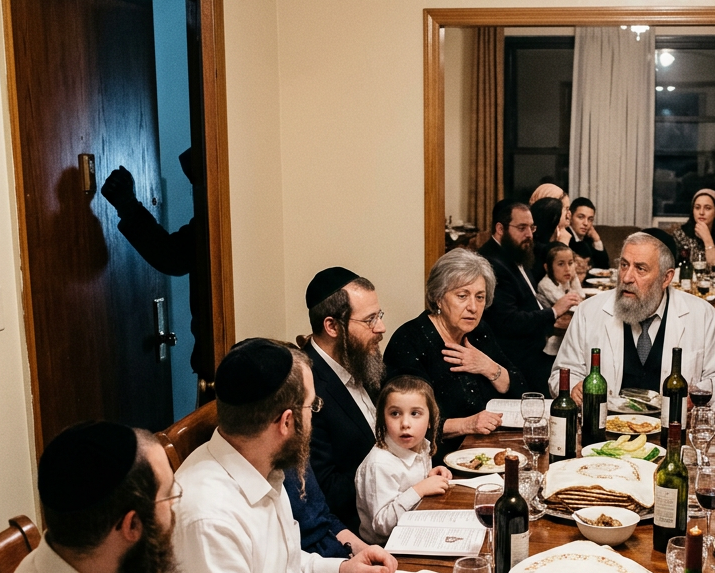
Everyone knows that rabbis sometimes have an odd mix of guests at their Sedarim—chasidim and Litvaks, baalei teshuvah and askanim, converts and…terrorists?
Indeed, that happened to us one year.
This past Seder, as I began the simanim, I made a humorous reference to this event, only to discover that my youngest daughter had no idea what I was referring to; she hadn’t been born yet when it occurred.
And so, with our guests listening closely, I shared the follwing story:
It began at JFK International Airport in January 2006. I was returning from drawn-out meetings, and Terminal 3 was packed.
Suddenly, and through the haze of people, I spotted him out of the corner of my eye.
Something was different about this man.
Post-9/11 trauma and paranoia were still very much with us, and our imaginations were apt to run wild. But this time I wasn’t imagining things. The man I was watching had trained with Ayman Al-Zawahiri, who would later become the second-in-command of al-Qaeda, and for a time, he had appeared on the watch list of every intelligence service from the CIA to the Mossad and Interpol.
He had deep black eyes and jet-black hair, and was most likely Egyptian. I was the only visibly Jewish person in the terminal, and he couldn’t seem to take his eyes off me.
Then I saw him walking straight toward me.
“Excuse me,” he said in a thick Egyptian accent. “I would like to give you my seat.”
“No, thank you,” I said, turning away.
“Please, I insist.”
Dozens of people were standing in that terminal. Why offer his seat to the man in the religious fedora?
Too nervous to push back, I accepted. “Suicidal empathy,” they call it. I slowly lowered myslef onto a seat that I was about 23% sure was wired to a weight-censored bomb.
After surviving the seat, I breathed a sigh of relief. The man again smiled at me, as I convinced myself that he wasn’t even on my flight and that this whole awkward saga would soon be over.
Of course, he was on my flight. And to my horror, he asked the flight attendant if he could sit next to me -as if we were old buddies!
Please recall how paranoid we all were back then, so perhaps the reader can excuse any honest uncouthness on my part thus far described.
In any event, we boarded, he sat down next to me, and extended his hand.
“My name is Tawfik Hamid. Are you a rabbi?”
*GULP*
“Yes.”
After all, I figured that if I was going to be a martyr then I should do so with pride.
To this confirmation, he responded:
“That is why I offered you my seat. Whenever I see a Jew, especially an Orthodox one, I go out of my way to help them.”
“How nice….Um…Why?”
“Because of respect…and guilt. I was once a trained terrorist. I had nothing but unsophisticated interpretations of the Quran. Just before 9/11, I saw the error of my ways and repented. I now dedicate my life to combating radical Islam.”
He was returning from briefings on Capitol Hill and meetings with then Senator Carl Levin of New York. He was now en route to speak at the University of Buffalo. We were soon deeply engaged in conversation, and the flight went by in an instant. We exchanged contact information, and he joked that this would make a great JetBlue commercial.
I was not convinced Park Avenue would concur that such a campaign would sell out any flights.
At the terminal in Buffalo, we shook hands and went our separate ways.

I thought that maybe I’d get a good drashah out of the incident, but otherwise that was the end of it.
A few months later, a professor at UB, called to apologize in advance for the unorthodox nature of her forthcoming request. She and Dr. Hamid were friends, she explained, and he had expressed a wish to attend my Passover Seder.
Would I be willing to host him?
(Incidentally, there are some halachic considerations involved in inviting a non-Jew to a Seder or any Yom Tov meal. One should consult a competent halachic authority if such a situation arises.)
My wife’s entire extended family would be with us—my in-laws and many of their raucous grandchildren. One more guest seemed manageable.
I said yes—but only remembered to tell my wife on Erev Yom Tov.
My mother-in-law was, to put it mildly, ‘displeased’.
“You invited a terrorist to the Seder?!”
Sheesh, she was making me feel that I was the first Rabbi son-in-law in history to have such a guest.
I tried to calm everyone down, noting that this was probably not the culmination of an elaborate plot, decades in the making, all to be carried out in our Amherst, NY dining room.
Then, remarkably, a miracle!
That Erev Pesach, the guest editorial in The Wall Street Journal was written by…. Dr. Hamid!
This certainly helped ease the tention in the air…a little.
The night arrived. Dr. Hamid understood his role as an observer; for example, he was not given a piece of the afikoman, but he asked good questions, and he cried when we sang “B’chol dor vador.” He marveled at the fact that the Seder is largely oriented toward children.
I felt bad for him, as he was probably did not eat all day, awaiting brisket and other delights that would be served. While we indeed eventually serve such delectables, he likely was not warned that he would have first have to wait three-hours to earn it.
Worse, I could only image his shock when we first passed around celery and salt water!
When we finally reached Shulchan Aruch, and the Haggados were set aside, Dr. Hamid clasped his hands and said with great feeling:
“Forget torture. Forget Guantánamo Bay. We should force Islamic radicals to watch a Seder so that they can see with their own eyes what Judaism is truly about—the beautiful people and faith they want to destroy.”
Quixotic, perhaps, but it was astonishing to hear this from a man of his background.
Then, at the strike of midnight, he apologized and asked to be excused since he had an early flight. I couldn’t resist making the obvious joke: “But the Seder is about Jews escaping Egyptians at midnight, not the other way around!”
As I finished telling this story at our Seder this year, my daughter and the guests all turned to my wife, too polite to ask me directly whether any of this was true.
It occurred exactly as written.
After my wife confirmed these details, the guests turned back to me and asked, “So Rabbi—what’s the lesson?”
There is, of course, the Rambam (Hilchos Teshuvah 6:5), who explains that the Egyptians were punished even though they fulfilled Hashem’s decree to Avraham. Why? because the decree was not directed at any particular individual, and each taskmaster chose to act cruelly of his own free will.
In other words, any one of them could have done what Tawfik Hamid did and backed away, refusing to inflict pain.
But the deeper message is one we must carry with us long after Pesach, into the spring and beyond.
I shared:
“If Tawfik can do it, so can we. Here was a man who had once appeared on terrorist watch lists…and was now briefing world leaders.
“He had risen from the depths of darkness to defend civilization.
“What a vivid illustration, l’havdil, of Yetzias Mitzraim itself -where a nation at the lowest rung of tumah would stand at the foot of Sinai only fifty days later.
“The sefarim stress how Pesach should serve to remind us that no matter how bleak things may appear for the klal, no matter how low a person feels he has sunk, Hashem is eager for us to return.”
Concluding:
“If Tawfik can do it, so can we.”

Leave a Reply