& Other Fasting Imponderables, such as fasting erev Shabbos, Fridays.
January 2025
I. Friday Fasting
I’m writing this on the morning of Asarah B’Teves.
It seems that every time this fast falls on Erev Shabbos, people forget that it is even possible…even though it happened just last year (2024)!
This misconception is based on the halachic myth that one may not fast on an Erev Shabbos.
This inaccuracy is likely inferred from the fact that when we have a nidcheh, a deferred ta’anis, we don’t observe it on a Friday (see Aruch Hashulchan, siman 470:4).
However, the Shulchan Aruch informs us that anshei maaseh—very conscientious people—had the custom to fast every Erev Shabbos (Orach Chaim 249:3)!
The Mishnah Brurah states that although it is no longer appropriate to take on this minhag, a person who will enjoy the Friday-night seudah more if he does not eat on Friday is allowed to adopt this practice.
In our current calendar, Asarah B’Teves is the only one of the four ta’aneisim listed in Tanach (Zechariah 8:19) that can fall on Friday (siman 550 se’if kattan #10 in Mishnah Brurah; see also Meiri on Megillah 2a, as well as the Bach and the Taz).
HOWEVER….Fasting on an Erev Shabbos could technically apply to any of the rabbinical fasts listed in Zechariah. Rather, in our calendar cycle they happen to never fall on Friday.
As for a unique quality found only in Asarah B’Teves, the Avudraham (d. circa 1370) asserts that, for this date only (and Yom Kippur), if were to fall on Shabbos itself, we would not move it (see Beis Yosef, siman 550 at end; see also Aruch Hashulchan 549:2)!
This view is solely academic since Asarah B’Teves could only fall on a Shabbos if Rosh Chodesh Teves falls on a Thursday, which can never happen in our system (Shulchan Aruch, siman 428:2; nor can Rosh Chodesh Teves fall on a Shabbos).
II. Shaving/Haircuts on a Fast
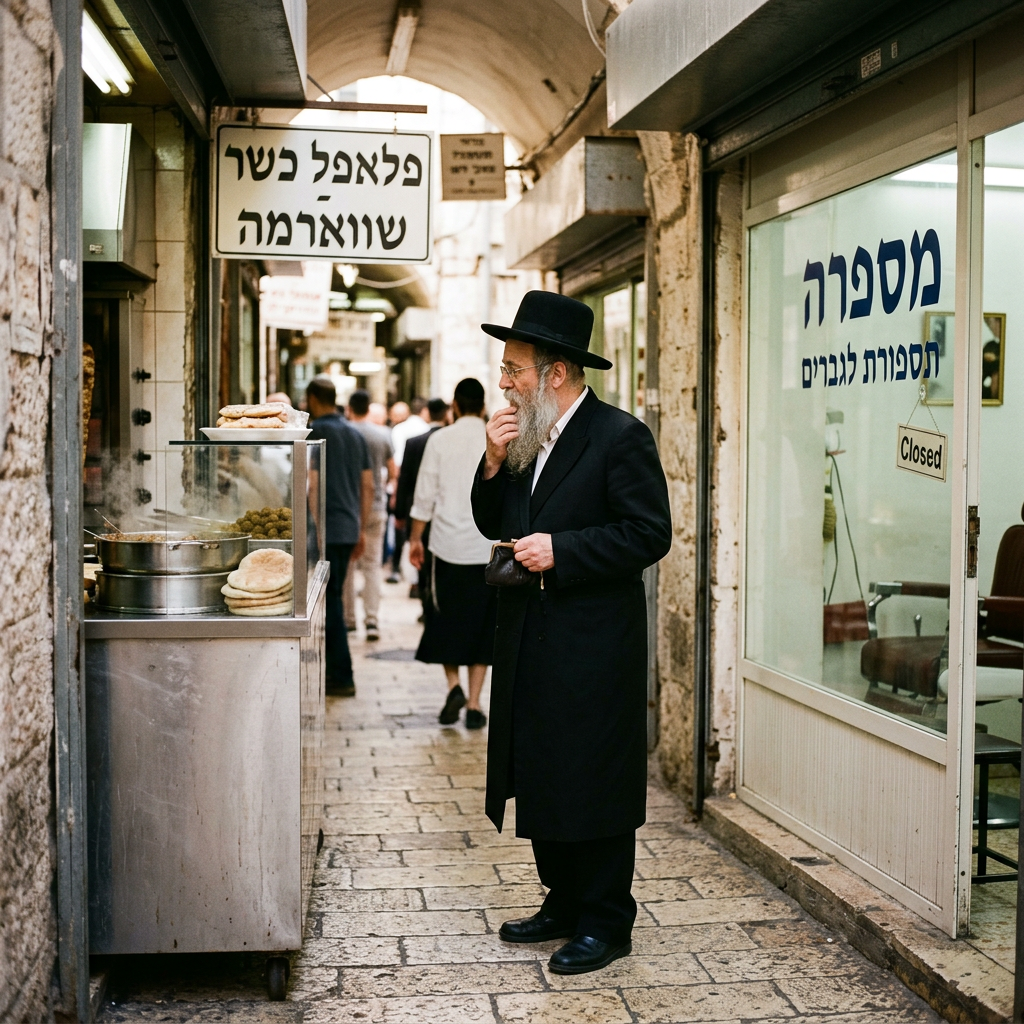
Because I am writing this on Erev Shabbos, I have been receiving many sh’eilos about shaving and haircuts. For example, I was asked whether the fact that we don’t cut our hair on a fast day eclipses the requirement to tidy ourselves up l’kavod Shabbos (see Rema, siman 260).
A similar question was whether it is permissible to taste the food l’kavod Shabbos and then spit it out even though we don’t do so on a public ta’anis (Mishnah Brurah, siman 567:6).
This is a popular sh’eilah even on a weekday fast. Others included whether it is permissible to listen to music or buy new clothing.
The sole reference to cutting one’s hair on a fast day (cf. Tishah B’Av) is a famous gemara relating to Chanukah (Rosh Hashanah 18b). Here is the background.
In galus, Chazal wished to nullify our observance of the days mentioned in Megillas Taanis. This sefer containsthe earliest recordings of 30-plus post-biblical salvations and their commemorations, and it is the original source for the events and laws of Chanukah. Although the other observances were annulled in time, Chazal made an exemption for Chanukah (see my upcoming sefer on Chanukah, iy”H, which explores this in depth).
Rav Yehoshua ben Levi held that this sefer’s contents were not nullified, and he was therefore shocked when the town of Lud declared a fast on one of the days of Chanukah. His shock is not surprising since the name “Megillas Taanis” was given precisely because fasting is not allowed on most of the days it records (see the hakdamah to the Oz V’hadar ed.).
In protest, Rav Yehoshua decided to take action to demonstrate to the populace his displeasure with observing a fast during these celebratory days. He got a haircut!
Evidently, haircuts were known to be forbidden on a fast. Can we infer from here that it is indeed forbidden to cut one’s hair on a fast day?
Well, the Shulchan Aruch states that all inuyim—discomforts such as not bathing and not anointing oneself—which are prohibited on Tishah B’Avare permissible on other rabbinical fasts (siman 550).
The Mishnah Brurah adds that although it is permissible to do these things, “baal nefesh yachmir,” meaning that a conscientious person should be strict about abstaining from them—with the exception of wearing leather shoes, which even a baal nefesh wears on standard fast days.
The Biur Heitiv states similarly, “Perhaps we should be machmir in these areas on the other fast days as well,” implying a more universal chumrah (siman 551, s.v. mei’rosh chodesh).
But haircuts are not mentioned specifically, nor is the story about Rav Yehoshua. Wouldn’t this be a clear source, and also demonstrate that haircutting is not simply a chumrah?
Enter Rav Chaim Pilagi (d. 1868), who ruled that it is forbidden to have one’s hair cut on a taanis, even citing the above gemara as his source! He states further that one should not even get a haircut the night before a taanis.
He does say, however, that when a taanis falls on Erev Shabbos, a haircut would be allowed (Ruach Chaim, siman 566:4; see also shu”t Lev Chaim).
But if the gemara is so clear, why do many say it is only a chumrah not to have a haircut on a weekday taanis? And if, for whatever reason, it is allowed, why should we establish a chumrah?(See, e.g., Rav Tuvya Goldstein in shu”t Emek Halachah, pg. 175, where he permits haircuts on a taanis but leans toward acting strictly.)
The Acharonim point out that the above gemara is actually the source for both the allowance and the chumrah!
Rav Yehoshua’s decision to have his hair cut on a taanis always seemed curious. If he wanted to protest the taanis, why not just eat and drink?
The Shaagas Aryeh (d. 1785) lived over a hundred years before Rav Chaim Palagi and was the rav of the Ashkenazic community, as opposed to the revered Lev Chaim, who was a Sephardic leader in Izmir, Turkey. He raises many questions about Rav Yehoshua’s decision (Turei Even on Rosh Hashanah).
To explain it, he interprets the gemara brilliantly, stating that Lud’s ta’anis must have been institutedby its own rabbanim, binding everyone to it—including rabbanim such as Rav Yehoshua who might have vehemently opposed it. Therefore, the only form of protest available was ceremonious in nature.
The obvious conclusion, then, would be that this gemara and Rav Yehoshua’s decision are proof that a haircut is perforce allowed on a rabbinic fast, except that it is not in the spirit of the day. (Cf. Ritva, who also asks why Rav Yehoshua didn’t simply eat as a protest. He answers that Rav Yehoshua wanted to do something publicly. Perhaps the Ritva understood that Rav Yehoshua wouldn’t eat in a public domain, which the gemara compares to the behavior of dogs.)
In summation, there is no clear prohibition against shaving or having one’s hair cut even on a weekday taanis (with the exception of Tishah B’Av). Rav Chaim Palagi’s opinion is a singular one.
Nevertheless, and although it is not a halachah, we should try to be strict regarding haircuts, music, and other activities that may counter the spirit of mourning on a fast day (Dayan Fisher, shu”t Even Yisrael 7:28). ●

Leave a Reply