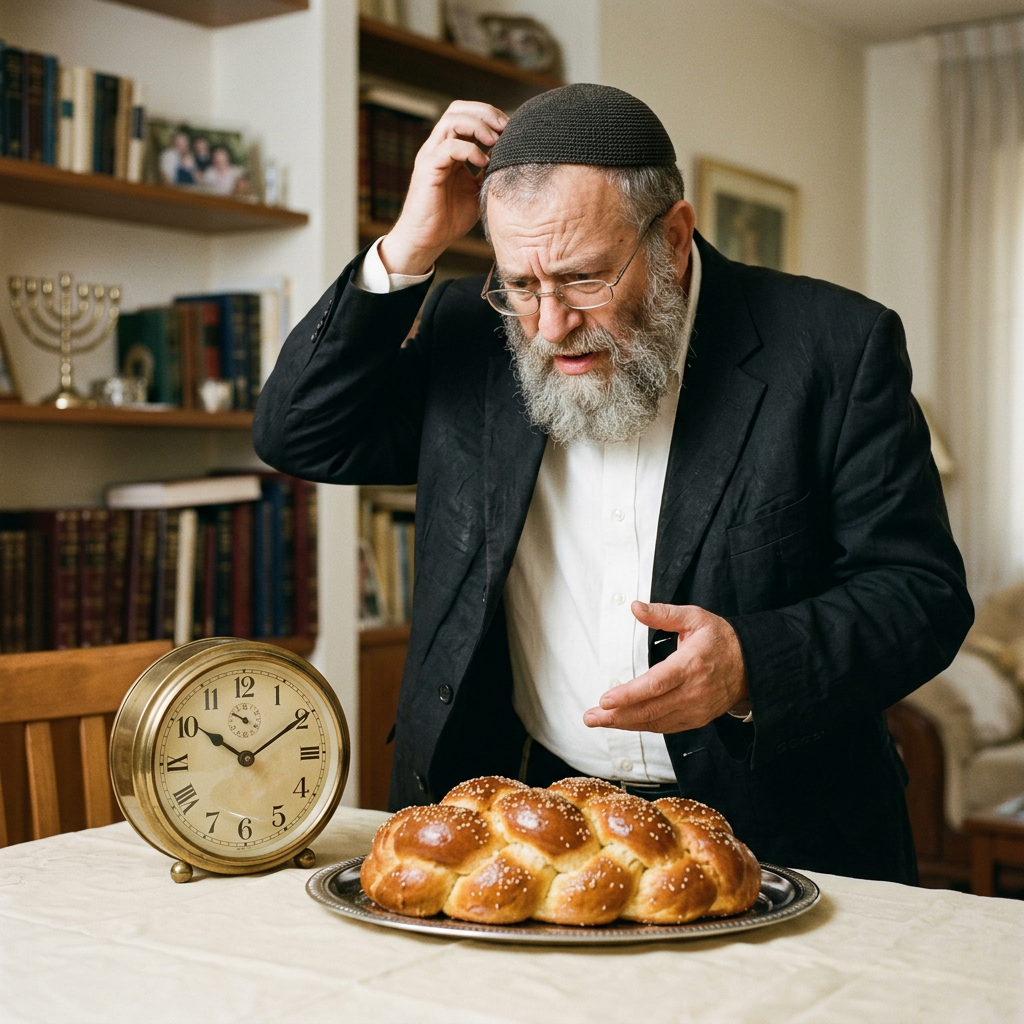
Bentching on a Motzai Shabbos Rosh Chodesh
March 2024
I. A-typical Timetable
I recently shared how this year (5784) is unique in that we will be leining the haftaros of Mikeitz, Tazria, and Kedoshim. The haftarah of Tazria was last leined in 5763, a gap of 21 years!
Such a long “drought” occurred only three times—in the years 4180, 5537, and now, 5784.
The haftarah of Mikeitz is leined in only 10.1 percent of years.
Haftaras Kedoshim is the real anomaly, leined injust 5.8 percent of years, with a potential 44-year gap between readings! It’s leined only in a year exactly like this one—a 383-day leap year, when both Kislev and Cheshvan are 29 days, and Rosh Hashanah is on Shabbos.
Typically, when Shabbos is Erev Rosh Chodesh, we lein the haftarah “Machar Chodesh.” However, this Erev Adar Sheini we didn’t because of Parshas Shekalim.
I wondered how unique it is not to lein “Machar Chodesh” on a Shabbos Erev Rosh Chodesh and learned that it is surprisingly common, occurring on average 55 times every 100 years, and only when before Rosh Chodesh Nisan, Elul and Adar (I and II).
However, unless a shul leins haftaros from a klaf, all of these curiosities don’t pose much of a challenge.
But there is another calendar query that fools many people into thinking it’s rare when it’s actually relatively frequent.
II. Commonly Rare
The issue to which I refer occurs 182 times every 100 years, or 1.82 times per year. (Of these times 182 times, “Machar Chodesh” will be omitted 55 times.)
This is the dilemma of when the first day of Rosh Chodesh falls on Sunday.
RULE: This issue can only arise in Nisan, Iyar, Sivan, Elul, Cheshvan, Kislev or Adar (I or II).
Each time this occurs, it’s the same routine. Long after shekiah, the sponsor for the shul’s shalosh seudos lifts up the kos to lead the zimun, and the gabbai calls out, “Rabbi, what should we do—say both Yaaleh V’yavo and Retzei? Or should we skip one of them?”
Often, someone will wisely recognize this issue even before we wash. “Should we make sure to eat a certain amount in a certain amount of time so as to minimize the sh’eilos with Yaaleh V’yavo?”
III. The Rabbi’s Changing Mind
The answers to some sh’eilos—with no reigning ruling or minhag, and where the sho’el is protected from any serious violation, irrespective of the psak—can change based on the slightest nuances.
For me, this was true with our bentching problem where, each time I go through all the technical issues, I seem to come up with a different conclusion.
The concern here, of course, is whether this period of time should be treated as Shabbos by reciting Retzei, or whether it is Rosh Chodesh, in which case Yaaleh V’yavo should be said.
They can’t both be true!
Such dualities are often termed “tarti d’sasri,” or self-contradicting (see the very first Tosfos in all of Shas and on Beitzah 14a, s.v. “tarti”; see Chayei Adam 118:5).
The Shulchan Aruch rules (199:10) that a Shabbos or Yom Tov meal that extends into the night, when it is already technically the next day, is considered to belong to the time when the bread was first eaten. This would mean that it is still considered to be Shabbos (or Yom Tov).
(Based on this, many assume that they may continue eating after shekia, so long as they washed and began eating before. While this is true, many rule that it is only true for bread. Making a mezonos or another beracha before shekia may perhpas not allow one to continue eating similar-berach– items after shekia. Some are lenient for women. See siman 399, with achronim)
This continuance is only active so long as one hasn’t yet davened Maariv; in fact, even saying, “Baruch hamavdil” before bentching should be avoided (see Shulchan Aruch Harav 188:17, Chayei Adam 47:24, and Mishnah Brurah 273:7. Regarding Al Hanissim, there is some debate).
IV. Rosh Chodesh or Shabbos: Psak
Based on the rule that the ‘day’ is tethered to the start of a meal, our question seems answered—so long as one began eating before shekia, if shalosh seudos extends into the night, even though it is Rosh Chodesh, we consider it Shabbos and we say Retzei.
If it were only so simple!
The Chofetz Chaim writes that it’s possible in such a case for one to say Yaaleh V’yavo…and not Retzai!
How? He was referring to a case where a person also eats a kezayis of bread after dark.
The Choftez Chaim then writes that others disagree, ruling that one should say both Retzei and Yaaleh V’yavo in such a case (Mishnah Brurah, siman 188:33; see Magen Avraham on simanim 271:15 and 419:1).
Perhaps we can now understand why the rabbi seems to change his mind from case to case!
One may be thinking, “If this is such a common issue, just follow the great poskim.”
Well, Rav Moshe Feinstein and others ruled that at such a shalosh seudos, if one eats a kezayis of bread only before dark and not afterward, then he wold only recite Retzei.
So why wouldn’t a rav announce this psak?
The reason is that some people come late, or they don’t hear the announcement, or they may simply forget and eat more bread—commonly done without thinking, during the rabbi’s devar Torah.
On top of that, Rav Moshe was not saying that this is the only option. He seems to say that one may instead choose to eat bread both before and after dark – and then say both Retzei and Yaaleh V’yavo!
In fact, some poskim actually encourage people to do just that (Shulchan Aruch Harav, shu”t Be’er Moshe 1:5, all based on the Taz).
Confusing matters, Rav Ovadia Yosef and others disagree, ruling that one should always only recite Retzei; explaining that the idea of not eating bread after dark is only a precaution to avoid a doubt and would not change the outcome.
Rav Elyashiv agrees, also urging one not to eat bread after dark.
However, both he and Rav Yosef rule that should one mistakenly eat bread after dark then he should in fact add Yaaleh V’yavo.
Rav Shlomo Zalman Auerbach agrees with Rav Elyashiv but adds a leniency. He states that if one eats less than a kezayis after dark, or even if he eats more than this shiur but over a span longer than nine minutes, he would still be in the “Retzei only” camp.
It comes out that in the average shul, where many eat a kezayis of bread both before and after dark (both times within the nine-minute window):
- Rav Moshe would require both Retzei and Yaaleh V’yavo;
- Rav Yosef would require only Retzei;Rav Auerbach and Rav Elyashiv might view this as a b’di’eved but still advise that both be said;
- Chofetz Chaim would advise that one say only Yaaleh V’yavo!
My “inconsistent” psak is dependent on what’s happening in the group. When I realize there is a concern about bentching, I reply based on what people may already have eaten and what can still be prevented.
The Be’er Moshe (ibid.) records that he witnessed the Divrei Chaim of Sanz go out of his way to eat shalosh seudos early on such a Shabbos in order to avoid any question!
May the zechus of investigating this matter be a protection from error! ●
I wish to thank Rav Yosef Yehuda Weber of Toronto, who lent his expertise on the calendar; all mistakes are my own.

Leave a Reply