&
Joie de Vivre Within The Final ‘Kshanim’ HaTovos Of The Year
Erev Yom Kippur, 5782
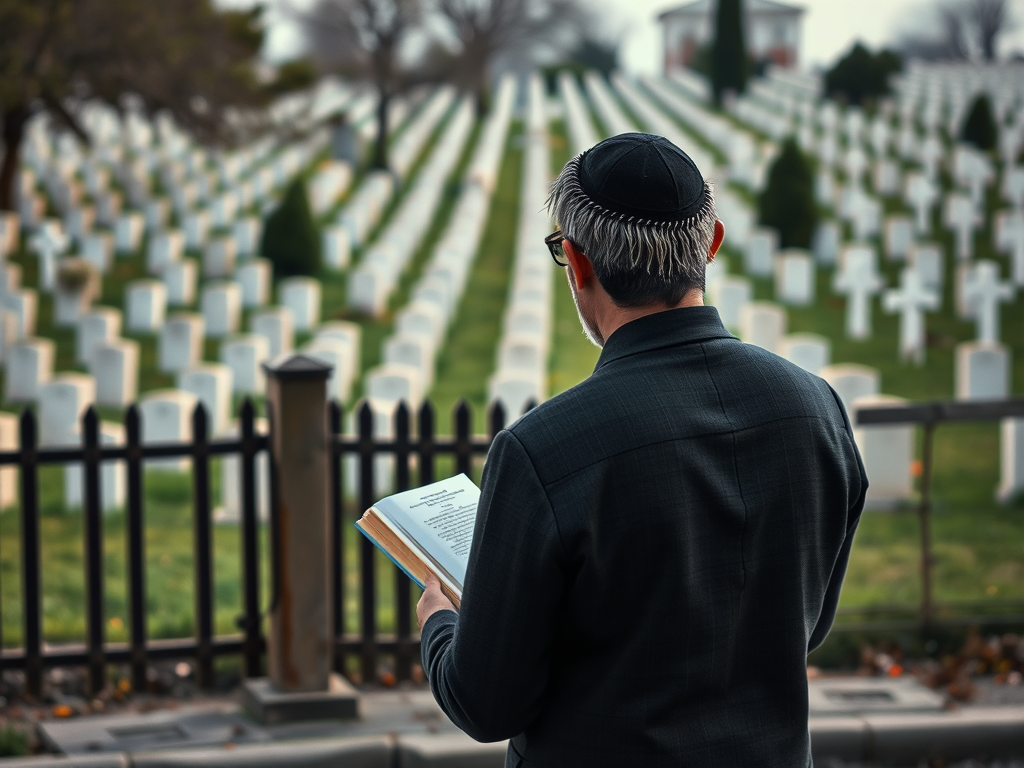
A recent visit to Toronto allowed me to visit the cemetery before Rosh Hashana. There is where my brother-in-law is buried and where my mother and her parents lay. My mother is buried near the end of a long section, close to the gate. Because we are kohanim, this allows us to stand nearby and daven. The brushes have grown significantly since I’ve been there last, and I had to climb the fence to get a better view of the matzeiva (see shu’t Tzitz Eliezar 15:40, et al).
While a cemetery is never a place where ones feels at ease, as a kohein who is rarely near such a place, I was quite out of sorts. What and how to be mispallel at a cemetery is an enormous discussion in and of itself, and we will discuss this fascinating topic after the yomim tovim, be’H. I managed to navigate my teffilos appropriately, and then looked out into the vast dark and quiet and the sea of matzeivos that lay before me.
The following three thoughts came to mind, and I share them here.
- Seeing is Believing
My first thought was one that would come naturally to any child: did my mother know I was there? I do not mean to get into the larger nistar discussion of the awareness of the deceased regarding the lives of their living loved ones; chazal discuss this. Rather, whatever gain there may be in such a visit, do I -standing at a distance from her kever -facilitate it?
In the sefer shu’t Duda’ai Hasadeh #21 (d. 1916, erev Rosh Hashana) he discusses this. First, as to the nistar, he proves from a story recorded in the Zohar (acharei mos, 71) that, yes, a niftar is aware of the presence of even a kohein standing at a distance, and, that such knowledge gives the neshama nachas ruach (we would be remiss not to point out that the Gra strongly discouraged the visitation of his mother’s kever).
He then shares a critical point that is found in the Maaver Yuvuk (Imrei Noam, 40, at end). The minhag of placing a matzeiva with a description of the niftar upon a burial spot serves to awaken those visiting. So, whether one is able to be up close or a kohein at a distance, simply being reminded of the life of a loved one -or a tzadik -will awaken within them the power to harness their yetzer hatov and unleash their internal kedusha.
This always seemed to me to be the simple explanation as to why Kalev travelled all the way to Chevron to maaros hamachpeleh. Why not just daven directly to Hashem? Or, why not ask Moshe for a beracha (after all, Moshe gave Yehoshua a name change which helped in protecting him)?
I believe Kalev went to be close to Avraham -who had to fend off Terech and the influence of his youth; Yitzchak-who had to battle with Eisav; Yaakov-who had to overwhelm Eisav; the imahos-who had to protect themselves and their children at great cost. Can there be greater chizuk in defeating the influences of the meraglim than reminding oneself of others under similar pressures and who come out victorious?
- A Frightening Sermon
When researching the early rabbanim of America, I often come across interesting material that hasn’t yet found a home in a column. One example is the very first Yom Kippur in Buffalo, New York in 1847. It was contemporaneously reported:
“It was on the Day of Atonement that Rev. Itzig Slatsky stood in the synagogue in his white linen robe and white cap. Toward dusk…the congregation could no longer read without lights…they sent for a non-Israelite to light their hall. He, on entering the synagogue, seeing Mr. Slatsky with his pallid face and his long white beard, in full keeping with white attire…was seized with terror -ran out as quickly as he could -and reaching the stairs, fell headlong down the whole flight, causing quite a sensation by his precipitate exit”
(See The First Rabbi, p. 406)
Standing in the dark cemetery, another event, from five years earlier, came to my mind.
Erev Rosh Hashana of 1842 Rav Rice, the first musmach in America, decided that the best place to give mussar to this orphaned populace was at a levaya, surrounded by kevarim.
“I must describe the religious observance at it exits” he begins. He then goes on to describe himself like a doctor who vacillates between revealing the truth and thereby risking panic, or, hiding it so as the patient can be at peace. His choice becomes crystal clear when he admonishes:
“How foolish you are! If you would but open your eyes and look upon these graves hereabout and realize the transitoriness of life on earth…”
Eleven days later, on Yom Kippur, he completed his words. “You have forgotten the grace of Gd that brought you here…the very fact that are synagogue is closed from one Shabbos to the next is the clearest evidence of your irresponsible behaviors in this land…one thinks that here he is no longer in the presence of Hashem, and that in this land human destiny lies only in the accumulation in vast riches…”
Perhaps, one of the reasons for the minhag of visiting cemeteries during these days is due to the fact that noting opens one’s heart to the foundational truths, to seeing error, like being faced with the one truth from which no one escapes.
- Life vs. LIFE
In 1780 the world was first introduced to the Chassidic machshava with the publication of Toldos Yaakov Yosef.
Rav Yaakov Yosef of Polnoye was a dedicated student of the Baal Shem Tov and recorded the teachings of his master in this volume.
In the section on hallel, he details a question from the holy Baal Shem Tov. “Lo Emus, Ki Echyeh –I shall not die, because I shall live”.
What is the point of this redundant prayer? Either just ask for life, or request that one should not die!
The Baal Shem Tov explained that the word ‘ki’ has many functions. One of these is ‘Because’, and yet another is ‘When’.
This teffila is not meant to be translated ‘I shall not die, because I shall live’ rather, “I shall not be dead when/while still alive”!
In other words, it is describing those who are Dead-Men-Walking.
How many of us go through life not appreciating all that we have? How many of wake up dreading the day ahead? Questioning what others have while ignoring the bounty of our own lives?
Rav Steinman once met with Rav Shach this time of year and asked why in u’nesanah tokef –when we describe some agonizing methods of departure from this world –we also mention ‘mi yichyeh?’.
“Why are people prone to crying at those words? Is not that the very thing we are all asking for?”
He answered his own question, and Rav Schach concurred. We are asking ourselves, ‘Will we be able to enjoy all that Hashem did grant us?” Who is alive but not vivaciously taking for granted every moment, every gift?! (Divrei Siach, 196)
A cemetery reminds us that not only are we alive, but we must take advantage of every moment, and be thankful for this gift.
My eldest daughter drove me to the airport to leave for Toronto. I asked her, “What is the last teffila we say each year?” She responded croecctly, “mincha, erev Rosh Hashana”. I then shared that it always bothered me at we say then, in shemoneh esreh, ‘uvareich shenuseinu kashanim hatovos -Hashem should bless this year like the best years’, “We only have seven minutes left!” I asked, “What are we supposed to have in mind?”
She thought for a moment, and the said, “Perhaps at this point we are not asking about the future. Perhaps we are asking Hashem to help us be able look back at this past year and see all of the positive He gave us, and we had accomplished. To appreciate what we do have”
A great answer!
Gmar Chasima Tova!

Leave a Reply