-Blowing Shofar With No Minyan-
-Making-Up A Missed Shofar-
-Offseting A Shul’s Missed Shofar By Mincha-
September, 2025
Rabbi Moshe Taub
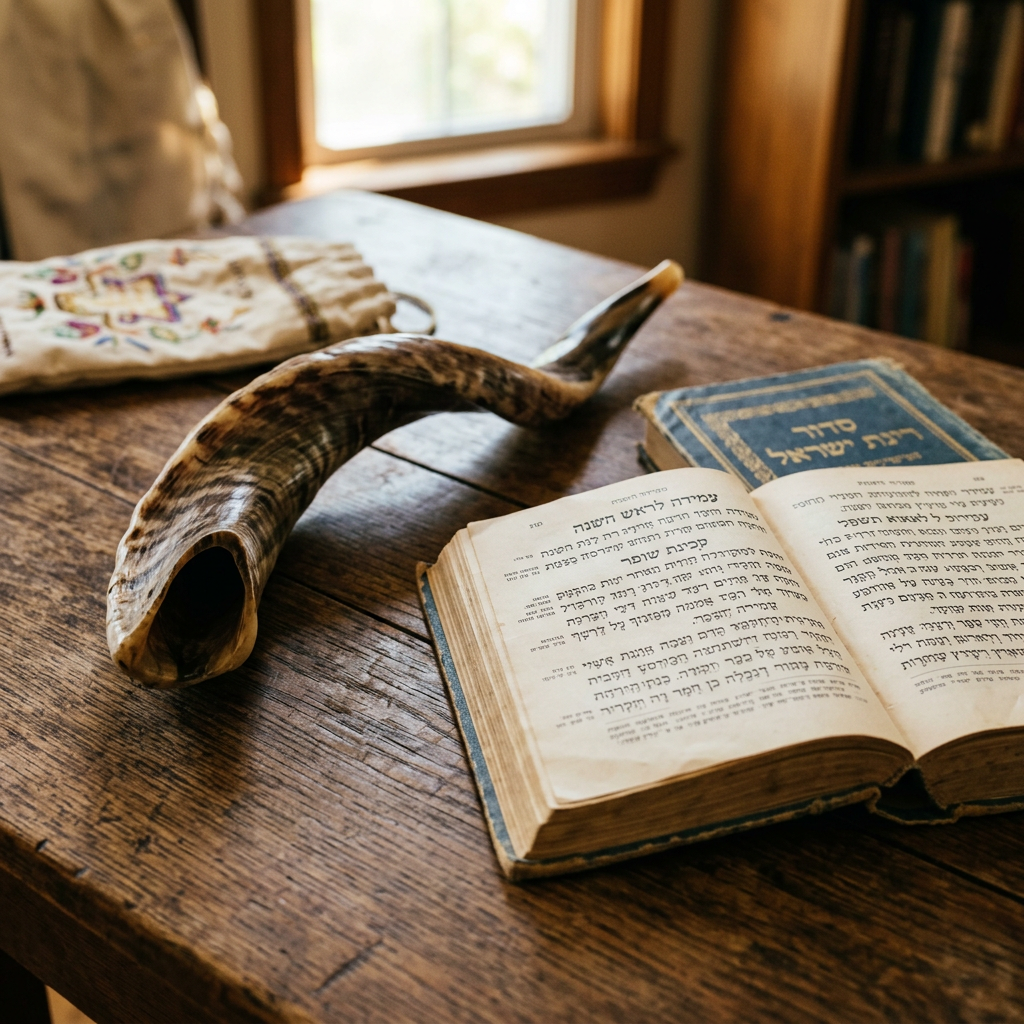
The minhag of tekios elul -blowing the shofar after shachris throughout the month of elul -leads to commonly asked questions.
- How far must one go -in time, distance, or loss – to hear this shofar?
- If one is not davening with a minyan, or if he stepped out during its blast, should he make up this shofar himself? Must he?
- Is there a need for a shul to make-up for a missed/forgotten shofar?
In the 1970’s, a rabbi by the name of Rav Tzvi Pesach Frank shared with Rav Eliezer Yehuda Waldenberg (d. 2006) his views relating to these questions (shu”t Tzitz Eliezar, 12:48).
This rav is not to be confused with the more famous posek and chief rav of Yerushalaim of the same name -as the latter was niftar thirteen years prior to this teshuva’s composition! Nevertheless, this unrelated and younger Rav Frank was a talmud chacham himself, and his sefarim bear haskamos from Rav Abramsky and Rav Shlomo Zalman Aurbach.
This Rav Frank argued that one must privately make-up any missed elul tekios. He then sought Rav Waldenberg’s approval to this psak.
Rav Waldenberg , however, dismissed this ruling out of hand, writing:
“Never have we heard, even among the most precise and pious of individuals, that – should they have needed to daven alone during the month of elul – to then [need to bring] them a shofar from which to blow…”
While this testimonial/mesorah may be enough to dissuade people from privately making up missed tekios, he goes on to independently prove why such make-ups have no basis in minhag.
To explain, let’s first review the provenance of our elul tekios.
The standard source for this minhag comes from the Tur, quoting a midresh:
On rosh chodesh elul, Moshe went up to har sinai to receive luchos shniyos. Before he went up, a shofar blast was sounded throughout the entire machaneh, demarcating the date and time. The purpose of this was so the date of his departure be made clear so that a repeat of the last miscalculation error -which led to the chet haegel –be avoided.
Pirkei D’Rav Elezar, perek 46
The Tzitz Elizar explains that a minhag can never fully depart from its original source, and since the tekios performed the day Moshe went up were blasted/heard throughout the machaneh -i.e., in a public setting – so too our minhag is only for a public setting, i.e. in shul with a minyan.
He further posits that this holds true even according to those rishonim who offer another source for this minhag, pointing to the following pasuk:
“Would not a shofar blast in the city cause people to shake?…”
-Amos (3:6)
Even there, it references the unique inspiration and drive drawn from a public setting (“…a city...”).
Rav Waldenberg concludes with one final – and fantastic! – proof to his ‘shul only’ verdict:
As most are aware, halacha demands that we cease these elul tekios on erev rosh hashanah to create a clear separation between the minhag blasts of elul and the biblically mandated ones of rosh hashana.
Interestingly, the Magen Avraham and others are lenient on erev rosh hashanah when done for practice and in one’s private home.
Meaning, in the Magen Avraham’s view, elul tekios in one’s home are not even at the level of minhag! For if they were, separating minhag from obligation would apply at home as well!
Accroding to the Tzitz Eliezar, this alone demonstrates that there is no significance to such tekios.
I would humbly offer another proof to the Tzitz Eliezar:
The Maharam M’Ruttenberg explains the minhag of elul tekios as based on practical concerns: So that the baal tokeah has a chance to train and prepare for rosh hashana!
In fact, this goes beyond mere basic practice. For him to blow in a shul setting also allows him to train in an environment of eimsah d’tziburra (stage fright; with an audience).
So that, according to this approach to the minhag as well, the Tzitz Eleizar remains sound, as blowing at home would be illogical for anyone other than the baal tokea! And, perhaps even for the baal tokeah himself too there may have no reason to make these up – as such home-practice would be weakened by the lack of a kehilla present!
(On this concept of ‘nerves’ and the chazan/baal tokea, see, e.g. Rambam, hil. tefilla, 10:3 w/ mishneh, berachos 34a and Yerushalmi, berachos, 5:4)
Based on the Tzitz Eliezar: A person alone need not blow; A shul need not make up missed elul tekios
This would be true whether the source for elul tekios is the A) midresh by Moshe, B) the pesuk in Amos, or C) for the baal tokea’s practice.
Some poskim, however, slightly differ or add caveats.
While agreeing that tekios elul is not an obligation, some praise those who privately, at home, make these up. They explain that, in the final analyses, the goal of the these tekios is to awaken us to teshuva. While perhaps of no minhag consequence, such action may still offer aid in inspiration (see Siach Yitzchak, et al.)
Relating to this last idea, Rav Moshe Feinstein explains that the reason why we choose the very end of our first teffila of the day for these blasts:
“…so as to cause awakenings of teshuva in order that one perform their business b’derech haTorah“
– shu”t Igros Moshe, oh”c, 4:21;5
Rav Moshe then writes:
“…in any event, if the shul did not to blow shofar in the morning, they should do so by mincha”
-Ibid.
Of course, this too would be a public setting and wouldn’t be proof regarding a private individual’s need for a make-up.
At this point, some may be wondering: “What difference does it make? After all, there is no harm in making up such a missed shofar blast privately!”
However, such an assertion is not as simple as it may seem. Poskim will always defend historical practice and be suspect toward a personal practice of ‘minhag invention’.
(For a deeper dive, see Igros Moshe who questions even the minhag of fasting for a fallen sefer Torah – unless, of course, a clear proof from chazal can be found. See ‘Fasting For A Fallen Sefer Torah where this is explored in detail).
There is much more to discuss, such as which blasts do we make during elul, why before l’dovid, as well as why we start this practice only on the second day of rosh chodesh, etc. Perhaps another time, iy”H.
For now, we will conclude with the following thought:
How does the one-day shofar blast in the desert lead to our month-long shofar blowing?!
I would suggest that the solution comes from the end of that source (Pirkei D’Rav Elezar, ad loc.), which concludes:
“and Hashem lifted Moshe up along with the sound of that shofar blast…”.
Perhaps, then, our minhag is to recall not that one day they blasted the shofar in the midbar, rather to remind oursleves how that one simple blast lifted Moshe higher – how on each of day of elul, with just one tekiah, one push to grow, Hashem can lift us the rest of the way.
B’Sikum:
An Individual: one who missed davening or who is davening alone during elul need not blow shofar nor make it up. Indeed, the custom was only to blow shofar in a shul and with a minyan. If one chooses to anyway make it up, he has what to rely on – so long as he is aware he is not accomplishing a minhag yisroel, per se. A Shul/Minyan: a shul or minyan that missed/forgot a morning tekiah during elul should make it up by next mincha, if possible.

Leave a Reply