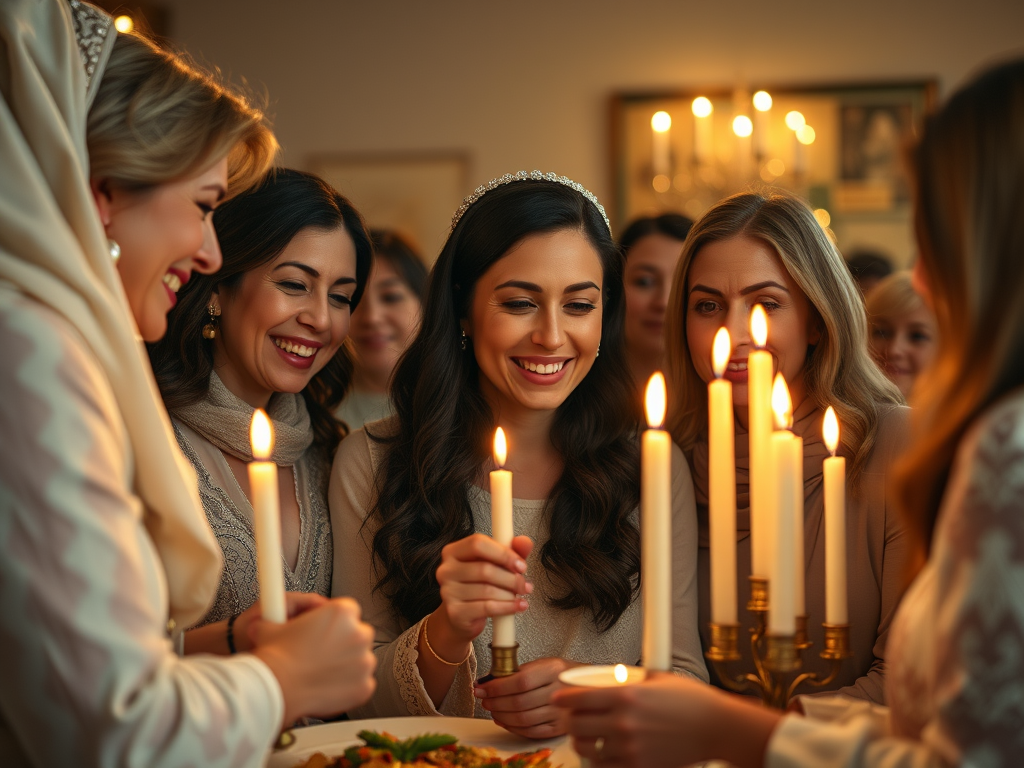
The Source For the Common Minhag of Lighting One Shabbos & Yom Tov Candle For Every Child
I. One Is Enough?
At a recent Shabbos sheva berachos, the female guests were in the hall preparing their candles for Shabbos as they awaited to greet the new and happy kallah. For many, the week of sheva berachos will be the first time they light neros Shabbos, and her close friends and family wished to witness the auspicious moment. When the kallah finally arrived, they all greeted her with jubilation.
The kalla excitedly made her way to her table on which she and her chosson would be eating, and on which she was planning to light. “I need candles” she said, mostly to herself. The women scurried to bring their malkah her first two of what would, iy”H, be many future Shabbos candles. However, to their alarm, they discovered that there was only one sole candle remaining. One of them quickly darted to the front desk, but the clerk gently reminded her what year it was and explained they do not stock candles. Shabbos was inching closer and closer, so running to the store was no longer an option, and all the men were several blocks over at a local minyan.
The cousin of the kallah, who will be graduating Shevach High School later this year,asked about the commotion and why the kallah looked so distruaght. When it was explained to her that she was not able to perform her first hadlaka as a wife, the niece made a quizzical face.
“Why not?” the niece asked, clarifying that while it is urged to light at least two lights -one for shumer and one for zachor – the basic mitzvah is accomplished with just one (see Rambam hil. shabbos 5:1 and Shulchan Aruch, siman 263:1). With no rav around, and just several minutes until Shabbos, the niece understood that she needed to somehow gain the confidence of this kallah, who was slightly dubious to this last claim. She eagerly turned to the kallah and said, “The beracha we make on this mitzvah is ‘lahadlik NER shel Shabbos’, in the singular! Obviously then the basic mitzvah is satisfied with one. It is so appropriate and such a zechus that your very first opportunity to perform this mitzvah you get to do so in its purest form”.
Now swayed -and relieved -the kallah jovially lit, made a beracha and davened before her first Shabbos candle.
I only know this story because the young cousin of the kallah is a student of mine in 12th grade halacha.
I am met with skepticism whenever I first teach this halacha, and always use the words of the beracha to prove the point.
II. A Candle Per Child
But this is just the beginning of misunderstanding when it comes to hadlakos neros.
Over the years we have share many, such as why we wave our hands before the beracha, and, just a few weeks ago, where one may and may not light when in a hotel (both available on this site).
However, like this story illustrates, the number of candles one needs to light has its own unique misconceptions.
A great majority of women will say that they light candles for the number of children they have. So, if one has, say four children, they will light six candles – four for the children and two for shomur v’zachur.
What may be surprising however, is that we are not sure where this custom comes from, when it began, or what the correlation between our candles and the number of children.
The language of the halacha is, “One should be alacritous (toward the mitzvah) of having a nice/strong light/candle (for Shabbos). There are those who emphasis lighting two lights/candles corresponding to shomer v’zacher. Rema: one may add to this number and light three or four candles, and so is the custom…one may add any number emphasizing/corresponding to other matters, so long as one does not seek to light less (than two)” (Shulchan Aruch, siman 263:1).
The Chofetz Chaim offers other customs, such as lighting seven neros-corresponding to the days of the week, or ten neros –corresponding to the aseres hadibros. The Vilna Gaon was known to light a very large number of neros (Maaseh Rav, 112), the Bnei Yisasschar would light 36 neros (Mamarei HaShabasos 3:8; see column regarding lechem mishneh where I explain this number), and some rabbanim of Yerushalaim would urge women to light twenty-six candles, corresponding to the shem Hashem (Rav Bengis, as quoted in shu’t Mishnas Yosef 4:33).
The one opinion missing is the custom to light equivalent to one’s children!
The earliest source of this latter-day minhag that I could find is the Likutei Maharich (d. 1922).
The question remains: what is this based on, and, why did it spread as it did?
Explanation #1
I used to offer an explanation that I later found written by Rav Moshe Shternbuch (shu”t Teshuvos V’Hanhagos 2:157): By Chanukah, the gemara explains, the basic mitzvah is one ner on each night, like for Shabbos. However, the gemara then shares that one can perform this mitzvah in extra mehadrin ways, one of which is a ner for each member of the household!
Perhaps, we can suggest that we applied this mehadrin of Chanukah to our weekly neros Shabbos.
The only problem with this explanation is that this mehadrin by Chanukah is regarding the number of people presently in the house, whereas the minhag by Shabbos is for mothers to light a ner even for the child(ren) who has(have) moved out, away that Shabbos, or, R’l, has passed on.
Explanation #2
Others suggest that this minhag is based on another custom. The Rema brings the knas (fine) women accepted upon themselves that should one ever forget to light neros Shabbos then she must light an extra candle by Shabbos candles for the rest ofher life. (The conditions are rare, and if one ever forgets to light, before accepting upon herself this knas, a rav must be consulted).
Since women would often forget -or be unprepared -to light after giving birth, they began to adopt adding an additional ner after each child was born -whether they deserved that k’nas or not (see, e.g. shu”t Mishneh Halachos 7:35).
Explanation #3
Others point to Megilas Esther for an explanation: in hilchos yom kippur (siman 610:4), the Elyah Rabbah (d. 1712) brings from an ancient targum to the megilla that for the lighting erev Yom Kippur the minhag was to light a ner for every person in the home.
Explanation #3.1
Based on this last explanation, we can posit an explanation as well for this minhag’s relatively recent proliferation:
The Rema in hilchos yom kippur (ad loc.) records the minhag of lighting a ner neshama before Yom Kippur for one’s deceased parents. (The current minhag of lighting a ner neshama before any yom tov with yizkar is of recent and unknown origin).
After the war, where so many lost their families, perhaps they would light a ner neshama for their children, hy’d, and explained to their more recent children that they are lighting for all of their brothers and sisters. Maybe this is what popularized and spread what was once a more dormant minhag.
So many secrets in minhagei yisroel!

Leave a Reply