In a shiur a few weeks ago, I mentioned a fascinating shailah I had received concerning lashon hara.
I opened by reminiscing about a book our rebbeim in Eitz Chaim Toronto had once given us in elementary school, titled ‘Apples of Gold’, which is on the laws and power of shemiras halashon (Rav Dovid Berstein, Torah U’Mesorah publications).
“The book’s name was taken from a pasuk that describes well proper communication as tapuchei zahav, meaning ‘golden apples’ (mishlei, 25:11)”.
Simple enough, right?
Not to one member, who yelled out:
“Rabbi, that is incorrect. Tapuach means orange, or perhaps som other citrus fruit!”
“Excuse me?” I said, genuinely confused.
The man, one of our wonderful gebbeim, replied by adding, “In fact, tapuach may likely refers to an esrog”!
There went my planned shiur, as instead we had a geshmak-and very public – beautiful argument about this issue.
Defending himself, he continued:
“Chazal say we are to add some tapuach to our seder’schorases because it will add tartness/sourness to it, and, because it reminds us of the tapuach trees under which Jewish women gave birth in mitzraim (pesachim 116a).”
Concluding his point, “Citrus fruit are tart, not apples! More, there were no apple trees at the time in Egypt.”
He further supported his arguments -sharing later he had first heard them from his rebbeim –, by marshaling a Tosefos that posits that ‘tapuach’ mentioned in a pasuk was referring to an esrog. I later found that Tosefos (shabbos 88a), and that particular pasuk (shirhashirim 2:2). I would assert that Tosefos only meant such a transation to tapuach in this one pasuk because, elsewhere, chazal list tapuach and esrog as two separate entities (e.g. the fourth mishneh in maaseros)!
After maariv, I privately shared with him that while delighted he spoke up, I think offering his comments under the guise of a ‘correction’ was a little extreme, as he was not simply ‘correcting’’ me. “After all, ‘puk chazi mah d’amah devar-go out and observe minhag yisroel’, we must respect the understandings and actions of our holy nation. Perhaps a better method would be to say, ‘I once heard…’ or ‘Have you ever heard…’ or ‘But this seems difficult to understand…’, or the like”.
More saliently, I shared, “Leaving aside if anthropologists, botanists and other secular chokrim have yet to confirm the existence of contemperanous apple trees in mitzraim, anachronistic arguments are hardly a challenge to the Exodus story when we begin to consider the sextuplets born under those same trees and the melachim who raised them. This is not to mention the ten makkos, the splitting of the sea, and the myriad of wondrous nissim that are either explicit in chumash or mentioned by chazal during our exile in and exodus from mitzraim.
“Of all these extraordinary events in mitzraim, are you really bothered by apple trees?!”
As for the ‘tartness/charoses’ proof, apples too can be acerbic. In fact, Rav Yaakov Kamanetzky rules that on Rosh Hashana one should make sure “not to use a tart apple, rather a sweet one” (Emes LYaakov, siman 188). In other words, the gemara regarding choroses may simply be referring to Granny Smith or other more bitter apples, while on Rosh Hashana we are to use Big Red Delicious (my personal favorite).
Nevertheless, he piqued my interest. I later found that Rav Moshe Shternbuch agrees that we are indeed unsure if our apples are the tapuach of chazal or tanach. He brings some of the same proofs mentioned above (shu”t Teshuvos V’Hanhagos 5:183; see also Kaf Hachaim, siman 583:18 and shabbos 88).
Nevertheless, Rav Shternbuch does not suggest forgoing apples on Rosh Hashanah.
So as not to leave the reader with doubts, I will offer four proofs to our use of apples for ‘tapuach’:
-One of the earliest sources for the minhag of apples dipped in honey on the night of Rosh Hashanah is the Tur (d. 1340). In that same siman, after mentioning this minhag, he mentions that some use ‘esrogim’ as one of the simanim. Clearly, he saw these as two separate entities. (siman 583; cf. Knesses Gedolah who says that the Tur’s use of the word ‘esrog’ was a misprint!).
-The 11th century Rabbeinu Simcha ben Shmuel, in his Machzor Vitry (siman 323) states: “In France the custom is to eat on Rosh Hashana tapuchim edomim [red ‘tapuchim’]…all foods that are either new, light and good [sweet]…”. I doubt he was referring to blood oranges. Rather, this very early source seems to support apples and, like Rav Yaakov, specifically red/sweet ones.
-The Pardes Yosef (hachadash, rosh hashana, p. 196) suggests that many of the simanim listed in the gemara were not commonly available in Europe, Russia, Spain, etc.. So, we chose the ubiquitous apple precisely because of its commonality. The uncommon esrog would certainly not assuage their concern for availability.
-Finally, even if our translation of tapuach is inaccurate, it would still be ‘correct’ to use apples, and not just because of the vitality of mimetic practice. My proof? The Alef L’Magen (d. 1828) brings an amazing ruling of the Pri Megadim (d. 1792): What should one do if he does not have a ‘tapuach’ [whatever a tapuach may be!] for the night of Rosh Hashanah?
He writes that in replacement, they should eat with honey,…tapuach adama/potatoes, as has the term “tapuach” in its name!
“Dip the Potatoes In The Honey, Make A Beracha Loud And Clear…” doesn’t seem to have the same ring to it!
Now, potatoes were certainly unknown to chazal, only making their worldwide debut after Columbus’ discovery of the Americas! Clearly then, what matters is not so much which fruit (or tuber!) we dip in honey, rather that is an entity for which we colloquially choose to use the term ‘tapuach’.
This seems to be because more important than whichever food this term is used for, it’s the name which carries the significance, in that it has the same numerical value as pru ‘urevu (see, e.g. Imrei Noam, moadim, 2, likutim, ois 9, et al.).
We should note that the Sdei Chemed and many others do bring a separate minhag of eating an esrog as one of the simanim. Many reasons are offered for this, one being that chazal tell us (berachos 57) that seeing an esrog in a dream is a sign of being special in the eyes of Hashem, thus this is a good sign for Rosh Hashanah.
In addition to surrendering to our mesorah, and what our own parents and rebbeim have done, there is further significance to an apple (or a potato) and honey:
An apple slice will turn brown after time. Historically, they would protect such fruits from oxidation by securing it in honey or sugar; hence the name for jam, ‘preserves’, as in to preserve. That is the lesson of the tapuach in honey on this night:
It is as if we are saying: “Hashem, without You and Your Torah we will, chalila, naturally wilt away”! (see Pardes Yosef p. 194).
This lesson certainly works with an apple, honey…and a tear.
On Chanukah, unlike all other Yamim Tovim, there are no specific obligations throughout the day, such as matanos la’evyonim on Purim or a seudah on the Shalosh Regalim. There’s also no constant
mitzvah like dwelling in the sukkah or refraining from chametz and no issur melachah like on Shavuos.1
To this point, Rav Moshe Feinstein remarkably writes that outside the moment of lighting, one may not recite the berachah of Shehecheyanu during Chanukah because “these days of Chanukah have no greater kedushah than any day of the year…this, as opposed to, say, Yom Kippur, when we can say this berachah unconnected to a specific act because the day itself has special kedushah.”2It is therefore all the more peculiar that the one and only act unique to Chanukah—the lighting of the menorah—does not seem to be per- formed in the way initially designed. Let’s start at the beginning. The Gemara teaches:
The Chanukah menorah is to be positioned by one’s doorway from the outside. If one lives on an upper floor, he should place it in a window that is adjacent to the public domain. In times of danger, it should be placed on his table and that is enough.3
This is also precisely how the Shulchan Aruch records the halachah,4 indicating that when not in times of danger, like in, arguably, today’s America, one must light outside. However, later the Rama makes it clear that already in his days the standard practice was still to light indoors.5 This is largely the accepted practice, at least among Ashkenazim living outside of Eretz Yisrael.6
Most Gedolim and their adherents still follow or followed this practice of lighting indoors. Is this still due to danger? And if so, would someone living in, say, Lakewood, with only frum neighbors, still have this same allowance? I cannot think of many other clear halachos found in Chazal for which our practice seems to veer from its basic structure.
Even more confounding is that in every other element of this mitzvah, we perform it mehadrin min ha’mehadrin, adding one extra candle for each night instead of the basic one per night and having others in the house light in addition to the father.7 Moreover, Chanukah was always set apart with this precise unique quality in that its pirsumei nisa was to be done outside and in public, as opposed to the “inside” pirsum ha’neis of Purim done in shul.8 Why, then, would we agree to take this distinctivenessaway? The Brisker Rav, for example, was very careful to light outside, considering that to be an essential part of the mitzvah.9 In fact, if ever he had to light inside due to a concern, he would relight outside if that risk went away; in this, he saw the din comparable to mitzvas sukkah.
Rav Elyashiv, too, strongly opposed the idea that nowadays, in locations where it is safe, we must still light indoors. For, if this is no longer the halachah, “for whom was that clear law in the Shulchan Aruch written? Even the Rama does not comment at that place.”10 Nevertheless, most poskim do not seem to take this strict approach, with Rav Moshe Feinstein even stating that today “it is not possible to light outdoors.”11
Why should this still hold true? Some early Rishonim mention this minhag of not lighting outdoors, yet they often also urge one to at least light inside the doorframe of their home, facing the street.12 Nevertheless, the basic halachah allows one to simply light anywhere visible in their home—on a dining room table, for instance. Many approaches have been offered throughout the centuries to this question.
Already in the twelfth century, the minhag among many was to light indoors, causing the Ohr Zarua to wonder, being that there are no longer any dangers, why should we not light outside?13 And this was nine hundred years ago. While he does not provide an answer, a few decades later, the Sefer Ha’itur does, writing, “U’meiachar she’nahagu al hasakanah, nahagu.”14 Meaning, seemingly, that although there may no longer be a danger, once we accepted this practice of lighting indoors, we retained it.15
The words of the holy Baal Ha’itur are difficult to fathom. To give an extreme example to make the point, would we say that someone who worked at a truck stop as a teenager when he received an allowance not to wear his yarmulke due to safety concerns, still need not wear one twenty years later as a doctor on Madison Ave? Chalilah! Rav Yerucham Olshin offers a way to understand this Sefer Ha’itur based on how Rav Meir Soloveitchik would quote his father, the Brisker Rav: “Once our leaders were mesaken a new din of lighting indoors due to danger, this new takanah stands even when its reason ceases to exist!”16
The Rama’s statement was based on the view of Rabbeinu Yerucham, who explained that the reason we light indoors is not just due to a physical sakanah but a monetary one as well, as thieves may steal one’s menorah.17 This concern would certainly still stand today. However, this reasoning would lead to an obvious question: Who said one must light with an expensive menorah? If indeed this is the reason for our present-day minhag, why not then light with Coke bottles (cleaned and stripped) so as to perform this mitzvah in its proper location?
One may be tempted to suggest that the Rama in Darkei Moshe was concerned for the view of the Raavad who posits that hiddur mitzvah (i.e., using a silver menorah) is a Torah law,18 which would then, indeed, require one to light indoors with a nice menorah instead of outside with a makeshift menorah. This is because the Torah law of beautification eclipses the Rabbinic placement of the menorah. However, this would be a stretch, for the very mitzvah one is beautifying is a Rabbinic one, so how could the commandment to beautify it be Biblical?19
Many others give a more technical approach to our still lighting indoors. While a sakanah may no longer exist, most Jews moved to northern countries where the weather during Chanukah is cold, windy, and wet. The Ritva quotes his rebbi as telling him that if it is windyoutside, one should light indoors;20 and the Ritva extends this to many other weather-based concerns.
Rav Amram Gaon states the same. This would explain why many of those outside Israel, who indeed light outdoors, purchase special glass containers to protect their lights from the elements. The reader should, however, note that not all poskim allow for such encasements.21
The Shu”t Imrei Noam22 finds an answer to our question from Chanukah’s original source: Megillas Taanis, a sefer written by the Tanna Rabbi Chananyah ben Chizkiyah, delineating more than thirty special dates and events we are to celebrate.23
Amazingly, it states there: “Should one fear from leitzim [ridiculers], then one may light by the door inside one’s home.” Meaning, aside from the issue of sakanah, wind, and robbers, there is another concern: scoffers.
From the B’nei Yissaschar,24 it would seem that these leitzim were cynical Jews who would challenge the propriety of either a public display of love for Hashem and for His Torah or, perhaps, our very fight against the Hellenistic forces. And so we light indoors. This is quite different from a concern for other nations.25
Rav Moshe Sternbuch offers another powerful approach: The fact that there have been times, like today, when we live in relative peace does not mean that we should abandon the protections needed by others today (e.g., Iran) or that we may need at some future time, lo alenu.26 He cites a number of proofs to such halachic thinking, and also reminds the reader of Rav Yisrael Salanter who, during a cholera outbreak on Yom Kippur, urged everyone to eat so that those sick would then certainly eat some- thing. We see from here that sometimes we all must sacrifice halachah’s
“best practices” so that it can be preserved for everyone’s future. For example, the Chanukah following the pogrom of Simchas Torah 5784, I was asked by many people if they may light on their kitchen table instead of by the window. In galus, we should never act with certainty.
A final approach is one that I have often suggested. In preparation for this chapter, I was delighted to discover that Rav Yeruchum Olshin suggests something similar.27, 28
This approach requires some brief context. Rashi gives an example of what Chazal mean by a sakanah that allows or forces our lighting indoors: when the Persians did not allow anyone to light candles outside the Persian batei avodah zarah. The Bach expresses amazement at this example. That decree applied equally to non-Jews, so it could not have been describing a time of shmad (when Jews must risk their lives for any mitzvah or social value). How, then, can this be Rashi’s paradigm case? For such a severe situation, we would be halachically dissuaded from even lighting indoors.
This Rashi also seems redundant. Do we even need an example of “a danger”? Why does Rashi feel he needs to share an example for some-
thing that we can all sense? I would therefore suggest that this Rashi is seeking to provide us with something far deeper than a simple example. Chazal share that following the Churban Bayis Sheini, we nullified the celebratory days found in Megillas Taanis, as we can’t be celebrating every other week while mourning our exile.
To this, the Gemara asks a stunning question: Why, then, do we still celebrate Chanukah? After all, Chanukah’s origin is found in this same text. The Gemara offers only one reason for keeping only Chanukah out of all the holidays in Megillas Taanis: the people have accepted Chanukah and its mitzvos.29
Perhaps what the Gemara is suggesting is that along with remembering the neis of Chanukah during these days, we also recall the affection and sacrifice that Klal Yisrael had for this mitzvah. And, for this same reason, we light even when in danger, albeit indoors. Rav Olshin takes this idea even further: Because the menorah represents the light of Torah (which is perhaps why the klal did not wish to forgo these days), we are obligatedto risk our lives for it. All of this would explain why Rashi chose Persian times as the example of sakanah rather than examples from the times of the Gemara or in his own lifetime, for example, the Crusades of 1096 that he composed Selichos for. Our still lighting the menorah indoors today is a surreptitious memorial of such “indoor lighting sacrifice” in times of historic danger. We are also commemorating lighting the Chanukah candles indoors in times of danger, even though that original sakanah allows us to forfeit lighting completely.
Our present lighting indoors represents not a leniency but a great act of stringency. Thus, our retaining the minhag of lighting indoors is not simply to avoid a danger that no longer exists; on the contrary, it is to recall such mesirus nefesh for this mitzvah in times of danger, when we lit inside even though we didn’t have to light at all.
The Gemara states that because Jews have always risked their lives for milah, it will always be observed.30 Indeed, even today, the not-yet-frum, as well as the frum, largely perform brissim. Perhaps the similar sacrifice for our past Chanukah lighting in times of danger (even if indoors) is why Chanukah, too, is kept by so many of the non-observant today.31 According to Pew Research, while 56 percent of all American Jews own a Seder plate, 81 percent own a menorah!32
The Minchas Elazar mentions that the B’nei Yissaschar had a glass encase- ment ready for when Mashiach will come and he can again light outside.33
May we see that day soon.
NOTES
Note that even on Purim, in addition to its many other obligations, they initially wished to restrict all melachah; see Megillah 5b.
Igros Moshe, Orach Chaim 5:43:2, confirmed firsthand with the original handwritten letter to Rav Levovitz, with whom I spoke. We should note that with this p’sak, Rav Moshe acknowledges that he disagrees with the Chafetz Chaim as recorded in Shaar Hatzion, siman 676:3. We should also point out that the Meiri to Shabbos 23b would seem to support the Chafetz Chaim. Meiri there records a view that if someone is without the ability to light a menorah, he may still make the She’asah Nissim and Shehecheyanu berachos during the days of Chanukah. Some readers may assume that having a Rishon say this would mean that Rav Moshe, had he been aware, would have acquiesced in his position. However, this is not so simple to suggest. For one, Meiri is simply recording what others have said, and perhaps even he disagreed. Second, just because one Rishon takes a view does not mean that other Rishonim would have consented. But number three is most crucial: Rav Moshe, in a separate teshuvah (coincidentally, also about something found in a newly discovered Meiri), makes clear that newly published Rishonim must be carefully considered before utilizing them for actual p’sak halachah. This is not due to these specific Rishonim themselves, of course, but rather to the lack of critical study of these manuscripts over generations, as well as uncertainty as to who the many copyists were for all these years.
Shabbos 21b.
Siman 671:5.
Siman 672:2. On the oddity of the Rama waiting until here to make this comment and his initial silence, see Rav Elyashiv, below.
Cf. Rav Ovadia Yosef in Chazon Ovadia, Chanukah, p. 37.
See Shabbos 21b.
See D’rashos Chasam Sofer, 5592, Chanukah; see also Rav Soloveitchik, as brought in V’DibartaBam, Chanukah, p. 113; Inside Chanukah, pp. 190–91.
See Kuntres Chanukah U’Purim 3:3; Yerech L’Moadim p. 107; see, however, his views as brought by others below.
Shu”t Kovetz Teshuvos 1:67, pp. 98–101.
Igros Moshe, Orach Chaim, 4:125.
The significance of a doorframe will be discussed below, in the chapter titled “Are Our Mezuzahs Kosher?,” page 134.
Ohr Zaruah 133:2.
Sefer Ha’itur, Aseres Hadibros, Chanukah 114:2.
See also Shu”t Minchas Yitzchak 6:67.
Kovetz Shulchan Melachim, Kislev, 5766; see Yerech L’Moadim, p. 112.
See Darkei Moshe, siman 671:9.
See Chidushei Anshei Shem to Berachos 38a.
See, however, Orech L’Neir to the first Mishnah in Makkos; see also Shabbos 23a that lighting neir Chanukah is a fulfillment of the verse “lo sassur,” which may mean that while the lighting is Rabbinic in nature, its beautification can still be a Biblical fulfillment.
Shabbos 21b.
See, e.g., Aruch Hashulchan 671:24 as well as Moadim U’Zemanim, vol. 2, siman 140, n. 1; Cf. Shu”t Yaavetz 149, who allows, although does not urge, such encasements.
Shu”t Imrei Noam 2:22.
This sefer will be discussed at length in the chapters that begin on pages 50, 82, and 106.
As brought in a footnote to Piskei Teshuvos, siman 671.
This is not a concern of the past. Indeed, one of the most celebrated public intellectuals of the twentieth century, Christopher Hitchens (who was a Jew who found out about his Jewish background at the age of forty, when his mother was lying on her deathbed), once horribly wrote against, of all holidays, Chanukah, based on this very cynical outlook of fighting the Hellenists: Jewish orthodoxy possesses the interesting feature of naming and combating the idea of the apikoros or “Epicurean”—the intellectual renegade who prefers Athens to Jerusalem and the schools of philosophy to the grim old routines of the Torah…the Greek or Epicurean style had begun to gain immense ground among the Jews of Syria and Palestine. The Seleucid Empire, an inheritance of Alexander the Great—Alexander still being a popular name among Jews—had weaned many people away from the sacrifices, the circumcisions, the belief in a special relation- ship with G-d…I quote (from a contemporary rabbi), “Along with Greek science and military prowess came a whole culture that celebrated beauty both in art and in the human body, presented the world with the triumph of rational thought in the works of Plato and Aristotle, and rejoiced in the complexities of life presented in the theater of Aeschylus, Euripides, and Aristophanes.” But away with all that. Let us instead celebrate the Maccabean peasants who wanted to destroy Hellenism and restore what they actually call “old-time religion.” Thus, to celebrate Hanukkah is to celebrate the triumph of tribal Jewish backwardness. A celebrated atheist, Mr. Hitchens would often debate faith and challenge his interlocutors, asking what possible virtue would be lost without religion or what could be gained with it that would not already be obvious to him. Aside from the false premise of this question—as his present morals were so obviously relying on the remnants of religious culture from whose crumbs America and the Magna Carta were formed—the above paragraph regarding Chanukah best displays the nakedness of his challenge. I refer to the bias of seeing inherent honor in the “new” versus the old, of allowing the nebulous winds of time and the capriciousness behind how “the vogue” takes hold and the arbitrary nature of who is given the power to introduce it, and the mysterious sociological quirks behind which fashions capture a time or place. Absent the safety net of a moral identity, to be untethered to a constitution, is precisely what leads to his article—of judging virtue on modern dress rather than thoughtful design, believing righteousness is found in the avant-garde rather than antiquity, and in the assumption that the peasantry must be as poor on the inside as they are on the outside. All this is anathema to Yiddishkeit. Yet, its pull becomes alluring to those unmoored from it. Truth is neither “old time” or “new”; it is unaffected by “tribal” acceptance or “tribal” neglect. Virtue is unbothered by new styles or last year’s fashion. Rather, truth is and will always remain simply that: truth. Judged not by time, unchanged by those who fail to embrace its legitimacy, it endures unperturbed by physical phenomena and social cues. Emes is emes.
Moadim U’Zemanim, vol. 2, siman 140, p. 79.
Ibid., p. 543.
We will quote his words below.
As explained by Rashi ad loc.
Shabbos 130a.
See chapter below, “Why Is There No Yom Tov Sheni on Chanukah Outside of Israel,” where the Pri Chadash draws an additional milah-Chanukah connection.
Pew Research Center, “Jewish Americans in 2020,” May 11, 2021, https://www.pewresearch. org/religion/2021/05/11/jewish-americans-in-2020/.
From ‘Hamakom Yinachem eschem…’, to ‘Devarim HaYotzim…’,
From ‘Ein Navi B’Iro’ to ‘Maaseh Avos…,‘
‘Kol Harodef...’, to’Kabdeihu V’Chadsheihu‘,
& More….
April, 2014
Rabbi Moshe Taub
“Don’t believe every quote you read on the internet”
Abraham Lincoln
This will hopefully be a fun, yet illuminating article in honor of Shavous.
“Ein navi b’iro”-It is hard to be a Navi in one’s hometown, is a common expression used to articulate the idea that it is hard to find honor among those who knew a person from back in their youth.
Where is the adage taken from?
One can search all the ‘Bar Ilan’ Torah software’s, as well as all the libraries of the world, yet come to one conclusion –it does not come from chazal, rather it comes from a book within a series of books that, lets just say, is often found in hotel room drawers.
This does not mean that it did not emanate first from within klal yisroel, rather that we do not find it written in toras chazal.
In past Shavous issues we discussed the idea of hufuch bu v’hufuch bu sh’kulu bu, that everything can be found within the Torah. Be it science or mathematics, we sought to demonstrate the inherent truth of this statement.
Ironically, this year, I wish to show saying that while people often assume come from the Torah or chazal in relaity are not found, at least not in the written form. Many gedolim and mechabrei sefarim have published their own lists of unsourced ‘chazals’ (see, for example, ‘OtzarHayedios’chelek 2 by Rav Yechiel Michel Stern, and, ‘MitzuvehV’Oseh’ ch. Talmud Torah by Rav Shmuel Freidman), and we will offer ours.
While many of the sayings we will mention may indeed be alluded to in chazal, they are either not said the way we same them, and sometimes not clearly even hinted at.
Some axioms have their provenance in early rishonim. For example, ‘Bo Shabbos, bo menuchah’ –with Shabbos’s arrival comes tranquility, is a Rashi, but not a chazal.
Others have their source in kabala. For example, “Ein davar omed b’fnei haratzon”-nothing can stand in the way of will, is stated, although in different terms, by the Zohar.
In fact, the latter category may help illume history. Rav Chaim Kinievsky writes (KriasMelec,h p.282, in the footnote) that the Rambam never saw or studied the Zohar. However, some disagree. Rav Reuvein Margolios wrote an article seeking to prove that the Rambam must have studied the Zohar. One of the famous examples is a ruling in Rambam (hilchosdeos 2:7) that has now become a famous Jewish proverb: ‘kol hakoes k’ilu oved avodah zara’- whoever loses their temper it is as if he served idolatry.
This statement can not be found anywhere in chazal, however it is stated by the Zohar several times.
While some indeed use this, among other statements of Rambam, as evidence that he had access to the Zohar, Rav Chaim (ad loc.) explains that such examples more likely came from the sefarim of the geonim or midrashim that Rambam had access to yet that are no longer today extant.
Indeed, this proverb is strongly alluded to by chazal themselves. The gemara (Shabbos 105) states, “Anyone who tears his clothing in anger, or breaks utensils, etc. is as if he served idolatry”.
A similar example of a famous proverb that likely came from an analogous chazal is ‘maaseh avos siman la’banim’-the actions and histories of our forefathers allude to the future history of klal yisroel. Although originated and mentioned by the Ramban several times in his peirush on chumash (see, e.g., 12:6), we have no chazal utilizing this phrase. However, chazal do say that Hashem told Avraham “Stay! –as you are a siman for your children” (BereishisRabba).
But there are still maxims for which we seemingly find no written source at all. One of the most famous examples of these may be, ‘Devarim hayotzim min halev nichnasim el halev’ –things said from the heart enter the hearts of others. Although a very popular expression, it is not found in any writing from chazal or kabala!
The well-known three volume encyclopedic work ‘Michlol Hamaamarim V’Pisgamim’, sources this adage to R’ Moshe Ibn Ezra (d.1066), while others (see the yarchon Nezer Hatorah, kislev 5769 p. 305, as well as Metzuveh V’oseh p.367) source this proverb to a gemara (Berachos 6) where we are taught that any person with yiras shomayim will find his words listened to.
Another, perhaps even more surprising, axiom that has no known source is ‘Yeshuos/Teshuos Hashem b/k’heref ayin’ –the salvations of Hashem can/will come in the blink of an eye. While certainly a statement in fact to any baal emunah, it is not a pasuk as some may asume, and in truth is not found even in chazal.
While some quote Rav Aryeh Levin as asserting that this came from a piyut said on the Yomin Noroim, in the Torah journal OhrYisroel, Rav Gedalia Oberlander offers other potential sources. He first brings from other sefarim and likkutim that sought to find its source, one even suggesting, incorrectly, that it came from a midrash Tanchuma. In the end he shows numerous piyuttim over the centuries that use this idiom.
This should not trouble is, for as a nation suffering through two-thousand years of galus we likely developed this phrase, as well as many others, as a response to amazingly swift salvations, as well as in the hope of future ones.
Moments before I sent this article in to the editor, I found one last amazing potential source for this most famous adage. In a Hebrew academic work on the siddur (‘Teffila L’yisroel Bihitpachusa Ha’historiot’) where the authors lay out every nusach of the siddur ever discovered, they show a nusach of Shemoneh Esreh from a geniza in Eretz Yisroel that reads as follows (ibid. p. 392): “…michalkel chaim b’chesed…m’chayei meisim k’heref ayin yeshuah lanu tatzmiach…”!
Another famous proverb goes, ‘mi sh’yeish lo manah ratzah ma’asaim’-when one acquires a hundred (he will not be satisfied, rather) he will then desire two hundred. No such chazal exists, although it is strongly alluded to in Koheles Rabbah (1:32).
There are so many more examples of proverbs from unknown sources.
‘Kol harodef achar hakavod, kavod baorech momenu’-whoever chases honor will find honor allude him (likely taken from the Shelah, korach).
‘Mitzvah habah l’yadecha al tachmitzenah’-when a mitzvah comes up do not push it off (mentioned by the Rama siman 625 and perhaps first formulated by Rashi to Megilla 6b)
‘Kabal es ha’emes m’mi sh’amro’-accept the truth from whoever says it
‘Kabdeihu V’Chadsheihu’-Honor (all) but remain suspectful. (In America there is a simaler saying, rooted in Reganism: ‘Trust but verify’)
‘B’yoser sh’yehudi shomer es hashabbos, hashabbos shomeres es hayehdui’-As much as the Jew kept Shabbos (throughout the generations), Shabbos has ‘kept’ us Jewish.
‘Osiyos machkimos’ –letters make us wise. This is a very common expression with a few meanings, yet that has no known provenance.
But perhaps the most famous example of this column’s topic is the one that will surprise the most.
‘Hamakom yenachem eschmen b’sochshaar avlei tzion v’yerushalim’. Although commonly said upon taking leave of an avel, its provenance is a mystery. Although the Tur and others give other sentences to say that strike some of the same themes, the hamakom we say must have developed over time.
In fact, even before shiva, by the levaya itself, there is a pasuk often quoted (Yeshayahu 25:8) that although exists, is so often misquoted. The famous niggun based on this pasuk goes, ‘umucha Hashem dima m’al kol panim’-Hashem (in the days of Moshiach) will erase the tears from upon our faces. Although popularized through this song, the actual pasuk reads ‘umucha Hashem Elokim dima m’al kol panim’.
All of this should only serve to galvanize ourselves this Shavous to study as much of the Torah Shb’ksav and Baal Peh for ourselves, thereby knowing what indeed stems from chazal and what does not, and by which will bring the merits to hasten the very day to which the Yeshayahu hanavi was reffering.
Its 19th century invention & the great halachic debates that still endure through today
Versions Initially Published in Ami Magazine (in three parts), 2012, 2013, 2018; and later in the Jewish Press, 2024
Introduction:
What type of matzo did you eat by the seder?
Was it handmade?
Machine-made?
Square?
Round?
What do you plan on using the rest of Pesach?
When I was growing up, my family would bake our own hand matzos at the Shatzer matzo bakery in Kensington, NY. Because of this, the sight of machine matzos would seem foreign to my young eyes.
If this was true about little me, now go back 150 years –when machine-matzos were first introduced – and imagine how alien they appeared to the Jews living in that era!
Note further how this introduction of machine-matzos came at a precarious time, both socially and religiously. The aftereffects of the Industrial Revolution were still being felt all over the world and, for the Jews, there was another revolution brewing: the Haskala and, to a greater extent, ‘Reformation’
There was ample reason for many to become suspicious of most innovation. The winds of change made it seem apt for most Jews of that time to secure themselves with, and warm themselves in, the traditions of our past, even those with no clear basis in halacha.
Summing up the ethos of the time succinctly, the Chasam Sofer famously coined the well-known pun, “Chodash assur min haTorah” – innovation [a play on the prohibition of ‘chadash’] is biblically forbidden.
But what were the limits of innovation? Was any societal or technological innovation at the time to be shunned? As Rav Eliezer Halevi Hurwitz rhetorically pondered (Bitul Moda’ah): “Should we, too, ban the new innovation for printing sefarim (i.e. the Gutenberg press)?!”
On the other hand, by then we already witnessed the fact that small steps and even minor innovations were all that were needed to give birth to movements that led away from Torah. Reform, at first, desired certain changes, some of which seemed relatively not too controversial, yet the gedolim smelled danger as well as the certain encroachment on more serious halachah to come.
With this backdrop in mind, let us discover the story behind machine matzos and the resulting controversy.
I. The Birth and the Demand
(Most of the facts stated below without a given source are taken from the sefer Bitul Moda’ah by Rav Yosef Shaul Nathanson z’l, known as the Shoel U’Meishiv)
Although the heated controversy was 20 years away, this story really begins in Ribeauvillé, France in 1838 when the first matzo baking machine was invented by a Frenchman named Isaac Singer and approved by his local rabbis as well as rabbanim in Furth, then a major yeshiva center. By 1845 the new invention was in use in Germany (Frankfurt). Seven years later, in 1852, there was a machine matzo factory in Poland, in the city of Poznan (Posen). This is an important place and time, for the famed Rav Shlomo Eiger (son of Rav Akiva Eiger) was the rav in Posen until his death that same year. The Shoel U’Meishiv asserts that Rav Eiger was alive at the time and had authorized its kashrus for baking matzos.
By 1857 many of the major Jewish cities in Europe had adapted to machine-matzos. From London to Breslov to Pressberg (home of the Ksav Sofer) this innovation began to spread like wildfire. The main reason for the contagion is easy today to recognize: cost. The average hand matzo factory demanded twice the workers as a machine matzo facility would. The owners of these hand matzo bakeries explained to the Ksav Sofer that after recouping the money from their initial
investment in this new “machine”, the savings would be enormous, and the price of matzo would go down significantly. This would allow not only for cheaper matzos for the hamon am (average person) but would also help bring dignity to those who, up till now, had to rely upon kimcha d’pischa (moas chitim) in order to feed their families for Pesach; should he allow machine-matzos, they argued, then even the very poor would afford matzos! Beyond the economic. There was –at least in Pressberg (see shu”t Ksav Sofer for further details) – a shortage of frum laborers, which in turn resulted in the hiring of non-Jewish workers. If this was not cause enough for concern, there were reports by the Krakow beis din that on occasion some workers were so tired that they only pantomimed the act of working the dough. But it gets even worse, as the working-hours at these bakeries were so exhausting that the Krakow beis din reported that there had been occasions where workers were caught sneaking bread sandwiches and the like into their mouths as they worked on the matzos!
As those familiar with geography can see from the above, this new innovation was spreading in an eastern direction. On this journey, in the years 1857 and 1858 it moved from Krakow 350 km east and entered Galicia, and the town of Lvov (Lemberg). It arrived with the haskamah from none other than Rav Yaakov Ettlinger – the Aruch L’ner- one of the leading lamdanim and rabbanim of his age.
This is when the main story begins.
II.Lvov & Krakow: The Birth of a Machlokes
The town of Lvov was lead for many years by Rav Ettinger (not to be confused with Rav Ettlinger, the Aruch L’ner). In that town lived a learnt a young man by the name of Yosef Shaul Nathanson. Together with the rav’s son, Mordechai Zev Ettinger, they studied the entirety of the yam shel talmud. They both went on to receive semicha, all the while learning with each other. They even published important sefarim together, including the oft-quoted Magen Gibburim (my colleague Rav Yirmiyah Milevsky pointed out that the Mishnah Berura quotes this sefer over 200 times!).
Rabbi Nathanson was so prodigious that he went on to marry the rav’s daughter, and when the rav passed away, his son, R’ Mordechai Zev, did not get the position; it went instead to Rabbi Nathanson, the rav’s son-in-law. Soon, Rav Nathanson had become one of the poskei hador. A prolific author, he is most known for his shu”t Shoel U’Meishiv. We will refer to him by that name for the remainder of this story.
This background will become important later in our story, but for now, notice that the year this new machine arrived in Lvov was the Shoel U’Meishiv’s first year into his tenure – 1857.
So back to the story…
Eruption
The machine arrived in Lvov in 1857. At first they tried to test the machine, but it was too cold. On the second try it worked. In addition to the many advantages to machine-matzos in the eyes of some – and listed above – some claimed that there was another advantage. There was another rav in Lvov by the name of Rabbi Simon Aryeh Schwabacher. Coming from Germany that same year and already used to machine-matzos he argued to the Shoel U’Meishiv that hand-matzos are dirty, as the workers do not wash their hands; therefore such matzos are ‘muktza machmas mius (forbidden to touch due to disgust)”!
We should point out that at this point in his life this Rabbi Schwabacher may have been reform, and he was likely a maskil, and indeed the Shoel U’Meishiv had to explain why he mentioned the points of this rabbi in his own defense of his psak.
(Rabbi Shwabacher left Lvov just three years after his arrival, in 1860, and assumed a rabbinic position in Odessa, Russia [now Ukraine] after once giving a Chanukah speech there in 1859 where he enthralled the audience. He died in Odessa 28 years later. Even during his tenure there, the progressives and conservatives, the frum and the reform were confused regarding whose side he most stood most for, although it
seems hard to argue that he was a reformer in the classic sense. He also corresponded with the Netziv and other great rabbanim. See ‘The Jews of Odessa: 1794-1881’, Steven Zipperstein, Stanford University Press)
In any event, for reasons known and unknown, the Shoel U’Meishiv approved the new adaption to machine-matzos.
That same year in Krakow their beis din also ruled to allow machine- made matzos.
Now is when things begin to get interesting.
There was a man in Krakow by the name of R. Chaim Dembitzer who was not at all happy about this new development of machine-matzos. While questions would soon surface whether he was really a rav –or a dayan, as he referred to himself – that reality is of no real consequence for he set out to gather letters from the great rabbanim of the time showing that the leaders of the Torah veldt forbade such matzo. Regardless of Dembitzer’s standing or goals, the facts remain that he did receive many responses from some of the great poskim of the time prohibiting machine-matzo.
In fact, R. Dembitzer published a book in Breslov in 1859 titled ‘Moda’ah L’Beis Yisreol’ (‘A Warning to the Jewish People’) where he records all of the responses he received.
Who were some of the gedolim who responded banning machine matzo? None other than the Gerrer rebbe (Chidushei HaRim), the Sanzer rebbe (Divrei Chaim), as well as one of the leading halachic authorities of the time, Rav Shlomo Kluger, the great rav of Brody.
There was also another rav who wrote a letter prohibiting machine matzo. In fact, this letter came from a posek living in the town of Lvov –where the Shoel U’Meishiv’s original allowance came from!
Who was this man? None other than Rav Mordechai Zev Ettinger, the Shoel U’Meishiv’s old chavrusa and brother-in-law!
While we do not know what went on in the Shoel U’Meishiv’s personal life, we could only imagine how uncomfortable his time in Lvov was becoming. There is strong evidence that a few years later (1862) he sought to leave Lvov, and accepted the position of rav in the town of Brisk – it was even made public. For reasons that are still unclear he never did take that position choosing instead to stay on in Lvov.
III. ‘Moda’a L’Beis Yisroel’ The First Pamphlet:
What was the reasoning of these great men who disagreed with the Shoel U’Meishiv and prohibited machine matzo?
The arguments found in that pamphlet, written by Rav Kluger and others, ran the gamut from the intriguing to the very convincing. For instance, one of the fears (incidentally indicating that the old machine-matzos were once circular in shape and not square as they are today) was due to the following protocol: after the machine shaped the matzo into a square-shape, a worker would round it off so that it would be circular, taking the excess dough back and adding it to the other dough so it could be used in the next batch of matzos.
The fear was that in the meantime, the extra dough would have time to turn into chamtez! Indeed, it is for this reason that machine matzos are all square today (so as to avoid cutting off extra dough), for even those who allowed machine-matzos accepted this argument.
However some now argued that the custom among klal yisroel for millennia was to have round matzo, and to change the shape to square was a problem onto itself!
Some went even further and challenged creating such an innovation in making matzos simply because it differed so radically from how we had been making matzos for thousands of years. Some went so far as asserting that this innovation came from German Jews who are known to appreciate innovation more so than their Galiztianer brethren.
That was not to be taken as a compliment to German Jews!
Some important rabbanim even suggested that the introduction of this machine was a surreptitious way to bring innovation among the charedim, for the reformers to get their foot in the door, as it were.
In addition, they pointed to serious questions relating to kavana (intent). The Shulchan Aruch (siman 460) rules that matzos have to be made by an adult, and that matzos for the seder must have specific intent. The Mishnah Berurah, for instance, rules (ad loc. # 3) that even to watch over a non-Jew would not help in this regard. This being the case, how could a machine have kavana?!
There were also concerns regarding the ability to clean the machine from all the dough that would become stuck in crevices, as well as other similar concerns.
Furthermore, as the matzos moved toward the oven there was a fear that the heat escaping would speed-up the chimutz process before the matzos are placed inside the oven.
A separate issue raised was the concern for all of the people who would lose their jobs making hand-matzos. One of the reasons, points out Rav Kluger, that the gemara gives for postponing the reading of the Megilla when Purim falls out on Shabbos is the concern that the poor people will not receive their matanos l’evyonim.
So we see, he argued, that we must be mindful of the poor when making community policy, and the fact that many would lose their parnassa (sustenance) with the advent of machine matzo factories is reason enough to ban them.
IV. The Shoel U’Meishiv Responds: The Second Pamphlet
That same year (1859), in response to ‘Moda’a L’Beis Yisroel’, the Shoel U’Meishiv put out his own pamphlet, titled ‘Bitul Moda’ah’ (‘Nullifying the Warning’).
In it he responded to all the arguments against machine-matzos – pointing out that most of the gedolim who were recorded in the previous pamphlet never even saw these machines, rather they relied on testimony, and often this testimony concerned antiquated machines that didn’t represent the hiddurim made to them since their inception. As the Aruch L’ner, in reference to this debate, put it, “seeing is better than hearing”.
The Shoel U’Meishiv, together with the Krakow beis din, also demonstrated that R. Dembitzer might not have been who he claimed he was.
In fact, the Shoel U’Meishiv unflatteringly refers to him as ‘sheker haCheyN’ (false is grace), a play on the verse in mishlei and R. Dembitzer’s name, Chaim Nossan.
He also compiled letters from across Europe seeking support for his position. They included: the Ksav Sofer (see his teshuvos, Orach Chaim, hosofos 12), the Aruch L’ner, and the rav of Danzig, Rav Yisroel Lipshutz – the baal Tiferes Yisroel. The latter not only supported machine-matzos but wrote that it was he who requested such a machine be brought to Danzig, and that when he saw it he proclaimed the beracha ‘m’chadesh chadashim- bless be He who creates new things’!
As to the issue of the workers who would lose jobs, the Shoel U’Meishiv argued that there were other ways to help those individuals, and that this innovation would help far more people.
As for the issue of intent, he argued in strong words that the machine does not work on its own (comparing it to rolling pins, which, of course, don’t work on their own either) and since a Jewish adult is operating it there is no issue.
(Today these machines are far more advanced, see section below – Manischewitz, for instance, owns dozens of patents –and in addition they are not mechanical in nature but rather electrical, leading to issues beyond the scope of this brief monograph)
Regarding the issue of innovation, the Shoel U’Meishiv rhetorically asked whether it would also then be forbidden to ride a train.
The Aruch L’Ner also wrote in defense of innovation, as well as a vindication of German Jewry who are “upright” while also accepting “the innovations of men of science…for the purpose of observing mitzvos”.
Regarding the issue of requiring circular matzos, the Shoel U’Meishiv and others dismiss this out of hand. In fact some even suggest (based on beitza 22b, menachos 57a) that since many of the laws of matzo are learned from the lechem hapanim, which were square, square matzos are preferred!
IV. ‘The Shape’ Of Matzos –A Brief Aside
1) The Ibn Ezra (vayikra 2:4) and other rishonim debate the shape of the matzah used for some Korbanei Mincha; some say they were circular, while others say, square. I would posit that this would be a stronger comparison to our matzah than the Lechem HaPanim –as these minchas were non-chometzmatzos . Yet, as we see, even their shape remains an unsettled debate. (See Shaarei Aaron ad loc.)
2)U’Maivy Geulah L’Olam: On Parsha Bo 5786 (2026), we were vacationing in Miami. I brought the always fantastic Otzar Plios HaTorah which, sadly, I otherwise haven’t the time to peruse. To my sheer delight, on page 294, he offers a short treatment on why matzos have been round for centuries. We will bring down, in order, what he shares:
A) The term ‘Ugos‘ used my the initial matzah command (“…ugos matzos…”, shemos 12:39) is derived from the fact that these loaves were ‘Ugulos-Round’ (shu”t Yehuda Ya’aleh 1:157). This etymology is based on a Rashi to taanis (23a), menachos (94b), and moed kattan (4b). This same idea is found in the Ran (end of 3rd perek of taanis regarding Choni Ha’magel; HaRav Bartunera (taanis 3:8) and Tosfos Yom Tov (ad loc.). See also Rashi, chullin 41a in the mishneh.
A-1) After proving from this term its shape, Rav Asad explaining why this was to be its shape: Since matzah is to representlechem oni (the poor mans’ bread – devarim 16:3), roundness is symbolic of poverty, as alluded to by chazal (shabbos 151b) who describe poverty as a circle, or ball, that returns and retruns to this world/family (based on devarim 15:1).
B) Another purpose behind the round shape, offers Rav Asad, is based on a midresh (Eicha Rabbah, pesichta #18) and a halacha (Shulchan Aruch, oh”ch 428:3), the first night of Pesach will fall on the same day of the week of that year’s Tisha B’Av. This is the source for the minhag brought in the Rema (ad loc.) to eat an egg by the Seder’s meal. Why an egg? When Avraham died, and Yaakov made – and then fed Eisav – ‘adashim‘, Rashi shares (bereishis 25:30) how eggs and certain legumes are symbolic of mourning – as they are round, without a ‘mouth’ (perhaps alluding to our muted response to tragedy), and, because they are circular. This shape alludes to death’s circular/repeated/always returning nature (ad bias goel) [this is similar to how chazal explained ‘aniyos-poverty’ above]. More, according to many, Avraham’s death and Yaakov’s meal in response was on erev Pesach. Since this is Avraham’s yartzeit, it becomes an additional intent when eating an egg by the seder (Pri Megadim 476, msh”z 3). For these reasons do we also round the seder’s matzah: to remind us of both our mournful state in galus, and, to commemorate a nation still in mourning since the death of its founder, Avraham.
C) The Mahari Asad further suggests a reason for our round matzos [already proved from his understanding of ‘Ugos’] by reminding us how the mitzrim would bake their bread either square-shaped or triangle-shaped, to allude to the duality in their godly beliefs R”l (I am unsure of his source for this -although it does give new insight into Hamantashen!). To counter this,bnei yisroel made their bread in Egypt circular -one entity, without a beginning or end, best representing the yichud (oneness) of Hashem!
C) The HaDarash V’Ha’Iyun, by Rav Aahron Levin, hy”d!, proves from the same Ibn Ezra we brought above that our matzos are to be round.
D)In another of his sefarim (shu”t Avnei Cheifetz 34:4), Rav Levin offers an additional reason for round matzos: ‘Roundness’ is beloved by Hashem, which is why He fashioned the sun, earth, moon, inter alia in that shape. To celebrate this, we are to make our matzos round.
The Ksav Sofer also dismissed the square matzo concern by stating, “In the merit of the four-cornered matzos, may Hashem redeem us from the four corners of the earth”!
The Shoel U’Meishiv also expressed disappointment in the perceived motive behind his brother-in-law’s attack against his psak. However, from what I have seen, his brother-in-law’s letter was first written in 1856, several months before Lvov welcomed their new machine.
While the Shoel U’Meishiv wanted to avoid this issue turning into a Chasidim vs. Misnagdim debate, in many ways that is precisely what happened, largely due to the letters from the Sanzer and Gerrer rebbes. To this day almost no chasideshe branch uses machine-made matzo. However, whereas during the early days of this machlokes many did write of their concern that machine-matzo may contain real chometz, this is no longer a concern today even among chasidim (Nitei Gavriel in the name of the Klausenberger rebbe. See also shu”t Mishne Halachos 1:114).
Sadly the Jewish journalists of the 19th century got wind of this debate and began to pick sides as well as go beyond their breadth of ken by placing themselves between the heads of giants. Most notably was the Jewish newspaper ‘Hamagid’ –a largely haskalah leaning paper – who published derogatory articles about those who wanted to prohibit machine-matzos.
Due to their clear bias it is hard to know if some of the facts they cite are true. For instance, on March 9, 1859 Hamagid reported that the Shoel U’Meishiv was taken to court in Lvov where he had to prove that his pamphlet was not filled with lies, as was told to the censor by the advocates of the first pamphlet against machine-matzos. The Shoel U’Meishiv was able to convince the judge that nothing wrong or untrue was to be found in his book, reported Hamagid. A fantastic account…if proven true. Perhaps I am being too cynical.
There was also another individual who took to writing into various journals and newspapers in support of machine-matzos whilst attacking –in very strong words- Rav Shlomo Kluger. This fellow, R. Chaim Kara, would later write to the Gerrer rebbe explaining that at the time he had no idea who Rav Shlomo Kluger was (!) and had he known he would have spoken with more respect.
As we can see from all the above, the new innovation of machine- matzos led to a heated machlokes that shook the Torah world of its time.
So what do we take from all of this? On the one hand neither the Mishnah Berura nor the Aruch HaShulchan ever even mentioned machine matzo, on the other hand great poskim like Rav Shlomo Zalman Aurbach ate only machine-made matzo.
Well, the truth is we only told the first half of this story. Machine matzo continued to spread throughout the second half of the 19th century and into the 20th.
This innovation travelled south to Eretz Yisroel, and west to America, changing in design and concern with each passing decade.
That is a story unto itself, and just as fascinating.
Alas, it will have to wait till next year (see next section), when iy’H I will write a sequel to this article, and when Ami will hopefully be headquartered in Yerushalim Habenuyah, where we can all witness as Rav Shlmo Kluger and the holy rebbes of Europe sit together with the Shoel U’Meishiv and the Ksav Sofer as they argue their respective cases in front of Moshe rabbeinu, Rebbe Akiva, and Rav Yehudah HaNasi.
V. Where ‘Time Magazine’ Got it Wrong
Before we describe what happened next, let me share a recent discovery that highlights the sad reality of the initial machlokos and what was left in its wake.
In April of 2009 Time Magazine published a brief history of the ‘machine matzo debate’. They write:
“In 1959, a well-known Ukrainian rabbi named Solomon Kluger published an angry manifesto against machine-made matzo, while his brother-in-law, Rabbi Joseph Saul Nathenson, published a defense.”
In just this one sentence we find three major inaccuracies. (a) Their date is off by a hundred years (b) although quoted in it, Rav Kluger was not the one who published this sefer (c) they mistook Rav Kluger and Rav Nathenson as brother-in-laws!
How could they err so?
Perhaps this was due to the fact that there was a brother-in-law element to the story. In his younger days Rav Nathenson would study with his brother-in-law Rav Mordechai Zev Ettingah (not Rav Kluger!). The
two soon became a world-renown Torah-force to be reckoned with. They even published very popular sefarim together, including the important work ‘Magen Gibburim’, one of the most oft quoted sefarim in the Mishnah Berrura.
It was therefore a shock to many to discover that in ‘Moda’ah L’Beis Yisroel’ one of the rabbis who had written strongly against machine matzos and the ruling of Rav Nathenson was none other than Rav Ettingah!
Time Magazine was right that a brother-in-law was involved, they just got the wrong name.
But that is not even the central discovery I want to share; that was just its introduction.
A few moths ago I was looking something up in one of Rav Nathenson’s works (‘Divrei Shaul’, Bereishis/Shmos, vol. 2) when I noticed that near the end of the sefer a relative of his offers a brief biography of its author. He mentions that the family once wrote to Rav Nathenson asking if the rumors were true – that he and his brother-in- law, Rav Ettingah, had written a monumental work of responsa based on the questions they received while sitting together in the beis medresh.
This would indeed be an epic work, as I am unaware offhand of any sefer of shailos v’teshuvos written by a set of chavrusos!
Moreover, the book was to be called, ‘shu”t Sheves Achim’ (‘Responsa: Unity of Brothers’), a most appropriate title for such a unified holy venture.
Rav Nathenson responded to this query with a melancholy and revealing play-on-words, by stating that the ‘sheves achim’, the peace among brothers, no longer exists.
Machlokos does not just harm our relationships with each other, but has the power to even conceal Torah!1
1 One last point regarding the 19th century debate. Rav Shlomo Ahron Wertheimer of Yerushalaim (d. 1935) discovered that the 13th century rishon Meiri (in his ‘Magen Avos’) seemed to have described a process of matzo baking in his time that seems to portray a very crude type of matzo machine. He therefore posits that had gedolim against machine matzos been aware of this precedent they would have yielded to the Shoel U’Meishiv.
We should note however that many of the Meiri’s works were only discovered recently, and indeed Rav Wertheimer was a celebrated researcher of kisvei yad (manuscripts). While I have not yet been able to discover if this particular source in the Meiri was also a modern discovery, it should mentioned that if it was many would not feel obligated to it as Rav Moshe Feinstein and the Chazon Ish were very weary of modern finds –even from rishonim –influencing halacha. See this author’s forthcoming sefer on Chanukah (Chanukah: Mysteries and Histories -Mosaica Press) where this issue will be discussed at length, iy”H.
Rabbi Tzvi Yechezkel Michelson (hy’d; d. 1944), in a discussion about this machlokos, decides to end his treatment “…on a humorous note”.
He reports that Rav Shlomo Kluger and Rav Nathenson had many other communal needs to work on together. They had no choice but to move- on from the harsh arguments and words regarding machine matzos. It would seem they developed a positive attitude toward this once vitriolic debate. Once, Rav Kluger and Rav Nathenson came together to Vienna to meet with the Kaiser regarding a matter of communal import. Rav Kluger sent a request to an officer asking if they could meet that day, instead of waiting till the morning. The official explained that whatever they came for would have to wait till their scheduled meeting the next day with the Kaiser, as he is very busy and “not a machine”.
Rav Kluger smiled, turned to Rav Nathenson and said, “You see! Even in Vienne they stay away from machines!” (Shu”t ‘Tirosh VeYitzhar’, 1:188, end)
A similar story of humor being shared between disputants is told about Rav Moshe Feinstein and the Satmar rebbe. They famously debated on several sensitive matters of halacha. One of the more prominent issues that they disagreed upon was the purpose of a mechitza in a shul. The outcome of Rav Moshe’s understanding was that a valid mechitza need not be as high as what many may assume. The Satmar rebbe strongly disagreed.
It once happened that Rav Moshe and the Satmar rebbe were at a shiva house together. Sitting in front of the avel the Satmar rebbe leaned-in toward Rav Moshe and started to speak to him in learning. Rav Moshe was surprised and, glancing at the avel, hinted to the rebbe that perhaps now was not the time to learn Torah. The rebbe pointed to an ottoman next to the avel’s feet and replied, “No, we can talk in Torah in front of the avel because according to you that stool is a mechitza!”
VI. The Waters Cool…Briefly
From the 1870’s until the turn of the century things slowly started to die down in Europe. While there were still people – and their respective rabbanim –on both sides of the fence, it became clear that machine matzos were (a) here to stay and that (b) those supporting it were not out to harm Torah or mesorah.
By the 1890’s, and in many ways still true today, the question of the permissibility of machine matzos became divided along chassidim/misnagdim lines (something that Rav Nathenson was very disturbed by).
For instance, in the city of Dvinsk Rav Meir Simcha, author of the Meshech Chochma and Ohr Sameach3, who was the rav of the non- chassidim of the city, allowed machine matzos and wrote a letter to his community stating such, while the Rogatchever Gaon, Rav Rosen, who was the rav of the chasideshe shul in Dvinsk, did not approve of them.4 (Footnotes start here, with #4, as I incorporated the prior ones into the main text. Upon uploading this file, I was unable to renumber them. I apologize for any confusion)
It should then be of no surprise that Rav Moshe Mordechai Epstien of the famed (non-chasidesh) Slabodka yeshiva also allowed machine matzos, even when the machine is run on electricity (shu”t Levush Mordechai).5
However there were exceptions to these dividing lines, on both sides.
For instance while the Chafetz Chaim does not mention this raging debate in his halachik works like the Mishnah Berrura (for reasons unknown), he does state in a letter his strong suspicions relating to machine matzos 6.
So too do we find some in the chasideshe veldt who seemed to have broken ranks. The maggid of Yerushalaim R’Shalom Schwadron’s grandfather, the great chasideshe posek Rav Shalom Mordechai Schwadron –known as the Maharsham –wrote a number of teshuvos on the topic of machine matzos. While it is difficult to know precisely where he stood on the issue, it is safe to say that he leaned toward permissibility. He even stated that the suggestion that something should be presumed guilty simply because it is an innovation to how we had performed it in the past is a very weak argument.8
Another great chassideshe posek was none-to-thrilled with this disruption in chassidehshe practice. The holy rebbe of Sochatchav, Rav Avraham Borenstein, known as the Avnei Nezer, responded in a short but sharp letter regarding this psak of the Marharsham (who he does not mention by name), comparing those who would allow machine matzos in the face of the great rebbes who had already banned it as “a fly facing lions”.9
The Avnei Nezer further argues that nothing is added by having new people enter this debate. “Who is greater than Rav Nathenson who already allowed it?” asks the Avnei Nezer, “[Y]et the holy rebbes have already rejected his view…”
This is a fascinating argument. The Avnei Nezer seems to be saying that once the first generation of a holy debate closes we must assume that all the points on both sides have been exhausted. Our job then is simply to follow how our parents and teachers guided us.
Although the Marharsham’s ruling caused quite a stir, it may have been for naught. Even till today, what the Marharsham’s position regarding machine matzos really was remains hotly debated. In some letters (like the one written to St. Louise) seems to allow it, in others he even seems to prefer it, and still others where he says that he ‘never allowed it’.
So much confusion surrounds the Marharsham’s opinion that twenty years ago a great grandson of his wrote a long treatise on the matter for a Torah journal of Karlin.10
VII.The Machine Makes ‘Aliya’
The short but sharp letter of the Avnei Nezer quoted above was written in 1909. That letter, along with several others from Europe, made its way to eretz yisroel.
Already in 1873 the first matzo-baking machine was brought to Israel, however, likely due to the fact that it never became popular, it did not cause a stir.
But by 1908 and 1909 things the winds changed. Six years earlier the Cohen/Halperin machine matzo plant was founded and their matzos became prevalent among many of the non-chassidic charedim at the time (then called perushim). This was not by chance, as this factory was given hashgacha by none other than Rav Shmuel Salant! Rav Yosef Chaim Sonnenfeld also gave his hashkama –in theory –to machine matzos.11
The chassideshe charedim however truly believed these matzos to be a major violation of law.
In fact, the very same Marharsham who caused a stir in Europe because he allowed machine matzos was now being quoted as one of the main sources of the chassidim disallowing them!
Anyone who might be confused as to the give-and-take to this debate need look only to the pashkivillim (posters) that painted the walls of Yerushalaim in 1908-1909 where every opinion regarding machine matzos, every argument, is quoted, debunked, and quoted anew. As the Jewish Observer once put it, it was an all-out ‘pashkavillim war’.12
The machine matzo debate has now arrived in our holiest city.
In one of the pashkivillim citizens of Yerushalaim are invited to see the matzo baking of Rav Shmuel Salant himself!
While it comes as no surprise that some wanted machine matzos banned, it may however surprise readers to learn that the pendulum swung both ways. Rav Shlomo Zalman Aurbach reported how he remembered 13 that the situation with handmade matzos was so bad 14 that many rabbanim wanted to ban hand-made matzos!15
This may sound odd to our ears (and mouths) but keep in mind that this debate –going all the way back to Rav Nathenson – was not just about if machine matzos were kosher for Pesach, but if they were superior to hand matzos.
Rav Shlomo Zalman himself would only eat machine matzos on Pesach. However by the seder, he would also try to find mehadrin hand matzos to fulfill all opinions.16
As Rav Tzvi Pesach Frank explained 17 a machine has no concept of daas (knowledge) so the ‘wrong’ type of intent is impossible to place on it. All that matters is that we are able to establish that a machine is the extension of the person who turned it on. In the view of these poskim once we eliminate such concerns then a machine is not just permissible to be used for the baking of matzos, but recommended. This is because by having a machine designed for this purpose one thereby eliminates human error. In addition, the custom, based on the Chasam Sofer 18 , is to go from dough to oven in just a few minutes, something which a machine makes far more plausible. 19
We should point out that although we have written in the past of the dangers of innovation in halacha, these poskim would point out an obvious distinction: it is only innovation that could have easily have been done in the past yet, for whatever unknown reason, was ignored or bypassed that we mustn’t now ignore the mysterious concerns of old and act differently for ourselves.
In other words, it is irrelevant that until 1838 Jews only ate handmade matzos, for they had no other choice! Who is to say what the rishonim would have also rejected machine matzos had these machines been invented earlier? That is the crux of mattirim’s argument as it pertains to innovation.
While this debate in Israel has cooled, we can still find allusions to it. For instance Dayan Fisher (d. 2003) writes20 that while both types of matzo are acceptable, should be stringent and eat only machine matzos!
On the other hand, when the Chazon Ish saw that his brother-in-law, the Steipler Geon, had machine matzos for his children to eat on Pesach he promptly informed him that it was chametz!21
So, we began in Lvov and ended in Yerushalaim. In both Europe and Israel what began as a heated debate ended in mutual respect.22
But this machine still has one more stop to make: America.
VII.‘Only In America’
NPR’s ‘Planet Money” recently had a report on matzo in general, focusing on Manischewitz. 24
“’My guide through the factory is one of the world’s leading authorities on making matzo. He’s not a rabbi, or even a Jew. I was raised Southern Baptist and my wife is Roman Catholic and I’m running operations for the country’s largest Jewish food company,’ says Randall Copeland. Only in America.”
According to the April 10, 2012 edition of the New York Times, each year about 130 million dollars is spent on matzo. Manischewitz alone – according to a recent story in the New Yorker –produces over 76,000,000 individual pieces of matzo annually!
While most of these sales take place on or before Pesach, there is also a not-insignificant percentage that is bought throughout the year. In fact, former president Bill Clinton has a famous friend who often makes him matzo-brei when he comes over to visit!
The story of how machine matzo in America came to be, and came to be accepted by many, is a notable one.
One of the main supporters of machine matzos in Israel was Rav Nafatlai Amsterdam. Born in Salant in 1832, he would later become one of the most famous disciples of Rav Yisroel Salanter. Often supporting himself with a bakery owned and operated by his wife, he settled in Israel in 1906, three year before the eruption of the ‘matzo storm’ examined in the last chapter.
Some thirty years after the birth of Rav Naftali another baby boy was born in Salant. Born to R’ Yechiel Michael Manischewitz, they named their new son Dov Ber. He too would go on to study with Rav Yisroel Salanter (in the town of Memel), and, as we could guess from his last name, he too would support himself with a bakery of some type.
Indeed, this family was not just close with Rav Yisroel Salanter, but truly desired to follow in his ways. Soon after Manischewitz Matzo was founded in Cincinnati in 1888 a friend of Rav Ber opened up a competing matzo business. Writing to his father in Europe in search of a letter from a respected rav disallowing this competition, the son received a reply letter of harsher tone, beseeching him to follow the ways of the recently deceased Rav Salanter and seek only peace.
Matzo had been baked in America since its infancy; there is even documentation of Jewish soldiers during the civil war –on both sides – receiving rations of matzo during Pesach.
However, machine matzos were still largely unheard of in America. In the above referenced New Yorker piece Rav Ber is likened to Steve Jobs (the creator of Apple Computers) whose genius was not based on problem –making the matzo even more removed from the hand of its creator(s).25
The reader should note that at this time in American history there were very few chasideshe rebbes in the country, and the absence of these, the strongest opponents of machine matzo, allowed Manischewitz’s successes to grow exponentially. To illustrate, Rav Eliyahu Yosef Rabinowitz, often cited as the first rebbe in America, emigrated in 1899 and passed away in Buffalo, New York just eleven years later (where he is buried and visited by many each year. He is the subject of this author’s 2023 Summer Series in Ami Magazine. Others may posit that Rav Avraham Ash was in fact chassidesh and therefore should be considered as the first rebbe in America).
Although the opposition to machine matzos in America was minimal, and even Rav Yaakov Yosef26 (also a student of Rav Yisroel Salanter,invention per se, rather in taking that which already exists and perfecting and streamlining it.
R’ Ber Manischewitz not only accepted machine matzos as kosher for Pesach, he perfected its process, and even advertised them as ‘square’, something which some rabbanim in Europe had taken issue with (as discussed last year in Part 1).
It should also be pointed out that, in time, the matzos that Manischewitz was producing were not exactly like the machine matzos of Europe. Manischewitz owned tens of patents making not just their matzos ahead of their time, but even their factory. Much of their innovations were adopted by other companies of the time and are still in use –although modernized –today, such as ‘electric eyes’ that count how many units are being produced during production.
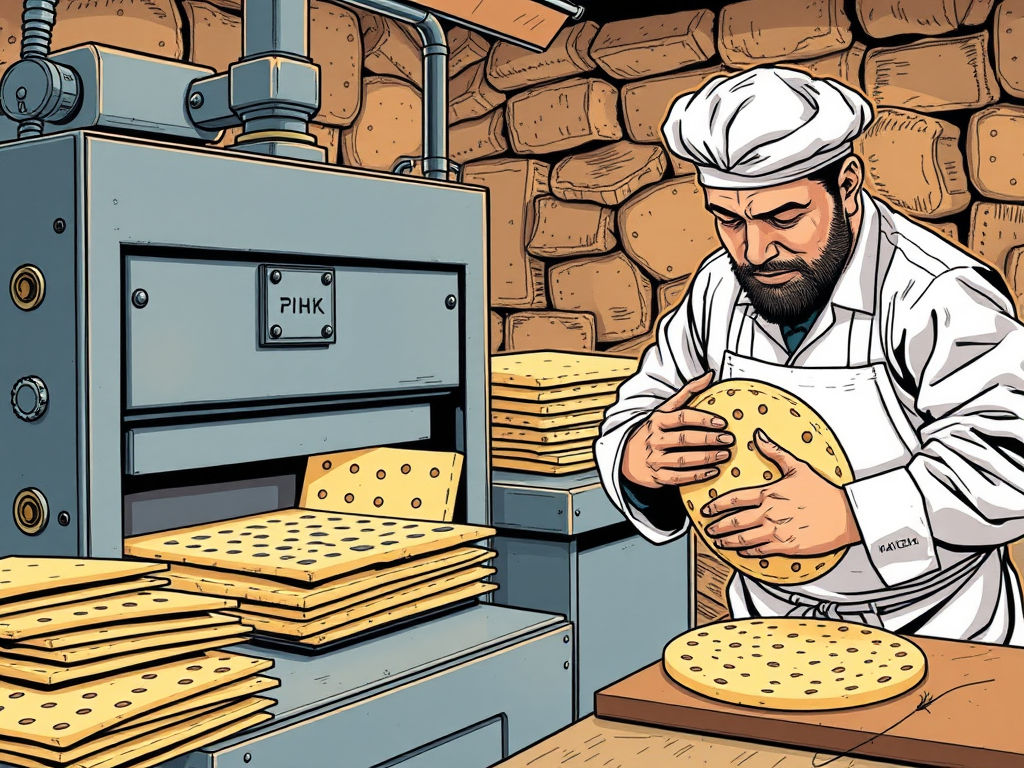
Whereas initially a ‘machine’ matzo was but rolled mechanically, now they were rolled, shaped, pulled, and marked all by a machine. The oven too was far more modern than what was being used in Europe, and was gas fueled.
While some would argue that these made the process less problematic from a halachic perspective, others saw this as only adding to the problem –making the matzo even more removed from the hand of its creator(s).25
The reader should note that at this time in American history there were very few chasideshe rebbes in the country, and the absence of these, the strongest opponents of machine matzo, allowed Manischewitz’s successes to grow exponentially. To illustrate, Rav Eliyahu Yosef Rabinowitz, often cited as the first rebbe in America, emigrated in 1899 and passed away in Buffalo, New York just eleven years later (where he is buried and visited by many each year. He is the subject of this author’s 2023 Summer Series in Ami Magazine. Others may posit that Rav Avraham Ash was in fact chassidesh and therefore should be considered as the first rebbe in America).
Although the opposition to machine matzos in America was minimal, and even Rav Yaakov Yosef 26 (also a student of Rav Yisroel Salanter, interestingly) supported their use on Pesach,27 there remained some doubt in the hearts of some.
Enter Rav Zechryah Yosef Rosenfeld. Rav Rosenfeld was already a distinguished rav in Europe when he fled to America in 1893. By 1894 he was elected rav of one of the shuls in St. Louise.
Although few recognize his name, Rav Rosenfeld was one of the most important rabbanim to the history of America. To understand his sacrifice in taking a stand regarding machine matzos at the turn of the century, one needs to be aware of the bristly decade leading up to it.
In the late 1890’s Rav Rosenfeld designed and constructed the very first city eruv in America. This was no small feat, as even before his St. Louise eruv was built it drew heavy criticism from another gaon who also served as rav in that same city, Rav Shalom Elchanan Jaffe. Rav Jaffe published a sefer, ‘Shoel K’Inyan’, a treatise seeking to show that the (proposed) eruv would be unacceptable.
Looking at the dates it is apparent that the very same year Rav Rosenfeld arrived in St. Louise he announced his plans to build an eruv! Like many rabbanim, he felt it was his duty to protect Shabbos by building a city eruv.28 In 1896 he published a defense of his planned eruv, in a sefer titled, ‘Tikvas Zecharyah’. Utilizing telegraph wires and the Mississippi River, the first city eruv in America was built.
Although he was viscously attacked for his eruv –and both sides sought haskamos from around the world (an article for a different time) – Rav Rosenfeld somehow found the strength to write another sefer, on yet another controversial topic.
In 1905 29 he published ‘Tikvas Yosef’ where he demonstrates why machine matzos, and specifically those, like Manischewitz, being produced in America, are kosher for Pesach. Like with his sefer defending his eruv, he sought letters from distinguished rabbanim. Once again, the Marharsham is quoted as allowing machine matzos, with certain conditions,30 and once again his true position remains unclear.
Many supported Rav Rosenfeld arguments, however there were exceptions. The author of the Darkei Teshuvah, for instance, wrote that he simply could not offer a haskama after the holy Divrei Chaim banned machine matzos.31
Manischewitz for their part opened their doors to any and all rabbanim to see and inspect the process for themsleves. In the late 1930’s they even published a book listing over one hundred rabbanim who supported their venture. They even assert that Rav Meir Shapiro ate Manischewitz matzo the entire year, knowing that there would never be any kashrus concern with their product (i.e. hafrashas challa)!
In the March 1938 edition of the prestigious Torah journal ‘HaPardes’ a 25-page supplement was published celebrating the yovel (jubilee) of Manischewitz machine matzo (ending right before the yiddish advertisement for Dr. Pepper!). There one finds letters from the most eminent litvehse poskim of the time.
One will also discover something else, something fascinating. The Manischewitz family had opened a yeshivah in Yerushalaim, becoming quite close with many of the poskim of the city. It is unclear when this small yeshiva was dissolved, but from the information provided in HaPardes it was clearly a serious place. Indeed, already as young boys, Rav Ber Manischewitz sent his two sons to Yerushalaim to learn at the famous Yeshivas Etz Chaim, something that few families in Ohio of the time did! Rav Ber was serious about Torah and, in addition, these connections to great leaders of Israel allowed him ‘in the door’ so that he could better articulate how his machine matzo process worked. So that the reader does not misunderstand this last point, it is not to suggest that friendship changes a psak, challila, rather that a posek needs to know that the man seeking to innovate is not after a more perverse prize or heading toward a more rash progression.
Knowing Rav Ber as a man of Torah, a family with deep roots in the classical Torah world, evidenced character and helped soothe any question of a ‘greater agenda’, which if the reader recalls from Part 1 was no small part of the concern of those who wanted machine matzos banned when they were first introduced.
[See Sidebar for a picture that Rav Tzvi Pesach Frank and others had sent to HaPardes in celebration of Manischewitz’s jubilee].
IX. Epilogue?
Many people see machine matzos as a b’dieved, something only allowed on Pesach ex post facto, at best. The information we have provided shows that, at least among the non-chasidim, it is far more complicated than that, with some gedolim even preferring machine over hand matzos.
In addition, no one would argue that machine matzo factories are anything but vigilant in controlling their environment. So intense is the kosher for Pesach supervision at Manischewitz, Streits, Yehudah, etc. that it caused NPR to state, “The matzo business may be the most heavily regulated business in the world.”32
Aside for gaining an understanding of the effort and Torah that goes into so much of what we enjoy, we can learn another valuable lesson from what we have learned: not every machlokos in Torah and halacha must end in bitterness. When there are legitimate poskim on either side of an issue, and after all the points have been made and all the ink spilled, each family can follow the views of their particular leaders while at the same time recognizing that eilu v’eilu (the principle that two incompatible views in halacha can each retain an inherent truth) did not perish with the closing of the Gemara.
However, our story has one last chapter…
X. “Are These Also ‘Machine Matzos’?” A New Company Breaths New Life Into An Old Debate
When it comes to Pesach, the ‘new’ is always, and should always be, suspect.
We all saw, for example, how something as innocuous as
quinoa has divided poskim and even families over the past decade. When my in-laws come for Pesach we actually make two cholents –one for my family with quinoa and one for them, without.
This is more so true when it comes to innovations in matzah production.
Over the past two years (this was written in 2018) ‘Birchas HaPesach’ in eretz yisroel has been producing a new kind of matzah. This new matzah is described by some as handmade matzah, and by others as no better, or different, than machine matzas. Still others, unconcerned how they are described, are ambivalent toward them simply because they are ‘new’.
What is this new machine?
First , imagine a pasta machine.
One places their prepared pasta dough into the tiny space
between two pins/rollers and he begins to crank with his hand, causing the pins/rollers to pull, press, stretch and roll out your dough in seconds. He does this a few times and his dough will become thinner and thinner, ready to be cut and shaped into fresh lasagna noodles.
Now imagine this same type of metal pins/roller-crank used for making and shaping matzas.
The dough starts off the same as any handmade matzah, however, once made and cut into balls, instead of handing each ball to someone to roll
out and shape with a rolling pin, it is handed to a man who places it into a ‘pasta-maker-like’ contraption. It is simultaneously cranked as it is placed between the metal pins which then quickly pulls it through, coming out longer and thinner.
Immediately, someone then takes this-now flatter- dough and passes it on to the next, similar crank device, which thins it out even more. All in all, it passes through five such hand-cranked devices and goes from there immediately to the oven.
Amazingly, from dough to matzah takes about two minutes! From the above description these matzas would seem not only kosher, but mehudar.
The Rema rules that matzah dough should not rest before its baking. Although the Mishneh Berrura points out that it would still be kosher if it rested a little bit, we should try to have it not rest at all, he writes.
In addition, the custom, based on the Chasam Sofer 33 , is to go from dough to oven in just a few minutes, something which until now was only feasible with a machine. 34 With these new matzos, it can now be done with this new ‘hand’ method where almost all waiting periods in matzah production are eliminated.
However, one crucial question remains: while perhaps mehudar in some ways, are these new matzas considered to be machine made thereby prohibiting chassidim and many others from eating them on Pesach, or should they be seen as handmade?
Although these matzas are kosher l’pesach under the hashagacha of Rav Mordechai Gross shlita, Rav Moshe Brandsdorfer wrote a letter expressing his support for these ‘new’ matzas even for chassidim.
The other day – together with Rav Chaim Schwartz, rav hamachshir of the Vaad Harrabanim of Queens -I spoke with Rav Moshe Brandsdorfer over the telephone. He explained his position as well as answered some of the detractors’?
Rav Moshe Brandsdorfer comes from chashuv chassidishe yichus. His father was Hagaon Harav Meir Brandsdorfer (d. 2009), one of the gedolei haposekim in Yerushalaim of the last generation. Rav Moshe himself is a highly respected posek and av beis din.
This yichus is important because, as pointed out before, chassideshe poskim are generally weary of machine innovation in matzah. Therefore, Rav Moshe’s approval is very substantial and significant.
The salient question I posed to him was the following: at what point is a matzah handmade and at what point does it cross the line into something else and become ‘machine’ made? As the Shoel U’Meishiv put it –does even using a simple rolling pin make matzas machine made?
Rav Moshe explained that he believes that any concern the great poskim of the past had with machines used for making matzah simply does not exist by these new matzas.
Before quoting from our conversation, in his teshuva (responsum) written in support of these matzas he explains why these are hand matzas and not machine. Even though in the early days of the debate of machine matzas they were also not using electricity and yet were banned by chassideshe poskim –so that one can claim that the fact that these new matzas use no electricity does not prove that they are not machines- there is still a vital distinction bwteen those initial machine matzas and these new ones. Those early ‘machines’ were using rollers that rolled the rollers. Meaning, a ‘machine’ by definition is not the use
of one man and one tool-like a kneading pin-rather the use of a system, a processing of many actions.
In other words, these crank rollers are indeed no different –halachickly- from regular rolling pins.
After reading this teshuva, and after listening to him express these same thoughts in our phone conversation, I asked him another crucial question. It is one thing to say that these too are handmade and not machine made, but is there a maaleh with these new matzas even above and beyond regular handmade matzah?
He replied by making a fascinating point: With regular rolling pins, they and one’s hands get warm/hot from
the constant non-stop action of rolling matzah after matzah after matzah. This heat can lead to issues of possible chimutz. So that this new method is not only matzas yad (handmade) but is better than typical rolling-pin- made hand matzah!
He then shared a personal matter.
“My family has the minhag of not only avoiding-of course-all machine matzah, but we do not even use matzah where regular rolling pins are used in shaping the matzah. So of course, if someone has this family chumrah then indeed they should avoid
these new matzas –as well, for that matter, even many traditional hand matzas.
“However, this is not so common, and so long as someone does not have such a minhag, even among chassidem, this matzah is kosher and considered hand matzah, no different than hand matzah made with regular rolling pins”
He added the following caveat:
“Of course, when it comes to Pesach every family has personal and familial chumros…” but when it halachikly these matzas are indeed handmade.
His point was clear. If one eats hand matzah rolled with regular rolling pins then this matzah is not only the same thing, but perhaps even better (due to avoiding any idle resting and warmed rolling pins and hands).
As to the arguments that even if these are not ‘machine matzas’ per se, they are still utilizing a new and unique method, he explained both on the phone and in his letter. “The concerns of Rav Shlomo Kluger and the other great poskim do not exist here. The simple fact is that these matzas are made with a koach rishon (a person is churning the crank)
no different than rolling pins, this is as opposed to a machine where the major concern was koach kocho (a secondary force; a person only presses a button-or the like- which then causes a whole chad gadya to take place beyond his input).”
With this he also explained why the kavana issue which was at the heart of many of the concerns of the past simply do not not exist here.
This is a significant distinction, as the rav pointed out, for even teffilin made and advertised as avodas hayad (handmade) often use various koach rishon mechanisms and tools.
In addition, he pointed out that such ‘new’ rollers are not that new at all.
Furthermore, concerns of excess dough that was cut away from the molding and shaping of the matzah is unique as well to (certain older, crude) matzah machines, whereas in this case the matzas are simply formed from the pressure –no different than a rolling pin-leaving no excess matzah behind.
The rav explained that he does not typically provide hashgachos, and even here it is under the hashgacha of Rav Gross, rather he wanted to show his support to a matzah that he felt was very lichatchila.
Are there any detractors to this view?
Initially I could not find any posek on the record who disagreed with this psak. However, a couple of weeks before Pesach this year, a series of letters were distributed purported to assur these matzas for those who do not eat machine matzah. In particular, there was a letter signed by none other than Rav Shmuel Vosner zt’l.
However, upon closer examination of this letter, it turns out that if read carefully (which we should always do when reading letters of gedolim) it says no such thing.
For instance, looking at the date of the letter one notices that it is from ten years ago! (16 years ago from 2025).
Rav Mordechai Gross –a close disciple of Rav Wosner- explained that this was written regarding a new type of machine that was devolved a decade ago and which has no bearing to these new matzas. I contacted Rav Moshe Refoel Laufer, one of Rav Brandsdorfer’s gabbeim who not only agreed, but told me that Rav Moshe Brandsdorfer also believes that this ten-year old idea would have been considered machine matzah.
As for the few letters that were signed this year by some chassidesheh rabbanim, some make mention of the psak of Rav Vosner, and others mention the ruling of Rav Shlomo Kluger, which calls into question if they were given an accurate description of these particular matzas, which indeed are very different than machines and seem not different than stam rolling pins.
In the end, chassidesheh readers, as well as others who only eat handmade matzah will have to ask their personal morah horah if they are to consider these new matzas machine made or hand made, as we have entered uncharted waters in this one-hundred and fifty year-old debate.
“Ki Lo V’Chipazon Teitzu…- You Shall Not Go Out In Haste…” (Yeshayahu 52:12).
The navi teaches us that whereas we left mitzraim in a hurry and therefore our dough did not have time to rise, when moshiach comes we will leave with calmness.35
Perhaps the navi is issuing a challenge to us, that when great poskim share their holy views, we should not automatically attack and question it, rather, and with a sense of calm and with a feeling of being unrushed, we shall discuss it dispassionately.
Perhaps, if we can allow for an eilu v’eilu and a peaceful machlokos l’shem shomyaim, this alone can be a zechus for bias goel.
May this Pesach bring about a new geulah and a new calm. May we soon join to share in matzas together with the korban pesach in Yerushalaim.
———————————————————
NOTES:
Due to a glitch, notes start at number 4:
4 Both of their respective views are expressed in letters: Rav Meir Simcha to his surrounding areas, and the Rogatcahver in a 1909 letter to Yerushalaim. It is interesting that the latter seemed to have kept his opinion to himself in his own city, likely to avoid machlokos, or, perhaps R’ Meir Simcha was viewed more as the rav ha’ir. See also shu”t Tzphanos Paneach 2:39.
5 For a full list of those who discuss electricity as it pertains to machine matzos, see shu”t Vayevarech Dovid 1:91.
6 I would venture to suggest that he did not mention the issue because this debate was still ongoing, and, because there were respected and trustworthy views on both sides, the Chofetz Chaim may have wisely surmised that adding one more name to either the ‘approve’ column or the ‘disapprove’ one would accomplish but one thing: cut the number of those who would study his monumental work in half, as theones whom he offended would avoid his work. Even more surprising than the Mishnah Berrura’s omission of this debate is the Aruch Hashulchan’s. He as well fails to mention machine matzos. The difference between the M.B. and the Aruch Hashulchan, it seems to me, is that M.B. comes to explain the Shulchan Aruch, as a collected commentary, and it is not always its goal to share customs unless directly reflecting on a point being discussed. The Aruch Hashulchan however is meant not as a commentary to the Shulchan Aruch per se but rather a research tool to be used instead of or in concert to the Shulchan Aruch (for those who desire more background material, etc.). Accordingly, the Aruch Hashulchan oftenbrings the minhagim from across Europe. Nevertheless, regarding machine matzos, he may have had the same fears which I suggested above that the Chofetz Chaim may have had.
7 See ‘Chafetz Chaim –Chayav U’Poelo’ vol. 3
8 Shu”t Marhasham 5:82, as quoted by Hildesheir and Lieberman.
9 2:537 (may not be found in some volumes). See also siman 372 where the Avnei Nezer expresses his displeasure even regarding the mass production of matzo, of even handmade. He felt that this too wasnot just a new development, but should concern us because when one makes matzo for themselves they are far more particular than one making it for unknown and unseen people.
10 ‘Kovetz Beis Ahron V’Yisroel’, vol. 3:51
11 To a plant in Haifa. This was later rescinded due to concerns unrelated to this discussion
12 Jewish Observer, April 2004. Much work on this topic proceeded my own and whose research benefited me greatly. Shu”t VaYevarech Dovid 1:88; R. D. Schwartz, Sinai, issue 64; J. Sarna’s written remarks on this subject based on a lecture given at Touro College and found at Brandies.edu, Jewish Observer ibid., Hildesheimer and Leiberman’s ‘The Controversy Surrounding Machine Made Matzot’, inter alai.
13 Although born the year following this debate -1910 –this was still a controversial issue for at least a decade after. It is more likely that he was referring to a later time
14 See part 1 for what these problems might have been
15 Halichos Shlomo, Pesach, 157-158 #46
16 While everyone agrees that he ate machine matzo for the remaining days of Pesach, what he did by the seder is a matter of dispute. Based on the two sources I found that discuss his custom (Halacha Shel Pesach (Freidman) p. 481 and Halichos Shlomo ad loc. what is written above seems to be the most accurate
21 Maaseh Ish vol. 5; see also Shaarei Ish p. 44 that the Chazon Ish said that as a matter of law one mustn’t eat machine matzos; Cf. Chazon Ish O’C 6
22 See Nittei Gavriel who quotes from the Klausenberger rebbe z’l that even those against machine matzos would no longer call such matzo ‘chometz’
23 See ‘Sarna’ mentioned in a footnote above. Much of the material found in this section would not be possible without his investigations into this subject
24 April 10, 2012
25 The Satmar rebbe –in Divrei Yoel 1:35 –makes just that argument, suggesting that the early mattirim of machine matzos are poor evidence to the allowance of the more modern ones.
26 Incidentally, this writer published the following last year (2024): “If asked to name a yeshiva in America that was founded by a ‘Rav Kotler’, the inevitable response would be: Beth Medrash Govoha, known colloquially as ‘Lakewood’.While a correct answer, it is not the only one, as we will briefly explain: The famous Malbim was initially hired to fill the position as the first ‘Chief Rabbi of New York’. However, he sadly passed away before his departure to America.It would be several years later when the city would choose the incomparable RJJ, Rav Yaakov Yosef to lead them, and soon, Rav Shlomo Nosson Kotler moved from Lita to New York to serve as his sgan.Rav S.N. Kotler was not simply an assistant, rather was an accomplished gaon in his own right. Telz’s Rav Eliezar Gordon described this Rav Kotler as ‘The Ketzos of the generation”! Incidentally, Rav Kotler may aid in resolving a question I’ve had for years: what was RJJ’s last name? Writing in a haskama to a sefer published in Buffalo, NY in the 1880’s (!) Rav Kotler shares (translation): “Behold, I come as the messenger for the great gaon, Rav Yaakov ‘Yozuhf’, the rav hakollel…”Here, Rav Kotler’s spelled ‘Yosef’ as:זיעאף : yud, aleph, zayin, ayin, pehThis may demonstrate that ‘Yosef/Yozuhf was his last name!”
27 See ‘Tikvas Yosef’ at length; See also ‘Hapardes’ March 1938 in the supplement (mentioned in more detail below) for a complete list of the many chashuvim who gave their haskama to the Manischewitz Co.
28 Refer to shu”t Ro’sh, klal 21
29 Although the book states that it was published in 1903, this was impossible
30 His letter to Rav Rosenfeld can be found in shu”t Marharsham 2:15
31 Found in the back to the Darkei Teshuvah’s sefer on Chumash, ‘Tiferes Banim’. His words echo the argument made by the Avnei Nezer
Rav Yosef Adler, zt”l, the Rosh Yeshiva of MTJ before Rav Moshe Feinstein. His version of Megillas Antioches is disccused below.
December, 2022
There is something about the story of Chanukah.
Of all the events that we commemorate each year, there is no doubt that Chanukah is the one that many know the least about. As a child, I vividly recall my initial confusion when I first discovered that the events of Chanukah took place well after the story of Purim, and then, as I got older, discerning the dearth of a record of the events that are only passively recorded by chazal.
It only became more confounding from there.
Famously, the gemara only discusses, briefly, the ness of the oil (Shabbos 22b), while in al hanissim only the milchama is mentioned -and again, very pithily. Due to the ambiguity of these days in general, and its story in particular, we must ask regarding what the exact provenance is of the stories of Chanukah we do know.
While in the last chapter we discussed why there no sefer in tanach detailing the events of Chanukah, and why chazal seemed to avoid detailing these days and its laws, here our focus is on what we do know and from where it comes.
Let us start with a sefer mentioned many times in this volume: Megillas Taanis. This may be the earliest recording from our mesorah of the events of Chanukah.
Megillas taanis was gathered, or written, or, completed during the time of the second beis hamikdosh, and then redacted, or canonized, or codified by the tanna Chananya ben Chizkiya.
It delineates more than thirty joyous dates and salvations that our nation had witnessed.
According to the Chasam Sofer, megillas taanis was written before torah sh’baal peh was chronicled in writing. This megillah was therefore only written akin to a luach, divided into the months of the year, with a sentence or two by certain dates.
The Chasam Sofer goes on to explain that it was only later, during the period of the (later) tennaim, that the events behind these brief words were expounded upon in greater detail. For this reason, he explains, the gemara will quote from this megillah with the words ‘d’ksiv’ (as is written) – a phrase usually reserved for text from tanach or other such holy catalogues. However, he continues, when chazal quote from the fuller sections of this megillah, they use terms like ‘tanya,’ which is reserved for braissos and other tannaic/mishnaic writings.
(See Chasam Sofer to rosh hashnah 18b; see Maharitz Chiyus, maamer Divrei Neviim, Divrei Kabala; see the introduction to the Oz V’Hadar ed. Megillas Taanis for other views.)
With the words of the Chasam Sofer in mind, let us first read the earlier prose of Chanukah in megillas taanis.
It reads simply as follows:
“On the twenty fifth of the month is Chanukah, eight days on which we do not offer hespeidim.”
Underneath this, in the section that according to the Chasam Sofer was added later by early chazal, we find more details added:
“When the Syrian-Greeks entered the heichel they made all the oil impure. Then, the chashmonaim overwhelmed them, and defeated them. They searched and could not find any [oil] but one container that rested with the kohein gadol’s seal, and that was not made impure. However, there was only enough for one day, yet a ness happened where it lasted for eight. The next year, they established this as a yom tov…At the time of the ness, they sang praises of thanksgiving…Since the Syrian-Greeks had defiled all the vessels, there was nothing with which to light. When the chashmoniam were victorious, they brought seven spits of iron and covered them with tin and began to light [as a makeshift menorah]…”
It then goes on to record our obligation in the recital of hallel for each day of Chanukah, how we light the menorah outside of our homes, and the time frame of ‘mishetaka hachama ad sh’tichelh regel min hashuk.’
According to the meforshim there, the few references in shas to Chanukah are taken directly from this text.
However, readers may still not be satisfied, as they surely have heard more details regarding the Chanukah events than those recorded above.
Where did those particulars come from?
I recently learned the background of one of these mysterious sources of the Chanukah story, when a retired couple in my shul sold their empty-nest home after several decades in the neighborhood.
They called me to kindly offer to look through any of their old books and sefarim before sending them to the trash/shaimos.
I became like a kid in a candy store! I delighted in discovering disparate treasures: a first-issue record of Yosseleh Rosenblatt, several manuals for Jewish soldiers in World War II, and cheder rebbe-aid volumes from pre-war New York.
One sefer in particular caught my eye. It was a pocket-size, black, very thin book -maybe fifty pages -in size. Its back jacket translated into English what was written on the front.
“Megillas Antioches; Ness Chanukah – Scroll of Antioches -Miracle of Chanukah.”
Now, many readers may be aware of this ‘megillah’, but what was even more fascinating about this edition is what was written underneath its title:
‘Mesivta Tiferes Yerushalim, 145-147 East Broadway New York City. 1936.’
While most would associate this yeshiva with Rav Moshe Feinstein, this volume was published about twelve months before Rav Moshe would arrive in America (he would arrive the following kislev, in fact).
The leader of MTJ at that time was Rav Yosef Adler. This gaon wrote a historical introduction to this volume for his yeshiva’s publication -what a find!
Who was Rav Adler?
A talmid of Volozhin, Rav Adler was a massive talmud chacham who arrived in America around 1910 (Toldos Anshe Shem, p. 1). While serving as a rav in New York, in 1924, he began teaching at Torah V’Daas. It was in 1931 when he was hired by MTJ. Soon before his shocking death in 1938 (by drowning, R”l), he hired Rav Moshe Feinstein, explaining to his talmidim, “No matter how much you continue to grow in your learning, you shall never surpass him!”
In any event, he writes there (translated):
“The chacham Tzvi Fillipowski discovered the manuscript of an Aramaic megilas antioches in the British Museum in London…Now the Mesivta Tifferes Yerushalim in New York accepted upon itself to distribute among the Jews this megillah in an Aramaic, lashon kodosh, and a new English translation. This so that we may know the true events of the miracle of Chanukah and the miracle of the oil from its most original source, from this megila whose ancient kedusha hovers above it. For it, and only it, has been seen through the eyes of our chazal…therefore it is a great mitzvah to print and publicize this volume, so that Jews do not follow the apocrypha…Perhaps it is due to the long-suffering exile, and our beaten down spirit, that this sefer is not known to most.”
This ‘megilla’ opens with the familiar refrain borrowed, seemingly, from esther:
“And it came to pass in the days of Antiokhus, king of Greece, the great and mighty monarch, firm ruler over his dominion, to whom all kings hearkened…”
While Rav Adler references a specific edition of this sefer (from Tzvi Hersh Filipowski, London), this ‘megillah’ had been known-and used-for millennia. In fact, its first known printing was in Spain in 1482 (see Antiochus, Natan Fried, 1966).
It was originally published in Aramaic, and according to many, it was first referenced in the ninth century in the gaonic work Halachos Gedolos (Warsaw ed., p. 174), where its authorship is attributed to none other than the yeshivos of Hillel and Shammai.
A century earlier, the Behag had written the same thing about the megillah’s authorship (Hilchos Sofrim), although it is debated whether he was referring to the same work or to another Chanukah sefer (see below [MP3] for another ancient Chanukah sefer to which he may have been referring).
In the tenth century, this ‘megillah’ is mentioned again by Rav Saadia Gaon (d. 942), who quotes from it under a different title: “Ksav Bnei Chashmonai.”
Amazingly, he attributes its authorship to the protagonists of the story itself—the five sons of Mattisyahu!
Like the sons of Mattisyahu, Yehudah, Shimon, Yochanan, Yonasan and Elazar wrote a sefer relating the events that occurred to them…”
(Sefer Hagaluy)
Although the sefer concludes with the destruction of bayis sheini – which would indicate that the heroes of the story couldn’t have possibly written it, at least not the entire volume – there are a number of possible resolutions to this.
(See bava basra 14b-15 regarding some of the sifrei Tanach; see also ‘Inside Chanukah,’ note #571, for more possible solutions.)
In any event, it would certainly make this the oldest mesorah for these events.
The Tosfos Rid (d. 1250) refers to a minhag in his time to read this megillah publicly on Chanukah, but he asserts that no brachah should be made on it (his comments on Sukkah 44b, s.v. “v’chabit”).
As for when it would be read, some older siddurim cite a minhag to read it on Shabbos at the end of minchah (after kaddish tiskabel), whereas others cite a custom to read it following the haftarah for Shabbos Chanukah. (For further study, see Kuntros Beis Aharon V’Yisrael, Kislev 1992, p. 111, Rav Nosson Fried.)
What about the Book of the Maccabees? Do some of our stories of Chanukah derive from this work as well?
First, it is interesting to note that the spelling and meaning of the word “Maccabee” is debated. Some say it comes from the Aramaic word meaning “hammer,” thereby describing their strength in battle.
This would mean that we should spell it with a kuf (see Mishnah Bechoros 7:1).
Others agree with this spelling but not with the meaning, arguing that the word is derived from Yeshayahu (62:2), where it means “to pronounce” or “to assert.”
Another source for the name spelled with a kuf, explains its meaning as ‘hamatzvi’ or ‘the general.’
Some then posit that, often, when translating into or from Greek, the tzadi is exchanged for a kuf.
However, many spell it with a chaf, asserting that it is an acronym/backronym for “Mattisyahu Kohen ben Yochanan,.” Others posit that this spelling is to stand for “Mi kamocha b’keilim (Y)Hashem” (from shiras hayam, and which refers to the fact that Hashem is the director of all wars).
While there are several books/sections to Books of the Maccabees, the first, and perhaps the second, may be reliable, or that are at the very least referred to in our sefarim.
Some opine that this was the very ‘Sefer Chashmona’im’ to which the Behag was referring.
Midrash Chanukah and other sefarim of mysterious origin are beyond the scope of our discussion here.
There is still one final question to be answered: Why did chazal not simply choose to record the events of Chanukah more clearly?
In his first maamar on Chanukah in Pachad Yitzchak, Rav Hutner shares a fascinating insight.
Chazal ask, “Why is Esther compared to the morning (Tehillim 22:1)? They answer that this is to teach us that just as morning ends the night, so, too, Esther was the end of the period of miracles. In response to this, the Gemara wonders, ‘But what about Chanukah?’ The Gemara responds cryptically, ‘We mean to say that Purim was the last of the nissim to be recorded in writing’” (Yoma 29a).
Here Rav Hutner finds an answer to our question. When the Gemara says that Chanukah was not intended to be written down, it is not describing, chas v’shalom, some sort of deficit in Chanukah; instead, it is defining its essence.
The Greeks failed to defeat us. Although they sought to diminish the value of the Written Torah by watering it down with translation (the Septuagint) and their cultural influences (Hellenism), one can never take away the true secret of our survival—Torah Sheb’al Peh and mesorah. Because this is what saved us—and saves us still!—the story of Chanukah is transmitted largely by oral tradition, both in Tanach and in Mishnah! The Sfas Emes offers a similar idea (5684).
Rav Yitzchak Sender offers a remarkable insight. The word “Chanukah” is given many meanings, such as “Chanu chaf hei, they rested (from war) on the 25th (of Kislev), but it also represents something deeper. There are 24 books in Tanach, and the canon “rested” when it came to the 25th book—the story of Chanukah!
In fact, there is an even greater allusion to this idea. “Chanukah” stands for ches, eight (books) in nun, nine (neviim); vav, six (books) in chaf, nine (kesuvim); and finally, hei, five megillos!
All of these ideas serve to explain why much about the events of Chanukah remains shrouded in mystery and why we rely on our mesorah for information about it more than with any other Yom Tov.
May we embrace the mesorah and Torah Sheb’al Peh even more fully during these days.
Every shul has the older gentleman or couple who are the last to stick around after retirement and who remember, perhaps, when the shul first opened. Like you, they were once surrounded by their closest friends on those same streets. They are sometimes overlooked for the reservoirs of wisdom and history that they are.
I once read that when ArtScroll was first working on its machzorim, they had an issue concerning the placement of a certain Kaddish when Rosh Hashanah falls on a Shabbos. Understanding that what they published would be accepted by many as fact, they needed a final determination. Rav Zlotowitz and Rav Scherman went to their rebbeim and ArtScroll advisors, Rav Moshe Feinstein and Rav Yaakov Kamenetzky, for guidance. Both eminent leaders gave the same response: “Find an old shul, search for the oldest member or gabbai, and ask him.”
When I entered the rabbinate, that older man for me was Rabbi Dr. Irving Fried. He was a classic old-time American Jew whose descriptions of growing up in Boro Park in the 1930s and ’40s had me laughing hysterically. He once recounted watching as some chickens got loose and the shochet chased them down 13th Avenue, which was then a dirt road, in his bloody apron!
After receiving his semichah from Beis Yosef Novardok and Torah Vodaas, Irving Fried dedicated his life to chinuch. He refused to be called “Rabbi” (even asking that I not use the title in this article) and got upset even at an aliyah if the typical “Ya’amod rav” was used; he often joked, “I am not a rav…maybe an eruvrav.”
Around 1954, after teaching in Trenton and then in Springfield, Mass., he became the founding principal of Atlanta Hebrew Academy in Georgia. In 1960, he moved to Columbus, Ohio, to serve as the principal at Columbus Torah Academy, working closely with the city’s beloved Rav Stavsky. In 1973, he received his doctorate in education from Ohio State University. His dissertation was titled “Trends and Issues in Hebrew Day School Education.” His thesis became the cover story for the October 1976 Jewish Observer.
Rav Nisson Wolpin wrote in that article, “The extent of the [day-school] problem and some of its causes were uncovered in a study by Dr. Irving Fried, principal of the Columbus Torah Academy. He launched his study in fall 1972, and its results were published in Torah Umesorah’s Jewish Parent (June ’74).
“He surveyed 35 schools… The day schools themselves are, in some measure, falling into the hands of the Conservatives. ‘There is pressure being exerted on the Hebrew day-school movement to change the religious philosophy on which it was founded. In 27.6% of the cases, there had been a movement within the school to bring about a change in the religious philosophy during the previous five years (1967-72), almost always towards a weakened religious position. Parents were the primary group seeking change… The likelihood for the future is towards an increased shifting in the direction of a weakened Orthodox position…
“To head off this impending crisis, he suggests that day schools embark on an intensive one-to-one rabbi- or teacher-to-parent education campaign, concentrating on such core mitzvah experiences as Shabbos. The parents, too, should witness the beauty of the private life of the Torah Jew ‘to taste and see that it is good.’ Dr. Fried’s suggestion is a worthy one…”
With great pikchus, Irving Fried sensed when children were willing to grow in their Yiddishkeit; he sent some girls to Yavneh in Cleveland, and many boys to Ner Yisrael, Telshe, and other yeshivos. In fact, at his levayah several years ago, Rabbi Yonasan Seidemann, his former student who is now a rav in Baltimore, remarked, “Rav Ruderman used to tell Rabbi Irving Fried that he was in the exporting business because he would export so many students to Ner Yisrael from Columbus.”
In the late 1980s, when he became principal of Kadima Academy in Buffalo, he had the same success. Countless descendants of his graduates owe their Yiddishkeit to him, and some even owe him their lives:
In 1974, he and a few teachers took the eighth grade on a trip to Washington, DC. They went by plane, and his son Rav Mordechai Fried, who is now the rabbinic administrator for Kosher Miami, tells the story of what happened.
When they arrived at the gate, one of the chaperons—likely the father of Rabbi Yonasan Seidemann—discovered that there was no ticket for him, and the flight was sold out. He encouraged the class to go without him, but Irving Fried wouldn’t hear of it. He felt that dividing the group would be a bad lesson for the children, and he found another flight, enabling them to stay together.
They didn’t know that the original flight was the infamous TWA Flight 514, which crashed and killed everyone on board, R”l.
This news caused panic in Columbus. Another son, Rabbi Tzvi Fried, today the rav of Young Israel of Bedford Bay, was eight years old at the time and remembers the dread in his home before everyone learned that the eighth-grade group was safe.
One student, Agi Hartstein (née Neubauer), kindly shared her recollections of the event. What struck me was that she didn’t recall any traumatic reaction at the time, and another former student shared the same thought. It’s likely that Irving Fried and his staff were very careful about the way they handled these events in front of impressionable young people.
Irving once brought in a rebbi named Rabbi Greenbaum to teach in the school. When this rebbi retired, Irving asked him, “Why are you still in Columbus? Don’t you have family and friends in larger frum towns?” Rabbi Greenbaum explained that his plan was to retire in Eretz Yisrael,but he was in debt and couldn’t go. One day Irving called to tell him that his debts had been taken care of. It was later discovered that Irving had gone door to door to collect for him.
When he first moved to Buffalo, he was given a list of potential Jewish donors to the school, and one person’s name had been crossed out. He learned that this was a wealthy man who never gave to Jewish causes. Irving saw this as a challenge and called him. The man responded dismissively, but Irving was prepared. “I don’t want money,” he said. “I just want to show you something. I’ll let you know when.”
On Chanukah, Irving asked him to come down to his office. It was the day of the school’s Chanukah event; the kids, dressed in their best clothes, were singing and giving divrei Torah, and the man started to cry. “I never gave to Jewish causes because of my anger after the war,” he said. “I believed that supporting Torah causes was a waste of money because I couldn’t believe that Yiddishkeit would ever thrive again. I was wrong.” He left a hefty check.
There are many more stories about Irving Fried, and I hope to tell some of them next week, iy”H.
PART 2
Sometimes when I have an idea for a column and begin to write, the words take me on a completely different journey than I intended.
Before Chanukah, I shared a little about Irving Fried, a”h, who was an older member of my shul in Buffalo when I first entered the rabbinate. I spoke about his sixty-year career in chinuch, which took him all over the country, the pioneering methods he introduced that were embraced by Torah Umesorah, and the extraordinary story of how he saved an entire class from a plane crash.
Initially, I planned to share two stories about Irving that have aided me in rabbanus, butI thought it would be best to share a little about his life first. I found cover stories about him in The Jewish Observer, as well as many news clippings and amazing stories about him that I thought readers would enjoy, so I included some of that information in the column. At the end, I realized that not only did I not get to half of what I discovered about him, but I never even got to the two stories!
Well, here they are.
About a month ago, I ended a shiur with a little chizzuk about the importance of being kovei’a ittim laTorah. My shul, baruch Hashem,has a significant Daf Yomi contingency, but I felt it could be even stronger and said so. One member of the shiur came over to me afterward and said, “Rabbi, we are in the middle of Nedarim, almost halfway through Shas. Why would anyone join now?”
And thatis when Irving came to mind. I responded to this man with the following story.
A few years after I arrived in Buffalo, Irving became ill and went to live with his son, Rabbi Tzvi Fried, rav of Young Israel of Bedford Bay. He was niftar soon afterward.I could not attend the levayah, but I drove to Brooklyn to be menachem aveil.
When I left the shivah house, I thought it would be wise to learn the daf before my long drive back. Then I noticed where we were up to in the daf…and I could hardly believe it.
You see, during my first month in Buffalo, Irving had approached me and asked, “Rabbi, could you give a daf shiur before Minchah each day?”
Although I was overstressed, I was also relieved. The daf is an opportunity to learn lishmah, disconnected from any occupational responsibility. I readily accepted.
After about a week, we got a mezuman, and soon more people came. It was turning into a real daf shiur. I asked Irving, “How many times have you been through the daf?”
“This is my first cycle. I didn’t want to die without going through all of Shas at least one time.”
“So you began right after the last siyum?”
“I wish I had done that. A thought occurred to me while they were in the middle of Gittin. The yetzerhara told me that it was too late, that I could start at the beginning of the next cycle, or maybe the next masechta. I almost listened, but then I realized that one never knows if there will be a next time. As it says in Avos (2:5), ‘Al tomar lichshe’efneh eshneh shema lo sipaneh’—a person should never delay, telling himself that he will learn when he has time, because maybe that time will not come.”
Imagine joining the daf in the middle of Shas, in Gittin, and not even at the start of a new masechta!
Years later, when I was sitting in the car outside of his shivah, I saw that we were again in the middle of Gittin! Although I cannot say for certain that he was niftar right after completing his cycle, it’s possible.
I turned to the daf member who was gently challenging my approach and replied, “Irving taught me that it’s never too late to start anything.”
Speaking of Irving, the daf, and seizing the moment, I will share another story that always comes to mind.
As I have mentioned before, thousands of visitors used to pass through the shul in Buffalo each year. Sometimes they would stay for several days or even several weeks, for business or medical purposes. There was once a Klausenberger chasid who was with us for a few days and came to the daf shiur.I decided to share something that his last Rebbehad said on the daf so that he would feel more at home, but first I gave a little information about the Rebbe’s amazing life so that the other participants could appreciate his gadlus.
When the shiur ended, we were heading to Minchah when Irving said, “I met the Rebbe. He had just arrived here from Europe. He came to our shul in Boro Park and made an appeal for the she’eiris hapleitah. He came right off the boat!”
I was in astounded. “You witnessed a seminal moment in our history! What did he say? ”
“I was young,” Irving responded. “But I do remember his image and the sound of his voice telling about the machine guns and all… It never left me.”
I said, “He likely collected a significant amount of money after that drashah.”
Irving laughed at this.
“Rabbi, I hope he did. And I am sure that what I am about to tell you is not indicative of most people. But I remember like it was yesterday going to the back of the shul to retrieve my things when the Rebbe was finished. I overheard two men talking. One of them asked the other, ‘How did you like the drashah?’ The other responded, ‘It was fine…but all these rabbis are the same. All they want is money!’”
I am not a fundraiser, but when I do have to collect for a cause, I often share this story. It highlights the fact that one never knows when he is witnessing history. It is easy to be cynical and to dismiss this type of event, but in the long run, the cynic may lose out on very valuable sechorah.
May I continue to learn from my amazing congregants, both those in this world and in the next.
& Joie de Vivre Within The Final ‘Kshanim’ HaTovos Of The Year
Erev Yom Kippur, 5782
A recent visit to Toronto allowed me to visit the cemetery before Rosh Hashana. There is where my brother-in-law is buried and where my mother and her parents lay. My mother is buried near the end of a long section, close to the gate. Because we are kohanim, this allows us to stand nearby and daven. The brushes have grown significantly since I’ve been there last, and I had to climb the fence to get a better view of the matzeiva (see shu’t Tzitz Eliezar 15:40, et al).
While a cemetery is never a place where ones feels at ease, as a kohein who is rarely near such a place, I was quite out of sorts. What and how to be mispallel at a cemetery is an enormous discussion in and of itself, and we will discuss this fascinating topic after the yomim tovim, be’H. I managed to navigate my teffilos appropriately, and then looked out into the vast dark and quiet and the sea of matzeivos that lay before me.
The following three thoughts came to mind, and I share them here.
Seeing is Believing
My first thought was one that would come naturally to any child: did my mother know I was there? I do not mean to get into the larger nistar discussion of the awareness of the deceased regarding the lives of their living loved ones; chazal discuss this. Rather, whatever gain there may be in such a visit, do I -standing at a distance from her kever -facilitate it?
In the sefer shu’t Duda’ai Hasadeh #21 (d. 1916, erev Rosh Hashana) he discusses this. First, as to the nistar, he proves from a story recorded in the Zohar (achareimos, 71) that, yes, a niftar is aware of the presence of even a kohein standing at a distance, and, that such knowledge gives the neshama nachas ruach (we would be remiss not to point out that the Gra strongly discouraged the visitation of his mother’s kever).
He then shares a critical point that is found in the MaaverYuvuk (ImreiNoam, 40, at end). The minhag of placing a matzeiva with a description of the niftar upon a burial spot serves to awaken those visiting. So, whether one is able to be up close or a kohein at a distance, simply being reminded of the life of a loved one -or a tzadik -will awaken within them the power to harness their yetzerhatov and unleash their internal kedusha.
This always seemed to me to be the simple explanation as to why Kalev travelled all the way to Chevron to maaroshamachpeleh. Why not just daven directly to Hashem? Or, why not ask Moshe for a beracha (after all, Moshe gave Yehoshua a name change which helped in protecting him)?
I believe Kalev went to be close to Avraham -who had to fend off Terech and the influence of his youth; Yitzchak-who had to battle with Eisav; Yaakov-who had to overwhelm Eisav; the imahos-who had to protect themselves and their children at great cost. Can there be greater chizuk in defeating the influences of the meraglim than reminding oneself of others under similar pressures and who come out victorious?
A Frightening Sermon
When researching the early rabbanim of America, I often come across interesting material that hasn’t yet found a home in a column. One example is the very first Yom Kippur in Buffalo, New York in 1847. It was contemporaneously reported:
“It was on the Day of Atonement that Rev. Itzig Slatsky stood in the synagogue in his white linen robe and white cap. Toward dusk…the congregation could no longer read without lights…they sent for a non-Israelite to light their hall. He, on entering the synagogue, seeing Mr. Slatsky with his pallid face and his long white beard, in full keeping with white attire…was seized with terror -ran out as quickly as he could -and reaching the stairs, fell headlong down the whole flight, causing quite a sensation by his precipitate exit”
(See The First Rabbi, p. 406)
Standing in the dark cemetery, another event, from five years earlier, came to my mind.
Erev Rosh Hashana of 1842 Rav Rice, the first musmach in America, decided that the best place to give mussar to this orphaned populace was at a levaya, surrounded by kevarim.
“I must describe the religious observance at it exits” he begins. He then goes on to describe himself like a doctor who vacillates between revealing the truth and thereby risking panic, or, hiding it so as the patient can be at peace. His choice becomes crystal clear when he admonishes:
“How foolish you are! If you would but open your eyes and look upon these graves hereabout and realize the transitoriness of life on earth…”
Eleven days later, on Yom Kippur, he completed his words. “You have forgotten the grace of Gd that brought you here…the very fact that are synagogue is closed from one Shabbos to the next is the clearest evidence of your irresponsible behaviors in this land…one thinks that here he is no longer in the presence of Hashem, and that in this land human destiny lies only in the accumulation in vast riches…”
Perhaps, one of the reasons for the minhag of visiting cemeteries during these days is due to the fact that noting opens one’s heart to the foundational truths, to seeing error, like being faced with the one truth from which no one escapes.
Life vs. LIFE
In 1780 the world was first introduced to the Chassidic machshava with the publication of Toldos Yaakov Yosef.
Rav Yaakov Yosef of Polnoye was a dedicated student of the Baal Shem Tov and recorded the teachings of his master in this volume.
In the section on hallel, he details a question from the holy Baal Shem Tov. “Lo Emus, Ki Echyeh –I shall not die, because I shall live”.
What is the point of this redundant prayer? Either just ask for life, or request that one should not die!
The Baal Shem Tov explained that the word ‘ki’ has many functions. One of these is ‘Because’, and yet another is ‘When’.
This teffila is not meant to be translated ‘I shall not die, because I shall live’ rather, “I shall not be dead when/while still alive”!
In other words, it is describing those who are Dead-Men-Walking.
How many of us go through life not appreciating all that we have? How many of wake up dreading the day ahead? Questioning what others have while ignoring the bounty of our own lives?
Rav Steinman once met with Rav Shach this time of year and asked why in u’nesanah tokef –when we describe some agonizing methods of departure from this world –we also mention ‘mi yichyeh?’.
“Why are people prone to crying at those words? Is not that the very thing we are all asking for?”
He answered his own question, and Rav Schach concurred. We are asking ourselves, ‘Will we be able to enjoy all that Hashem did grant us?” Who is alive but not vivaciously taking for granted every moment, every gift?! (Divrei Siach, 196)
A cemetery reminds us that not only are we alive, but we must take advantage of every moment, and be thankful for this gift.
My eldest daughter drove me to the airport to leave for Toronto. I asked her, “What is the last teffila we say each year?” She responded croecctly, “mincha, erev Rosh Hashana”. I then shared that it always bothered me at we say then, in shemoneh esreh, ‘uvareich shenuseinu kashanim hatovos -Hashem should bless this year like the best years’, “We only have seven minutes left!” I asked, “What are we supposed to have in mind?”
She thought for a moment, and the said, “Perhaps at this point we are not asking about the future. Perhaps we are asking Hashem to help us be able look back at this past year and see all of the positive He gave us, and we had accomplished. To appreciate what we do have”
After maariv last night, a member approached me and wondered, “What is a megilla?”
“What do you mean? What is considered a ‘kosher’ megillasesther from which to read?”
“No, no. I mean, why are sifreiesther, rus, koheles, etc. called ‘megillos’? Why not also, say, sefershmuel. After all, it too is a ‘story’? And eichah is not even a tale, rather a lament!? What do these five sefarim have in common?”
This is no small question.
Have you ever noticed that one says colloquially on Purim, “When is the megillah?” but on Tisha B’av one would never use that term? No one says on Shavuos either, “What time are they reading the ‘megilla’?”
This is because those seferim are not really called megillos, as we shall see.
Its Real Title?
Rav Yonsan Eibishitz and others famously posit that the term ‘esther’ is due to the main theme of the megilla being the hester panim (‘hiding’) of Hashem, as chazal famously teach (Chullin 139a; Devarim 31:18)”. Being that this is the main feature of the events of Purim, the megilla is titled ‘esther’ to allude to this, and, for this reason too do we use the name Esther and not Hadassa (YaarosDevash 2:17).
Going one step further, the sefer Tenufah Chaim adds that the word ‘megilla’ itself holds dual meanings. The root of this word is ‘giluy’, to reveal. In other words, megillasesther means “The revelation of the hidden”! This is a most impeccable description of the events of Purim.
Perhaps, then, for this same reason, is the name of the mesechta on Purim called ‘megillah’.
The One True ‘Megilla’?
Indeed, the only sefer of tanach to be called a megillain all of shas is esther!
This is not a trivial point. At the height of Covid -and as we discussed in halachic detail last year -many wanted to be yotziesther over Zoom. Without getting into the complex halachic details again, suffice it to say that I and other rabbanim discovered that a not insignificant minority of their shuls -especially those without the benefit of a yeshiva education -were under the impression that hearing esther was no different than listening to koheles on Sukkos or rus on Shavous. For this reason alone, it is important to highlight that esther is the one true ‘megilla’ and with halachos and obligatory seriousness all to itself.
While the Talmud Yerushalmi does refer to eichah as ‘megillas’ kinos (Shabbos 16:1), this may simply be due to the fact that in sefer Yirmayahu the navi/author of eichah himself refers to his kinnos as a ‘megillah’ long before it would become part of tanach (Yirmiyahu 36:14).
However, in truth, later in mesechtossoferim, we do find the colloquial term ‘megilla’ hinted at for these four other sifreitanach (14:3). There it states, “For rus, shir hashirim, eichah, megillas esther (and koheles -Gra) one must say (in the blessing) ‘al mikrah megilla’. Yet from the fact that even in this lone source only esther is given the title ‘megilla’, we may assume the beracha refers either to the fact that these small ‘scrolls’ were taken out to be read on certain days, or, that the beracha was composed for esther and utilized for these other sefarim as well out of a desire to not modify a beracha.
Aside for this source, perhaps our budling of ‘five megillos’ due to the authoritative Midrash Rabbah which was composed by chazal only for/on the chamishei chumsha Torah (i.e. Bereishis Rabbah, Shmos Rabbah, Vayikra Rabbah, Bamidbar Rabbah, and Devarim Rabbah), and, for these five sefarim (i.e. Esther Rabbah, Rus Rabbah, Eichah Rabbah, Shir Hashirim Rabbah, and Koheles Rabbah). It exists for no other sefarim. As to why the midrash was only composed for these other five sifrei tanach, I simply have been able to discover.
Either way, this may have popularized the notion of these five standing apart.
Two New Approaches
So then what is a true ‘megilla’, and why did only esther get this title?
After not finding this discussed elsewhere, I wish to offer two simple understandings as to how this title was chosen for this one sefer in tanach.
– The first begins with a fascinating midrash that is nothing short of outstanding and perplexing (Yerushalmi 1:5, Rus Rabbah 4:5, Zoharki sissa 191b). It opens with a question. How is that Mordechai and Esther, along with the sanhedrin, were able to ‘add’ to the Torah by creating a new yom tov along with a new obligatory reading reminiscent of krias haTorah b’rabim (see Ramban to devarim 4:2 for a deeper explanation of this question)? A group of chachamim in the midrash offer the following answer that is nothing short of staggering:
“This megilla was not sanctioned by a beis din, rather it was taught to Moshe at Sinai, but there is no order to the Torah”!
Far from being seen as an enigmatic midrash, many commentators on esther take it at face value, going as far as asking, “If so, Mordechai should’ve known the ending of the story of Purim before it began!”. Some suggest that Moshe passed it down secretly so that Mordechai would not have known (Yad Yosef and Midrash Eliyahu). They bring support from the story of Amalek at the end of bshalach, wherethe pasuk states, “Hashem said to Moshe, Inscribe this as a zikaron ba’sefer (memorial in the book), and recite it into Yehoshua’s ears, that I will surely obliterate the remembrance of Amalek from beneath the heavens”. The pasuk refers to what was written for the world to see(ba’sefer), and, what he privately wrote for Yehoshua’s eyes only (into…ears), to be passed down secretly, i.e. the story of Purim!
Others explain that Mordechai did know the ending but chose to act as if he didn’t so as to bring klal yisroel to teshuva (e.g. Yaaros Devash 1:17; see HalilahD’Mordechai #935 and #1774-1780)!
How does this explain or warrant for the term ‘megilla’ used specifically for the book of esther?
Chazal share (gittin 60a) that while we were taught Torah sh’baalpeh for forty years in the desert, the only written Torah was the dibros. So then, when did we get the Torah in writing as we have it today? The gemara offers (one of two approaches) that we received the written Torah ‘megilla, megilla’. Meaning, throughout our time in the midbar, Moshe would speak to Hashem in the ohel moed and often return with a new scroll, adding to it for forty years, until it was completed on the zayinadar of his demise.
Based on the above midrash there was one of these megillos taught to Moshe still in hiding, waiting to be revealed -the story of esther. This may also explain why it will be read -along with the rest of torasmoshe -when moshiach comes! This too explains why we view Purim as our final acceptance of the Torah (Shabbos 88)!
A second approach I would offer is based on another midrash (ShmosRabbah 5:18 with Eitz Yosef et al.). Chazal share that Moshe negotiated a day of respite during our subjection in Mitzraim –Shabbos. What did we do on this day off? Chazal share that we had megillos from which we read. These were scrolls that gave us hope while in galus (see Artscroll Tehillim, #90, where Rav Yaakov Kamanetzky is quoted as suggesting that the Tehillim composed by Moshe was written at that time).
Now it makes sense why we call esther a megillah! This sefer was also written to give us hope in galus, as the story ends still under the authority of Achashveirosh!
May our story also end with the immediate building of the beis hamkidosh!
Chanukah is most unique among our yearly yomim tovim.
For instance, it is the only yom tov we have that was, at one point, annulled, only to later be reestablished – as the gemara in Rosh Hashana teaches (18b with Rashi). So much of the history and events surrounding Chanaukah are a mystery.
We have covered many of these mysteries throughout the years, such as ‘who was Yehudis and in what era did she live?’ (a tremendous debate); is it true that Chanukah is the secret final day of Yom Kippur’s din?; what ness of Chanukah is our focus -the war or the oil? And, much, much more.
But perhaps the one question relating to the mysterious nature of Chanukah that is most famous, and one that has vexed our gedolim greatly, is why Chanukah and its laws are entirely absent from mishnah. Unlike even Purim (another rabbinical festival) which has its own entire mesechta, Chanukah’s history and halacha is relegated to a few lines in the later gemara.
Why?
It may be tempting to some to dismiss this difficulty by asserting that Chanukah’s establishment took place after the codification and redaction of the mishneh, but this would be historically inaccurate. More peculiar, the mishneh does, oddly, make references to Chanukah, although parenthetically. This fact only serves to strengthen our question -once we do talk about Chanukah, why not mention its special laws and mitzvos at all?!
For example, the mishneh states that a store owner who places his lamp outside near the street is liable for any unforeseen damage caused. However, continues the mishneh, on Chanukah he would not be liable if his menorah enflames someone’s cargo (Bava Kama 6:6).
Even when it comes to observant-adjacent halachos of Chanukah, there is some parenthetical references, here are some quick examples: one may bring bikkurim until Chanukah (Bikkurim 1:6); messengers are sent on certain months to let people know when rosh chodesh was, including kislev, due to their need to know when to begin Chanukah (Rosh Hashana 1:3); we do not establish fast-days on Chanukah (Taanis 2:10). Even more references are found in moedkatan, megillah, and many toseftos.
So then why not dedicate a whole mesechta on Chanukah, as we do for Purim? At the very least, why not mention any of Chanukah’s laws in any mishneh?!
Many, many approaches have been offered, I will share some of the lesser-known and more fascinating ones:
Rav Hutner’s Thesis
My father shared with me last week how it was Rav Hutner’s yartzeit, and that he was reviewing the first maamer to Chanukah (Pachad Yitzchok, 1). There, Rav Hutner first asks an additional question: why didn’t the anshei knesseshagedolah allow parts of the story of Chanukah to be canonized in tanach?
Some may feel that this question is far simpler to answer than our first: the books of tanach may only include those written in the era of nevuah. Since all prophecy ceased at the beginning of the second beishamikdosh, there was no way to include the Chanukah narrative together with other sifreikodesh written with nevuah/ruachhakodesh.
Yet, Rav Hutner points out that it is deeper than that. Chazal tell us “Why is Esther compared to the morning (Tehillim 22:1)? To teach us that just as morning ends the night, so too Esther was the end of miracles.” In response to this teaching, the gemara asks, “But what about Chanukah?” The gemara answers cryptically, “We meant to say that Purim was the last of the Nissim to be recorded in writing” (Yoma 29a).
With this gemara, Rav Hutner answers both questions. When the gemara shares that Chanukah was not given to be written down, it is describing the very essence of this yomtov.
The Greeks failed because while one can try to besmirch the value of the written Torah by watering it down with their translation (the Septuagint) and with their cultural influences, one can never take away our true secret of survival –Torah sh’baal peh, and mesorah. Because this is the very element that saved us -saves us still! -we represent this fundamental part of the story of Chanukah by maintaining a largely oral tradition regarding its own events -both in tanach and in mishneh! The Sefas Emes has a similar idea (year ‘684)
One of my father-in-law’s rebbeim in high school is the prolific Rav Yitzchak Sender. In one of his sefarim, he shares something remarkable.The term ‘Chanukah’ is given many meanings, such as chanu choff hei –they rested (from war) on the 25th (of kislev), however it also represents something deeper.
There are twenty-four books in tanach, the anshei knesses hagedolah ‘rested’ for the 25th book -the story of Chanukah! In fact, there is even a greater allusion to this. ‘Chanukah’ stands for ‘cheis’, eight (books) in ‘nun’ nevium; ‘vav’, six (books) in ‘choff’ kesuvim, and finally, ‘hei’, five megillos!
In any event, all of the above serves to explain why chazal wished to keep Chanukah limited in writing, both in tanach and shas.
The Secret Mesechta
We know that there are certain mesechtos of gemara in the Talmud Yerushlami that were written yet are no longer extant. In a similar vain, both the Vilna Gaon (in his son’s hakdama to Midrash Agadas Bereishis) and the Ben Ish Chai (hakdama to Rov Peolim) teach that there was a mesechta of mishnayos on Chanukah that has since been lost!
On a related note, the Chida (Devarim Achadim, derasha 32) points out that megilas taanis -written before the mishneh and containing many celebratory dates along with their histories and practices -already shares with us the story and halachos of Chanukah. For this reason, there was no need to add its own tractate.
Hidden Danger
Many give a vastly different approach than the ones above. The Yerushalmi shares a story f a king whose daughter was born on Tisha B’av and he saw the Jews fasting. This daughter then died on Chanukah, and yet he saw us celebrating. He went out and killed Jews in response. Because of this incident – and also so as not to upset the then current Roman empire, or any galus home -we kept much of Chanukah to ourselves. (See, shu’t Tzitz Eliezar 19:26, and the shu’t Eidus B’Hayosefsimam 15. Cf. Rav Reuvien Margolis in his Yesod Hamishen V’Arichta and shu’t Shoel V’Nishal 4:37 and shu’t Mikveh Mayim vol. 5 page 39 who focuses on the need to show outward fieldity to any host nation we are in, and the story of Chanukah nay be misunderstood by our Gentile neighbors)
To State the Obvious
For those who read the feature I wrote for the Sukkos issue on the history of Mechitzah in America, we stated there:
“The following ChasamSofer offers a fundamental rule of what chazal choseto explicate in greater detail when they regrettably had to write down the Torah sh’baal peh. He writes (Chidushei Chasam Sofer, Gittin 78a) that chazal did not spend time on matters that were obvious and in full observance. He goes on to state some examples: ‘…in no place in the mishneh is it mentioned that we must put on teffilin, or that a four-cornered garment requires tzitzes…or the obligation on Chanukah to light candles…’”
Although, many question why dafka Chanukah was known and obvious, and not a myriad of other dates and halachos that are explicated in the mishneh (see shu’t Beis Naftali 28, Yad Neaman to Shabbos 2a, and Iyun HaMoadim, chanukah, question #237)
The Famous Approach
Although we quoted above an answer from the pen of the Chasam Sofer, he is also quoted as giving another explanation. The following is the most difficult of all the approaches, and yet the most famous. The seferTaameiHaminhagim (chanukah, 847) quotes him as stating that this was due to the fact that the chashminoim, who were from Levi, took away the meluchah (kingship) from shevet Yehudah. Rebbe Yehudah Hanassi, known simply as Rebbe, who was the redactor/editor of the mishneh was a scion of Dovid hamelech and wished to ‘avenge’ their act of perfidy by omitting their events (see also shu’t Siach Yitzchak 359)!
Some of the Chasam Sofer’s talmidim denied their rebbe said this (see, e.g. shu’t Mahariatz by Rav Yehoshua Aaron Weinberger, #78), as how can Rebbe simply omit Torah (see Horiyos 14a for the rules -from Rebbe himself-as to when to omit either someone’s Torah or their name)? However, many seek to find justification -and authenticity -in what the Chasam Sofer is quoted (see Kovetz Beis Ahron V’Yisroel, year 18, gilyon 104, p. 137).
Some of the mysteries of Chanukah will have to wait to be answered when moshiach comes, when according to many Chanukah will still be observed (see MagidMeisharim from the Beis Yosef, parshasvayakhel).
A member of my shul was sitting shiva in Miami recently. When he returned, he shared that when he mentioned who his rav is, while many said “I read him in Ami” some others responded, “Oh, he is the one who writes about history”.
Initially, I was slightly insulted by this. For ten months out of the year, this space is dedicated to halacha and rabbanus; why then would some only mention the summer series?
However, the truth is, there is a lot in-common between halacha and, lh’aln, history, which is why I think I enjoy researching it over the summer.
An example relating to Chanukah: several years ago, in the Chanukah issue, I wrote about the misconception many have in assuming that we seek to use olive oil for the menorah because it was part of the ness. However, we explained -based on Rav Moshe and many others – when one traces the true source for using olive oil, while the above reason is a nice idea, it is not at its center. It may surprise some to learn that the Shulchan Aruch (siman 673) never mentions using olive oil for the menorah at all, let alone as a remembrance of the ness! While the Rama (ad loc.) cites the view of lighting with olive oil, he does not give the popular inspiration behind the practice. In fact, the two early Rishonim who also mention using olive oil – the Mordechai and the Rokeach (cf. Kolbo) – never say that the reason is to commemorate the miracle. The Chofetz Chaim quotes the shu”t Mahari Bruna, recommending that we light with some type of oil since oil better represents the ness. Neither the Chofetz Chaim nor the Mahari Bruna mention olive oil specifically at all! See Dibros Moshe, Shabbos, perek 2, ha’orah 23 at length.
Lahavdil, history too has similar misconceptions, that once repeated take on a life of their own. “Hamilton may have been Jewish” (not true) is a popular one, as is “RJJ was America’s first rav” (also, not true).
Surprisingly, many books on American history often repeat from other books without tracing the legitimacy of an event. Unless a historian is a navi, or has a built a time-machine, everything they write must have some original source. I have therefore found it a wonderful exercise in being mevakeshhaemes to write about history.
In addition, when one learns to keep tracing sources back to the original it can allow for new findings, as well as dispel old ones.
A great example of this is the story of George Washington and Chanukah. In 2007 the Sydney Taylor Book Prize went to a children’s book titled ‘Hanukkah at Valley Forge’, by Stephan Krensky.
The back flap of this book states: “This story…is based on facts…it is known that in December of 1778, Washington had lunch at the home of Michael Hart, a Jewish merchant in Easton, Pennsylvania. It was in the middle of Hanukkah, and when Hart began to explain the holiday to the general, Washingon replied that he knew already…”
How did Washington know of Chanukah? The Jerusalem Post writes (December 7, 2016) about the winter one-year earlier:
“The winter of 1777 was harsh…The soldiers stationed at Valley Forge had no inkling why they were there. In their midst was one Jewish soldier and it was the first night of Chanukah…he took out his menorah and lit one candle, recited the blessings…”
It was also the eve of the Christian holiday.
“The general [Washington], in person, stood by his side. He looked at him and said gently, ‘Why are you weeping? Are you cold my friend?’ The soldiear jumped to his feet and saluted. Then he said quietly, ‘I am weeping before my Father in Heaven…He controls the fate of millions… I came to this country because I was fleeing the persecution of tyrants who have forever oppressed my family, my townspeople and my nation. The despots will fall, sir, but you will be victorious!”
“Thank you, soldier!” The General replied heartily, and sat himself on the ground before the menorah. And what have we here?” he asked, full of curiosity. This is a Candelabra. Jews all over the world are lighting the first candle of our festival, Chanukah, tonight. This serves to commemorate a great miracle that occurred to our ancestors. They were only a handful compared to the massive armies, but they held out, thanks to their faith in G-d, and were granted a miracle.
The bright flame ignited a flame of hope in the weary General’s eyes and he cried out joyfully, “You are a Jew? Then you are descended from a people of Prophets! And you say that we will win the war?” “Yes, sir!” he replied confidently. The General rose, his face glowing with renewed hope. They shook hands heartily. Washington asked the soldier for his name and address and disappeared into the night.”
Now a year later at the Hart’s home:
“The first Hanukah light was burning brightly on his [Hart’s] windowsill. Suddenly, there was a knock on the door. His wife rose to open it wide. To her astonishment, there stood President Washington.
‘There is that fabulous light, the Chanukah light,’ he cried out happily, spotting the candle by the window. ‘That flame, and your remarkable words, kindled a light in my heart on that dark and bitter night,’ he reminisced. ‘We were in a tight situation then, and your words encouraged me so! They spurred me on with new hope.
‘You will soon be awarded a Medal of Honor from the United States of America for your bravery in Valley Forge, but tonight you will receive a personal memento from me.’ With these words he placed on the table a gold medal upon which was engraved a Chanukah menorah with one light burning. Upon this medal was inscribed: ‘As a sign of thanks for the light of your candle. George Washington.’”
Is this story true?
Well, the first night of Chanukah in 1777 did fall out on the eve of their holiday. And…that is all I was able to confirm!
Michael Hart was indeed a frum Jew, indeed a local shochet. His daughter -from whom the fact that Washington once visited their home derives (although she makes no mention of Chanukah) -does describe her father: “Let it be remembered that Michael Hart was a Jew, practically, pious, a Jew reverencing and strictly observant of the Sabbath and Festivals; dietary laws were also adhered to, although he was compelled to be his own Shochet.”
She also states, “Mark well that he, Washington, the then honored as first in peace, first in war, and first in the hearts of his countrymen, even during a short sojourn became for the hour the guest of the worthy Jew”.
But, again, did this story take place -either in 1777 on the field of battle, or in a frum home the next year?
First, the daughter from whose diary the above quote comes, was born in 1803 -four years after the death of Washington!
In the 1888 book ‘Jews of Philadelphia’ it is recorded that the chair Washington sat in at the Hart home was preserved. This is also recorded in 1895’s ‘American Jew as a Patriot, Soldier, and Citizen’. However, none of these early writings make anymention of Chanukah (see also, ‘Hanukkah in America: A History’, A. Ashton, NYU Press).
The story has expanded even more with time -an impossibility with true history. In I. Harold Sharfman’s ‘Jews of the Frontier’ the author writes, “Michael Hart’s wife, Leah, prepared a kosher meal…complete with latkes…it being the sixth day of the festival…” Wow! This story is getting better and better!
While books such as ‘Consider the Years: The Story of the Jewish Community of Easton’, surmises that latkes were served, by the time Sharfman tells the story it begins to snowball: “Michael wished the general well, expressing his hope the he, like the Macabees of old, would hammer and level the enemy as symbolized in the flattened pancakes enjoyed on this holiday…The commander-in-chief presented the three hart boys with silver coins…”
Now there is Chanukah gelt in the story?!
Like latkes and Chanukah itself -as potatoes were only recently brought to West (cf. Ri Migash and the article we once wrote about the halachik history of fried foods on Chanukah) -the true connection between Washington and Chanukah is minimal at best.
We do not need to embellish the past; our history is rich enough. And, the true history Chanukah is a powerful enough reason to enhance our dveykus to Hashem during these days.