Rabbi Moshe Taub for Ami Magazine, December 2025
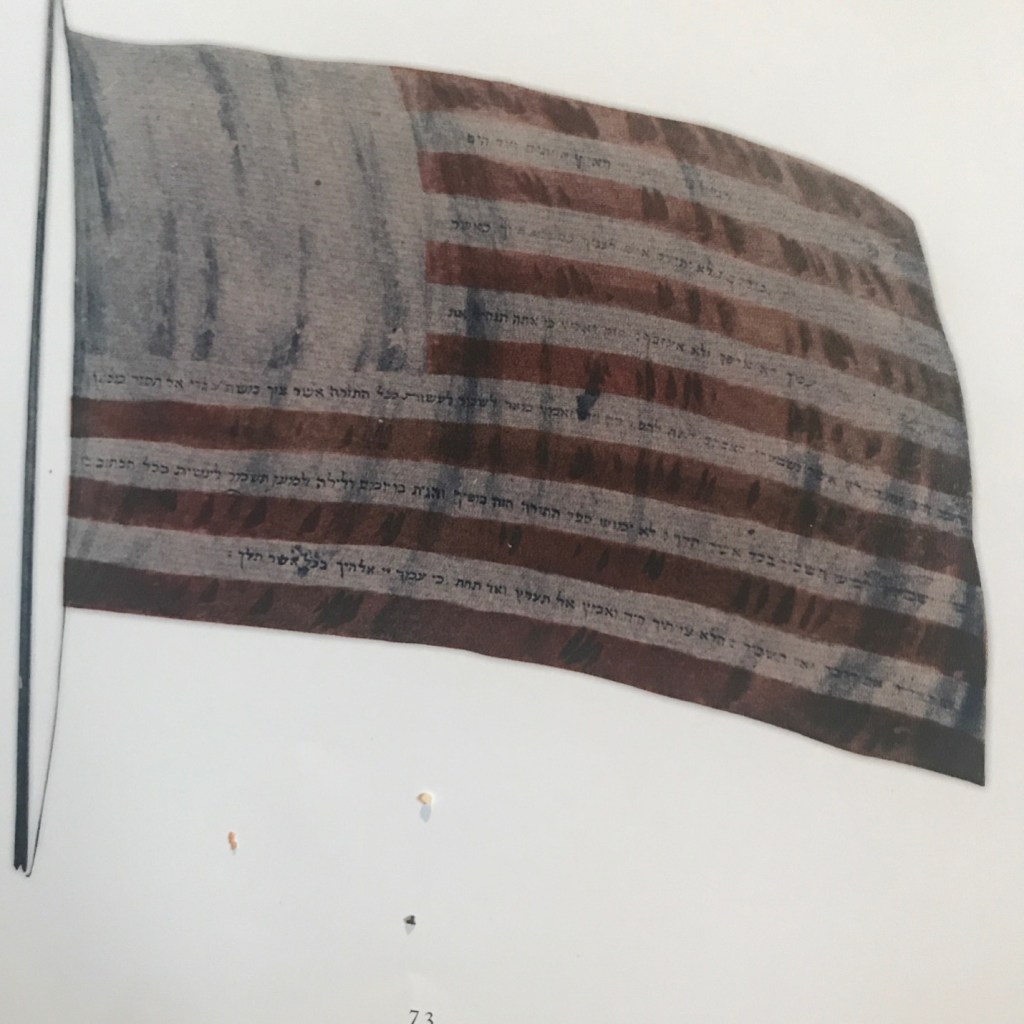
The above picture depicts the American flag which was presented to Abraham Lincoln a few weeks before his inauguration by Abraham Kohn. It was embroidered with original Hebrew verses. See footnote for more of its background.[1]
“When things go badly for Jews in Britain, they can go to Israel. When things go badly for me in Britain — where do I go?” -Douglas Murray
A member of my shul was annoyed with me. I could sense it.
To his credit, he soon approached me to share his frustration.
“I was very unhappy with a recent drasha. The first part was fine…but how you ended shocked me”.
He was referring to my drasha for Shabbos Chayay Sarah (Genesis 33ff), having taken place right after Mamdani was elected our next mayor.
For context, a brief synopsis:
I opened with the classic scene of two Jews meeting at an airport – an American moving to Israel, and an Israeli moving to America. Each thought the other one was foolish for their respective choice.
“Which one is correct. Who among these two is being more realistic”, I asked.
Letting that rhetorical question breath, I then shared a famous speech of the Mir rosh yeshiva, Rav Chaim Shmuelevitz (d. 1979):
He began by asking how we are to understand the fact that Avraham (Abraham) responded to the idea of sacrificing his son with alacrity, while Sarah reacted with death-through-shock (As the Talmud teaches)?
Rav Chaim finds the solution in a seemingly unrelated midrash (biblical exposition/tradition from the rabbis of the Talmud), where Esav astonishingly arrives at the burial for Yaakov (Jacob). He soon begins to complain, adamant that maaras hamachpeila (cave of the patriarchs) belonged to him. Naftali is immediately dispatched to swiftly retrieve the deed and prove his uncle mistaken. In the meantimes, Chushim the son of Dan – being a deaf/mute – was confused by all the tumult, seemingly unaware of the situation and what lead up to it.
Chushim is quickly informed of all of the events…and responds by immediately decapitating Esav, which caused his head to roll into the cave where it remains until today.
This midrash begs many questions. For one, and adduming Chushim’s act was just, weren’t Shimon, Yehudah, and Levi warriors?! How could they sit idle? How was it that only Chushim responded with such righteous anger?
Rav Chaim explains that the reason Chushim alone responded appropriately was due to that one feature we know about him:
He was a deaf/mute.
This deafness separated him from all the others who slowly adapted to the ever-changing situation and acclimated themselves to their new reality:
“Oh, Esav came!…He his now making murmurs!… He wants to eulogize his brother!…He seems upset about something…”, until, “Oh, he wants to prevent the burial and deny the sale!”.
Like the proverbial toad gradually and unnoticeably being boiled in water, we all have the capacity to slowly adapt; to accept, little by little, any situation as being normal, as settling into a new reality, of something peculiar as being simply of ‘our times’.
The deaf/mute Chushim was oblivious to these slow drips, incapable of slowly adapting to circumstances. Chushim was instead informed of everything all at once.
Now alone in appreciating the matter with clarity, he responded reflexively, without acclimation.
Similarly, continued Rav Chaim, Hashem put in each parent the sheer inability to slaughter their child, and therefore Hashem communicated this particular command/test in a different manner than He did the others: slowly and as a build-up. This gave Avraham time to adapt, so as not respond reflexively.
“I have a command….You must offer a sacrifice…A human…Your child…The one that you love…Yitzhak….”.
Through this method of adjustment and matriculation, Avraham could then fairly and soberly approach the test.
The Satan cruelly utilized the opposite tact when informing Sarah, throwing all the information at her in one fell swoop.
Like all human traits, the power of adaption can be used as a poison pill or as an elixir for good -aiding Chushim while aggrieving Sarah.
I first connected this idea to the abnormal challenges with which our children are presently faced. These are so new to history that they should keep us up at night…unless we have been slowly acclimated to this new reality.
I then turned to the election, politics, and the American Jew.
“Have we adapted to having security guards in front of our buildings? Have we grown used to feeling the weight of our yarmulkas on our heads when on the subway? Are we accustomed to the libelous chants, even now when one of those chanters is our next mayor?”
Now, a drasha has to ‘land’. It can’t leave people in a lurch, or without some positive message.
So, after stressing the need to strengthen our emunah, I concluded with the recognition of how much we love we have for our country, America. How thankful we are for her.
“We must help save her just as she saved so many of us.”
And then came the line that caused his ire:
“We mustn’t over-panic. We still have more yeshivos and shuls being built weekly in this country than at any time in our long galus. Often, the groundbreaking for such institutions is joined by government representatives. We also still have majority support in our government, and a plurality around the country…There is an abundance to be hopeful for ….”
It was this ‘landing’ that alarmed and confounded this member.
“Rabbi, aren’t you a historian? Isn’t this what they said in Europe, in Spain…in Bavel?
“When is it time for rabbanim to tell people to leave, to make aliya? Rabbi Taub, do you want the achroyos of families who stay behind due to your pollyannish diagnosis?”
Was he over-reacting? Is he over-learning the lessons of history? Or, perhaps it is I who became naïve. Worse, have I allowed this ‘power of adaption’ to overtake my ability to dispassionately reason?
Should rabbanim and leaders be telling families that they must leave America?
During the second Intifada a parent called a noted gadol asking if it was safe to send his child to learn in Israel. This gadol responded, “And how do you know he will be safer in America?”.
His point had little to do with this country at that time, rather to remind that father that the keys to life and death are governed solely by Hashem (see taanis 2b).
In other words, so long as someone is within his halachic guardrails of being shomer nefesh and is acting l’shem shomayim they must surrender to Hashem’s will.
[The level of risk sanctioned by halacha impacts a myriad of halacha, such as Shabbos, kashrus…and ‘escape’. This broad topic is well beyond the scope of this short column]
Has America, or New York, reached such a level of sakana so as to breech the horizons of halachic sakana?
It seems to me not.
However, have the seeds been planted in the American youth – of all persuasions – that could predict a future where a slow-drip of deviations from the past, and over time, will take place, thus making life in America, of New York, intolerable for Jews?
Perhaps.
Indeed, and due to this, more people are moving to eretz yisroel.
More, not every decision is a matter of halacha, nor does every family judgment demand rabbinic input (see letter of the Baal HaTanya- found in the back of most volumes of sefer Tanya – where he bemoans those talmidim who seek his counsel about business matters and other areas outside his role as teacher).
The man continued, “I know eretz yisroel has its risks. Look at October 7th! But I would rather die there then here.”
When describing Yaakov seeking to find favor in the eyes of Esav, Rashi shares an old French word “appesemento” or appeasement (bereishis, 33:10); ironic that it’s a French word!).
Yet, in that very same parsha, Shimon and Yehudah go to war with Shechem. Should they have also, at least at first, tried to work it out?
I believe the answer is hidden within what is perhaps the most famed Rashi in all of chumash: הלכה היא, עשו שונא יעקב – It is a matter of law: Esav (throughout history) despises Yaakov.
Few notice the oddity of where chazal transmit this revelation. They don’t mention this rule by the fright of Yaakov, nor when Eliphaz strips him bare, and not even when they now confront each other.
Instead chazal waited until the phrase “they embraced” (33:4).
Why here?
If anything, this seems to be the very antithesis of that very rule!
Ah, but perhaps this is the secret.
Sure, we must be pragmatic and notice moments ripe for pacification. But there is one qualifying rule to such appeasement: during those moments of pragmatism, when sitting across from each other, when embracing, that is when we must be reminded and be cognizant that he is an enemy, and not become softened by their smile.
As demonstrated through Yaakov, even when at the climax of appeasement – “they embraced” – we are not to forget with whom we are sitting. Only then can we even consider hope for reconciliation. “They embraced”, yes, however Yaakov was consciously aware that he was reviled. His emotions and feelings of brotherly love never deluded him.
Shechem came like a lamb, asserting to want only alliance and camaraderie, only to then go back home and continue violating their sister. Esav, as duplicitous as he was, never hid his feelings toward Yaakov (which is why Yaakov originally fled). His intentions were always clear. Yaakov therefore was able to try kabdeihu v’chadsheihu.
Indeed, the Esav’s in America are forcing us to enter the stage of kabdeihu v’chadsheihu –trust but verify. During this time, we will do our part of help save this country from this poison, to ‘appease’ its greater nature, as well as creating a ribuy kiddush shaomyaim whenever possible.
However, we now mustn’t forget the lessons of the past few years: an embrace may not be real (of course, often it is! See the Emek Davar to these same pesukim where the Netziv depicts the ideal world of brotherly love between Yaakov and Esav).
While I do not think we are at the stage of rabbanim bringing fear into members’ homes by telling parents and children that America is no longer a safe place to live, or that we must flee, it is certainly time to remind them of the pain of galus, and to appeal to Hashem that He move us just one last time -to Yerushalaim ha’benuyah!
And, in the meantime, let us fight to protect the America that we know and love.
Ig history is our guide, the cancer of antisemitism always metastasizes, eating away and corroding the healthy organs of once great empires.
May the sacrifice and benevolence of this great country, along with the brilliance and sincere foresight of her founders, protect her from such historical repetitions.
NOTE
[1] Excerpt from this authors forthcoming newest book, the second volume in ‘Jews in the New World‘ series:
…Let us go back to January 4, 1861.
That date happened to fall on an erev Shabbos.
The nation was cracking, tearing at the seems of the Mason-Dixon line and the Ohio River. The country was being torn asunder due to, largely, the issue of slavery.
A few months earlier, on Tuesday, November 6, 1860 -for the 19th time since the country’s founding -voting was held for the next President of the United States.
An astounding 81.2 % of the nation turned out to vote –the second highest voter turnout in American history (slightly beaten-out only by the 1876 election). With a civil war almost certainly on the horizon –there were four candidates running for the office.
Abraham Lincoln won with 39.8% of the vote.
The President at the time of Lincoln’s election was, of course, James Buchanan. Unlike Lincoln, who had great admiration for and was close friends with many Jews, James Buchanan was privately disdainful of the Jews in America (see Sarna, et al.).
When it came to the issue of slavery, Buchanan held views that were odd, and hard to explain.
He earned the nickname ‘doughface’, an epithet used to describe a Northerner with Southern adherences (see History Dictionary of the Old South, William Richter, page 111; see also William Safire’s ‘Safire’s Political Dictionary’, s.v. ‘doughface’).
While some describe Buchanan as having been pro-slavery, his position seemed more nuanced.
While certainly not a fan of the growing and vociferous abolitionist movement, this may have been for pragmatic reasons and feeling that sometimes the way to end evils is to let nature take its course, whereas fighting may only causes the opposing side to become emboldened.
He thus stated:
“Before [the abolitionists] commenced this agitation, a very large and growing party existed in several of the slave states in favor of the gradual abolition of slavery; and now not a voice is heard there in support of such a measure. The abolitionists have postponed the emancipation of the slaves in three or four states for at least half a century.”
-Philip Klein, ‘President James Buchanan: A Biography’, page 150
Regardless of his motives, Buchanan is often seen as one of the worst presidents, as he did little to prevent the Civil War (see book, ‘Worst. President. Ever’, Robert Strauss)
Only five weeks after Lincoln’s election – Lincoln would not be inaugurated until March – on December 20, 1860, and largely as a result to Lincoln’s election, South Carolina –historically the most extreme state relating to issues of slavery – seceded from the Union. Within two months the states of Mississippi, Florida, Alabama, Georgia, Louisiana and Texas would follow.
By February 9, 1861 this new Confederacy of states would elect their own president, Jefferson Davis.
Lincoln was inheriting a union divided and the United States of America seemed very vulnerable to collapse; so much so that he would have to sneak into Washington in disguise for his own inauguration!
Abraham Kohn, a Chicago businessman, and the founder of the first shul in that city, was a proud anti-slavery abolitionist. In fact, after 1860, when he became the first Jewish clerk in Chicago’s history, he was described by some as “one of the blackest Republicans”! (See, Lincoln and the Jews, Sarna, p. 72)
Other papers, in praise of him, would refer to Mr. Kohn, as the most ‘Hebrew of the Hebrews’. It is interesting to observe that in early America many viewed the term ‘Jew’ as a negative sobriquet, thus we often find the use of terms such as ‘Hebrew’ or ‘Israelite’ (see Sarna, ibid. p. 72).
Lincoln would meet Mr. Kohn in Chicago just a few weeks following his presidential election. The two spoke about the important role that the Bible played in their lives. (See, History of the Jews of Chicago, Markens, page 45)
Understanding the difficult road ahead for the new president, Kohn would send Lincoln a gift before his inauguration.
This gift was a portrait/picture of the American flag.
What made this particular flag unique was that inscribed in its white stripes were pesukim –in lashon kodesh –taken from sefer yehoshua (1:5-8) relating to his taking over leadership and conquering eretz canaan:
“No man shall stand up before you all the days of your life…be strong and have courage…do not stray from the Torah left or right…The Torah shall not leave your mouth…then you will succeed in your ways and then you will prosper”
Buchanan watched helplessly both the election and the issue of slavery coming to its breaking point, and felt the existential crises ahead.
So, on December 14, 1860 James Buchanan issues a proclamation, that a “National Day of Humiliation, Fasting and Prayer” should take place on January 4, 1861.
He stated:
“In this the hour of our calamity and peril to whom shall we resort for relief but to the God of our fathers? His omnipotent arm only can save us from the awful effects of our own crimes and follies…Let us…unite in humbling ourselves before the Most High, in confessing our individual and national sins…Let me invoke every individual, in whatever sphere of life he may be placed, to feel a personal responsibility to God and his country for keeping this day holy.”
This was not the first such proclamation issued by an American President, nor was it to be the last.
John Hancock –one of the signatures of the Declaration of Independence –already in 1775- before the Battle of Lexington, issued such a day, asking that we ‘confess’ our sins and seek forgiveness from Gd.
President John Adams ordered two such days, and Lincoln would go on to establish one of his won during the heaight of the Civil War.
Such days of prayer and fasting would eventually lead to a federal law – still in affect today –of a ‘National Day of Prayer’, held each year, the first Thursday in May.
{Naturally, in 2008, the FFRF (Freedom from Religion Federation) sued, strangely –in my view- arguing that if such a day is allowed then the federal government could also, in theory, pronounce a ‘National Day for Anti-Semitism’. Remarkably, the judge ruled in their favor, stating that such a day is “an inherently religious exercise that serves no secular function” (this judgment was later overturned by the Seventh Court of Appeals).}
How did the Jews, and rabbanim, of 1861 react to such a ‘taanis’?
Would they support it? Would they fast erev Shabbos?
Not only would many rabbanim of the time support this fast, but they gave derashos (sermons) discussing the precarious state of the Union. We still have these derashos extant today, and in the next chapters we will discuss what they said, in terms of both slavery and the future of America….
 Shul Chronicles
Leave a comment