Rabbi Moshe Taub, 2024
As discussed in another post, most living outside eretz yisroel light their menoros indoors.
Although chazal and the Shulchan Aruch rule that we should only light inside in times of danger, the Rema (672:2) states that the standard practice is to continue to light indoors.
Above, we shared numerous approaches to this issue, ending with the words of Rav Moshe Shternbuch (Moadim U’zmnaim, vol. 2, p. 79) who suggests that just because we live in peace now does not mean that we should forget or abandon the concerns of the past, and that they may, l”a, revisit us at some future time, l”a.
For obvious reasons, following the pogrom of October 7, 2023, his argument came to mind, and I repeated it in shul.
After, a young boy asked, “Shouldn’t we also now cover our mezuzos?”
Seeing the surprise on my face, he continued. “I understand that the obligation for a mezuzah is from the Torah, as opposed to Chanukah. But if the issue is sakana, why don’t we find chazal or poskim discussing covering or hiding it presence?”
Sadly, it has not been only little boys wondering this:
“Do Not Take Down Your Mezuzos!” yelled the headline in The New York Times op-ed page right after the October 7th attacks. The article went on to state how some non-religious Jews were indeed taking theirs down due to fear.
More positively, and on the other hand, reports have also been published of mezuzos being vandalized, R”l, causing a reaction to the other extreme: non-Jewish neighbors putting up (empty) mezuzos of their own! While potentially an issue of halacha, their intent is beautiful.
I explained to this boy that there is a deeper significance here: The story of Chanukah is about surviving the culture around us. In our days, such chinuch, such light, must begin in the home. As we shall see below, I am not alone in this idea.
Interestingly, Chanukah is in fact deeply rooted in the mitzvah of mezuzah.
First, contemporaneously, relating to this just this year and the current eis tzara: I’ve heard from a very prominent sofer sta”m how there is now a shortage of klaf due to the fact that many Palestinian Arabs would do the stretching for the klaf and, obviously, are not now available (a frum yid always begins the ibud process lishmah, and with the Gentile there to hear, for more details, see Shulchan Aruch, siman 32:8 and Mishneh Berurua sif kattan 30).
However, the connection to Chanukah and mezuzah runs far deeper.
The gemara states:
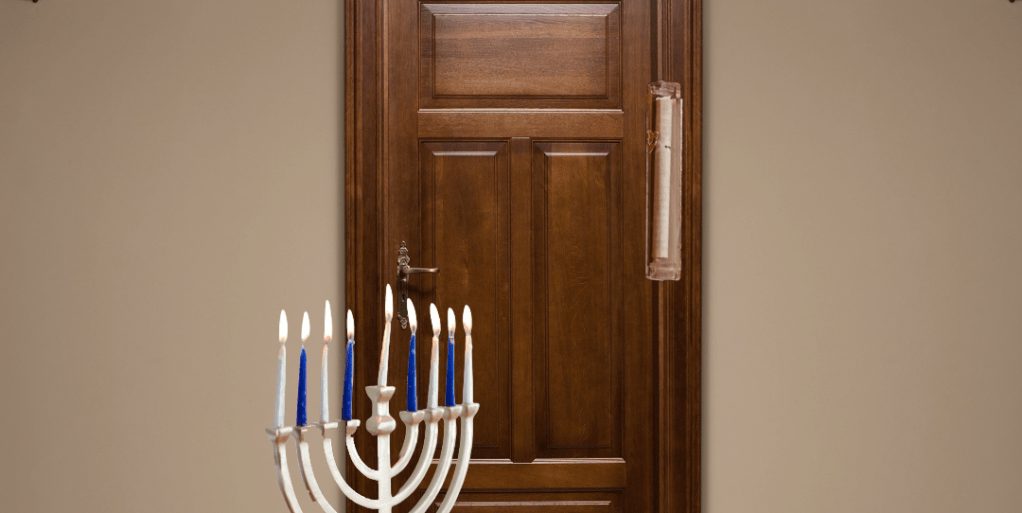
“Rabbah taught: ‘It is a mitzva to place one’s menorah within a tefach/handbreadth adjacent to the entrance.’ On which side does he place it? Rav Achah ben Rava said: ‘On the right;’ Rav Shmuel of Difti said: On the left. The halacha is to place it on the left, so that the menorah will be on the left and the mezuza on the right.” (shabbos 22a)
Chazal are teaching that by placing one’s menorah opposite one’s mezuzah he will thereby be surrounded by mitzvos. Chazal here teach that by placing one’s menorah opposite one’s mezuzah, he will thereby be surrounded by mitzvos.
Meseches sofrim expands on this:
“…The mezuzah should be on the right, and the ner chanukah to the left. Thereby fulfilling the verse (Shir HaShirim 7:7) ‘mah yafis u’mah y’amt…-how fair and how beautiful-. ‘Mah yafis’ -is mezuzah; ‘u’mah y’amt’ is ner Chanukah.” (Sofrim 20:5; cf. Shir HaShirim Rabbah, 7:1)
But why specifically mezuzah? What is its unique connection to Chanukah?
The Shem M’Shmuel (mikeitz) shares that the goal of the menorah is m’bifnim l’chutz-to take the kedusha created in our homes and bring it to the outside world. Whereas the goal of mezuzah is in the opposite direction – serving as our home’s most vital ‘filtering’ system, placed based on our way of entering our homes from the streets of life; our cue to first strain any-and-all tumah.
The Sefas Emes (Chanukah trn’t; see Sefer HaChinuch #423) explains that mezuzah ought to remind us of Hashem’s Torah u’mitzvos. After the yevanim wished for us to ‘forget Your Torah,’ we, dafka, wait until people are found in the street (tichleh regel) when they will then bear witness to the ner Chanukah and mezuzah – our constant symbiotic tools to succor our combat against the potent pull of regilos and tevious (culture and conditioning).
As to connecting the leniency by danger in regard to Chanukah to that of mezuzah, the Shulchan Aruch shares that whoever is careful in mitzvas mezuzah will be protected for a long life; he and his family (yoreh deah, siman 285). In other words, there is a built-in structure of protection already. (Of course, and as the Aruch HaShulchan stresses, we do not keep this or any mitzvah due to any specified protection that it may bring, rather, and only, as a gezeira from Hashem.)
In fact, it is not just ner Chanukah that we place opposite our mezuzos.
Growing up, following sukkos, we would lean our lulavim on the left side of the doorway, opposite our mezuzah, until nissan when the dried lulavim fueled the burning of our chometz (see Rema, orach chaim, siman 664:9).
Our mezuzos are uniquely empowered to bring an abundance of steady stimulus and koach, and also have the power to accentuate the other mitzvos performed in our homes (see further, Shir HaShirim Rabbah, ibid.).
In fact, this is why we have the minhag to touch the mezuzah upon passing it. The Shulchan Aruch (see Rema, yoreh deah, siman 285:2) writes:
“Some say that when one leaves a house/doorway, he should place his hand on the mezuzah…as well as when he enters.”
One of the sources for this practice is the famous gemara (sanhedrin 11a), regarding the soldiers sent to bring Onkeles back to Rome (after his gerus). When they witnessed him touch his mezuzah, they asked for an explanation. Onkeles responded: “The way of the world is that a king of flesh and blood sits inside his palace while his servants stand guard outside; but with regard to Hashem, His servants sit inside their homes and He guards over them outside. As it is stated: ‘Hashem guards your going out and your coming in, now and always’ (tehillim 121:8).When kissing one’s mezuzah, it is brought, al pi kabbala, that one should use, specifically, his middle finger (‘amah’), kissing his finger after (Birkei Yosef, siman 285:2; see Taz, sif katan 5; see shu’t Rav Akiva Eiger 1:58 regarding touching the actual klaf).
It is recorded, amazingly, how the Chasam Sofer once revoked a semicha after witnessing the young musmuch consistently ignoring the mezuzah when entering and leaving rooms (Maamer Mordechai [2007] p. 494)!
May we, too, follow toras chazal and their guidelines in how to protect ourselves.
May we have a safe and growing Chanukah, as we await the menorah of bayis shlishi!
 Shul Chronicles
Leave a comment