Including Fascinating Information Regarding:
- – The First Rebbe in America
- Coca-Cola Kashrus Secrets
- The Birth of YU
- America’s ‘New Jerusalem’
- The Mussar of Benjamin Franklin
….And Much More…
Published In Weekly Installments in Ami Magazine Over the Summer of 2023. By Rabbi Moshe Taub
Welcome to Buffalo
Rav Yona Landau is a fascinating individual who I first met when I was a rav in Buffalo. The shul would see many daily visitors, so, at first, seeing someone in his chassideshe levush did not bring any specific attention. After davening, he approached and gifted me with a sefer he had written. I still have this Yiddish volume, about the ‘early’ rabbanim and shuls of America. At the time, this topic was not even remotely on my radar. For whatever regretful reason -likely due to many other guests there- I did not ask him why he was in town. However, serendipity would soon take care of that.
Several weeks later, while driving home from a meeting, sudden horrid blizzard conditions began to deluge my car (not a surprise for Buffalo!). The storm caused such low visibility that I became utterly lost, finding myself in the township of Cheektowaga. This was around 2004, so I pulled out my trusty, printed (!) New York State map and worked-out a route home through safer sideroads. As I was driving in this remote area, suddenly, through the furious flurry, I saw what appeared to be a chassideshe yid -not a common site in these parts!
The certainty that my eyes were deceiving me was quickly dashed when I then saw another such yid, and then another. I began to pull over – to ask if they need help, and, to quench my curiosity as to why they were there – when I noticed this street aligned a cemetery. As a kohein, I had to park up the road on the other side of the street, get out of my car and walk through the intense sleet that was smacking my face, all the while calling out to them. “Are you here on business and now lost? Or, do you have a great-grandparent buried here?”
It was only at this moment when I became informed that this was the cemetery which housed the ohel of the holy Rav Eliyahu Yosef Rabinowitz (again, I am a kohein). Rav Yonah Landau is responsible for bringing this burial spot to broad public attention. Since his own group- trips began, pilgrimages to this site have been made by tens of thousands across all streams of the Torah world -from cholim, to those in need of a zivug or parnasah.
Even before this, my shul in Buffalo had a flyer for visitors to take which had information regarding kashrus, the eruv and mikveh, as well as other useful information for visitors. This flyer also contained some brief information about Buffalo’s Jewish history, including an image of a contemporaneous announcement of this Rav Rabinowitz’s petirah.
The American Hebrew & Jewish Messenger was a national Jewish magazine which began in 1879, and which still exist today (after various exchanges and transactions) as The Washington Jewish Examiner. In its November of 1910 edition, in their ‘Buffalo’ section, they wrote:
“Rabbi Joseph Rabinowitz, of the congregation Brith Sholom, Anshe, Russia, died last year at the age of fifty-four years. His death has caused a great deal of grief in the orthodox community, for the deceased rabbi was beloved by a large circle of friends, and was noted for his piety, his modesty, and his exceptional learning. He was officially connected with B’rith Sholem congregation, but was also greatly interested in the general religious and educational welfare of the Jews of his section. Although only a few years in Buffalo, he at once made his influence felt in many directions.
“Rabbi Rabinowitz was born in Justingrad, province of Kiev in 1856. His father was a famous rabbi. He came to Buffalo in 1908 and at once became popular and beloved by all the Jews in the city. He passed away Monday evening November 14, at his home, number 67 Walnut Street.”
In the next chapter we will iy”H share more about Rav Rabinowitz’s amazing life and his present-day connections to Buffalo.
Additionally, we will share other ‘secret’ burial spots in America that may surprise even the history-literate reader.
Family Trees & the Steipler Gaon The First Rebbe in America
In the last chapter we wrote about the first rebbe to reside in America, Rav Eliyahu Yisef Rabinowitz. Let us first pick up from there.
While a rav in Buffalo, I once received the following email:
“Dear Rabbi Taub,
I am travelling to Buffalo and heard that there is an ohel for one Rabbi
Eliyahu Yosef Rabinowitz. I was told he was a rebbe, perhaps the first in
our country. Is this true? Was he really a rebbe? How do we define that
term? And, how do we know he indeed was one?”
Ah, the questions rabbis receive!
Let us start with his amazing yichus, which is a story of galus:
One of the Baal Shem Tov’s prime disciples, of course, was Rav Yaakov Yosef (d. 1781). His sefer Toldos Yaakov Yosef is one of the main sources for the Torah of his rebbe and founder of chassidus.
One of Rav Yakov Yosef’s students -and a student of the Maggid of Mezritch as well, another pupil of the Baal Shem Tov -was Rav Gedalya of Linitz (d. 1804). Rav Gedalya himself was the son of a dayan, and was a great-great grandson of the Maharsha (His great grandmother was the Maharsha’s daughter, see source in the sefer Toras Avos below).
Many stories known today about the Baal Shem Tov were transmitted through Rav Gedalya (see, e.g., Shivchei Baal Shem Tov).
He himself authored the sefer Teshuas Chein.
When Rav Gedalya was niftar, his son, Rav Shmuel Yehudah Leib, took over as admor of Linitz. He was niftar in 1818, at just forty-six years of age.
His brother, Rav Yitzchak Yoel, assumed the role of admor next. He had learned under the holy Apter Rav (d.1825) together with ‘Der Heiliger Ruzhiner’, Rav Yisroel (d. 1850), who said about Rav Yitzchok Yoel, “If one desires yiras shomayim, go to him” (Toras Avos, p. 24 note 13). Rav Yitzchak Yoel was niftar in 1828.
He was followed by his son, Rav Gedalya Aaron who was married to the daughter of Rav Shmuel Abba, the grandson of Rav Pinchos Koritzer, a disciple of the Baal Shem Tov. It seems that he only accepted becoming admor in 1840, a dozen years since his father was niftar.
With this background, we can now begin to zoom-in a little.
For unknown reasons, in 1848, he would move his court to the town of Sokolivka, at the outskirts of the city of Linitz (known today as Illinitsy), both just about thirty-five miles from Uman.
As his fame grew, he would soon need to hide from the Russian authorities, escaping to the Romanian town of Podu Iloaiei. The last ten years of his lilfe was spent here. It is here where his talmid Rav Eliyahu Rosenthal would publish his rebbe’ s teachings in the sefer Chen Aaron.
Now away from their holy father, it is likely at this point that his four sons began to adopt the last name ‘Rabinowitz’, which is Slavic for ‘the son of the rabbi’. It seems probable that this surname was then pronounced as its Russian equivalent, Rabinovitch.
His eldest remaining son was Rav Yitzchak Yoel – who initially took over as admor, yet sadly was niftar at forty-five, in 1885, just eight years after his father’s petira.
His brother, Rav Pinchos, then took over as the rav and rebbe of Sokolivka. Rav Pinchos was tragiclly killed al kiddush Hashem in the pogrom on zayin av, 1918, hashem yinkom domo.
Chayah Shuman, whose four brothers were among those killed, recalled, “The Gentiles refused to bring the [dead] bodies to the shtetl.
The Jewish population rented horses and wagons from them, and themselves brought back the dead. My father was among those digging graves for my brothers. Nachum the apothecary tried to help him digging. My father said to him, ‘Take it easy, Nachum; let me take care of my children.’ My brother Baruch who was killed was married and the father of a little boy. Reb Pinchas was seventy-six at the time he was murdered.”
{Her grandson, Rav Avraham Meir Shuman, lives in Buffalo today, and makes a siyum every year on that date l’zecher nishmasum}
The next brother was Rav Eliyahu Yosef, who would soon arrive in Buffalo, NY.
Rav Eliyahu Yosef would marry the daughter of Rav Meshulam Zusha Aurbach. Rav Aurbach’s son -the Buffalo rebbe’s brother-in- law!- was the famed Rav Mordechai Dov Twersky, the Hornesteipler Gaon.
That the Hornesteipler took his mother’s -Rebbitzen Shterna Feigeh – maiden name was not uncommon of many Jews of the time (see my post regarding Jewish surnames -the history and logic behind this practice).
For the litvaks, like myself, who are reading, take note of the following: Rav Yaakov Yisroel Kinievsky -the father of Rav Chaim Kinievsky – was also known as the ‘Steipler’ or the ‘Steipler gaon’, a name that comes from that same town. Indeed, the Steipler’s parents were chassidim of Rav Mordechai Dov Twesky, and named him Yaakov Yisroel after Rav Mordechai Dov’s grandfather, Rebbitzen Shterna’s father – the Magid Meisharim, Rav Yaakov Yisroel Twersky (d.1876).
Rav Mordechai Dov’s son, the Buffalo rebbe’s nephew, was Rav Bentzion Yehudah Leib would take over as the official admor of Linitz.
His son, the Buffalo rebbe’s great nephew, was Rav Yaakov Yisroel Twersky -named for the same zaide as was the Steipler! -would famously move to Milwaukee, Wisconsin in 1927.
After arriving to the Lower East Side in 1899, he soon discovered that many of his brother’s mispallilim had relocated to Buffalo. It was only a matter of time until they excitedly invited him to be their rav, in the Jefferson Street shul. The reader should keep in mind that Buffalo was one of the largest cities in the country at the turn of the century.
He arrived there just a few years after President McKinley was assassinated at the world fair held in Buffalo.
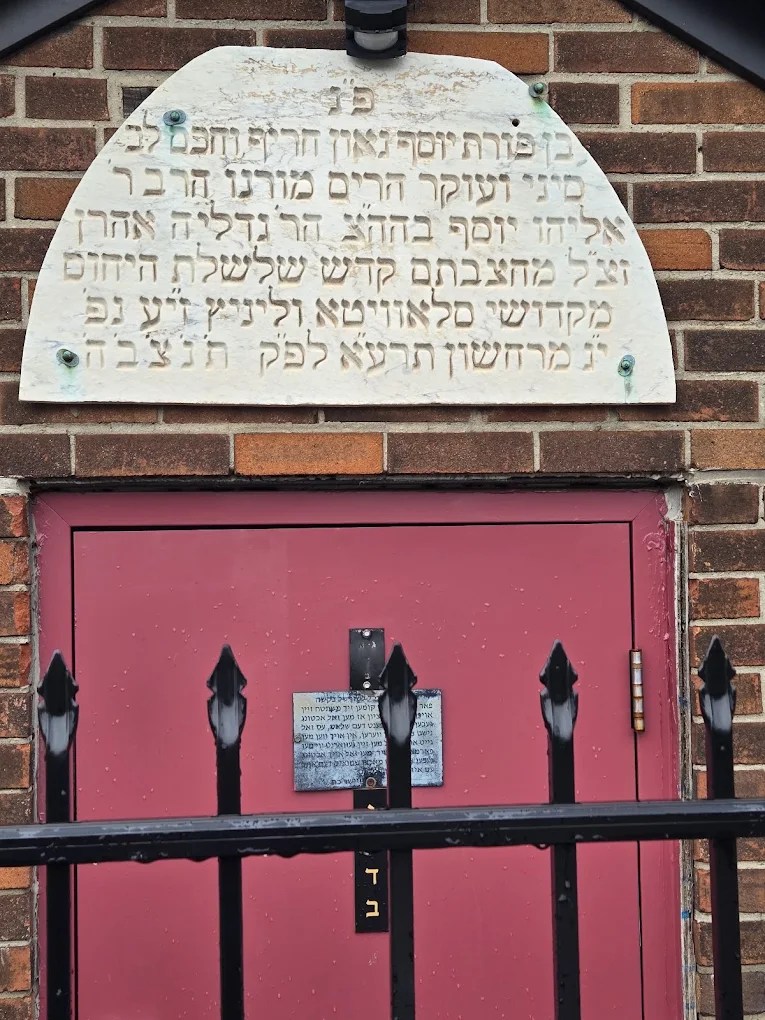
His kever at the Pine Ridge cemetery was beautifully redone with an ohel and a special room for kohanim. A plaque was installed giving special honor to those killed al kiddush Hashem from his hometown.
Thousands of yearly visitors come to daven at his kever.
So… was he a ‘rebbe’? Of course!
Yiddish Kezetzung, November 25, 1910
Gaons, Goons and Designations
&
The 13 Middos of…Benjamin Franklin?!
As a kohein, I have never been to Rav Rabinowitz’s ohel near Buffalo. When I asked a friend to share its image with me, he also shared an additional image of another matzeiva, asking “Have you ever heard of this rav?”
The matzeiva in the image read as follows [translation]:
“A man great amongst his brethren// A shepherd of a holy flock// a posek, advisor, and orator// Who judged and was charitable to his nation// Harav Hagaon Avraham Meir [bar Yitzchak Zev] Franklin// Av beis din of Buffalo and before this outside of Vilna (!)// Niftar 4th of cheshvon …[born] tuff reish chuff kimmel (1882/3)- [niftar] tuff reish tzadi gimmel (1932)”.
I was not immediately familiar with this rav, and initially wondered, “A rav with an American-sounding name such as ‘Franklin’ was formerly a rav outside of Vilna?!”
I would soon discover that his surname was originally ‘Frankel’, and later Americanized to Franklin.
Such a change -especially in a surname – is not new in our long galus, especialy when showing gratitude (see Eicha Rabbasi, 2:13, with Beis Ahron, chelek beis, p. 519).
But why choose, specificly, Benjamin ‘Franklin’ to honor?,
To answer this question, I will share something extraordinary with the reader:
Reminding us that they don’t make politicians like they used to, Benjamin Franklin’s writes in his autobiography:
“I conceiv’d the bold and arduous Project of arriving at moral Perfection. I wish’d to live without committing any Fault at any time; Habit took the Advantage of Inattention. Inclination was sometimes too strong for Reason. I concluded …that it was our Interest to be completely virtuous, was not sufficient to prevent our Slipping, and that the contrary Habits must be broken and good ones acquired and established,…
“I propos’d to myself… Thirteen Names of Virtues…
“1. Temperance-Eat not to dullness; drink not to elevation. 2. Silence- Speak not but what may benefit others or yourself; avoid trifling conversation. 3. Order -Let all your things have their places; let each part of your business have its time. 4. Resolution-Resolve to perform what you ought; perform without fail what you resolve. 5.-Frugality – i.e., waste nothing. 6.Industry-Lose no time; cut off all unnecessary actions. 7. Sincerity- Use no hurtful deceit; 8. Justice-Wrong none by doing injuries or omitting the benefits that are your duty. 9. Moderation- forbear resenting injuries so much as you think they deserve. 10. Cleanliness 11. Tranquillity- Be not disturbed at trifles. 12. Chastity- Rarely use venery. 13.Humility…”
Many who went to litvishe yeshivos may find this list very similar to the ubiquitous “Thirteen Middos of Rav Yisroel Salanter” chart that used to hang in the back of many classrooms.
It is possible -if not likely-that this list was composed not by Rav Salanter, but rather Franklin himself!
I will now very briefly explain:
In 1812 -twenty years after Franklin published his list – a famous sefer was first published –Cheshbon HaNefesh.
Its author explained that he borrowed the idea of 13 middos from a ‘secular moralist’, writing:
“Recently, a new and pleasing method was discovered, this invention innovation will spread quickly im yirtz Hashem”
–Cheshbon HanefeshMerkaz hasefer ed., p. 31
(See also article by Rav Nissan Waxman, Sinai, 1961, as well as a 5780 monograph by Shai Asafi).
In a recent edition of this sefer, Rav Mordechai Shmuel Edelstein writes a hakdama where he mentions this list’s original source coming from “The gentile sage […] Benjamin Franklin [in whom] there arose a powerful yearning to reach moral perfection,” (translation; see Asafi, ibid.).
This is not, chalila, to minimize the value of this list, which can be of great value, irrespective of its origin. Indeed the 1812 mechaber sought to improve upon Franklin’s list by changing its order, as well as modifying some of the middos themselves -i.e. omitting Franklin’s #1 and #12 for and exchanging them kavod and savlanus.
So, how did the provenence of this list become misplaced, and, how did this list become so popular in the litvish world?
When R. Yizchok Blazer zt”l (Peterburger) published Ohr Yisroel – the celebrated collection of writings and letters from his rebbe, Rav Yisroel Salanter zt”l, he makes no mention of these thirteen principles. However, in an 1845 edition of the 1812 Cheshbon HaNefesh the publisher mentions in his introduction how Rav Slanter urged this re- issue and (according to my friend Reb Moshe Friedman of Toronto, who shared this theory with many gedolim), this caused readers to assume this false attribution to both the sefer and its list.
Back to Rav Franklin:
In the archives of The New York Times from November 5th, 1932 we find on page 1 that they report on Rav Franklin’s death on page 15. Exasperatingly, their archoves were incomplete and, at first, all I could access was with this odd and confusing headline (emphasis mine):
“BUFFALO CHIEF RABBI, A. M. FRANKLIN, DIES-Descendant of ‘The Great Man of Goon’ – Was an Official of Rabbinical Association”
Great man of…what?! Later, when looking at the actual microfilmed image I discovered that the digitizer made an error. The headline actually reads:
“…Descendent of the great man of Gaon”
While clarifying the word ‘Goon’, their sentence still made little sense. However, the explanation may be simple: They erroneously transposed the translations of the words Vilna and gaon, assuming ‘vilna’ meant great man/genius, and that ‘gaon’ referred to his city!
Perhaps this error is due to the fact that ‘Vilnius’ -and not Vilna – is how gentiles refer to this city (although, see below where they use the term ‘Wilno’).
As a fascinating aside, the word gaon, meaning genius, is not found anywhere in Tanach! There, it always means ‘pride’ or ‘heights’, etc. It was only in the Geonic era (700-1000) when ‘gaon’ took on this new connotation (see e.g. Halachos Gedolos, 31).
It is interesting to consider how this came to be. Some suggest that in the late middle-ages we crowned our rabbanim with gaon based on the pasuk ‘gaon yaakov-pride of Jacob’ (Tehillim 47:4). Others posit that their given title was actually ‘reish kalla’ (leader of the shiurim), or aluf (meaning general/leader –perhaps the etymology for the English word ‘aloof’), and that gaon was simply a sobriquet. This is because gaon’s gematria equals sixty -in that they comprehended all sixty mesechtos of shas!
Back to Rav Franklin…
Here is the rest if their memorial (brackets are mine):
“The Rev. Abraham Mayer Franklin, chief rabbi of Buffalo, died last night at Buffalo General Hospital after several weeks’ illness…Rabbi Franklin was born in Wilno, Poland seventy-two years ago. At the age of six he began studies under Rabbi Isaac Elohanan [Rav Yitzchak Elchanan Spekter], one of the greatest of the modern rabbis, and from him he received his degree and diploma [semicha] after examinations lasting several days, an honor given to few men.
“Rabbi Franklin was a descendent of the Vilna Gaon, ‘The Great Man of Gaon’, a rabbi revered for his piety and his wisdom.
“He and his wife came to Buffalo at the turn of the century. There were several congregations in the city at that time and Rabbi Franklin was made chief rabbi, going from one to another each week…
“In 1930 he was elected vice president of the Rabbinical Association of America. He was offered a post recently by the Beth Hamidrosh Hagodol in New York but declined it.”
We discussed a few years ago how the term ‘Chief Rabbi’ was commonly used for a number of rabbanim of major American cities, and became a contentious matter. To be sure, such a title was not taken by Rav Franklin, or, for that matter, even voted upon, rather it was thrusted upon him, likely by the press (see ‘From Ararat to Suburbia: The History of the Jewish Community of Buffalo’ Adler, 1960, p. 220).
When Emenuel Chaim Nachman -later known as Leon Dryer – wished to give his rav, Rav Rice of Baltimore, this same imprimatur, it caused an uproar, although, to be fair, he demanded the title ‘Chief Rabbi of the United States’! Leon Dyer even made a special banquet in honor of Rav Rice’s new title and invited the press to participate. He and his board meant well, appropriating this title only to offset the rising threat from the reformers. Indeed, when The Baltimore Sun and the New York Herald obliged, some in the burgeoning reform movement were livid.
One reformer wrote to the Baltimore Sun:
“There is reason of suspicion that some busy-body [Leon Dyer], ignorant meddler of said society has mislead the editors into this most inconsistent and ridiculous idea of a Grand Rabbi or Chief Rabbi of the United States. The fact is that Mr. [!!] A. Rice in not a Grand Rabbi of the United States, or the several societies of this city, but in truth not even a rabbi official of this very society where it represented that he was officiating…”
Other communities gave this designation even more freely. On Purim in 1839, the kehilla in New Orleans asked one ‘Rolly Marks’ to lein the megillah. A local actor and fireman, he was the only one who knew how to read Hebrew. Soon, he was elected as the ‘Reader of Prayers’, then became known as ‘Rabbi’, and soon enough many–Jew and Gentile alike – referred to him as ‘Chief Rabbi’ of the city (refer to The First Rabbi, p. 67)!
In 1845 we even find this term by none other than famous reformer Max Lilienthal (a man discussed at length in past summer series).
It was not until the late 1850’s through the late 1870’s when the desire to create a serious, substantial, and sustainable office of Chief Rabbi (of New York) reached a critical mass.
One of the leaders of Reform wrote contemptuously of this idea:
“The Jewish Messenger of New York wants a Chief Rabbi, a sort ofAmerican Jewish pope, or something like it…”
Ignoring the cynics, R’ Hirsh Shuck (Chuck), president of Beis Medresh Hagadol, would soon form an official committee for this cause. Eventually, this job would go to the Malbim. It was only when the Malbim sadly-and-suddenly predeceased his move to New York, that the job would go to RJJ, Rav Yaakov Yosef (see bleow regarding his last name).
We have so much more to discuss about Rav Franklin, including how Coca-Cola ties into all of this!
In the next chapter we will finally arrive at that part of the story.
The Yeshiva Bochor &
The Fainting Stranger
In the last chapter we began to examine the life of Rav Avraham Meir Franklin who, after serving as a rav in Vilna, became a rav in Buffalo, New York until his passing in 1932.
We concluded with The New York Times’ obituary for him, and their description of his title as ‘Chief Rabbi’ of Buffalo. Let’s pick up from there.
The sefer Ohalei Sheim was first published in Pinsk in 1912 and bears the haskamos of Rav Chaim Soloveitchik, Rav Chaim Ozer, and Rav Dovid Karliner. This fascinating sefer chronicles cities and their rabbanim. It is in here (p. 295) that I discovered that Rav Franklin not only received semicha from Rav Yitzchak Elchanan Spector -as the NYT had correctly reported -but also from Rav Shlomo HaKohein of Vilna!
It should be no surprise that they shared this prized talmud, as these two gedolim were extremely close. Once, when Rav Yitzchak Elchanon turned seventy-five, Rav Shlomo sent him a letter (the topic of commemorating birthdays was discussed in a prior column). It stated: ‘Birchas kohein l’kohein-one kohein’s blessing to another kohein’. When Rav Yitzchok Elchanan’s students read this note, they thought it peculiar, as their rebbe was not a kohein! Their rebbe smiled and said, “You have to understand his language –‘kohein’ is gematria seventy- five!”
As opposed to the NYT, The Buffalo News had a more accurate description of Rav Franklin’s life in Vilna (emphasis mine): “He was one of Vilna’s famous sons. At the age of six, and for the next twenty years, he studied as a yeshiva bochor [!!!]”. This may be the first time that term had been written in English press!
Rav Franklin served as the rav of Kehillas Anshe Emes on Buffalo’s East Side, which was founded by Russian expatriates of chassidesh stock and nusach. Interestingly, it was, of all places, the Buffalo Evening News that pointed out the irony of a Lithuanian rabbi serving a shul with chassideshe leanings (November 4th 1932)!
In 1912 they purchased a larger building and Anshe Emes became known as the ‘Little Hickory Shul’. In 1918, their president, Morris Simon (1880- 1952), helped establish a committee of all the Buffalo frum shuls called ‘The Jewish Kehillah of Buffalo’ whose mission was to support other Jewish organizations and charities, most notably the Rosa Coplon Jewish Old Folks Home, which is still in existence today (under a larger umbrella group).
I quietly chuckled to myself when I read how Morris served as shul president for his eleventh term when Rav Franklin was niftar, and how he was incessantly elected to this role until his own passing in 1956 (Adler, From Ararat to Suburbia, 1960, p.196). I wasn’t being crass in my amused reaction, rather my quiet laughter was elicited due to my own Buffalo memory and experience: When I arrived in Buffalo, Richard Berger was our shul’s president…and he still is today! When an assembly finds someone worthy, why take it away from him?
To understand the need for such a unified group for tzedakah, the reader should note that the number of Jews who arrived in America from 1815-1930 was larger than the total population of world Jewry at the time of George Washington (The Writings of American Jewish History, 1957, 366-403)! The city of Buffalo, specifically, was going through its own unique Jewish growing pains in the eyes of the Gentile public (The Foreign Population Problem in Buffalo, 1908, pamphlet). Therefore, an organization that could represent these new immigrants was vital.
One humorous tale that speaks to this need goes back to Buffalo in 1847. It was Yom Kippur, and so the twenty-four, or so, Jewish families in town rented an office area and spent the day in teffila –its first such minyan (for my number of ‘twenty-four’, see ‘The Forerunners: Dutch Jewry in the North American Diaspora’, p. 340-352)
“It was the Day of Atonement Itzeg Moses Slatsky stood in the synagogue the whole day in his white linen robe and white cap, and with a white girdle. Toward dusk he began to officiate. The congregation could no longer read without lights; but it being strictly forbidden for the Israellites of the Orthodox school to kindle a light or touch a candlestick on such a day, they sent for a non-Israelite to light their hall {leaving aside if this was or was not allowed}. He {the Gentile}, upon entering the synagogue and seeing Mr. Slatsky with his pallid face and long white beard, in full keeping with his white attire…was seized with terror- he {the Gentile} ran out as quickly as he could- and reaching the stairs, fell headlong down the whole flight, causing quite a sensation by his precipitate exit”! (Adler, ibid. p. 56).
I have been unable to discover more about this one ‘Itzeg Slatsky’ (see ibid. p. 58), other than that he served as a mohel, baal koreh, chazzan and shochet in Buffalo for an annual salary of $200 (about $8000 today). It is also reported (in 1860) that he would stay up to ‘watch the dead’, i.e. act as a shomer. He died in 1875. It also seems he was fired and rehired numerous times. Today, this temple -Beth El -is reform, and my guess is that they could not withstand his orthodoxy.
Such committees that Morris wished to start were also beneficial for the yidden as well. When Rav Aaron Selig arrived in America to collect for the poor of eretz Yisroel, Sir Moses Montifure had already sent hamlatzos to some of the wealthier communities anticipating his arrival and encouraging them to take part in this holy collection.
However, upon arriving in Albany, their reform leader, Isaac Meyer Wise -the first in our history to allow for mixed seating, a story we told in detail in an Ami sukkos feature, 5782 – wrote him a glowing letter, and that is all (see The First Rabbi, p. 503). Lamentably, banks do not accept that as currency.
These collections would improve with time. For example, the president of a shul in Sacramento, California -one Colonel Abraham Andrews -wrote the following note accompanying his shul’s donation of $250 (about ten-thousand dollars in today’s currency!):
“Our little congregation has been painfully impressed by an appeal from Jerusalem…It will not be overlooked by our brethren at home, that we have been peculiarly sufferers in the floods and flames which have so often desolated our own city {likely referring to the flood of January 1850, and to the fire of November 4, 1852 which destroyed close to ninety percent of Sacramento}…the suffering of Jerusalem, Hebron, and Tiberius. This bitter time for Israel will pass, and the people shall be gathered together and Messiah will come…”
The Jews of Buffalo, and Rav Franklin in particular, may have seen the need for such a committee after the pogroms of April 19, 1903 – Easter for Christians – and the last day of Pesach for us. In the towns of Kishineff and Bessarabia forty-seven Jews were killed, hy”d; the result of a ghastly Passover blood-libel.
In response to this news, Rav Frankel(lin) held a mass meeting at the Pine Street Shul on Sunday, May 17th. Rav Franklin spoke in yiddish and the Europeans in the audience wept (The Buffalo Express, May 18th).
But then Rev. Israel Aron -a reform leader at Buffalo’s Beth Zedek, and a graduate of Hebrew Union College in Cincinnati -entered the assembly. He began to shout in English how there is only one refuge for the Jew -America. He oddly argued that these Jews should just arrive on these shores to save themselves.
A direct quote from his speech: “The highest ambition for a Jew is to be an American citizen”! He concluded by maintaining that American Jews should not get involved in foreign matters!
Yet, ironically, it will be Rav Franklin, the rav from Vilna, who would both stand for Torah and mesorah…and to be the one to help secure one of the most American of things for the future.
As we will see in the next chapter.
A Coke and a Smile …and a Hechsher
More on the Life of Rav Franklin
One encounters odd protest and objections when operating a vaad hakashrus.
I was once contacted by a small local upstart. Their focus was on producing one specific famous condiment, a kitchen staple, and one with many brands already saturating the market. So, as to level the playing field with their many national competitors, they were investigating the feasibility of becoming certified.
I answered their many questions, giving them basic primer of what such certification may entail. We then set-up an in-person consultation at their plant. After waiting in their lobby for over an hour -those in kashrus know the unique discomfort of long-term wearing of those hair and beard nets – the two owners finally came out. They had clearly been intensely discussing a particular matter for some time and came out looking defeated.
They got right to the point. “Rabbi, you won’t be seeing the production area after all”
“Why not? Is this not why I’m here?” I asked.
“Rabbi, we have reconsidered becoming kosher. You see, our product is so unique [it wasn’t] and special [again, no]. We fear sharing our secret formula with you and your organization. We simply cannot risk it getting out.” While corporate spying is a reality, this small operation in North Tonawanda had nothing to fear.
I tried assuaging their distrust. “In the history of kashrus, proprietary material has never been broken.”, to my knowledge.
They remained incredulous, and after a tiresome back-and-forth, I gave up, saying:
“Look, my job isn’t to persuade you or any factory/company to convert to kosher; in this regard, I operate as a service, not a business. However, I feel compelled to remind you of something, in defense of my industry.
©Moshe Taub//2023//moshemtaub@gmail.com
“The greatest secret within the food industry – a mystery that has reached almost mythical status – remains the veiled formula to Coca- Cola. They have been kosher certified for close to one hundred years without their secret(s) ever once being betrayed”.
The condiment company still didn’t budge, and today their product no longer exits – thus assuring their great secret remain forever secure and protected from both mind and mouth.
On January 3, 1992, the Jewish Telegraph Agency blared the headline: ‘Israeli Rabbi Learns What It is That Makes Coke the ‘real Thing’
“The giant Coca-Cola Corp. has yielded to an Israeli rabbi a secret hitherto known only to the soft drink’s founding family and a handful of the corporation’s most trusted executives: the formula for making Coke. ‘There was a need to know’, says Rabbi Moshe Landau of Bnei Brak”.
The kashrus history of Coca-Cola has been well-documented, and it seems that every several years at least one Jewish publication will include a feature on this remarkable story.
Even the secular press -from The New York Times (April 22, 2011) to The History of Science Institute (Distillations -Unexpected Stories from Science’s Past, January 2013 issue), is charmed by this tale. Although, sometimes, they venture beyond their breadth-of-ken, like when the latter states:
[A]n important kosher principle known as blios—literally, taste—that applies to the materials touched by food and food ingredients”.
To be sure, blios doesn’t mean taste – a more accurate translation would be ‘infused transfer’; and ‘touching’ alone doesn’t, regularly, cause blios.
But beyond this, even their history portion is incomplete.
In fact, virtually all the articles about Coke’s kashrus miss one component of the story. They all, rightly, hail Rav Geffen of Atlanta for making this product kosher year-round and for Pesach, in 1935 (see Karnei HaHod, ‘Teshuva Concerning Coca-Cola’).
But there is more to this story, and in fact, the story of Coca-Cola becoming kosher is a who’s-who of the rabbanim in America of the time. (see Adam Mintz’s Is Coca-Cola Kosher; Rav Yehudah Spitz’s article at Ohr Sameach on the subject).
Back in 1925 antisemitism was on the rise -largely due to the Leo Frank affair (a painful episode, for another time).
Remarkably, this was when one of America’s newly iconic brands certified many of its products as kosher. “
The first major coup scored by OU Kosher was its agreement with Heinz that its vegetarian baked beans, and twenty-five more of its famous 57 varieties, merited the kosher stamp of approval.”
Although it is now reported that Heinz’s made-up the 57 number as a marketing ploy (e.g., CNN, Feb, 2022), I was able to locate an advertisement from around that time where Heinz itemized all of their 57 offerings (The Birmingham News, May 22, 1925, inter alia)! In fact, had Joe DiMaggio’s still unbeaten 1941 56 game hitting- streak extended just one more game -to 57 -Heinz promised a $10,000 prize!
In any event, kosher was now in vogue, with Heinz reportedly even helping the OU design their now ubiquitous, simple – and importantly to Heinz, Hebrew-less – logo (see How Heinz and Coca-Cola Made America More Kosher, by Nicholas Mancall-Bittel, in Taste).
Now it was Coca-Cola’s turn.
Some already assumed this beverage was kosher, and it is reported that due to prohibition – when even cheap wine was not easy to come by –some were using Coca-Cola for kiddush/havdala (ibid.; As to its halachic status, see Igros Moshe, oh”c 2:75)!
Well before Rav Geffen’s 1935 teshuva certifying Coke, rabbannim from around the country -such as Rav Elihu Kochin of Pittsburgh- would petition Rav Geffen, asking for his opinion -as he lived in Atlanta, near Coke’s headquarters. Rav Geffen maintained it was not kosher due to certain problematic ingredients.
But, strikingly, Rav Shmuel Aaron Pardes of Chicago had already publicly announced Coke’s kosher status in his renowned yarchon HaPardes…in 1930!
It would be another five years until Rav Geffen’s famous Coke hashgacha would be born!
So, we are left with two questions:
- What information could Rav Pardes have had to assert Coke was kosher five years before Rav Geffen’s 1935 detailed teshuva?
- What does any of this have to do with Rav Franklin in Buffalo?!
Rabbi Yaakov Bienenfeld, rav of the Young Israel of Harrison, NYwas recently by my office. He is a sixth generation American rav (!).
Among his many collections was a bottlecap. But it wasn’t just any bottlecap. It was a Coca-Cola kosher for Pesach cap…from 1931! (See Image Below)
The plot now thickens!
Rabbi Bienenfeld then shared a page The American Heritage Haggadah whose author was granted access to Coco-Cola’s vaults (a grandson of Rav Geffen). Gathered on one page are any number of early certifications for Coca-Cola, interlacing each other.
The earliest is from 1931, stating, (translation) “Enjoy every seudah
this Pesach with Coca-Cola! Only if the bottle cap says Kosher for Pesach, J.B., 1931…under the certification of Rav Yaakov Bienenfeld”
This was Rabbi Bienenfeld own grandfather and namesake!
(See Pic)
In any event, it now becomes clear how Rav Pardes could state it was kosher:
Rav Bienenfeld, a native English speaker, was easily able to converse with the manufacture and owners of Coca-Cola so as to collect the needed information. Rav Pardes, whose yarchon began in pre-WW1
Europe, was far from a native speaker, but was able to take this information and write to Rav Chaim Ozer Grodzensky, asking about its then treif glycerin.
Now for the crescendo of all this information: If one looks even closer on that page they will see another stamp of kashrus approval, also from 1931, from the vaad of Rochester, New York…and Rav Franklin of Buffalo! (See Pic)
Meaning, Buffalo and their rav Rav Franklin -along with Rochester -were the very first city vaadim in the world to officially certify their local Coca-Cola plants, four years before Rav Geffen.
©Moshe Taub//2023//moshemtaub@gmail.com
©Moshe Taub//2023//moshemtaub@gmail.com
©Moshe Taub//2023//moshemtaub@gmail.com
©Moshe Taub//2023//moshemtaub@gmail.com
A Tale of Two Mordechais
History is a long and interlacing fabric. Nothing ever stands alone, and every element is tethered to another. We will see this play out in this chapter.
We opened this monograph discussing the fascinating life-and-times of the first rebbe in America – Rav Eliyahu Yosef Rabinowitz of Buffalo (d.1910) – which then led us to discover Rav Avraham Meir Franklin from Vilna (d. 1932) – whose tenure in that same city overlapped with the rebbe’s – all culminating with last chapter’s discovery that the city’s vaad made their Coca-Cola plant kosher and Pesach certified already in 1931 (under guidance from Rav Chaim Ozer) -several years before Rav Geffen of Atlanta gave his famous imprimatur.
Long before these rabbanim arrived to this area, a major American Jewish episode took place within miles of Buffalo. We would be remiss to ignore this story, iy”H returning to other prominent early rabbanim following our chronicling of this event.
The first recorded mention of Buffalo among Jews may be from 1814, made in a sermon delivered by Hazzan Gershom Seixes, the first native- born Shul leader. Gershom’s father Yitzchak came to the New World from Lisbon, Portugal, settling in Rhode Island. Already at the tender age of five, young Gershom gave a derasha in shul! (The American Jewish Year Book, Vol. 6, ‘Biographical Sketches, 1904-1905 /5665, p. 40-51; see also Otzar Zechronosi, Eisenstein, p. 12). At the young age of just twenty-one (some historians posit he was twenty-four) young Gershom became the leader of the famed Spanish-Portuguese Synagogue in New York City.
In 1814, during the ‘War-of-1812’, Toronto -then known as York – was captured by the Americans, while the-then village of Buffalo was destroyed by the British.
In response to this, R’ Gershom gave a derasha appealing to his congregants to donate funds to help their brethren in Buffalo. He spoke of “the distressed situation of our fellow citizens in the northern boundaries of our state” and emphasized the “piercing cold” of Buffalo. Its good to know even back then Buffalo was made fun of nfor its weather! R’ Seixes then declared that the shul would commence of special teffilos/Tehillim to be said daily on their behalf after mincha.
Remarkably, during that war, a frum soldier was stationed just outside of Buffalo.
From his barracks, this soldier wrote to his friend Naphtali Phillips. Naphtali was the son (one of twenty-one siblings) of Jonas Phillips (d. 1803), among the founders of the famed Mikveh Yisroel shul in Philadelphia, and fought valiantly in the American Revolutionary War. In fact, on July 28, 1776, Jonas wrote a letter from Philadelphia –talk about a time and place in history! -to his friend Gimple Samson in Amsterdam where he described the war and wrote the entire Declaration of Independence in Yiddish! He assumed the British would not intercept such a prejudicial dispatch if written in this language. Sadly, that ploy did not work, which is why we have this letter today.
His son Naphtali was a childhood friend of Mordechai Myers, who was born in 1776. In 1813, the now twenty-three-year-old Mordechai was stationed with his troop near Niagara Falls and wrote the following (I have retained, with great reluctance, his spelling and syntax):
Naph,
I find I am Indebted…It being marked Kasher induces me to believe you are one of the Proprioters. If so please continue to send it to me…the time has arrived when the nation requirs all its advocats. Sum must spill there blud and others there ink. I expect to be amongst the former and I hop you are amongst the latter…I have wrieten you a long letter from Buffalo in February I shuld feel a grate plausure to here from you of alloccurences since I left the city …It is a fine thing to abandon the persute of welth, I never ware hapy in Persute of Riches and now that I have abandoned it I am much more contented. My Situation is not unpleasant…I am considered in a favorable light by my superior officers and Treated with respect by my Equals and Inferiors. I have a Compy that both respect & fear me. I keep but little Compy, give my whole attention to Duty… the most our trups being at Buffalo and Black Rock; a grate man once sayed he would rether be the first in a small viledge then second in rome. …My best respects to Mrs P and all the children, remember me to all friends.Yours Truley,
M. Myers
This same Naphtali, to whom Mordechai Myers was writing, was connected to another, more famous, American Mordechai. Naphtali had a sister named Tziporra who, in 1784, would marry a German expatriate named Manual Noah. Noah had fought in the Pennsylvania Militia during the Revolutionary War. In July of 1785 their bachor, Mordechai Menachem (Manual) Noah, was born. Sadly, his mother was niftarah when he was just seven years old, in 1792, and with his father eking out a living in the deep-south, young Mordechai was raised by his grandparents -Naphtali’s parents – Jonas and Rivka Phillips.
We have mentioned Mordechai Noah in passing several times in past summer series, and now is the time to illuminate to the reader how he played a prominent, although curious, role in Jewish American history, and how he related to this same area where Mr. Myers was stationed.
As Mordechai Noah matured into a young man, he began to long to create a Jewish haven and settlement. He would eventually settle his gaze upon Grand Island, New York, the third largest island in the State, sitting at about 28 square miles.
Any reader who has driven to Toronto, or even to Niagara Falls, would have had to have driven through/over this island, on Highway 190.
In 1815 -just a year after the above letter was sent!- the Americans purchased this island from the Native Americans, and allowed Mordechai Noah to purchase a third of it, with an option to buy more. By Tishrei of 1825, Mordechai Noah led a procession through Buffalo and into Grand Island, where he laid the cornerstone -still there till this day – that states:
“‘Shemah Yisroel Hashem Elokeinu Hashem Echad’.
Ararat: A City of Refuge for the Jews.
Founded by Mordecai Manuel Noah, in the month Tishrei, September
1825, and in the 50th year of American Independence.”
He chose the name Ararat due to his own last name, Noah. The pasukstates: “And the tevah came to rest in the seventh month, on the seventeenth day of the month, on the mountains of Ararat” (Bereishis 8:4).
We could only imagine the significance Mordechai likely placed on the serendipity of the month of Ararat’s founding, being that Noach’s tevah also came to rest in the month of tishrei (see, machlokos, in Rosh Hashana 10b ff).
Who was this Mordechai Noah exactly? Did the non-Jews or the American govenrmnet support his plan for a Jewish State? Was it met with any success? We will answer these questions in the next chapter.
In addition to independent research, much information found above was garnered from the following two books:
‘From Ararat to Suburbia’
1960
by Selig Adler and Thomas E. Connely
&
‘Jacksonian Jew’,
1981,
by the inimitable Jonathan Sarna.
Mordechai Noah
To best understand Mordechai’s passions and goals we need to understand who raised him -his grandparents Jonas and Rivkeh Phillips (after his mother’s early death). We already mentioned Jonas’ fighting in the Revolutionary War as well as his Yiddish translation of the Declaration of Independence. Let us now share his letter to none other than George Washington.
Jonas was deeply troubled concerning a Pennsylvania law demanding an oath on any and all official government business and/or hires. This pledge forced a statement of legitimacy to the ‘New Testament’, R”l. (I kept Jonas’ spelling, only hyphenating names for Hashem):
Philadelphia,
24th Ellul 5547 or Sepr 7th 1787
…I being one of the people called Jews, of the City of Philadelphia, a people scattered and despersed among all nations, do behold with Concern that among the laws in the Constitution of Pennsylvania… By the above law a Jew is deprived of holding any public office or place of Government which is a contradectory to the Bill of Rights that all men have a natural and inalienable right to worship A-mighty G-d according to the dictates of their own conscience and understanding…
It is well known among all the citizens of the 13 united states that the Jews…have been foremost in aiding and assisting the states with their lifes and fortunes, they have supported the cause, have bravely fought and bleed for Liberty which they can not enjoy.
Therefore if the honourable Convention shall in their Wisdom think fit and alter the said oath…then the Israelites will think themself happy toive under a government where all Religious societys are on an Eaquel footing…
My prayer is unto the L-rd—May the people of this states rise up as a great and young lion, may they prevail against their enemies, may the degrees of honour of his Exceellency the president of the Convention George Washington raise up, may everyone speak of his glorious Exploits—may G-d prolong his days among us in this land of Liberty— may he lead the armies against his enemys as he has done hereuntofore, may G-d Extend peace unto the united States…May the almighty G-d of our father Abraham Isaac and Jacob endue this Noble Assembly with wisdom, judgement and unamity in their Councills… the ardent prayer of Your Most devoted obed. servant,
Jonas Phillips
Jonas led a life of influence, and young Mordechai would demand no less of himself.
While Mordechai would become a famous character in the annals of American Jewish history, many historians incorrectly assert that Mordechai’s Jewish/real middle name was Emmanuel – due his English middle name, Manuel – with some contemporaneous newspaper accounts using the middle name Menashe (e.g.The Whig Standard, June 11, 1884; Vermont Telegraph, May 11, 1842, et al.). However, Mordechai signed his name in lashon hakodesh ‘Mordechai Menachem’, in the one extant of such documents (Sarna, ibid. notes, 162:3).
His burning desire to live a life of consequence was also aided by his uncle, Ephraim Hart – one of the founders of the New York Stock Exchange (then the ‘Board of Stock-Brokers’; Ephraim was married to Mordechai’s father’s sister). Ephraim would even write to President Madison on his nephew’s behalf.
Mordechai himself was an imposing figure. Grover Cleveland’s uncle, Lewis F. Allen, described him as:
“A man of large muscular frame, rotund, with a benignant face and portly bearing…the lineaments of his race were impressed upon his features. He was a Jew, through and thorough and accomplished”. (Publication of the Buffalo Historical Society, 1879, p. 305-328)
At twenty-eight old, Mordechai would borrow money from his other uncle, Naphtali Phi Phillips from the last chapter, and head to Washington to meet with President Madison face-to-face. Mordechai supposed it significant to “prove to foreign powers that our government is not regulated in their appointment of their officers by religious distinction” and that if Jews of foreign lands witnessed “one of their persuasion appointed to an honorable office” would lead Jews of other lands to emigrate to America.
Madison would indeed appoint young Mordechai as consul to Tunisia, in their capitol city of Tunis in late March of 1813 (not 1811, which many biographical resources claim).
Once he arrived in Tunis, much of his energy was spent with the local Jewish community, which, according to him, made-up one-fifth of Tunis’s one-hundred thousand citizens.
After many successes -and some failures -Madison’s Secretary of State, James Monroe, revoked Mordechai’s consul duties two years later, on April 25th 1815. The reason James Monroe offered Mordechai for his discharge has baffled historians:
“…It is known that the religion which you profess would form an obstacle to the exercise of your Consular functions…”!
It’s entirely conceivable that the Madison administration took note of the time Mordechai dedicated in dealing with and aiding the local Jewish population.
However, this letter would soon haunt James Monroe. The next year Monroe would be running for (and win) the presidency, and this letter, and Mordechai’s anger, could potentially harm his chances with both the Jewish and concerned-citizen’s vote. No less than both Thomas Jefferson and John Adams already shared their disgust that religion was the stated cause for Mordechai’s dismissal.
Monroe reversed himself, telling Naphtali, “The religion of Mr. Noah, so far as related to this government, formed no part in the motive of his recall”.
For his part, and to protect his reputation, Mordechai published “Travels in England, France, Spain, and the Barberry States, 1813- 1815”, a book praised by the secular press then, and prized today by yidden for its description of Jews of that time.
Mordechai would move to New York where he founded a number of newspapers. This too opened him up to attacks (this time from his competitors), which became viciously antisemitic – a list of examples would take up many pages. Unlike others of his time who have faced this scourge, Mordechai never denied his faith, rather viewed it as a badge of honor.
In 1817 he bravely openly attacked missionary efforts in Russia, and in 1820 would do the same concerning a missionary society and movement founded in America.
It is only with this background that we can venture to understand what Mordechai proposed to do next.
In the summer of 1825, Mordechai turned thirty-five years old. He accomplished more than most by this young age, but he also observed more – from the Muslim treatment of Jews in Tunisia to his own government’s – as well as private and public – antisemitism in the land- of-the-free; all conspiring with his unique personality to develop a radical plan.
On January 16, 1820, Mordechai travelled to Albany and shared with the Legislator his scheme:
The island of Grand Island, New York (nesteled between Buffalo and Niagara) – should be sold to him so as to fashion there a new refuge and safe haven for the Jews of the world; a secure colony built by-and- for this tired nation!
As one historian points out (Sarna, ibid. p. 62), Mordechai could have just requested acquisition of this land without revealing his ultimate goal. However, Mordechai was a wizard at publicity, even if it meant infamy. He understood that for this proposal to triumph ‘the street’ had to be in on it, and, for the idea to spread b’arba kanfos -to Jews everywhere – he needed as much free press he could muster.
The ‘City of Refuge for the Jews’
For this final installment of Noah’ s story, we arrive in 1825, Noah’ s fortieth year, when he designed to create a colony for all the world’s
Jews… on Grand Island, New York, which sits between Buffalo and Niagara Falls.
He called this refuge ‘Ararat’,
We will now conclude this beguiling chapter of American Jewish history.
One of the earliest examinations into Noah’s life and this plan was delivered on March 5th, 1866 by Lewis F. Allen, speaking before the Buffalo Historical Society, where, intriguingly, many distinguished individuals were likely in attendance:
Millard Filmore – the twelfth President of the United States – had retired to Buffalo a decade earlier, and was honored with giving this society’s opening address (see Publications of the Buffalo Historical Society, 1876, volume 1, pp. 1-15).
In addition, this Lewis F. Allen was the uncle to Grover Cleveland – soon become the twenty-second and twenty-fourth President of the United States. In 1855, eighteen-year-old Grover moved to Buffalo from New York to live with his Uncle Lewis. Lewis found Grover a job at the very same law firm for which President Filmore worked! Incredibly, by 1882, Grover would become Buffalo’s mayor; a year later he would become the Governor of New York; and one year after that he would be elected as President of the United States!
With his likely audience now illuminated, here is what Lewis shared:
“{Noah] had warm attachments and few hates…was a pundit in Hebrew law, traditions, and customs. He was loyal to his religion; and no argument or sophistry could swerve him from his fidelity or uproot his hereditary faith”. due to Noach who found rest for his teva on ‘har ararat’ (Bereishis 8:4).
Lewis shares a story of a Christian who had written Noah seeking his opinion about a new missionary movement whose goal was converting Jews, R”l. Lewis admiringly describes Noah’s response:
“He replied, elaborately setting forth the principles, faith, and the policy of the Jewish people, their ancient hereditary traditions, their venerable history, their hope in the coming of the Messiah; and concluding by expressing the possibility that the modern Gentiles would sooner be converted to Jewish faith, then the Jews would convert to theirs”.
This was a stunning statement for the time, when, lamentably, so many married and ‘converted’ outside the faith. Mordechai Meyers, mentioned in the last chapter, sadly took this path, and his children even took the their mother’s last name -becoming Bailey-Myers –so as to appear more Americanized (Ararat to Suburbia, p. 6).
After painstakingly detailing the events leading to Noah’s plan, and relating the events on the day Ararat’s foundation stone was laid, Lewis shares the text of Noah’s proclamation. Here are excerpts, enough to get a sense of Noah’s heart, but also his naïveté:
“…announcing to the Jews throughout the world, that an asylum is prepared… an asylum in a free and powerful country, where ample protection is secured to their persons, their property, and religious rights; an asylum in a country remarkable for its vast resources…where industry Is encouraged, education promoted, and good faith rewarded “….The asylum referred to is in the state of New York, the greatest state in the American confederacy… The desired spot …is called Grand Island, to be called ARARAT…It is my will that a census of the Jews throughout the world be taken… Those who prefer remaining in the several parts of the world …are permitted to do so. It is, however, expected, that they will aid and encourage the emigration of the young and enterprising…
“The annual gifts which, for many centuries, have been afforded to our pious brethren in our holy city of Jerusalem, to which may God speedily restore us, are to continue with unabated liberality; our seminaries of learning and institutions of charity in every part of the world, are to be increased, in order that wisdom and virtue may permanently prevail among the chosen people. …
“A capitation tax of three shekels in silver per annum, or one Spanish dollar, is hereby levied upon each Jew throughout the world… for the purpose of defraying the various expenses …
“A judge of Israel shall be chosen once in every four years …I do hereby name the most learned and pious Abraham de Cologna, knight of the Iron Crown of Lombardy, grand Rabbi of the Jews, and president of the consistory of Paris, likewise the grand Rabbi Andrade of Bordeaux, and also our estimable grand Rabbis of the German and Portugal Jews, in London, Rabbis Herschell and Mendoza…
“… ‘Keep the charge of the Lrd thy Gd, to walk in His ways, to keep his statutes and commandments, judgments, and testimonies, as it is written in the laws of Moses, that thou mayest prosper in all thou doest, and whithersoever thou turnest thyself’ {from Melachim 1, 2:3}…Given at Buffalo…Second day of Tishri, in the year of the world 5586, corresponding with the fifteenth day of September, 1825, and in the fiftieth year of American independence. A. B. Seixes, Sec’y. pro. tem.”
Noah’s signing secretary, Avraham Binyamin Seixas, was Chazan Gershom Seixes’ nephew. Both he and Mordechai grew up listening to Reb Gershom derashos where he commonly reminded the audience of our one true refuge. Although a celebrated American patriot, Reb Gershom affirmed this many times, e.g., in a 1789 derasha, he said:
“We are still in captivity among the different nations of earth. And though we are -through Divine goodness- made equal partakers of the government in these States, still we cannot but view ourselves as captives in comparison to what we were formally and expect to be hereafter…gathered together, as its says in Yishayahu 27:13 (‘Beholdon that day, a great shofar shall blast, those lost in the land of Assyria and those exiled in Egypt shall come and prostrate themselves before the Hashem on the holy mount in Yerushaklim’)”. (For more of such derashos of Reb Gershom, see Louis Ruchames, American Jewish Quarterly, vol. 64, 1975, pp. 201-203).
In fact, this same pasuk was consistently repeated in their shul, in
their teffila for the government, composed by Rabbi Hendla Yochanan van Oettingen, a local shochet from Amsterdam:
“…As Thou hast granted to these thirteen States of America everlasting freedom,
so mayst Thou bring us forth once again from bondage into
freedom, and mayst Thou sound the great horn for our freedom [Isaiah 27:13] . . . May the Holy One, blessed be He, restore the presence of Zion and the order of service to Jerusalem. And may we be granted to gaze on the beauty of the Lrd and to behold His sanctuary…”
Noah’s plan would ultimately fail, within months from its establishment. Grand Island was then purchased by…Lewis F. Allen!
Noah mentions one Rabbi Avraham de Colgona, who served as Napoleon’s chief rabbi (successor to the Yad Dovid, Rav Joseph David Sinzheim, who once held this same Napoleonic position -a story for another time). However, Rav Colgona warned that while Noah was a “visionary of good intentions” his idea was “an act of high treason against the Divine Majesty”.
While some in America were intrigued by the idea, many laughed it off. The Charleston Mercury (October, 4, 1825) published a blistering critique of Noah’s plan, signed it ‘Common Sense’, and thereafter this editorial was published in many other papers. Opening with a quote from the Merchant of Venice (a bad sign) and ending with the incongruousness of Noah wishing for both a refuge in America yet also praying for the restoration of Jerusalem – it seems the toxic idea of ‘dual- loyalty’ now entered American thought.
Today, all that remains from that day in 1825 is the three-hundred- pound cornerstone. The frum historian, Dr. Sarna, succinctly concludes this odd chapter of American history by sharing how the “glass cover which (now) ‘protects’ the stone is also symbolic. It bespeaks the chimerical unreality and deep inner contradictions which doomed Ararat from the start” (Jacksonian Jew, p. 75).
YOUston, HOWston, We All Scream for Houston!
Gittin: A Map of History
“Yom chamishi of parshas emor, 5688 (1928),
“To my dear friend Rav Yechezkal Abramsky, shlita, the av beis din of
Slutzk:
“I have received the get from the city of Houston in America on behalf of an agunah here [in Rav Moshe Feinstein’s town of Luban]. This get has many problems…”
After seeking and finding an allowance for this questionable get, Rav Moshe concludes:
“Nevertheless, there is still what to investigate, as it is clear that this rav is not proficient in these halachos…I am sending this rav (in Houston) a basic primer on hilchos gittin, for I fear that perhaps some/many other American rabbanim do not know the halachos of correct gittin…Your dear friend, Moshe Feinstein”
(shu”t Igros Moshe, ev”h, 1:142)
Rav Moshe then shared with Rav Abramsky a sharp letter he – Rav Moshe – composed and sent to this rabbi in Houston (ibid. 143):
“ To Harav…of Houston, Texas, shlita
“I received the get, yet I have yet to deliver it for [quoting from mishlei, 24:31]
‘thistles had grown all over it; nettles had covered its face’
regarding matters where one should be more careful…but for an agunah
we may perhaps allow it bdieved…I will judge you lkaf zechus, excused
©Moshe Taub//2023//moshemtaub@gmail.com
due to not having a proficient sofer nearby, and perhaps there are other
reasons…but I’m confused in that you honor yourself as a ‘baki’
(proficient) in gittin’ yet still asked that I send you a primer of its basic
laws and then treat it as a joke, clearly [from the get Rav Moshe later
received] not even looking at it…”
Rav Moshe then methodically shares with this rabbi each of the many
halachic concerns with this get, including how even some of the names
in the get were spelled incorrectly.
Rav Moshe concludes the printed teshuva with a rare afterward:
“After waiting a long time -until adar of 5689/1929 -and never receiving
[anything from this rabbi], because she is an agunah, I relied on what I
wrote [to Rav Abramsky]…and she may now marry…may Hashem aid
me in never stumbling, heaven forfend, in a matter of halacha, ever”
A noted posek shared with me a fascinating postscript to the above. Rav Nota Greenblatt, himself a talmud muvhak of Rav Moshe, told this posek that this Houston rav “Iz nit gevein ah katil kanya (see Shabbos 95a); eir iz geven ah gantz feiner Talmud chacham -he was no simpleton, but a real talmud chacham”.
Issues with gittin and local rabbanim can still arise. In 2008, I composed the following invitation to all Young Israel rabbanim:
“Rabbanim Chashuvim,
“It is a seminal moment for a young rav when HaRav Nota
Greenblatt is called upon to assist in a get…having a competent posek on ‘standby’ -willing to fly out at a moment’s notice – is an invaluable resource…one small error on our part can, for example, create a get me’usah, R”l.
“…We have arranged a ‘shiur klali’ on the topic of ‘Gittin L’Maaseh’ to be delivered by Rav Greenblatt, and open only to rabbannim…primarily focusing on matters critical for the ‘local rav’. This is an exceptional opportunity…”
Aside for the obvious, the patient reader will be rewarded with a deeper connection the above -and what follows – has with the history of our early rabbanim.
©Moshe Taub//2023//moshemtaub@gmail.com
In gittin, exactitude and meticulousness are indispensable; an error of omission or commission in any number of details can void the divorce contract in its entirety, possibly leading to the sullying of kedushas Yisroel, R”l.
Simply determining the name(s) and spelling(s) can be mystifying to even the most erudite masmid.
For instance, does ‘Monsey’ derive from the Munsee Indians (thereby necessitating an aleph)? Why is Muncie, Indiana spelled differently? (For the full story behind Monsey’s first get, The Jewish Observer, kislev 1976, by Rav Aryeh Kaplan, ‘A Get In Monsey’, p. 15- 19)
Related confusion was found in Brisk, which was known by three different names! (On Brisk, see Pischei Teshuva, even haezer, siman, 128:31)
It is astonishing to consider that even the uncommon expertise of ‘historical etymology’ becomes indispensable in writing gittin – ‘hufuch buh’, indeed!
I will share two examples, which will both show its complexity and serve the reader in understanding the connection these halachos have with our history.
A get will include both a city’s name and the name(s) of its water sources (see shu”t HaRan 42 with Shulchan Aruch, ibid.; cf. shu”t HaRosh 45;21). Not only does this remove the concern of confusing a get with that of another other city of the same name, but also because of consistency, as water sources will often maintain their original designations, even if/when its nearby city changes its name in the future.
Nevertheless, shailos abound, for instance, Queens and Brooklyn include the phrase ‘…al nehar east river…’EDITOR-keep ellipses, as more waters are named before and after. While this seems redundant – as ‘nehar’ already means river or lake, thus translating to ‘East River river’, Rav Moshe Feinstein asserts that ‘east’ is not seen as a descriptive alone, but part of its title (Igros Moshe, even haezer 4:101, end).
What about Houston, Texas -the city Rav Moshe mentioned above, in 1928? On the one hand, its pronounced youston, so yud, vav, samech, tes, nun would be its get spelling. On the other hand, on the Lower East Side is the famed ‘Houston Street’, which is pronounced howston! This shift in pronunciation derives from their two distinct origins. The street is named for one of America’s founding fathers, George Houston (d. 1813), who indeed pronounced it howston. The southern city is named for the Texas revolutionary general Sam Houston (d. 1863), who pronounced it youston!
While we spell it in a get ‘youston’ (yud, vav, samech…), in Rav Moshe’s first teshuva above he first spells it ‘howston’ (hei, vav, yud…), switching in a later teshuva to the way we spell it today.
In the sefer Ha’aretz L’Areha, the posek and get expert Rav Menachem Mendel Senderovic, shlita, shares a 1963 get from Houston still spelling it ‘howston’, although he agrees with the ‘you’ spelling utilized today (p. 36, s.v. ‘houston’).
All of the above should make the point that to discover who the early talmidei chachamim were in any given city, one can start by discovering said city’s earliest get. Indeed, this sefer is one of my ‘go-to’ references for this summer series.
In Buffalo -the city we have spent this summer discussing – some of the earliest gittin were written by Rav Dov Ber Zuckerman (see ibid. p. 9, s.v. ‘buffalo’).
Who was this gaon? And who were the others that served this city after the passing of the already discussed rebbe, Rav Rabinovitch, and Vilna’s Rav Franklin?
The reader may be surprised…
Kotler/Kotler, Singer/Singer
The Cycles of History & Men of Mystery
“‘Singer’ iz g’bleibin en ‘Sing Sing’”
(‘Singer’ is now in Sing-Sing [a New York prison]) (February 26, 1935 edition of Der Morgon Journal)
The above is one of the quirkiest headlines I have come across, and signifying the perils encountered when researching records. This ‘Singer’ is not the Rav Singer about whom we will be discussing below. Similar sounding names from a focused time-period can often lead to error or confusion.
I was researching one R’ Yehoshua Heschel (Halbert) Singer, a chazan from Riga who arrived in Buffalo, New York in the 1890’s, where he served as chazan in the Bnei Brith Shul on Hickory Street (Buffalo Jewish Review, September 30th 1931, p. 48).
Why research a turn-of-the-century Buffalo chazzan? Well, as we shall see, R’ Singer was a massive talmud chacham, publishing amazing sefarim during his Buffalo tenure. Additionally, these sefarim had haskamos from the likes of the Aderes and Rav Shlomo Nosson Kotler (more on the latter below).
We seem to encounter a version of ‘maaseh avos siman l’banim’ when learning about our Torah history, and poignantly this is not the first ‘Cantor Singer’ and a ‘Rav Kotler’ we have examined. Three years ago, I had the privilege to write a cover feature for Ami about Rav Shlomo Singer, familiar to any talmud of HaRav Meir Stern, zol gezunt zein, as this retired ‘cantor’ -today the rosh yeshiva of PTI in Passaic – would attend every shiur. I shared how he and Rav Shneur Kotler found a reel-to-reel recorder, created a surreptitious hole in the ceiling, and
©Moshe Taub//2023//moshemtaub@gmail.com
lowered a microphone into Rav Aron’s shiur room – allowing bachurim the amazing opportunity to chazer until they ‘got it’. A plan was conceived to let the rosh yeshiva know about these recordings. On Purim, with Rav Aron in attendance, a bachur delivered a shiur mimicking the rosh yeshiva’ s style and speech patterns (all in good humor). What Rav Aron didn’t know is that instead of speaking this bachur was mouthing a recording of Rav Aron from a covertly recorded shiur! Rav Aron commented that this was far from ‘Purim Torah’, rather substantive material! Coming from Kletzk, such technology wasn’t on his holy mind. The bachurim watched as it suddenly it dawned on their rosh yeshiva that he was listening to himself! Rav Aron didn’t get upset, rather had them assure him that they would protect all such recordings. It is from these reel-to-reel tapes that BMG publishes much of Rav Aron’s writings (i.e. Mishnas Rav Aaron)!
I find it amazing, maybe Providential, that seventy-years earlier, another Cantor Singer and Rav Kotler helped Torah flourish in America.
Before Buffalo, our turn-of-the-century R’ Singer spent significant time in the city of Poneviztch. Rav Eliyahu Dovid Rabinowitz-Teumim, known by his acronym the ‘Aderes’ shares this fact in his glowing 1903 haskama to R’ Singer’s sefer Mishneh Zikaron. The Aderes was then living in Yerushalaim, serving as the sgan to Rav Shmuel Salant. Woefully, although the Aderes arrived to eventually take over for the aging Rav Salant, he would pre-decease him; niftar at just sixty-two years old, in 1905.
The Aderes there writes:
“Although I do not write haskamos for works on derush and agada -as they demand serious review and I do not have that time -I have here made an exception…for the great darshan and one crowned with a good reputation, Rav Yehoshua Heshel Singer, now serving as chazan in the city of Buffalo, in America. I know him and his family as yorei shomyaim from my time in Ponevitzch, where I served for thirty-three years…What I have seen from this volume is sweet and his insights distinctive … this sefer’ s goal is to bring our brethren close to avinu
sh’ bshomayim…”
Several years earlier, he published another sefer from Buffalo titled Zikaron B’ sefer,, where one of the haskamos came from Rav Shlomo Nosson Kotler (d. 1945), who HaRav Lazer Gordon of Telz called the ‘Ketzos’ of our generation.
Even more peculiar -and surprising that no one points out – is that in 1896 this Rav ‘Kotler’ would become the first rosh yeshiva of… Yeshivas Yitzchak Elchonon! Rav Spector was niftar in the early spring of 1896, and the graduates of Yeshivas Eitz Chaim (an elementary school) wanted to continue their learning in a formal setting, and deciding to name their new yeshiva in this gadol’ s name.
That two major institutions in America had a founding rosh yeshiva by the same rare surname is…odd? Serendipitous? Coincidental? Meaningless?
Before that, and at the time of his haskama, Rav S.N. Kotler moved from Lita to New York to serve as the sgan for Rav Yaakov Yosef. Speaking of last names, Rav Kotler writes the following in his haskama for R’ Singer’s fist Buffalo sefer:
“Behold, I come as the messenger for the great gaon Rav Yaakov ‘Yozuhf’, the rav hakollel of the state of New York”. Rav Kotler’s odd spelling of Rav Yaakov ‘Yosef’ may resolve a question I’ve had for years: what was RJJ’s last name? R’ Kotler’s spelling ‘Yosef’ as yud, aleph, zayin, ayin, peh – יאזעף – may demonstrate that ‘Yosef/Yozuhf was his last name: Yosuhf, Rav Yaakov!)
R’ Kotler mentions that Rav Singer was a chazan in Buffalo, and then writes that this sefer will “…inspire/light the hearts of bnei yisroel toward avinu sheboshamiym”.
Rav Kotler then displays his own lomdus. “To prove that I perused this volume, I will share a thought on Rav Singer’s theory as to why eat dairy on Shavuos -suggesting it’s because until matan Torah dairy was forbidden, considered eiver min hachai. This is ostensibly, a brilliant peshat.”
He then proceeds to uproot this theory, demonstrating a tautology in Rav Singer’s assertion:
“But the truth is that even before matan torah dairy would be allowed, for the entire discussion in the gemara (bechoros 5bff) of ‘kol hayotzei min hatmaei etc’ (what comes from a non-kosher animal is not kosher, and what comes from a kosher animal is kosher) is only learned from the Torah itself, and is the very rule that could cause one to even condsider milk as an eiver …meaning that only before mattan Torah was its permissibility clear”!
I was unable to discover more about Rav Singer. He was niftar on the 8th of teves 5685 (1925) and is buried near the Buffalo rebbe. (As for the life of Rav Shlomo Nosson Kotler, this will have to wait for another time, iy”H)
Another Buffalo personage from around this period is one R’ Aron Yosef Bloch, who also wrote several sefarim in Buffalo, and is a mystery. His sefarim are powerful and poetic. In 1924 the shaar blatt to his sefer Hamavchin states that he has dwelled in America already for thirty-two years!
Before this sefer he wrote an anonymous sefer titled Likutei R”iav (an acronym for Rav Aron Yosef Bloch).
Rav Heschel Greenberg, who has served as a shliach in Buffalo for the past fifty years, showed me from his vast library another sefer written by this same Rav Bloch. It’s an edition of the Chayay Adam by Rav Danzig with Rav Bloch’s commentary, titled Lev Adam. I have been unable to find this sefer anywhere else, nor have I been able to discover any more information about this enigmatic Rav Bloch.
While this column’s circles of history have been exorbitant enough, I would be remiss not to point out the fortuitousness that Rav Greenberg’s library aided me in writing this chapter. In the 1930’s, Rav Greenberg’s father, the gaon Rav Meir Greenberg zt”l, contacted the-then Scranton-living Rav Dovid Yehudah Singer – the father of presnt-day’s, Rav Singer, shlita of Passaic- urging him to move to a makom Torah so that his children can become bnei Torah!
It all comes full circle!
While we have not yet arrived at the more recent rabbanim of Buffalo-and the mesadrei gittin alluded to in the last chapter -this will have to wait until the next monograph, iy”H,
 Shul Chronicles
Leave a comment