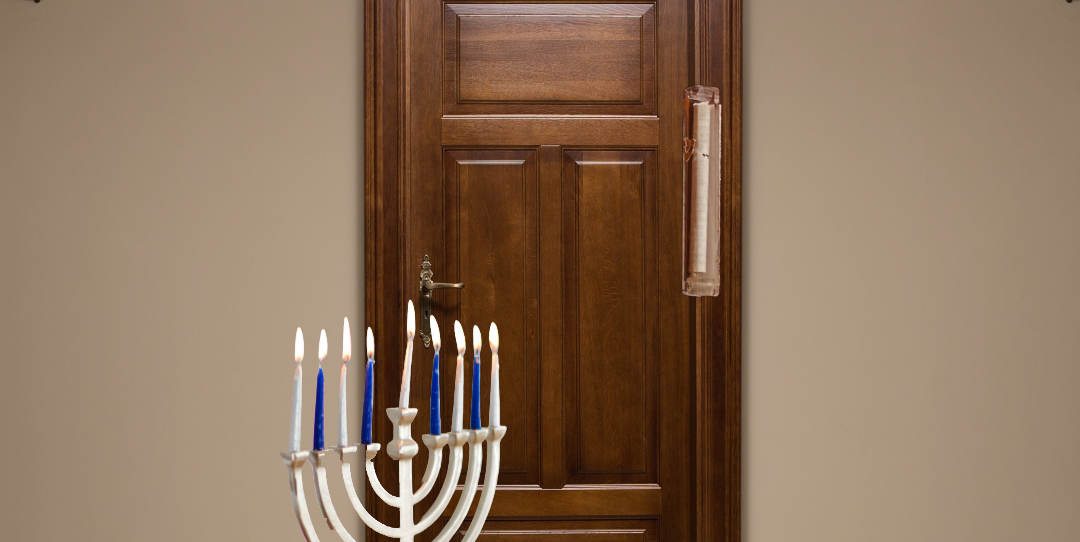
As discussed in another post, most living outside eretz yisroel light their menoros indoors.
Although chazal and the Shulchan Aruch rule that we should only light inside in times of danger, the Rema (672:2) states that the standard practice is to continue to light indoors.
Above, we shared numerous approaches to this issue, ending with the words of Rav Moshe Shternbuch (Moadim U’zmnaim, vol. 2, p. 79) who suggests that just because we live in peace now does not mean that we should forget or abandon the concerns of the past, and that they may, l”a, revisit us at some future time, l”a.
For obvious reasons, following the pogrom of October 7, 2023, his argument came to mind, and I repeated it in shul.
After, a young boy asked, “Shouldn’t we also now cover our mezuzos?”
Seeing the surprise on my face, he continued. “I understand that the obligation for a mezuzah is from the Torah, as opposed to Chanukah. But if the issue is sakana, why don’t we find chazal or poskim discussing covering or hiding it presence?”
Sadly, it has not been only little boys wondering this:
“Do Not Take Down Your Mezuzos!” yelled the headline in The New York Times op-ed page right after the October 7th attacks. The article went on to state how some non-religious Jews were indeed taking theirs down due to fear.
More positively, and on the other hand, reports have also been published of mezuzos being vandalized, R”l, causing a reaction to the other extreme: non-Jewish neighbors putting up (empty) mezuzos of their own! While potentially an issue of halacha, their intent is beautiful.
I explained to this boy that there is a deeper significance here: The story of Chanukah is about surviving the culture around us. In our days, such chinuch, such light, must begin in the home. As we shall see below, I am not alone in this idea.
Interestingly, Chanukah is in fact deeply rooted in the mitzvah of mezuzah.
First, contemporaneously, relating to this just this year and the current eis tzara: I’ve heard from a very prominent sofer sta”m how there is now a shortage of klaf due to the fact that many Palestinian Arabs would do the stretching for the klaf and, obviously, are not now available (a frum yid always begins the ibud process lishmah, and with the Gentile there to hear, for more details, see Shulchan Aruch, siman 32:8 and Mishneh Berurua sif kattan 30).
However, the connection to Chanukah and mezuzah runs far deeper.
The gemara states:
“Rabbah taught: ‘It is a mitzva to place one’s menorah within a tefach/handbreadth adjacent to the entrance.’ On which side does he place it? Rav Achah ben Rava said: ‘On the right;’ Rav Shmuel of Difti said: On the left. The halacha is to place it on the left, so that the menorah will be on the left and the mezuza on the right.” (shabbos 22a)
Chazal are teaching that by placing one’s menorah opposite one’s mezuzah he will thereby be surrounded by mitzvos. Chazal here teach that by placing one’s menorah opposite one’s mezuzah, he will thereby be surrounded by mitzvos.
Meseches sofrim expands on this:
“…The mezuzah should be on the right, and the ner chanukah to the left. Thereby fulfilling the verse (Shir HaShirim 7:7) ‘mah yafis u’mah y’amt…-how fair and how beautiful-. ‘Mah yafis’ -is mezuzah; ‘u’mah y’amt’ is ner Chanukah.” (Sofrim 20:5; cf. Shir HaShirim Rabbah, 7:1)
But why specifically mezuzah? What is its unique connection to Chanukah?
The Shem M’Shmuel (mikeitz) shares that the goal of the menorah is m’bifnim l’chutz-to take the kedusha created in our homes and bring it to the outside world. Whereas the goal of mezuzah is in the opposite direction – serving as our home’s most vital ‘filtering’ system, placed based on our way of entering our homes from the streets of life; our cue to first strain any-and-all tumah.
The Sefas Emes (Chanukahtrn’t; see Sefer HaChinuch #423) explains that mezuzah ought to remind us of Hashem’s Torah u’mitzvos. After the yevanim wished for us to ‘forget Your Torah,’ we, dafka, wait until people are found in the street (tichleh regel) when they will then bear witness to the ner Chanukah and mezuzah – our constant symbiotic tools to succor our combat against the potent pull of regilos and tevious (culture and conditioning).
As to connecting the leniency by danger in regard to Chanukah to that of mezuzah, the Shulchan Aruch shares that whoever is careful in mitzvas mezuzah will be protected for a long life; he and his family (yoreh deah, siman 285). In other words, there is a built-in structure of protection already. (Of course, and as the Aruch HaShulchan stresses, we do not keep this or any mitzvah due to any specified protection that it may bring, rather, and only, as a gezeira from Hashem.)
In fact, it is not just ner Chanukah that we place opposite our mezuzos.
Growing up, following sukkos, we would lean our lulavim on the left side of the doorway, opposite our mezuzah, until nissan when the dried lulavim fueled the burning of our chometz (see Rema, orach chaim, siman 664:9).
Our mezuzos are uniquely empowered to bring an abundance of steady stimulus and koach, and also have the power to accentuate the other mitzvos performed in our homes (see further, Shir HaShirim Rabbah, ibid.).
In fact, this is why we have the minhag to touch the mezuzah upon passing it. The Shulchan Aruch (see Rema, yoreh deah, siman 285:2) writes:
“Some say that when one leaves a house/doorway, he should place his hand on the mezuzah…as well as when he enters.”
One of the sources for this practice is the famous gemara (sanhedrin 11a), regarding the soldiers sent to bring Onkeles back to Rome (after his gerus). When they witnessed him touch his mezuzah, they asked for an explanation. Onkeles responded: “The way of the world is that a king of flesh and blood sits inside his palace while his servants stand guard outside; but with regard to Hashem, His servants sit inside their homes and He guards over them outside. As it is stated: ‘Hashem guards your going out and your coming in, now and always’ (tehillim 121:8).When kissing one’s mezuzah, it is brought, al pi kabbala, that one should use, specifically, his middle finger (‘amah’), kissing his finger after (Birkei Yosef, siman 285:2; see Taz, sif katan 5; see shu’t Rav Akiva Eiger 1:58 regarding touching the actual klaf).
It is recorded, amazingly, how the Chasam Sofer once revoked a semicha after witnessing the young musmuch consistently ignoring the mezuzah when entering and leaving rooms (Maamer Mordechai [2007] p. 494)!
May we, too, follow toras chazal and their guidelines in how to protect ourselves.
May we have a safe and growing Chanukah, as we await the menorah of bayis shlishi!
On Chanukah, unlike all other Yamim Tovim, there are no specific obligations throughout the day, such as matanos la’evyonim on Purim or a seudah on the Shalosh Regalim. There’s also no constant
mitzvah like dwelling in the sukkah or refraining from chametz and no issur melachah like on Shavuos.1
To this point, Rav Moshe Feinstein remarkably writes that outside the moment of lighting, one may not recite the berachah of Shehecheyanu during Chanukah because “these days of Chanukah have no greater kedushah than any day of the year…this, as opposed to, say, Yom Kippur, when we can say this berachah unconnected to a specific act because the day itself has special kedushah.”2It is therefore all the more peculiar that the one and only act unique to Chanukah—the lighting of the menorah—does not seem to be per- formed in the way initially designed. Let’s start at the beginning. The Gemara teaches:
The Chanukah menorah is to be positioned by one’s doorway from the outside. If one lives on an upper floor, he should place it in a window that is adjacent to the public domain. In times of danger, it should be placed on his table and that is enough.3
This is also precisely how the Shulchan Aruch records the halachah,4 indicating that when not in times of danger, like in, arguably, today’s America, one must light outside. However, later the Rama makes it clear that already in his days the standard practice was still to light indoors.5 This is largely the accepted practice, at least among Ashkenazim living outside of Eretz Yisrael.6
Most Gedolim and their adherents still follow or followed this practice of lighting indoors. Is this still due to danger? And if so, would someone living in, say, Lakewood, with only frum neighbors, still have this same allowance? I cannot think of many other clear halachos found in Chazal for which our practice seems to veer from its basic structure.
Even more confounding is that in every other element of this mitzvah, we perform it mehadrin min ha’mehadrin, adding one extra candle for each night instead of the basic one per night and having others in the house light in addition to the father.7 Moreover, Chanukah was always set apart with this precise unique quality in that its pirsumei nisa was to be done outside and in public, as opposed to the “inside” pirsum ha’neis of Purim done in shul.8 Why, then, would we agree to take this distinctivenessaway? The Brisker Rav, for example, was very careful to light outside, considering that to be an essential part of the mitzvah.9 In fact, if ever he had to light inside due to a concern, he would relight outside if that risk went away; in this, he saw the din comparable to mitzvas sukkah.
Rav Elyashiv, too, strongly opposed the idea that nowadays, in locations where it is safe, we must still light indoors. For, if this is no longer the halachah, “for whom was that clear law in the Shulchan Aruch written? Even the Rama does not comment at that place.”10 Nevertheless, most poskim do not seem to take this strict approach, with Rav Moshe Feinstein even stating that today “it is not possible to light outdoors.”11
Why should this still hold true? Some early Rishonim mention this minhag of not lighting outdoors, yet they often also urge one to at least light inside the doorframe of their home, facing the street.12 Nevertheless, the basic halachah allows one to simply light anywhere visible in their home—on a dining room table, for instance. Many approaches have been offered throughout the centuries to this question.
Already in the twelfth century, the minhag among many was to light indoors, causing the Ohr Zarua to wonder, being that there are no longer any dangers, why should we not light outside?13 And this was nine hundred years ago. While he does not provide an answer, a few decades later, the Sefer Ha’itur does, writing, “U’meiachar she’nahagu al hasakanah, nahagu.”14 Meaning, seemingly, that although there may no longer be a danger, once we accepted this practice of lighting indoors, we retained it.15
The words of the holy Baal Ha’itur are difficult to fathom. To give an extreme example to make the point, would we say that someone who worked at a truck stop as a teenager when he received an allowance not to wear his yarmulke due to safety concerns, still need not wear one twenty years later as a doctor on Madison Ave? Chalilah! Rav Yerucham Olshin offers a way to understand this Sefer Ha’itur based on how Rav Meir Soloveitchik would quote his father, the Brisker Rav: “Once our leaders were mesaken a new din of lighting indoors due to danger, this new takanah stands even when its reason ceases to exist!”16
The Rama’s statement was based on the view of Rabbeinu Yerucham, who explained that the reason we light indoors is not just due to a physical sakanah but a monetary one as well, as thieves may steal one’s menorah.17 This concern would certainly still stand today. However, this reasoning would lead to an obvious question: Who said one must light with an expensive menorah? If indeed this is the reason for our present-day minhag, why not then light with Coke bottles (cleaned and stripped) so as to perform this mitzvah in its proper location?
One may be tempted to suggest that the Rama in Darkei Moshe was concerned for the view of the Raavad who posits that hiddur mitzvah (i.e., using a silver menorah) is a Torah law,18 which would then, indeed, require one to light indoors with a nice menorah instead of outside with a makeshift menorah. This is because the Torah law of beautification eclipses the Rabbinic placement of the menorah. However, this would be a stretch, for the very mitzvah one is beautifying is a Rabbinic one, so how could the commandment to beautify it be Biblical?19
Many others give a more technical approach to our still lighting indoors. While a sakanah may no longer exist, most Jews moved to northern countries where the weather during Chanukah is cold, windy, and wet. The Ritva quotes his rebbi as telling him that if it is windyoutside, one should light indoors;20 and the Ritva extends this to many other weather-based concerns.
Rav Amram Gaon states the same. This would explain why many of those outside Israel, who indeed light outdoors, purchase special glass containers to protect their lights from the elements. The reader should, however, note that not all poskim allow for such encasements.21
The Shu”t Imrei Noam22 finds an answer to our question from Chanukah’s original source: Megillas Taanis, a sefer written by the Tanna Rabbi Chananyah ben Chizkiyah, delineating more than thirty special dates and events we are to celebrate.23
Amazingly, it states there: “Should one fear from leitzim [ridiculers], then one may light by the door inside one’s home.” Meaning, aside from the issue of sakanah, wind, and robbers, there is another concern: scoffers.
From the B’nei Yissaschar,24 it would seem that these leitzim were cynical Jews who would challenge the propriety of either a public display of love for Hashem and for His Torah or, perhaps, our very fight against the Hellenistic forces. And so we light indoors. This is quite different from a concern for other nations.25
Rav Moshe Sternbuch offers another powerful approach: The fact that there have been times, like today, when we live in relative peace does not mean that we should abandon the protections needed by others today (e.g., Iran) or that we may need at some future time, lo alenu.26 He cites a number of proofs to such halachic thinking, and also reminds the reader of Rav Yisrael Salanter who, during a cholera outbreak on Yom Kippur, urged everyone to eat so that those sick would then certainly eat some- thing. We see from here that sometimes we all must sacrifice halachah’s
“best practices” so that it can be preserved for everyone’s future. For example, the Chanukah following the pogrom of Simchas Torah 5784, I was asked by many people if they may light on their kitchen table instead of by the window. In galus, we should never act with certainty.
A final approach is one that I have often suggested. In preparation for this chapter, I was delighted to discover that Rav Yeruchum Olshin suggests something similar.27, 28
This approach requires some brief context. Rashi gives an example of what Chazal mean by a sakanah that allows or forces our lighting indoors: when the Persians did not allow anyone to light candles outside the Persian batei avodah zarah. The Bach expresses amazement at this example. That decree applied equally to non-Jews, so it could not have been describing a time of shmad (when Jews must risk their lives for any mitzvah or social value). How, then, can this be Rashi’s paradigm case? For such a severe situation, we would be halachically dissuaded from even lighting indoors.
This Rashi also seems redundant. Do we even need an example of “a danger”? Why does Rashi feel he needs to share an example for some-
thing that we can all sense? I would therefore suggest that this Rashi is seeking to provide us with something far deeper than a simple example. Chazal share that following the Churban Bayis Sheini, we nullified the celebratory days found in Megillas Taanis, as we can’t be celebrating every other week while mourning our exile.
To this, the Gemara asks a stunning question: Why, then, do we still celebrate Chanukah? After all, Chanukah’s origin is found in this same text. The Gemara offers only one reason for keeping only Chanukah out of all the holidays in Megillas Taanis: the people have accepted Chanukah and its mitzvos.29
Perhaps what the Gemara is suggesting is that along with remembering the neis of Chanukah during these days, we also recall the affection and sacrifice that Klal Yisrael had for this mitzvah. And, for this same reason, we light even when in danger, albeit indoors. Rav Olshin takes this idea even further: Because the menorah represents the light of Torah (which is perhaps why the klal did not wish to forgo these days), we are obligatedto risk our lives for it. All of this would explain why Rashi chose Persian times as the example of sakanah rather than examples from the times of the Gemara or in his own lifetime, for example, the Crusades of 1096 that he composed Selichos for. Our still lighting the menorah indoors today is a surreptitious memorial of such “indoor lighting sacrifice” in times of historic danger. We are also commemorating lighting the Chanukah candles indoors in times of danger, even though that original sakanah allows us to forfeit lighting completely.
Our present lighting indoors represents not a leniency but a great act of stringency. Thus, our retaining the minhag of lighting indoors is not simply to avoid a danger that no longer exists; on the contrary, it is to recall such mesirus nefesh for this mitzvah in times of danger, when we lit inside even though we didn’t have to light at all.
The Gemara states that because Jews have always risked their lives for milah, it will always be observed.30 Indeed, even today, the not-yet-frum, as well as the frum, largely perform brissim. Perhaps the similar sacrifice for our past Chanukah lighting in times of danger (even if indoors) is why Chanukah, too, is kept by so many of the non-observant today.31 According to Pew Research, while 56 percent of all American Jews own a Seder plate, 81 percent own a menorah!32
The Minchas Elazar mentions that the B’nei Yissaschar had a glass encase- ment ready for when Mashiach will come and he can again light outside.33
May we see that day soon.
NOTES
Note that even on Purim, in addition to its many other obligations, they initially wished to restrict all melachah; see Megillah 5b.
Igros Moshe, Orach Chaim 5:43:2, confirmed firsthand with the original handwritten letter to Rav Levovitz, with whom I spoke. We should note that with this p’sak, Rav Moshe acknowledges that he disagrees with the Chafetz Chaim as recorded in Shaar Hatzion, siman 676:3. We should also point out that the Meiri to Shabbos 23b would seem to support the Chafetz Chaim. Meiri there records a view that if someone is without the ability to light a menorah, he may still make the She’asah Nissim and Shehecheyanu berachos during the days of Chanukah. Some readers may assume that having a Rishon say this would mean that Rav Moshe, had he been aware, would have acquiesced in his position. However, this is not so simple to suggest. For one, Meiri is simply recording what others have said, and perhaps even he disagreed. Second, just because one Rishon takes a view does not mean that other Rishonim would have consented. But number three is most crucial: Rav Moshe, in a separate teshuvah (coincidentally, also about something found in a newly discovered Meiri), makes clear that newly published Rishonim must be carefully considered before utilizing them for actual p’sak halachah. This is not due to these specific Rishonim themselves, of course, but rather to the lack of critical study of these manuscripts over generations, as well as uncertainty as to who the many copyists were for all these years.
Shabbos 21b.
Siman 671:5.
Siman 672:2. On the oddity of the Rama waiting until here to make this comment and his initial silence, see Rav Elyashiv, below.
Cf. Rav Ovadia Yosef in Chazon Ovadia, Chanukah, p. 37.
See Shabbos 21b.
See D’rashos Chasam Sofer, 5592, Chanukah; see also Rav Soloveitchik, as brought in V’DibartaBam, Chanukah, p. 113; Inside Chanukah, pp. 190–91.
See Kuntres Chanukah U’Purim 3:3; Yerech L’Moadim p. 107; see, however, his views as brought by others below.
Shu”t Kovetz Teshuvos 1:67, pp. 98–101.
Igros Moshe, Orach Chaim, 4:125.
The significance of a doorframe will be discussed below, in the chapter titled “Are Our Mezuzahs Kosher?,” page 134.
Ohr Zaruah 133:2.
Sefer Ha’itur, Aseres Hadibros, Chanukah 114:2.
See also Shu”t Minchas Yitzchak 6:67.
Kovetz Shulchan Melachim, Kislev, 5766; see Yerech L’Moadim, p. 112.
See Darkei Moshe, siman 671:9.
See Chidushei Anshei Shem to Berachos 38a.
See, however, Orech L’Neir to the first Mishnah in Makkos; see also Shabbos 23a that lighting neir Chanukah is a fulfillment of the verse “lo sassur,” which may mean that while the lighting is Rabbinic in nature, its beautification can still be a Biblical fulfillment.
Shabbos 21b.
See, e.g., Aruch Hashulchan 671:24 as well as Moadim U’Zemanim, vol. 2, siman 140, n. 1; Cf. Shu”t Yaavetz 149, who allows, although does not urge, such encasements.
Shu”t Imrei Noam 2:22.
This sefer will be discussed at length in the chapters that begin on pages 50, 82, and 106.
As brought in a footnote to Piskei Teshuvos, siman 671.
This is not a concern of the past. Indeed, one of the most celebrated public intellectuals of the twentieth century, Christopher Hitchens (who was a Jew who found out about his Jewish background at the age of forty, when his mother was lying on her deathbed), once horribly wrote against, of all holidays, Chanukah, based on this very cynical outlook of fighting the Hellenists: Jewish orthodoxy possesses the interesting feature of naming and combating the idea of the apikoros or “Epicurean”—the intellectual renegade who prefers Athens to Jerusalem and the schools of philosophy to the grim old routines of the Torah…the Greek or Epicurean style had begun to gain immense ground among the Jews of Syria and Palestine. The Seleucid Empire, an inheritance of Alexander the Great—Alexander still being a popular name among Jews—had weaned many people away from the sacrifices, the circumcisions, the belief in a special relation- ship with G-d…I quote (from a contemporary rabbi), “Along with Greek science and military prowess came a whole culture that celebrated beauty both in art and in the human body, presented the world with the triumph of rational thought in the works of Plato and Aristotle, and rejoiced in the complexities of life presented in the theater of Aeschylus, Euripides, and Aristophanes.” But away with all that. Let us instead celebrate the Maccabean peasants who wanted to destroy Hellenism and restore what they actually call “old-time religion.” Thus, to celebrate Hanukkah is to celebrate the triumph of tribal Jewish backwardness. A celebrated atheist, Mr. Hitchens would often debate faith and challenge his interlocutors, asking what possible virtue would be lost without religion or what could be gained with it that would not already be obvious to him. Aside from the false premise of this question—as his present morals were so obviously relying on the remnants of religious culture from whose crumbs America and the Magna Carta were formed—the above paragraph regarding Chanukah best displays the nakedness of his challenge. I refer to the bias of seeing inherent honor in the “new” versus the old, of allowing the nebulous winds of time and the capriciousness behind how “the vogue” takes hold and the arbitrary nature of who is given the power to introduce it, and the mysterious sociological quirks behind which fashions capture a time or place. Absent the safety net of a moral identity, to be untethered to a constitution, is precisely what leads to his article—of judging virtue on modern dress rather than thoughtful design, believing righteousness is found in the avant-garde rather than antiquity, and in the assumption that the peasantry must be as poor on the inside as they are on the outside. All this is anathema to Yiddishkeit. Yet, its pull becomes alluring to those unmoored from it. Truth is neither “old time” or “new”; it is unaffected by “tribal” acceptance or “tribal” neglect. Virtue is unbothered by new styles or last year’s fashion. Rather, truth is and will always remain simply that: truth. Judged not by time, unchanged by those who fail to embrace its legitimacy, it endures unperturbed by physical phenomena and social cues. Emes is emes.
Moadim U’Zemanim, vol. 2, siman 140, p. 79.
Ibid., p. 543.
We will quote his words below.
As explained by Rashi ad loc.
Shabbos 130a.
See chapter below, “Why Is There No Yom Tov Sheni on Chanukah Outside of Israel,” where the Pri Chadash draws an additional milah-Chanukah connection.
Pew Research Center, “Jewish Americans in 2020,” May 11, 2021, https://www.pewresearch. org/religion/2021/05/11/jewish-americans-in-2020/.
The act of purchasing mezuzos or tefillin (“sta”m”) can sometimes seem time consuming, expensive and confusing. However, as a recent controversy demonstrates, it is much worse: it is an act strewn with landmines.
Unlike our careful purchase of food—which comes with kosher certification, thus giving the consumer real agency over what he chooses to eat—how does one even begin to know who wrote the mezuzos and other sta”m he buys, and with what method?
Several weeks ago, a socher (seller and middleman) of sta”m was on his way to America with merchandise to sell to American middlemen and sofrim. Such socherim will often book these flights in advance in the expectation that they will have an adequate supply of items to make the business trip worthwhile.
As the date of his flight inched closer, this socher recognized that he was still a little short of goods. He needed about 50 more ksav Arizal mezuzos to better assure a fruitful trip.
On an email group for sta”m brokers, middlemen and “shadchanim,” someone shared with this anxious American-bound socher that he could supply him with what he needed, adding that he had seen the ksav of these mezuzos and it was magnificent. Even better, although a reliable mezuzah retails for about $200, these were somehow 10% cheaper and could be had for around $180 apiece. This “shadchan” was able to deliver these mezuzos to the socher just as he was making his way to his flight through Ben-Gurion Airport!
Upon arrival in the US, one of his first stops was in Williamsburg, where he displayed the items he had brought to sell, but first, and wisely, brought the precious sechorah to Rabbi Shimon Zeide, an accomplished and experienced sofer, to be checked.
Rabbi Shmiel Aharon Traube, the owner ofBeis Hastam in Boro Park, fills in the details of the events that followed.
“Rav Zeide right away spotted that something was wrong,” Rabbi Traube said. “These mezuzos looked too similar to each other; too uniform.” In other words, they seemed as if they had been printed rather than written. He contacted Rav Avraham Tzvi Wosner, the acting rabbi and bochen of the Vaad Mishmeres Stam, and also sent out copies to some fellow sofrim and talmidim of the Vaad Mishmeres Stam.
As will be explained in the course of this article, unless one purchases directly from the sofer, trying to figure who wrote any mezuzah or other sta”m is an extremely painstaking process. To borrow a term from law enforcement, it is unfortunate that a “universal chain of custody” doesn’t (yet) exit for sta”m before it reaches your Judaica shop.
After establishing that these mezuzos had passed through four to five hands before their arrival in America, it was finally confirmed from whom they were first purchased. The “sofer”had been found!
As Rabbi Traube shared, “Rav Shimon Zeide called this man him up and said, ‘Why are you selling some type of printed mezuzos?’ The man responded, ‘They’re not printed. I have a new method of writing mezuzos so that they all come out the same.’” Rabbi Zeide wanted to know how he could be sure that this new method was kosher. He didn’t receive a satisfactory answer. It was later revealed that this man was not a sofer at all (rather, he hired others to produce mezuzos using his new method); henceforth, we will refer to this person as the “innovator.” In response to this phone call from Rabbi Zeide, the innovator sent out a letter written by the renowned dayan Rav Seriel Rosenberg, the av beis din Rav Nissim Karelitz’s beis din in Bnei Brak, dated Motzaei Shabbos Parshas Vayeira 5783 stating that this writing, as described, would be considered kesivah.
But the sofrim investigating these mezuzos still had doubts, and after examining them closely made a startling discovery: They looked as if they had been written using a stencil!
Rabbi Traube then headed to Eretz Yisrael, bringing some of these questionable mezuzos along with him, and went to talk to the innovator himself. “I went to his house, and he wouldn’t let me in,” he recalled. “But he did come outside, and we spoke for about a half-hour.” During this conversation, the man refused to explain what his exact method of writing was.
However, two weeks later, and after much confusion among sofrim, Rav Rosenberg wrote a second letter (dated the first day of Rosh Chodesh Kislev 5783)explaining that his first letter wasn’t intended to confer approval of any mezuzos; it merely commented on the method that had been described to him by this fellow. In fact, as this second letter concluded, he had subsequently learned of the possibility that the innovator wasn’t telling him the whole truth.
Five days later, Rav Rosenberg’s son-in-law, Rav Posen of Ramat David, wrote a letter clarifying that both letters were in response to information his father-in-law had been given by this innovator. He reiterates that no hashagachah was ever given nor implied, nor was there any way of knowing how these particular mezuzos were even created—only that some type of stenciling method was used.
In the interim, Rav Brach of Bnei Brak, a Satmar rav who is known to be an expert in sta”m, had issued his own letter stating in no uncertain terms that these mezuzos should be considered passul, quoting the Shevet Halevi(Rav Wosner) who paskened that any form of stenciling or silk screening is invalid.
Rav Brach then shared that after forcing a meeting with this innovator (which took much prodding), he could now assert that while this person was claiming that a kolmus (quill) is used, the mezuzos he had put on the market were actually created with a brush! This was no different from a previous controversy some 20 years earlier that had ended with all major poskim forbidding that practice. (In a letter written to Rav Posen dated 13 Kislev 5783, Rav Brach detailed his interactions with this innovator and explained why such mezuzos were passul.)
While all of this was happening, mezuzos from this innovator were being sold in Flatbush! And the ambiguous letter from the beis din—which in fact cast doubt on his method—was being used to show Judaica shops that his mezuzos were fine!
In the meantime, the American sofrim, especially Rav Leizerson in Lakewood, continued to investigate and share vital information with Rav Rosenberg and his beis din.
The fact that Rav Zeide was the person who first opened these mezuzos was very fortunate, as what he discovered might not have been otherwise discerned. In fact, when they were shown to a number of extremely well-regarded sofrim, they all said that they would have never been suspicious.
(See Next Page For Some Selected Images Of The Recent Letters Thus Far Mentioned)
The basic idea is similar to the children’s arts and crafts projects we all enjoyed when we were young. For kids, however, the letters or pictures are cut out of a hard substance like plastic, which is then placed on a piece of paper and filled in. Classic silkscreen printing is different. It requires the use of a taut material that can be perfectly aligned with the paper so the words will be clear when the ink is applied.
A couple of decades ago, someone developed a quicker and cheaper way to use this method to write sifrei Torah. As you can imagine, this caused quite an uproar. It worked as follows:
The sofer would lay a sheet over the klaf. This sheet had “windows” cut out to form each letter. (Indecently, the letters were shaped by a computer.) Ink was then poured onto the sheet, squeegeed down, the sheet was removed—and voila! Absolutely beautiful kesivah! An entire column of Torah could be created literally in seconds!
The response from the gedolei haposkim was unanimous, unequivocal and harsh. Among others, Rav Elyashiv, Rav Ovadia Yosef, Rav Nissin Karelitz and Rav Scheinberg all expressed astonishment that such a process was being used. (Unfortunately, by the time it was discovered, many sta”m items created that way were already on the market.) Rav Elyashiv wrote that not only were those who used such methods wrong to do, but even those who sold them were “machti es harabbim”(causing the public to sin).
New But Different?
The “innovator,” however, insisted that his method was different from the technique described above, thereby—in his opinion—eliminating the concerns of the poskim. Instead of the poured ink/squeegee process, the sofer used his own quill to fill in the windows.
Would this make a difference in the halachah? Let us examine some but not all the issues raised 20 years ago and see if they can be applied here:
Chazal explain that safrus must be written and not spilled (Yerushalmi, Shabbos 4; Gittin 2-3). Regular silk screening seems to be in direct violation of this requirement.
We are required to verbally sanctify each of Hashem’s names as they are being written (Orach Chaimsiman 32:19 and Yoreh Dei’ahsiman 276:2). Classic silk screening would not seem to allow for this.
The issue of dyo, the ink that is used for sta”m, is well beyond the scope of this article. But there would seem to be a need for special ink when utilizing such a process.
The obligation for sirtut (etched lines)may become compromised, as according to some poskim, such perfect “writing” would remove the prerequisite for sirtut, which we cannot do (Rav Moshe Feinstein).
Interestingly, the Chasam Sofer writes that if a sofer utilizes the power of nistar to suddenly be able to write with his less dominant hand, this would not be considered natural and hence kosher kesav (shu”t Chasam Sofer 6:29)!
In centuries past, the poskim issued similar concerns when it came to writing sta”m with a printing press (see shu”t Zereh Emes, Yoreh Dei’ah, 117, et al).
But there is yet another, and perhaps most serious, concern with standard silk screening. This relates to the issue of “chak tochos” (scraping and erasing). There is a clear halachah that letters in safrus must be formed through addition and not subtraction. In other words, one cannot scrape ink away, thereby leaving behind the shape of a letter.
This halachah has far-reaching implications. For example, if a blob of ink drips from a sofer’s quill and makes a splotch on a letter, he isn’t allowed to scrape it away to reveal the letter underneath (Gittin 20a; Orach Chaim siman 32:17). Many rishonim explain that the reason is that in such a scenario, the letters wouldn’t be formed by “regular” writing. (See Meiri in Kiryas Sefer, maamar 2; Rashi on Gittin ad loc and Tosfos on Sanhedrin 21b.)
Would these concerns extend to filling in a stencil with a kulmos?
(A Sofer Demonstrating What This Innovation May/Would Look Like)
Even if one could prove that these mezuzos are being written the way the innovator claims – and so far, this seems doubtful to me and almost everyone involved; some assert that he is really using a brush, either in the initial creation of the letters, or, after using his quill, and so as to fill in any gaps and to make it more clear – the question he posed to Rav Rosenberg was only about the kesivah. There are still many other matters involved.
What about the sirtut (these are the etched lines that all sta”m must have)? Using the above method would easily—and almost always—lead to sirtut misaligned with the kesivah, a potentially very serious issue! And what about the dyo/ink? The ink used for the process he described would most likely need to be different, for reasons beyond our scope.
There are many additional problems with such mezuzos, such as how the final mem and samech could possibly be made al pi halachah with such a stencil (think about a children’s stencil, in which the letter “O” or the number “0” is divided into parts), or the fact that Shulchan Aruch Harav (siman 32:32) requires that the sofer have kavanah while forming the letters (no “spacing out” or writing by rote).
However, all the above is just the halacha.
In order to truly understand why so many dismissed this innovation out-of-hand, irrespective of the halachic shailos involved, we must now shine a spotlight on the contemporary world of sta”m.
Statistics
While there are many amazing sofrim in our midst, there are also some whose work is less than stellar. And then there are those who have no business writing at all. Concerns relating to sta”m are not unique to our generation.The Chasam Sofer lamented the state of sta”m in his day as well (shu”t 205). Here are some examples of gedolim throughout the ages expressing similar frustration:
The Rivash (d. 1408) writes, “What can we do about those sofrim who aren’t proficient and forsake halachah for their own benefit” (shu”t Rivash146).
The Radvaz (d. 1573) testifies that he once checked 300 pairs of tefillin and they were all passul (shu”t Radvaz 8:6)
The Devar Shmuel (d. 1694) complains that most people look for cheaper prices and that almost all such tefillin are likely passul (Sefer Zichronos 9:3)
The Levush (d. 1612) blames all the above on those who write sta”m who either don’t know what they are doing or are simply looking to make money: “Asidin litein es hadin ulekabel onshum harbeh me’od—Hashem is going to punish them very harshly” (Levush, siman 32:20).
The Sho’eil Umeishiv (d. 1875) writes that “many of those who call themselves sofrim in our day have no clue about hilchos sta”m” (in his haskamah to Keses Hasofer).
Rav Chaim Palagi (d. 1858) once passuled every single sefer Torah in Izmir (shu”t Lev Chaim, Orach Chaim 174). He also writes, “The length of this galus is aided and abetted by the fact that so many people aren’t curious consumers and end up wearing tefillin that are passul, created by sofrim who aren’t proficient (Tenufah Chaimsiman 432)
The Ben Ish Chai (d. 1909) once passuled all the retzuos tefillin in Bagdad! And his grandfather once passuled everyone’s tefillin (Rav Pealim, Orach Chaim 4:2)
The Chasam Sofer writes that that people who believe all those who write our tefillin are knowledgeable about sta”m “lo hayah v’lo nivra”(no such thing is even remotely true)! In fact, some are public stumbling blocks! (Likkutei Shu”t Chasam Sofer 83)
The Aruch Hashulchan writes, “In our generation, those who think they can write sta”m have increased like locusts. There is one city with hundreds of ‘sofrim,’ but the majority lack yiras shamayim”(Yoreh Dei’ah 182:9).
More recently, the Klausenberger Rebbe (shu”t Divrei Yatziv, Orach Chaim 38:2) and Rav Moshe Feisntein (his haskamah to Yalkut Tzuras Ha’osios) bemoan the fact that people are purchasing sta”m with zero information as to who wrote them. In many cases, and certainly if the writer isn’t knowledgeable enough, one can almost guarantee that they are all passul. Amazingly, the Rebbewrites that until he commissioned a new sefer Torah, he challenged those in his own beis midresh to find even a single kosher sefer Torah among the ten in the aron! (B’veis Yatziv, p.130).
This list is incomplete (see Sefer Sta”m, p. 303-317 for even more historical sources).
Several years ago, Rav Eli Gutnick, a renowned sofer in Australia, published some statistics that would stop any ben Torah cold:
Only about 20% of sofrim have a ksav kabbalah and are frum (Rav Gutnick contacted me to explain that this term means that they, e.g. “…dress in heimishe levushim, are serious about learning Torah, aren’t known to be batlanim, etc”. It would also include a Lakewood or YU musmuch who may not have ‘levush’ yet who went on to receive a real ksav hakaballa, and who is known to be a serious Jew)
An additional 15% are frum but lack a ksav kabbalah.(This is like semichah, butfor safrus.) Without a ksav kabbalah, it is impossible to ascertain if the sofer is even aware of the myriad halachos of sta”m or is up to date about the latest concerns. Numerous knowledgeable sofrim have told me that any sta”m from such individuals should be assumed to be passul.
This poll (while using the best methods available was still, admittedly, unscientific) was taken in 2014. Rabbi Gutnick now admits that the number of sofrim with ksav kaballah is even lower, and that these days the majority of even heimishe and bnei Torah sofrimdo not have one. All in all, only 35% of sta”m is being written by sofrim who those who frumJews of any background would label as bnei Torah! This begs the obvious question: Who is writing the rest?
A full 50% (!) are not proficient in any way, and would run the gamut of character and observance. There are many “shababnikim”—yeshivah dropouts in need of parnasah who can now exploit their background to make money. While some of these are still frum, many are unfortunatelynot.
It gets worse; much worse.
Fifteen percent of the people who are creating mezuzos, etc., are Arabs, Chinese or women. Some sta”m in this category are printed.
Of late, there have been several Chinese sta”m “companies” whose skilled laborers can produce some pretty realistic sta”m. When I shared this with a ben Torah friend, his sincere but naïve response was, “I didn’t know there were so many Yidden in China!”! There are also clubs in Israeli universities where Arab students learn to write mezuzos in their spare time to make some money on the side.
What all of this means is that one has the same statistical odds of purchasing sta”m from a ben Torah with true shimush or a ‘degree’ of some type in this field as he does from an Arab or Chinese person!
It should go without saying that none of this information is meant to disparage the many real sofrim, as they have zero control over what an Arab or a non-shomer Shabbos Jew or am haaretz does. Rather, this information is meant as a warning to consumers as to what’s floating around out there and how dire the situation is.
One simply needs to make a cheshbon of how many sofrim he knows or live in his community. Then consider how many shuls there are in the neighborhood, each one with at least five sifrei Torah (of course, some scrolls will be older ones not included in the above statistic). Then continue adding up the number of mezuzos in each house, plus the tefillin and megillos. As one renowned sofer expressed, “Even with the knowledge that the vast majority of sofrim are in Eretz Yisrael, the numbers still don’t add up!” The gedolim are aware of this, and many ideas have been suggested to bring safrus under some type of control.
The reader is likely thinking, “This is all very unfortunate. But I live in city X, with a nice-sized frum population. This doesn’t affect me.” Perhaps. Or perhaps not.
Many Judaica shops operate through brokers, and while these stores are run by honest people who are sincerely G-d-fearing, some have no idea—or even any way of knowing—who wrote the sta”m items that they are selling. In fact, these items often pass through multiple hands before arriving in America, let alone a particular store.
The savvy consumer should therefore always ask, “May I have in writing that whoever wrote these has a ksav kabbalah in sta”m?” This would be a good start, as it is my strong contention that the consumer holds the key to change. Only after a demand is created would the many improvements planned have a chance of implementing some type of reliable ‘chain of custody’.
Organizations such as Vaad Mishmeres Stam(and its sister organization in Eretz Yisrael) have worked closely with both Litvish and Chasidish poskim and sofrim for decades to secure reliable sta”m for people. Although the monitoring and even certification of the raw materials in factory-like settings (retzuos, klaf and battim) is being done by the Eidah HaChareidis and others, they have no control over private sofrim who do the actual writing—again, many of them tzaddikim and geonim who produce stellar work.
In truth, relying on the fact that there are hundreds of reliable sofrim when there are so many more who are not is like saying, “I will eat in any restaurant that claims to be kosher without certification, because there are lots of reliable people who wouldn’t serve treif”!
A Plan for the Future?
Several years ago, in Buffalo, a man started coming to shul every morning for Shacharis. His tefillin were very small, often a sign of problems (this is also true of small mezuzos). I asked him if I could borrow the pair. Well, it turned out that the battim were made out of plastic (!) and the writing inside was a photocopy (!) of a handwritten (!) Shema in regular Israeli script (!)—and all on regular paper!
(He purchased these in his temple’s Judaica shop)
When I showed this to him, he was flabbergasted. His response expressed the naivete that exists among even shomrei Torah. “What kind of Jew would do such a thing?” I looked up from his “tefillin” and said, “Who said anything about a Jew?”
A well-regarded rav and maggid shiur in Queens recently shared that a talmid told him that one boy in his Israeli yeshivah was found to have comic strips in their battim!
I am often asked by parents where they should purchase tefillin for their sons. I fear giving them an honest answer. Naturally, they will compare the price to what their friends are paying (less than half) and either ignore my advice, or I will be in a position where I am compelled to share things that could cause a serious balagan. When I try to be frank, they often think I’m exaggerating, and who could blame them? Everyone else gets tefillin from this-or-that place! How could the Rabbi be right, they understandably wonder, when a pair of mehudar tefillin can be found for about $400?
A renowned sofer recently shared, “The problem is not that rabbanim refuse to wisely suggest that people purchase sta”m only from reputable places – rabbanim indeed do recommend this. Rather, the issue is that everyone believes that their source is reputable!”
Compounding the problem, some consumers are afraid to ask questions. A purchaser may feel that they are not proficient enough to make inquiries or to even comprehend the answers. But this is an error. A simple request of a guarantee that the sofer has kabbala is a straight, fair, and critical question. Any sofer or seller who gets anxious when asked about the sofer, his shimush, methods, or to whom they bring their own shailos is suspect…perhaps, now, of their own material.
Not long ago, a sofer in Lakewood told me that someone—a benTorah, mind you—brought him 50 mezuzos to help roll and insert in expensive cases for his new, large, house. “Did you get these checked?” the sofer asked.
The balebus gave him the name of the “magiah” who had checked them. The sofer, knowing he would be ignored if he shared that this person’s certification was meaningless, replied instead, “I will help you. But just to be clear, I will not be checking the kashrus at all.” Well, lo and behold, one of the mezuzos slipped open. The sofer immediately saw more than a few things that would render it passul!
Many people also don’t realize that being a sofer anda magiah require two different skill sets, necessitating different studies and bechinos. Not every magiah has shimush or a ksav kabbalah in safrus, and not every sofer knows how to check the work of others.
Is there any hope to rectify these pirztos (breaches) in the future?
B’chasdei Hashem, after many years of leadership by amazing experts who have since passed on or retired, Rav Avraham Tzvi Wosner in Monsey is taking charge of the Vaad Mishmeres Stam in America, with Rabbi Moshe Shaul Klein in Bnei Brak in charge of Eretz Yisrael. Many ideas are in the works to help strengthen this most sacred of mitzvos. Right now, the Israeli branch is in the midst of a massive campaign to get sofrim to either learn or review these halachos so they can receive a ksav kabbalah. Close to 1,000 sofrim have already taken the bechinos this past year, and equally important, renewed their ksav kabbalah.
Similar programs are now being developed in America as well. Rav Wosner in Monsey and Rav Yosef Fund in Lakewood are currently teaching, testing and certifying sofrim and magihim, thereby securing our future.
Some people have urged a system whereby every mezuzah, pair of tefillin or sefer Torah come with a hologramed hashgachah. Another idea is that each item of sta”m have a QR code (or an ID number, for those without Internet). This would then lead the consumer to a page or voicemail that would reveal all pertinent information about the item, including the names of the sofer and magiah, the type of klaf, etc.
Alas, without a robust demand from consumers, such plans are but a pipedream and could never come to fruition.
For now, at the very minimum, rabbanim should instruct their mispallelim to only purchase items for which they are given either the name of the sofer or an assurance of a ksav kabbalah. Such requests alone will cause an awesome ripple effect. This would be a good launchpad off which our leaders could work.
Painfully, even if all the above would be somehow resolved, this would not disentangle the entire issue. Even should all the sta”m on the market be certified, there would still be another hurdle to surmount.
Minhagim and Shittos
Let us for a moment put aside the frightening information shared above. In addition to the arduous challenge of making sure that a reliable sofer wrote one’s sta”m, there are other concerns of which the purchaser needs to be aware.
There are hundreds of shittos, chumros, kulos and minhagim when it comes to writing sta”m. Once we are already so far removed from knowing who wrote our sta”m or made our battim, how would someone even begin to know the standards and methods by which they were produced? And even if we could fix the real reliability concerns, the consumer is often unaware that there are certain shittos that should be avoided by “his” mesorah, even if they are perfectly kosher for someone else.
For example, a sofer told me that a certain oocher sta”m was recently called out for selling battim to Ashkenazim that were made in a way that is clearly not kosher according to how Ashkenazim have paskened for centuries (relating to how the shin on the shel rosh is made)!
Allow me to bring the interested reader a little deeper into the world of shittos so as to better appreciate their complexity.
There’s a famous written exchange between the Lubavitcher Rebbe and Rav Moshe Feinstein. In Rav Moshe’s lengthy response (Orach Chaim 4:9) he shares that although his minhag is to wear Rabbeinu Tam tefillin, he reluctantly had to stop and has had hard time commissioning a new pair in America, as they are often written by sofrim who follow their reading of the Shulchan Aruch Harav’s opinion, which differs from how Rav Moshe understood his psak.
The issue Rav Moshe was referring to is the complicated and much-debated subject of how to write the parshiyos of tefillin (i.e. setumos).
This machlokos is unresolved, leading to the following reality:
Most Sefardim follow the view of the Shulchan Aruch (Orach Chaim siman 32:36), while most Ashkenazim follow the Taz(ad loc. se’if kattan 26). There are still other Ashkenazim who follow a divergent way of reading this same Taz, e.g., chasidei Belz and Bobov; see also Igros Moshe, ibid. #12. Minhag Chabad follows the Kuntres Acharon based on the words of the Baal Hatanya.
The objective in sharing the above is not, chalilah, to convince anyone to abandon his minhagim in exchange for what Rav Moshe argued. Rather, the intent is to demonstrate that even amongst the greatest poskim there are many differing and even opposing views. And even after a sofer assures a customer that those concerns are met, there are also issues relating to the type of klaf, kesivah, ink, battim, etc.
Another consideration has to do with geographical areas. Some people may think that in Lakewood or Williamsburg, all of the tefillin being sold will naturally follow shittah X. This is not necessarily the case.
When my father-in-law headed the Kashruth Council of Canada (the COR), based on a teshuvah he received from Rav Shlomo Miller, he wouldn’t allow Diet Coke to be certified for Pesach due to an ingredient that is derived from kitniyos, namely aspartame. Instead, the COR gave the Pesach rights to that product to the Sephardic rabbanim in Canada.
Fair enough. But as odd as this may sound, some Torontonians asked their guests coming from the United States for Yom Tov to bring them Diet Coke that had an OU! True, Rav Belsky disagreed with Rav Shlomo Miller, and ruled for the OU that this type of kitniyosshenishtanah, meaning that it has been modified and manipulated to the point of being a new molecule, is of no concern on Pesach. But there was absolutely no difference between the Canadian Diet Coke and the American Diet Coke! Why not buy the Sefardi one in Canada for less trouble?!
The correlation to sta”m should be clear: A person may be under the false impression that if he purchases sta”m in a certain country or zip code he will be getting something that is aligned with the minhag hamakom. But the truth is that if sta”m isn’t acquired through transparent channels (or directly from a sofer or personal broker), the location where it is bought is of zero relevance.
Another concern: Let’s say that a person goes to buy a pair of tefillin and finds that the prices range anywhere from $800 to $4,000. Again, assuming that everything is kosher(which may be a stretch), the consumer must ask with great specificity for the distinction between these costs. The seller, of course, isn’t being deliberately deceitful.But again, if enough people demand more details, the effect could be very positive. The consumer must begin to recognize that he is not really buying a “pair of tefillin.” Rather, he is purchasing battim, retzuos and parshiyos. He should inquire about all three as the separate components they truly are.
Far too often, sta”m is the last item on an otherwise expensive checklist for a new house or simchah. That is why people should sit with a respected sofer or rav far in advance of the move or celebratory event and request unambiguous guidance in all these matters: halachos, nusach, hiddurim, chumros and hakpados.
Returning to Stencils
I would like to share the words of a preeminent chasidishe posek with regard to this supposed kolmus-style form of silkscreen printing:
“The shailah here is not between kosher and passul;it’s between muttar and assur!”
In my view, and in this case, these are profound words and demonstrate great pikchus/shrewdness. Meaning, should the focus be on the halacha alone, the average person may fall under the assumption that should we get around those issues we would then be in the clear. In truth, and like all matters – both secular and religious -that we wish to insure for the future, the law is the floor and not the ceiling.
Several years ago, many frum publications reported on a German university that had created a writing robot. To prove its significance, they taught it how to write Chinese, thinking that this was the most challenging writing style. They soon learned that there was an even more complex system of writing: ksav Ashuris and sta”m!
And so, several years ago, this robot was put on display in the Museum of Berlin, and observers could watch its robotic arm writing a “Torah scroll” on a piece of klaf.
That machine, the price of which was likely more than $1 million five years ago, is probably now half the cost. After looking into it, I can posit that it would take this android just three months to write a sefer Torah from start to finish (working day and night, nonstop, which it can do). It would have the most beautiful ksav. One could recoup his initial investment and be making very good money fairly quickly (earning about $200,000 a year, indefinitely)! But of course, it would be a willful michsol rabbim, just another in the long list of obstacles and deception when it comes to sta”m.
It should now be clear why those involved in sta”m have dismissed this (claimed) new stencil innovation out-of-hand. If unleashed on the market, nothing would stop sta”m that is being printed off a $2000 computer and printer setup from being sold under the guise that it is, as well, this new stencil design! We simply have enough issues to resolve in sta”m before creating new ones.
It boggles the mind that even if this innovator believed that he discovered a new technique of writing kosher sta”m—a technique that somehow eluded the likes of the Chasam Sofer and so many of our past gedolim, who would have loved nothing more than to discover a simpler and more efficient method of creating sta”m—why he wouldn’t first and immediately approach the gedolei haposkim; certainly before sending such items halfway around the globe to be sold! Why put them on the market without asking? Why sell them to consumers without notifying them as to what they are purchasing?
{We did not even broach the issue of mekach taus and geneiva –for even if one wishes to believe such stencil mezuzos are kosher, one still would have to inform the buyer that these are made in such a way. I would imagine that very few Jews -of any persuasion-would have purchased them had they known this, even if told forthright that it was allowed}
Throughout history, those individuals – like Sarah Schenirer – who had a genuine interest in adopting new approaches to modern problems have always first approached our gedolim (see Chofetz Chaim in his Likkutei Halachos to Sotah 11).This alone was proof positive of their sincere motives.
In Closing
Thousands and thousands of mezuzos are purchased every day. We have already expressed astonishment at how this is even feasible.
Alas, there are 27 oisios, but a million ways to write them incorrectly.
We have explained, if only in brief, that countless shittos exist with regard to the many separate elements that go into sta”m, leading to the potential for an unfathomable factorial of possibilities (see shu”t Min Hashamayim #3 with the notes of Rav Reuven Margolies).
If the reader walks away from this article concerned about his sta”m and becomes a savvy consumer who asks questions, then it has served its purpose. It is my opinion that only forthright questions and calm inquiries will change the current landscape.
As always, one’s personal moreh horaah should be consulted for the final psak on any-and-all questions and concerns.
I wish to thank the many expert sofrim and talmidei chachamim, both Litvish and Chasidish, who patiently aided me in my research.