
Tag: cholov yisreol

  • Yak Milk & Cholov Yisroel

    Yak Milk & Cholov Yisroel

    Which Uncommon Animals -and their milk- Are Kosher?

    April, 2023

           Close to fifteen years ago, I was offered a free ticket to attend a seminar for rabbanim. The goal was not simply respite, but to listen to various poskim and speakers and perhaps develop new and important relationships. On the last evening of this three-day retreat, a frum psychologist addressed our group. His presentation offered important information, as often a rav is the first to notice shalom bayis concerns, or made aware of a serious mental issue, or be informed of an addiction or other peccadilloes. So, if there is chochma to be gleaned in how to first respond, as well as for us to be made aware of frum experts or organizations in a variety of such fields, then such a session becomes highly valuable.

         However, it was with his conclusion with which I had some disagreement. He talked about how rabbanim need to guard their own health and energy – true. He expressed how he has seen to many rabbanim, and their children, who suffer from Cobblers Children Syndrome – meaning, while focusing on a kehillah, the needs of the rav and his family may get put on the bottom of the pile while everyone else is being cared for. “Therefore, one has to explain to the shul that there are certain hours that your phone is taken off the hook, or, one day a week or every other week you are not to be disturbed”.

         As I was in my late 20’s at the time, and responded a little sharply: “Should we just tell members not to die on certain days?”

         He responded, “Well, in cases of emergency…”

       “And a kashrus shailah…what should they do if it occurs on my ‘off day’?”

    “Well, if you answer shailos frequently, then maybe your cell phone should always be on. But at least at some point at night, say 10pm, all communication to the rabbi should be made unavailable”

       While his goal was noble -and I can testify that certain boundaries are beneficial-in my experience, people do not call the rav after even 9pm unless it is either time sensitive or urgent. My experience with middle-of-the-night phone calls is that they are b’H rare and have only been regarding urgent matters, often life-and-death issues.

        A rav is like, lahavdil, a fireman in that most often the bells do not ring at the inconvenient times, but when they do, he must be ready in a heartbeat to offer the necessary aid.

         My streak of never receiving a non-urgent middle-of-the-night call, however, sadly ended a few days ago. I picked up the ringing phone expecting bad news. Instead, I heard a jubilant voice on the other end. “Rabbi Taub? Can you hear me?”

    While static-y, I simply responded, “Yes”.

         “I am in the Himalayas”

         “Sorry, the connection is not so good. It sounded like you said you are in the Himalayas!”

         “I am in the Himalayas!”

        “Why?”

         “Stam. It is beautiful! I wanted to see nifloes haboreh!” he responded.

        Shabbos is in a couple of hours and I had a few shailos…”.

        After telling him to call back in a few minutes, he then listed several questions relating to his hotel room, eruv, etc. Nothing urgent. But his final shailah was a most peculiar one.

        “I brought salami and other proteins. But I am running low. Would I be able to have butter made by the local farmer here? Before you answer, you should know it is butter from a Yak”

        “A Yak?!”

        “Yes, a Yak!”

        At that moment, he suddenly realized what time it was by me. “Oh my! I didn’t realize it is close to 5am! I am so sorry!”

         However, I explained that this was a rare and fascinating shailah, touching on a variety of halachos, and I could not be happier. Who needs a coffee when one has this to think about?

         Let us briefly unpack the four compartments of this shailah.

    First of all, there is the issue of mesorah. Many poskim hold that even mammals that have simanei kashrus still must not be consumed unless there is a mesorah/tradition of us eating them (Shach 80:1, Chochmas Adam 36; this is not to be confused with fowl, for which the concern for mesorah is far greater).

       A Yak is a bovine mammal, and a cousin of the cow, it has a distinctive regal coat of hair and large horns. So while it has all the signs of a kosher animal, it is lacking in mesorah.

       Issue two is the concern for cholev yisroel. Many who eat cholev stam are often under the impression that they do not keep cholov yisroel. Nothing is further from the truth. The obligation in only consuming milk that is cholov yisroel is an undisputed halacha that all must observe. Rather, and without getting into the complexities, they follow a view that presumes that in certain countries and under certain conditions, general milk sold already fulfills these protocols. Those poskim would actually call such milk -or a Hershey Bar –cholov yisroel, however, so as not to confides those who do not accept this leniency the neologism ‘cholov stam’ was invented.

           This is not splitting hairs, rather vital information for the travelling consumer: just because one eats cholov stam in America, does not mean one can do so in a foreign country whose production is not monitored as well! In fact, on Pesach I received a call from someone staying in a Caribbean Pesach hotel. “We eat cholov stam in America. The kosher program ran out of milk. May I purchase the local milk?” This was a smart shailah from someone who knows the reasonings behind their minhagim.

         The third element is butter. The Shulchan Aruch is conditionally lenient when it comes to (specifically) butter produced from purely non-cholov yisroel. This is because this milk’s ability to be churned is proof enough that it came from a kosher animal (yoreh deah, siman 115).

         So, putting all of this together, can he eat the butter or not?

           Rav Moshe Shturnbuch is quoted (yarchon Otzros Yerushalaim), that even those ashkanazim who follow the view that kosher mammals need a mesorah, this is only regarding their meat, their milk, however, would be permissible. This being the case, and because this is butter, it may be allowed (if watched by a Jew or in the form of butter). More, many posit that the original chumrah necessitating a mesorah was issued only regarding chayos and not beheimos (see Aruch Hashulchan).

         So, what did I tell him to do?

          “Let me sleep on it”!
  • Butter and Cholov Yisroel

    Butter and Cholov Yisroel

    ​​August 2021

    ​​Old McDonald’s Butter

    An Uncomfortable Rejection

    We have all had something like this happen to us. A well meaning person going out of their way to offer us what they believe to be “kosher” food. 

    As kosher consumers living in a wonderful country, we are often victims of kindness.

    I was recently on a plane, when the flight attendant, seeing that I was the only noticeably frum person on the flight, came over and gave me extra “kosher” snacks. She was trying to be nice and accommodating, but the snacks had a hechsher few rely upon. I thanked her and told her I would “save” them for later (by save, I meant to give to someone on the plane).

    But it was a few weeks ago when I saw this on a grand and public level. 

    Like many families in late summer, we were looking for somewhere to go with the kids, a swan-song of summer, one last hurrah.

    My wife came up with the wonderful idea of heading to Pennsylvania.

    On our last day there, we decided to go to a farm that was located at least ten miles from the nearest town. While that may sound boring, this farm was the perfect place to spend a day with a family with children kn”a of all ages. With the state’s largest corn maze, hay rides and a myriad of activities for people of all ages, this farm was something to behold.

    Arriving in the parking lot—which itself was in a corn field—we noticed that it was filled with one mini-van after another. Virtually every one had a license plate from either New York or New Jersey and had magnetic bumper stickers representing one of the frum camps.

    Walking into the farm was like walking onto 13th avenue, if 13th avenue had a petting zoo and sling-shots. There weren’t just a lot of frum families there; there were virtually only frum families there.

    After completing the corn maze, which actually has a store—a store!—in the middle of it to purchase sandwiches and drinks, we divided up among age groups. Suddenly there was an announcement on the speaker system: “For our Jewish visitors, Minchah (pronounced the way most non-Jews pronounce “ch” as in “‘charge”) will take place at 2:30 in Barn B.”

    At first I thought I was hearing voices, but my wife and kids heard it too. We made up that we would meet after Minchah at the butter-making seminar to be held across from davening.

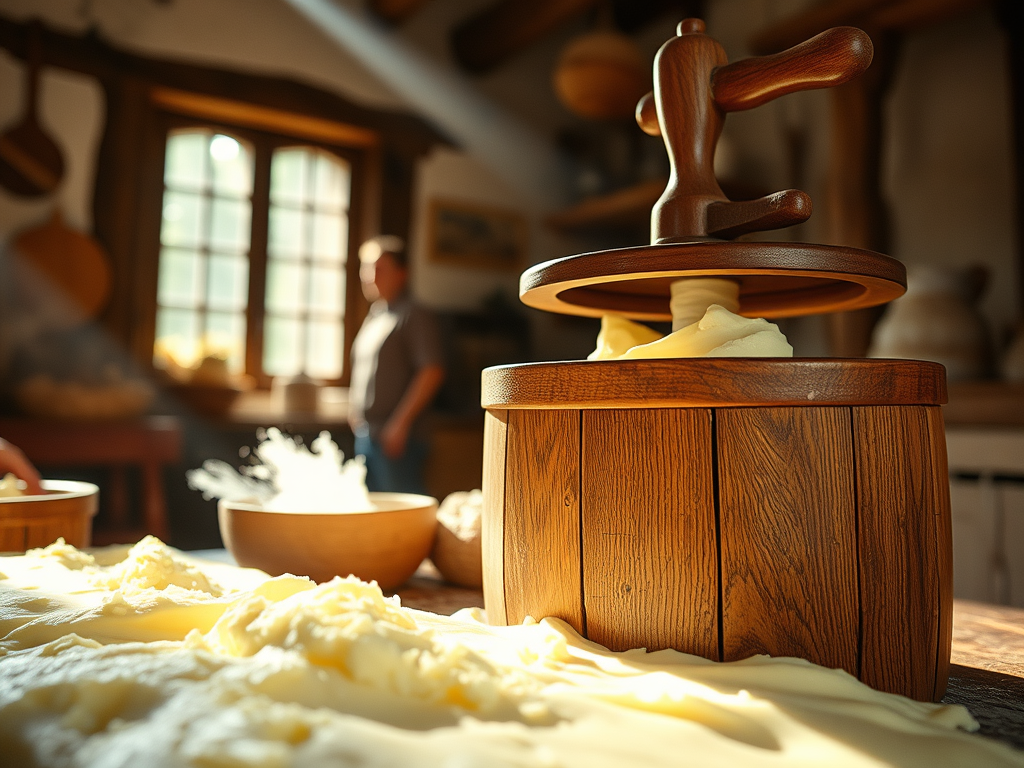
    At about 3 P.M., we met up and took our seats along with all the other frum families on one of the benches. An older woman came onto the stage. She had with her a bottle of heavy cream, small plastic containers—a little larger than a schnapps glaizel—with covers for them, as well as a few packages of saltines.

    Anyone familiar with butter production saw where this was headed. We were each going to be making butter—by simply rigorously shaking our small containers of cream—and then we would get to eat “our” butter with crackers.

    Ever the showman, she promptly explained to the crowd that she made sure to purchase cream and crackers with a reliable kosher marking.

    Oh boy, I thought to myself, she went out of her way to buy kosher, but it’s doubtful that anyone in the crowd will be taking advantage of her kindness, as close to 100% of this crowd, I presumed, ate only chalav Yisrael.

    While there was little room to allow this butter to be eaten for those who do not eat chalav stam, it allowed for an enjoyable conversation—a mini shiur—that formed among the fathers.

    Butter is produced by taking heavy cream and churning it (or shaking it) until it reaches the point of flocculation, when the butterfat becomes a butter-solid, leaving behind a liquid that we call buttermilk.

    The word for butter is chemah, but even that’s not so simple. As noted kashrus expert Rav Zushe Blech points out, “We know that Avraham fed chemah to the visiting malachim, but was it really butter? Rashi (Bereishis 18:8) explains chemah as the fat that one collects from the surface of milk, which implies that it is cream and not butter. The Targum seems to concur by translating as ‘shman’, which would mean the fat. Rav Aryeh Kaplan,z”l, feels that the verse is referring to cottage cheese. Interestingly, some editions of Rashi translate it as buerre—the French word for butter! Rav Dovid Tzvi Hofman, z”l argues that chemah originally referred to a fermented milk product (leben?), derived from the word chemah. Clearly, things are not always as they seem.”

    The siman in Shulchan Aruch dealing with dairy products, (Yoreh Deiah 115), is one of the most important for people to learn, as there are many, many misconceptions regarding its laws.

    Firstly, chalav Yisrael is not a chumrah! Rather, it is a matter of clear, undisputed halachah (cf. Pri Chadash ibid.). While it is true that Rav Moshe Feinstein and others allowed milk that we have termed chalav stam, they did so because they believed that such milk is indeed chalav Yisrael, and only to avoid confusion from classic chalav Yisrael do we call it stam (but never chalav akum!).

    In other words, we all only eat what we believe to be chalav Yisrael.

    The misconceptions don’t stop there. Next, the Shulchan Aruch speaks about gevinas (cheese) akum. The prohibition of such cheese has nothing to do with the chalav akum halachah that precedes it, as cheese can only be made from milk that comes from kosher animals. While the reason for gevinas akum is debated, the Shulchan Aruch accepts that the concern was that when making the cheese they may use the lining of a (non-kosher) cow’s fourth stomach for use of the enzyme that separates the whey and the curds. The minhag is to follow the strict view of the Shach, who understands that this concern is only assuaged if a Jew pours in the kosher enzyme-rennet into the milk himself. Based on this, there are some people who while they never would drink chalav stam milk would in fact eat kosher cheese (i.e. a mashgiach poured in the rennet and made sure all other ingredients are kosher) made from chalav akum.

    The reason why most people who only eat chalav Yisrael also only eat cheese that is chalav Yisrael is because the Rama and others mention an additional concern: although cheese can only be made from kosher milk (hence, there is no need for a chalav akum ban on cheese) there is still a small fear that a manufacturer will put in small amounts of milk from a non-kosher animal and the kosher milk will harden into a cheese around the non-kosher liquid, which would give the cheese a special flavor. (The reader is directed to Chelkas Binyamin 115:67 at length)

    Finally, there is the category of butter. The Gemara never mentions butter in it discussion of these halachos, which leaves room for a great debate.

    Butter, too, can’t be made from the milk of a non-kosher animal, and further, according to the Rambam and the Shulchan Aruch and some of the Geonim, butter was not under the ban of milk or even cheese and may be eaten even if made from truly chalav akum milk!  

    The Shulchan Aruch explains therefore that when dealing with clear, solid butter (without apparent cream residue, which could be milk from a non-kosher animal), a city with no minhag regarding butter may allow chalav akum butter.

    However, he clearly states that many cities had the minhag to still avoid stam butter, and this is still the minhag among all chasidim and some of the litvishe.

    We would be remiss not to point out that today the process of making butter is far more complex than it used to be and simply purchasing any butter may not be so simple as it once was.

    Based on the above—especially in a place where there is no set minhag, such as, perhaps, a farm in Pennsylvania—some fathers suggested an allowance of this butter; after all, isn’t this what the Shulchan Aruch allows, and wouldn’t this save this woman from feeling bad?

    Yet, on the other hand the Rama (end of se’if 1) clearly makes an important distinction:

    This that cheese and butter can’t be made from milk derived from a non-kosher animal, which then opens the door to all the potential leniencies mentioned above, would only be true once made. However, should a Jew take milk that has already been deemed assur to him because it is chalav akum and then the Jew himself makes it into butter or cheese, it would retain its initial issur status. 

    This would mean that those who only eat chalav Yisrael would have very little to rely on and could not eat this butter.

    So, back to the farm: what did we end up doing? We went over to the kind lady and, after thanking her for going out of her way to purchase kosher, explained that most of the Jewish parents will not be eating the butter they make today. She looked perplexed. “But isn’t the cream kosher?”

    How did we explain to a farmer the complexities of these laws just laid out above? 

    With a smile and a heartfelt thank you for trying to accommodate us.